
Take-home coding challenge: how to build one candidates will finish
What a take-home coding challenge is, when to use one, and how to design and grade it so candidates actually finish.

A take-home coding challenge is a coding task a candidate completes on their own time, usually at home and on their own tools, instead of live in front of an interviewer. The hiring team reviews the finished work against a rubric before deciding whether to move the candidate forward.
 ChatGPT
 Gemini
 Claude
 Grok
 Perplexity
TL;DR
- A take-home coding challenge is an asynchronous coding task, completed on the candidate's own schedule and reviewed afterward against a rubric.
- It works best when the task is scoped to the real job, timeboxed to 2 to 4 hours, and graded against criteria set before any submissions arrive.
- The biggest risk is candidate drop-off: a task that feels too long, too vague, or unpaid loses strong candidates before they submit.
- Pair it with a short live interview afterward to discuss the submission; that is where trade-offs, communication, and depth show up.
- Score every submission the same way and send feedback to every candidate, including rejections, to protect the candidate experience.
- Use a take-home challenge for realistic, multi-file work; use a live or proctored coding test when you need to verify the work is the candidate's own in real time.

What is a take-home coding challenge?
A take-home coding challenge is an asynchronous skills assessment: the candidate receives a coding task, works on it alone over an agreed window, and submits the result for review, usually through a Git repository or an upload. It differs from a live coding interview, where the candidate writes code in front of an interviewer or on a shared screen within a set time slot.
The format is common for software engineering, data, and other technical roles because it lets a candidate show how they actually build something with their usual tools instead of performing under pressure on someone else's whiteboard.
How does a take-home challenge compare to a live coding interview?
A take-home challenge and a live coding interview test different things and suit different stages of the hiring process. A take-home challenge shows how a candidate structures and finishes realistic work on their own; a live coding interview shows how they think, debug, and communicate while someone watches.
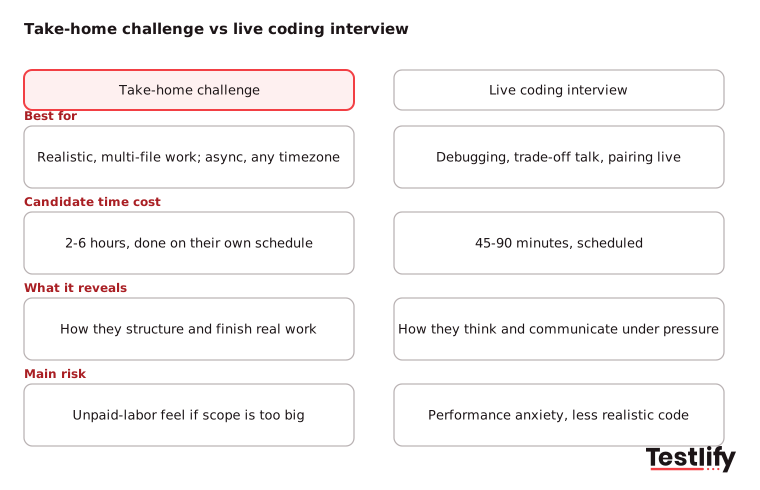
Most hiring teams use both at different stages: a take-home task earlier to see finished, realistic work, then a shorter live round to talk through that submission and watch the candidate reason through a change or a bug in real time.
What are the benefits of a take-home coding challenge?
A take-home coding challenge tests job-relevant skills under realistic conditions. CodeSubmit's guide to the format reports that well-designed work assignments correlate with job performance better than a timed whiteboard exercise, and it also removes some of the pressure that disadvantages otherwise strong candidates. Across the teams we work with, the most common failure point is not engineering skill, it is a task nobody bothered to calibrate against how long it actually takes to finish.
- Realistic work samples: Candidates build or extend something closer to the actual job than an abstract algorithm puzzle.
- Lower performance anxiety: Working alone, without someone watching every keystroke, reduces anxiety-driven underperformance for many candidates.
- More accessible: Asynchronous format fits candidates across time zones, with disabilities, or with other scheduling constraints that a live slot does not.
- A concrete artifact to review: The hiring team has actual code to discuss, not just a memory of how a conversation went.
- A signal beyond résumé prestige: A well-designed task can surface strong candidates whose background does not scream "top-tier school" or "famous employer."
What are the risks and drawbacks of a take-home challenge?
The main risks of a take-home coding challenge are candidate drop-off, review time, and the chance that the task itself turns off strong candidates before they ever submit. Every one of these is a design problem the hiring team can fix.
- Unpaid-labor feel: A task that takes longer than stated or feels disproportionate to the role reads as free work and pushes good candidates to drop out. CodeSubmit reports that its own take-home challenges see a 92% completion rate, though that figure comes from the vendor and is not independently verified.
- Reviewer time: Someone has to read every submission carefully; a vague rubric makes that slower and less consistent across reviewers.
- Authenticity: Without any check during the task, you cannot fully rule out a candidate getting outside help; a live follow-up interview is the simplest way to confirm the work is theirs.
- Timing in the funnel: Sending the task too early, before the candidate has spoken to anyone at the company, can feel transactional and increase drop-off.
How do you build a take-home challenge candidates will finish?
Building a take-home challenge candidates finish starts with a task scoped to the real job and a time estimate you actually mean, then a rubric written before any submissions arrive.
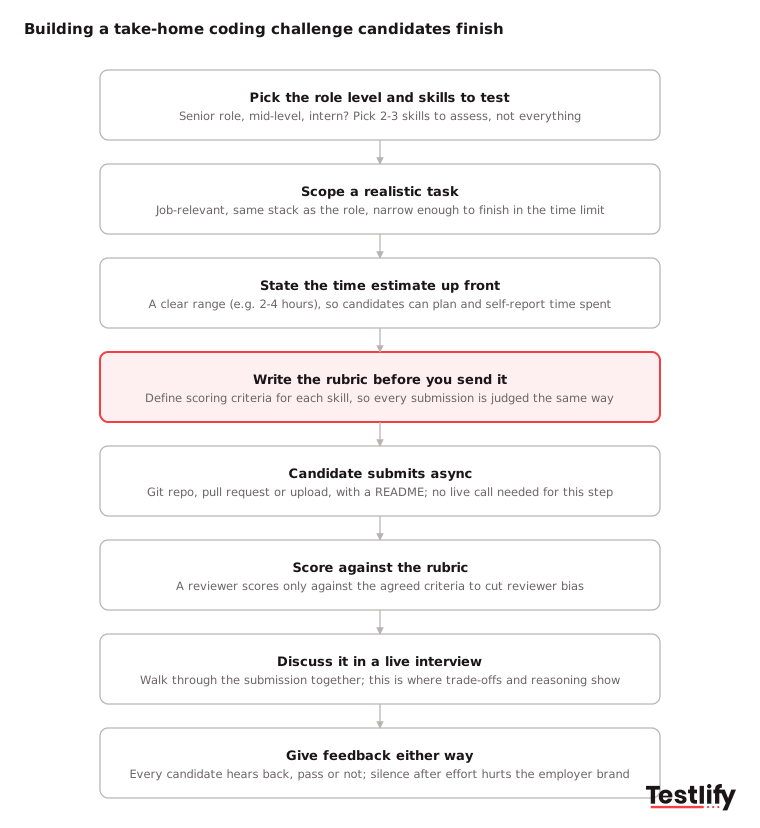
- Pick the role level and skills to test: Decide if this is a screening step or a deeper technical assessment, and name the 2 to 3 skills you actually need to see.
- Scope a realistic task: Use the role's real stack and a task close to day-to-day work, not a hypothetical puzzle. O*NET's task list for software developers is a useful sanity check for what the role actually involves day to day. Pre-supply a starter template so candidates do not burn time on setup.
- State the time estimate up front: Give a realistic range, not a hard deadline that punishes a slower but careful candidate. CodeSubmit recommends 2 to 4 hours and caps its own challenges at 6; Atlassian's hiring guidance allows up to 8 hours for certain roles, and Basecamp's engineering team has put its own exercise at 3 to 5 hours.
- Write the rubric before you send it: Define what you are scoring (code quality, correctness, readability, communication) and how many points each is worth, so scoring does not drift between reviewers or candidates.
- Let the candidate submit async: A Git repository and a pull request, or a simple upload, work well. Including your own automated tests lets candidates self-check before they submit.
- Score only against the rubric: Grade what you said you would grade. Scoring against an unstated expectation, such as rejecting a submission for missing tests you never asked for, is a common and unfair mistake.
- Discuss the submission live: A short interview to walk through the code, ask about trade-offs, and confirm the work is the candidate's own.
- Give feedback either way: Candidates who get feedback, even on a rejection, report a better experience, and that experience follows your employer brand into the next search.
Pro tip: Ask candidates what they would improve about the challenge after they finish, and act on good suggestions. It is the fastest way to catch a task that is quietly too long or too vague.
How do you grade a take-home challenge fairly?
Grading a take-home challenge fairly means scoring every submission against the same written criteria, decided before you read a single one. Without that, two reviewers can reach different conclusions about the same code, and bias creeps into decisions that should be about skill.
A simple rubric usually covers:
Criterion | What it checks | Typical weight |
|---|---|---|
Correctness | Does it meet the stated requirements and pass the tests | Highest |
Code quality | Readability, structure, naming, error handling | High |
Communication | README, comments, how trade-offs are explained | Medium |
Scope discipline | Solved the actual ask, not a gold-plated extra | Medium |
Extra effort (optional) | Bonus features done well, beyond the minimum | Low |
Slack's engineering team has described scoring its own exercise against more than 30 predetermined criteria for exactly this reason; a shorter rubric works for most roles as long as it is written down and used the same way every time.
When should you use a take-home challenge instead of a live coding test?
Use a take-home challenge when you want to see realistic, multi-file work and the role does not require verifying code is written unassisted in the moment; use a live or proctored coding test when you need that real-time verification, or when the role is high-volume and you cannot review long submissions from every applicant.
- Choose a take-home challenge for: senior or mid-level engineering roles, roles where day-to-day work is genuinely asynchronous, and any role where you want to see how a candidate structures a real feature, not just whether they can solve a puzzle fast.
- Choose a live or proctored coding test for: high-volume screening, roles where speed-under-pressure genuinely matters, and any stage where you need a time-boxed, supervised result you can compare consistently across hundreds of candidates. The US Bureau of Labor Statistics' outlook for software developers shows why volume matters here: demand for the role keeps outpacing many other occupations, so screening has to scale.
- Use both when you can: a shorter live or proctored round to screen at volume, then a take-home task for the finalists you want to see build something closer to the real job.
How does Testlify fit into take-home and live coding assessments?
Testlify runs structured coding assessments that can sit at either stage: a timed, proctored coding test for consistent screening at volume, or a longer live coding project for a closer look at finalists, scored against the same rubric for every candidate.
- Validated test library: 3,500+ validated tests, including role-specific and programming/coding assessments across beginner, intermediate, and advanced levels, so a screening test can match the actual seniority you are hiring for.
- Consistent scoring: Every candidate is scored against the same criteria, with a per-skill breakdown reviewers can check before making a call. how to evaluate coding assessments
- Proctoring when you need it: 20+ proctoring checks, including copy/paste tracking and AI-assistance detection, for stages where verifying unassisted work matters. proctored live coding projects
- ATS sync: Scores and reports sync back to 100+ ATS and HRIS platforms, so a coding assessment slots into a funnel that already includes a take-home or live round.
For more on designing the task itself, see best practices for designing coding assessments and common mistakes to avoid when creating a coding assessment.
Frequently asked questions (FAQs)

Related resources
View all
Technical assessments
Coding Interview: How to Run One That Tests Real Skill

Technical assessments
10 best technical assessment tools to consider in 2026

Technical assessments
Benefits of technical assessments you can’t ignore & myths you should

Technical assessments
What is a reciprocal technical interview? A definite guide

HR compliance
Employee monitoring policy template: free sample and guide

Workplace culture
What is an upskilling strategy? A practical guide for HR teams
Get started.
Hire on proof, not resumes.
Run your first skills-based assessment free — no credit card required.