
What is a reciprocal technical interview? A definite guide
A reciprocal technical interview treats hiring as a two-way evaluation, not just a test the candidate has to pass.

A reciprocal technical interview is a technical interview designed so the candidate is evaluating the company at the same time the company is evaluating the candidate. Instead of a one-sided test, the process is published upfront, the task is scoped to a realistic amount of time, and the company shows its own work alongside the candidate's.
 ChatGPT
 Gemini
 Claude
 Grok
 Perplexity
TL;DR
- A reciprocal technical interview judges the company as well as the candidate, not just the other way around.
- Four signals make a technical interview reciprocal: a published process, a tightly scoped task, a reviewer who stays present, and feedback that goes both ways.
- Running one takes five steps: publish the process, give a scoped task, review the work together, score against shared criteria, and ask for feedback.
- One in five candidates have turned down a job offer because of a bad interview experience, and technical candidates compare notes about take-home tests more than most roles.
- A multi-day take-home assignment is the single biggest reciprocity failure; cap real work at one to three hours.
- Pair a short, well-scored technical task with a live walkthrough instead of a pass or fail grade handed down in silence.

What is a reciprocal technical interview?
A reciprocal technical interview is one where the candidate gets to assess the employer at the same time the employer assesses them. It's like giving each candidate the same effort they put into applying, built on respect, transparency, and diligence. In practice, that means the process is visible, the task is fair, and someone from the company engages with the candidate's work instead of only grading it.
Technical candidates are in a strong position to notice when this does not happen. A multi-day take-home test with no feedback, or a live coding round where the interviewer stares at a shared screen in silence, reads as a one-way test, and skilled engineers increasingly compare notes about which companies do this well before they apply.
What makes a technical interview reciprocal?
A reciprocal technical interview has four key elements. The process is shared in advance, and the task is time-bound and reflects real-world expectations. A person is present to discuss the work, and feedback is exchanged by both sides.
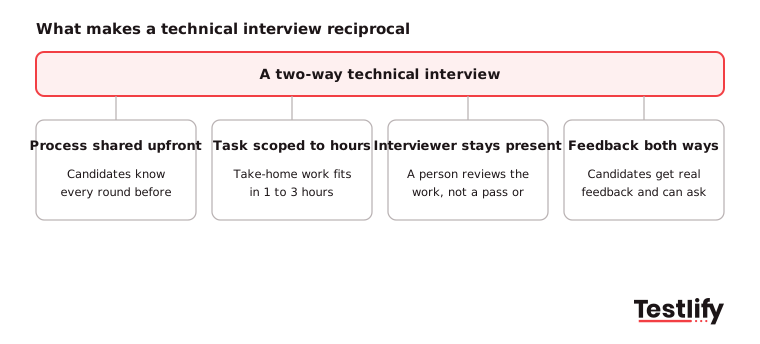
- Process shared upfront: Candidates know every round, roughly how long each takes, and what gets scored before they agree to the first one.
- Task scoped to hours, not days: A take-home assignment fits inside one to three hours of real work, not a multi-day project disguised as a screen.
- Interviewer stays present: Someone from the company walks through the candidate's solution with them, rather than disappearing with a submission and returning only a pass or fail.
- Feedback both ways: Candidates get specific feedback on their work, and the company asks what the process felt like from their side.
Pro tip: If a take-home assignment would take you, as the interviewer, more than an hour to solve yourself, it is too long for a first-round technical screen. Scale the task to the stage, not to how impressive it looks.
One-way technical interview | Reciprocal technical interview | |
|---|---|---|
Process | Candidates learn rounds as they go | Every round shared before it starts |
Take-home task | Open-ended, often multi-day | Scoped to 1 to 3 hours |
Review | Graded alone, result sent later | Walked through with the candidate |
Feedback | Template rejection or silence | Specific, given to every candidate |
Criteria | Can shift between candidates | Same written rubric for everyone |
Key takeaway: The difference between a one-way and a reciprocal technical interview is rarely the questions asked. It is whether the process, the time asked of candidates and the feedback they get are the same ones the company would want if it were applying for its own job.
How do you run a reciprocal technical interview?
Running a reciprocal technical interview takes five steps: publish the process, give a scoped task, review the work together, score against shared criteria, and ask for feedback at the end.
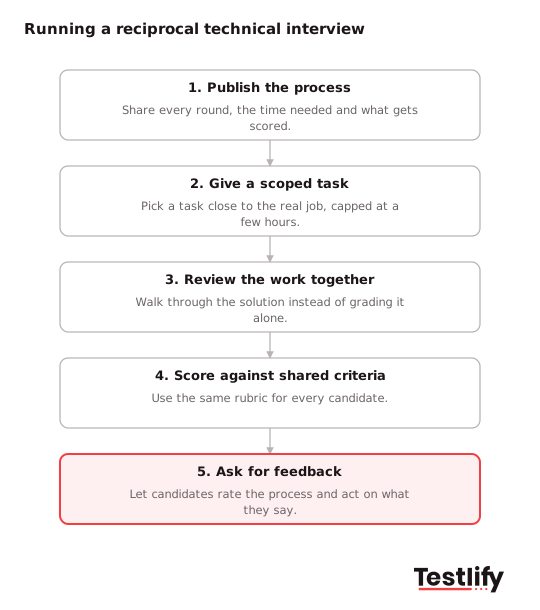
- Publish the process: Tell candidates upfront how many rounds there are, roughly how long each takes, and what each one is scoring for.
- Give a scoped task: Pick a task close to the real job and cap it at a few hours. structured coding interview formats and live pair-programming rounds work well for this because the time box is built in.
- Review the work together: Walk through the candidate's solution live, or leave written comments on specific lines, instead of returning a single score with no explanation.
- Score against shared criteria: Use the same rubric for every candidate in the role, written down before interviews start, so two interviewers would reach the same verdict on the same answer.
- Ask for feedback: Close with a short question about how the process felt from the candidate's side, and act on patterns you hear more than once.
What should you include in reciprocal technical interview questions?
Reciprocal technical interview questions should test the skills the role actually needs, give the candidate room to explain their thinking, and avoid trick questions that only reward having seen the puzzle before. Our guide to what to include in your technical interview questions covers the question design side in depth; the reciprocal part is in how those questions get delivered.
A short set of realistic questions, asked the same way of every candidate and discussed rather than silently graded, does more for both sides than a long list of brain teasers. Our piece on why you need technical interview questions in your hiring process explains why a structured set of questions still outperforms an unscripted technical chat, even when the goal is a more conversational, two-way interview.
What mistakes break reciprocity in technical interviews?
The most common mistake is a take-home assignment that takes candidates far longer than advertised, which feels like unpaid work rather than an interview. Close behind it are live coding rounds where the interviewer gives no context or encouragement, and feedback that never comes back to candidates who were not hired.
- Scope creep on take-home tasks: A task described as "an hour or two" that actually takes a motivated candidate most of a weekend.
- Silent grading: A reviewer who reads the submission alone and never discusses it with the candidate, even in the next round.
- One-way feedback: Rejected candidates hear nothing beyond a template email, so they cannot tell a weak answer from a role that was never a fit. SHRM's guidance on giving candidates feedback points to poor communication and missing feedback as common reasons candidates drop out mid-process.
- Changing criteria mid-process: Adding new requirements after candidates have already started, which signals the process was not planned before it began.
Why does candidate experience matter in technical interviews?
Candidate experience matters in technical interviews because a bad one costs companies candidates they already spent time and budget sourcing. Research compiled from Aptitude Research and cited across the industry puts the number at one in five candidates who have turned down a job offer specifically because of a negative interview experience, and technical roles are among the easiest for candidates to compare notes on publicly.
A reciprocal process does not mean a soft or lower bar. McKinsey's research on candidate experience found that a fair, well-explained process changes how candidates feel about a company even when they are rejected. The goal is that candidates leave every round, hired or not, with a clear sense of what was being tested and how they did. Pairing live coding interviews with transparent scoring and real feedback keeps the bar high while keeping the experience fair.
We have seen hiring teams close stronger candidates simply by explaining the process and the scoring before the first technical round starts, with no change to the bar itself. Testlify's live coding and structured interview tools let hiring teams run the same scored process for every candidate, with the same questions and the same rubric, so reciprocity does not depend on which interviewer happens to be in the room. Start a free trial to try a structured technical round on your next requisition.
Make technical interviews a two-way conversation
Testlify helps hiring teams assess candidates' technical skills through structured, role-specific assessments and AI-powered interviews. Give candidates a fair opportunity to demonstrate their abilities while helping your team make more informed hiring decisions.
Frequently asked questions (FAQs)

Related resources
View all
Technical assessments
Take-home coding challenge: how to build one candidates will finish

Technical assessments
Coding Interview: How to Run One That Tests Real Skill

Technical assessments
10 best technical assessment tools to consider in 2026

Technical assessments
Benefits of technical assessments you can’t ignore & myths you should

Hiring Guide
Finance director job description: duties, skills and template

HR compliance
Employee monitoring policy template: free sample and guide
Get started.
Hire on proof, not resumes.
Run your first skills-based assessment free — no credit card required.