
Seasonal and project-based hiring: Playbook for volume flexibility
Discover a complete guide to seasonal and project-based hiring for enterprises to optimize flexibility, reduce costs, and boost workforce agility.

Businesses tend to have fluctuating workloads caused by seasonal spikes in demand, special projects, new product launches, or expanding markets. Seasonal and project-based hiring comes in as a game-changer here.
If you’re in HR, you know all about the challenges of bringing on employees quickly or trimming headcount in slow months.
This blog is your guide for seasonal and project-based hiring to provide your business with the volume flexibility it requires without sacrificing quality or compliance.
 ChatGPT
 Gemini
 Claude
 Grok
Grok Perplexity
Why is flexibility in hiring important?
Being able to scale your staff quickly is vital. Market fluctuations, changing customer needs, and volatile workloads make hiring flexibility a strategic competitive tool.
The changing nature of work
We’re seeing a shift. Traditional 9-to-5 jobs are giving way to more fluid, demand-driven roles. Whether it’s the rise of the gig economy, remote work, or the increasing need for agility, companies are looking for ways to stay lean while still meeting operational goals.
Business cycles are less predictable
Consider the holiday season retail, summer hospitality, or the logistics industry during a worldwide supply chain shortage. Seasonality is not confined to a handful of industries anymore. Nearly every industry has peak seasons and off seasons.
Projects are more common than ever
From software deployments and advertising campaigns to construction projects and compliance redesigns, short-term assignments now comprise the majority of business activities. They demand skilled labor quickly and on a temporary basis.

What is seasonal and project-based hiring?
Let’s clarify what we mean by these terms.
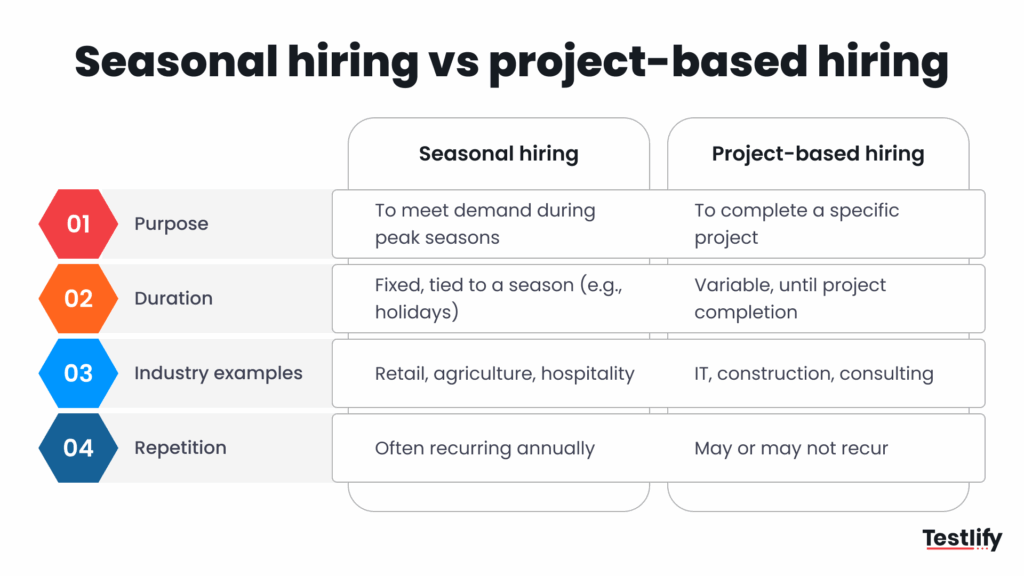
What is seasonal hiring?
Seasonal hiring refers to bringing on workers to meet short-term spikes in business activity. This usually aligns with a calendar event or time of year, retail seasonal, summer tourism, or tax season.
Examples:
- Hiring retail associates during Christmas
- Adding extra customer service agents in January for insurance enrollment
- Staffing agricultural laborers during harvest season
What is project-based hiring?
Project-based hiring is focused on bringing in specialized talent for the duration of a specific project. The start and end dates are usually well-defined.
Examples:
- Hiring developers for a new software feature
- Contracting consultants for a compliance audit
- Engaging a marketing team for a product launch
Benefits of seasonal and project-based hiring
So why should HR leaders take this seriously?
1. Cost efficiency
Project and seasonal hiring enables businesses to control labor expenses better by hiring employees when necessary. Rather than having a large stable workforce throughout the year, organizations minimize payroll charges for off-peak periods.
This approach reduces overhead, maximizes resource utilization, and enhances financial flexibility without compromising output or productivity during peak seasons or short-term business projects.
2. Agility
By doing seasonal and project-based hiring, companies have the power to ramp up or down their workforce immediately in accordance with real-time business requirements. Be it the need to meet an unexpected surge in customer orders or undertake an immediate short-duration project, this methodology facilitates a more rapid, more agile workforce management.
It makes sure that the supply of talent and the demand for operations are properly matched, enabling businesses to remain competitive in fluctuating and uncertain marketplaces.
3. Access to specialized talent
Most projects entail extremely specialized abilities that aren’t required throughout the year. Project-based recruitment allows you to hire experienced professionals with particular expertise whether that is IT development, marketing strategy, or work on compliance.
It’s an inexpensive way to tap into top talent for important work without all that long-term obligation, allowing organizations to implement complicated projects more efficiently and at a better quality.
4. Reduced risk of burnout
Your full-time staff members can become overwhelmed in busy times, which can result in burnout, decreased morale, and reduced productivity. Adding seasonal or contract help to your staff allows you to spread the workload more evenly.
This not only safeguards your foundation staff’s health but also ensures that the performance level remains the same throughout, leading to a healthier, more sustainable workplace in high-volume times.
Challenges HR faces with volume-flex hiring
Now, let’s get real for a second. This isn’t always smooth sailing. Here are some common pain points.
1. Time-consuming recruitment
When demand is suddenly high, HR departments tend to have tight deadlines to hire quickly. Finding able seasonal or project staff under time pressure takes a lot of time.
Traditional recruitment processes might not be designed for speed, leading to holdups that affect operations. Without efficient processes or pre-curated talent pools, you may end up hiring too slowly or settling for low quality just to get something right away.
2. Maintaining quality
Seasonal and temporary workers are sometimes viewed as less committed to the work, creating problems related to work quality and consistency. Having short-term workers meet expected performance can be a genuine challenge.
You need to have clear expectations, quick onboarding, and monitoring of performance in order to have high standards despite the shorter duration of employment. Otherwise, service levels, productivity, and customer experience could be impacted.
3. Compliance and legal risk
Volume hiring presents sophisticated legal issues. Misclassifying contractors, ignoring wage regulations, or not providing required benefits can land companies in court and pay steep fines.
Every type of worker, temp, freelancer, or project-based brings specific compliance requirements that differ by location. You need to be aware and closely collaborate with legal or compliance departments to manage contracts, taxes, and labor laws correctly.
4. Training and onboarding
Even temporary workers must receive adequate training to do their jobs well, but onboarding is time and resource-intensive. During high-turnover environments, it becomes a labor of constant repetition that can exhaust HR departments and frontline managers.
Rushed or unorganized onboarding hurts productivity and boosts error rates. Getting the balance of speed and efficiency just right is the secret to positioning temp workers for success.
How to do seasonal and project-based hiring right?
Here’s your step-by-step guide to mastering volume flexibility.
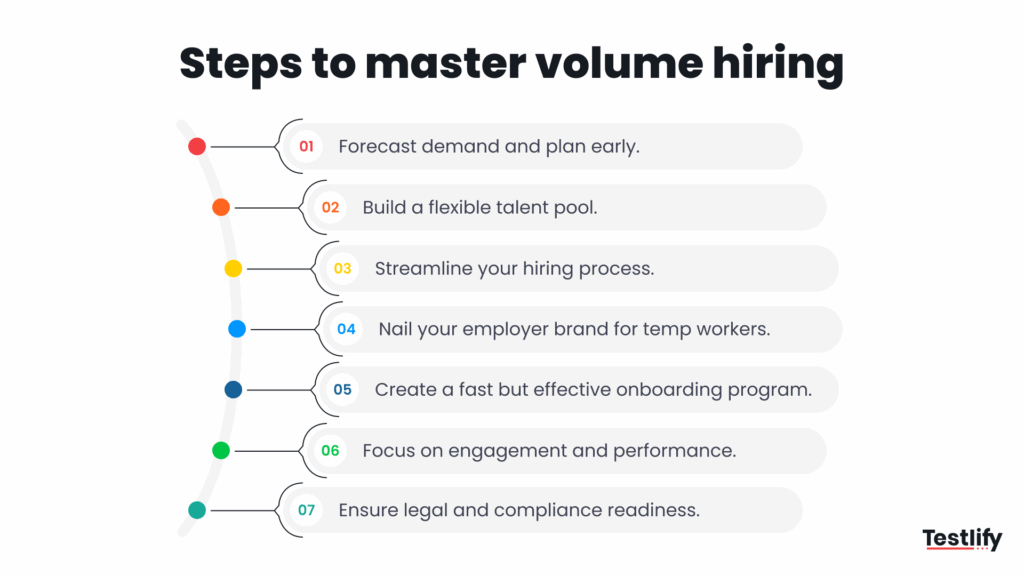
Step 1: Forecast demand and plan early
Begin by examining historical trends and projecting future needs. Discuss with department heads what job and skill requirements will be needed and when. Create a hiring schedule that corresponds to peak seasons and project deadlines.
Planning ahead not only allows you a head start on hiring, but it also helps you avoid last-minute scrambling when demand arises.
Step 2: Build a flexible talent pool
Having an on-hand bench of pre-hire talent is time-saving. Maintain a list of trusted seasonal employees from previous years. Develop relationships with staffing firms and utilize freelance communities.
Promote cross-functional “project teams” so internal human capital can be redeployed cost-effectively. Being so proactive, you can fill gaps rapidly when calls arise.
Step 3: Streamline your hiring process
Speed is important, but never at the cost of fit. Streamline job applications and eliminate unnecessary steps. Swap lengthy interviews with skills-based tests to measure real ability.
Leverage technology such as applicant tracking systems or AI-driven screening to automate the early stages. A streamlined, contemporary recruitment process enables you to move quickly without sacrificing candidate quality.
Step 4: Nail your employer brand for temp workers
Contract and seasonal workers should feel just as valued as full-timers. Promote your company culture, flexibility, and team environment. Highlight real stories of temp-to-perm growth to show opportunity.
A positive experience builds loyalty, encourages referrals, and enhances your reputation, making it easier to attract great talent again in the future.
Step 5: Create a fast but effective onboarding program
Effective onboarding positions short-term employees for success. Create quick-start packages specific to every job. Leverage technology such as video tutorials or bite-sized learning modules.
Provide buddies to assist new hires in getting settled in a hurry. This reduces ramp-up time, minimizes early turnover, and enables seasonal employees to make a meaningful contribution from day one.
Step 6: Focus on engagement and performance
Short contracts do not translate to short-term work. Engage seasonal and project employees by acknowledging their input and providing frequent feedback. Involve them in meetings, team discussions, and celebrations.
If temp workers feel valued and engaged, they perform better and are more likely to return or refer your workplace to others.
Step 7: Ensure legal and compliance readiness
Each type of professional, freelancer, contractor, or seasonal employee has special compliance requirements. Implement clearly defined contracts outlining duties, compensation, and length of time.
Familiarize yourself with labor regulations, tax regulations, and benefits obligations. Maintain records in order for auditing purposes. Collaboration with legal or compliance staff guards your company from expensive mistakes and liability.
Technology tools that help with?
Modern problems need modern solutions. These tools can make your life easier.
1. Skills assessment platforms
Skills assessment platforms allow you to test candidates’ actual abilities prior to hiring. From coding and writing to customer service and technical skills, these platforms assist HR teams in breaking free from resumes to examine demonstrated skills.
Adding assessments to the hiring process eliminates wrong hires and increases confidence in hiring decisions, especially when time is short and performance demands are high.
2. Applicant Tracking Systems (ATS)
An ATS streamlines your recruitment by allowing you to track, sort, and manage candidates effectively. It minimizes manual labor, decreases time-to-hire, and prevents any resume from falling through the cracks.
By allowing automated screening, interview scheduling, and tracking of status, ATS platforms are a necessity when scaling seasonal or project-based hiring without sacrificing organization and consistency for many different positions and hiring campaigns.
3. Onboarding platforms
Onboarding technology streamlines the entire new-hire process, from electronic forms and policy acknowledgments to role-specific training modules. It guarantees that all temporary or project-based workers experience a constant, professional environment.
These sites decrease administrative load, accelerate training, and ensure new hires become productive sooner, particularly important when job duration is short and onboarding must be both quick and efficient.
4. Gig talent marketplaces
Online gig marketplaces give you instant access to a wide pool of pre-vetted freelancers and contract workers. Whether you need a developer for a software build or a designer for a campaign, these platforms make it easy to source talent quickly.
With user ratings, portfolios, and verified credentials, they’re ideal for finding high-quality professionals ready to jump into short-term roles.
5. Workforce management software
Workforce management software keeps you organized by automating scheduling, time tracking, compliance audits, and communications. Particularly helpful when dealing with large numbers of seasonal or contract workers, these platforms give you visibility into employee availability, labor budgets, and shift coverage.
They enhance operational effectiveness and keep you compliant with labor regulations, even across multiple departments or locations.
Seasonal and project-based hiring best practices
To maximize the value of flexible hiring, it is crucial to do it with a solid strategy and wise execution. These best practices will enable you to attract high-quality talent, manage them wisely, and maximize results.
1. Turn great temps into full-timers
Seasonal and project-based positions can be unofficial test cases for future full-time staff. Look for those who perform in excess, mesh well with your culture, and learn to fit in faster.
Providing permanent roles to your best performers cuts down on recruitment expenses, accelerates the onboarding process, and creates a loyal, high-quality workforce. It’s an intelligent, low-risk method for organically building out your talent pipeline.
2. Build relationships with contractors
Freelancers and independent contractors who produce solid results are a valuable long-term resource. Rather than treating projects as isolated transactions, cultivate long-term relationships.
Keep in contact, offer feedback, and invite them to return to do additional work. Familiar contractors who know your team and workflows ramp up more quickly and need less supervision, making them a reliable resource for future requirements.
3. Track metrics that matter
To enhance your hiring process over time, you must gauge what is effective. Track important metrics such as time-to-hire, seasonal retention rates, candidate performance, and overall hiring expense.
These statistics allow you to refine your processes, budget more effectively, and make informed decisions. Ongoing monitoring and assessment convert seasonal and project hiring into a more predictable, improved component of your workforce planning.
Final thoughts
Seasonal and project-based hiring is no longer a back-pocket plan; it’s a business imperative. Done correctly, it provides your business with the flexibility to grow, change, and succeed without the need for unnecessary overhead.
HR executives do have a genuine opportunity here. With proper planning, tools, and approach, you can create a workforce model that’s not just flexible but future-ready too.

Content Writer
Yashika Khandelwal is a Content Writer with 3+ years of experience creating research-backed content on hiring, talent assessment, and HR technology. She is a registered Organizational Psychologist and subject matter expert who combines behavioral science with practical recruitment insights to produce accurate, evidence-based content.
LinkedInRelated resources
View all
HR & recruitment
Why Employer Value Proposition (EVP) is your talent magnet in 2026?

HR & recruitment
eSIM for HR and Global Talent Mobility: 6 Ways eSIM Transforms HR Management

HR & recruitment
How to evaluate professional certifications for recruiting success

HR & recruitment
What CTOs should know before hiring DeFi developers

HR & recruitment
Internal mobility vs. external hiring: Striking the right balance

HR & recruitment
Reviving cold talent: The goldmine sitting in your ATS
Get started.
Hire on proof, not resumes.
Run your first skills-based assessment free — no credit card required.