
Internal mobility vs. external hiring: Striking the right balance
Discover the pros, cons, and strategies of internal mobility vs. external hiring to build a future-ready, agile, and high-performing workforce.

According to LinkedIn’s 2024 Global Talent Trends Report, internal mobility has surged by 20% over the past two years, with companies that excel at it seeing twice the retention rate compared to those that don’t.
At the same time, 69% of employers say external hiring is essential for bringing in critical new skills, especially in fast-growth sectors like tech and digital transformation.
The reality? You can’t afford to pick just one.
In this blog, we’ll break down:
- The benefits and risks of both internal mobility and external recruitment
- When to choose one approach over the other
- How to create the right balance to future-proof your talent strategy
Whether you’re scaling rapidly, nurturing leadership pipelines, or bridging critical skill gaps, a blended approach is key to building an agile, resilient workforce.
 ChatGPT
 Gemini
 Claude
 Grok
Grok Perplexity
What is internal mobility?
Internal mobility refers to the movement of employees within an organization. This includes:
- Promotions
- Lateral transfers
- Cross-departmental moves
- Short-term assignments or project-based shifts
It’s about recognizing and leveraging the talent you already have. Whether it’s a marketing associate shifting to a product management role or a team lead being promoted to a manager, internal mobility helps organizations retain institutional knowledge and reward loyalty.

What is external recruitment?
External recruitment is the process of attracting and hiring candidates from outside the organization. This can happen through:
- Job boards
- Recruitment agencies
- Social media platforms like LinkedIn
- Campus hiring
- Employee referrals
External hiring often brings in fresh skills, diverse perspectives, and new energy. It’s particularly valuable when your company is growing, evolving, or lacking specific expertise.
Internal mobility vs. External recruitment
So, how do these two approaches stack up against each other? Let’s take a closer look.
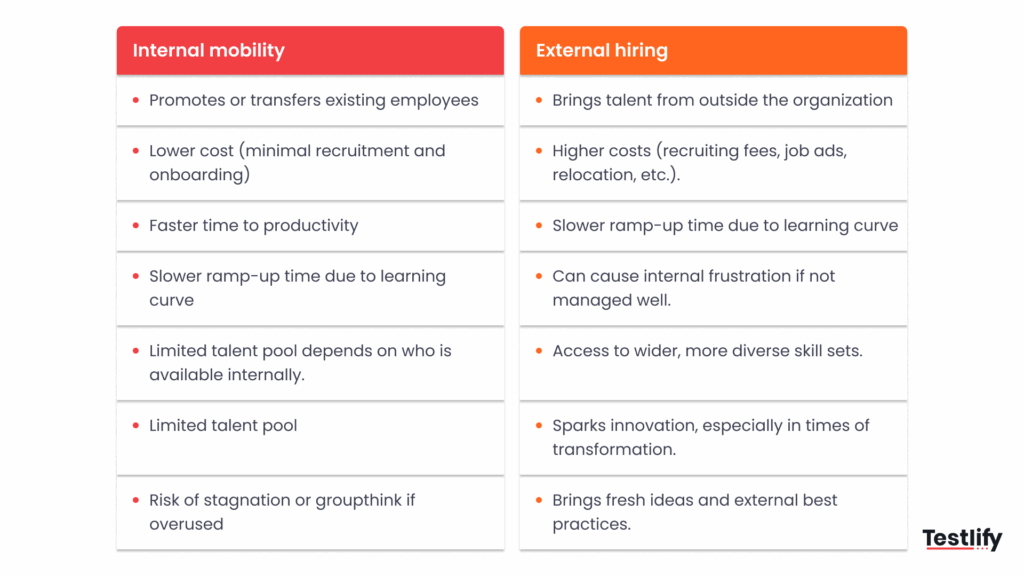
Pros and cons of internal hiring
Internal hiring can be a game-changer for organizations focused on talent development, retention, and cultural consistency. But like any strategy, it comes with its own set of challenges.
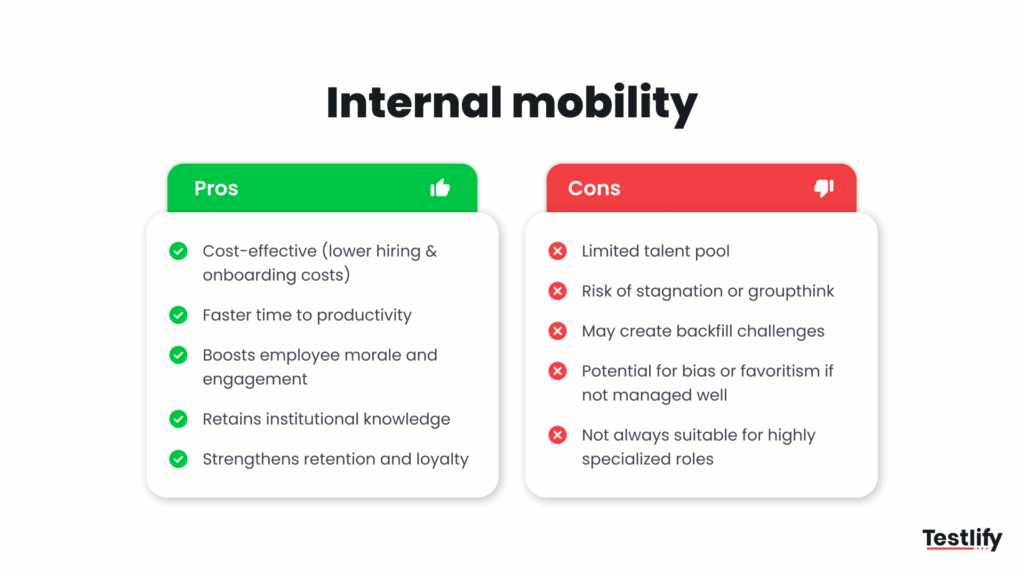
Let’s unpack the benefits and drawbacks of promoting from within.
Pros of internal mobility
1. Cost-efficient
Hiring internally often results in significant cost savings. You bypass many of the expenses tied to external recruitment, no job ads, agency fees, or hefty onboarding programs. Plus, internal candidates typically require less training, which means they can hit the ground running faster. In times of economic uncertainty or budget constraints, this efficiency can make a huge difference.
2. Boosts employee morale and engagement
Nothing says “we believe in you” or “you deserve this” quite like a promotion or a new role within the same company. Internal hiring sends a powerful message that growth is possible without having to leave the organization.
This sense of upward mobility can significantly improve employee satisfaction and engagement, which in turn helps reduce turnover. When employees see their peers moving up, it motivates them to aim higher, too.
3. Shorter learning curve
Let’s face it, new hires, no matter how experienced, need time to adjust. Internal candidates, on the other hand, are already familiar with your company’s culture, processes, systems, and people. They understand the internal politics, know how to get things done, and are aligned with your mission. That translates into a much faster ramp-up time and fewer onboarding headaches.
4. Retains institutional knowledge
Every company has its own way of doing things. Internal hires bring valuable organizational memory to the new role, knowledge of historical decisions, client relationships, and internal systems that would take months (or years) for an external hire to develop. Retaining and elevating this institutional wisdom helps maintain continuity and avoid reinventing the wheel with every leadership change.
Cons of internal mobility
1. Limited talent pool
Your next superstar might not be sitting in the break room. While internal hiring is convenient, it limits your options to the people already within your ecosystem. For highly specialized, technical, or innovative roles, your current bench might not have the right skills or experience. Relying too heavily on internal candidates can also create skill gaps over time if you’re not continuously developing your people.
2. Risk of stagnation
If your company only promotes from within, you might unintentionally create an echo chamber. While cultural continuity is important, it’s equally vital to challenge existing ways of thinking.
Without external input, organizations can fall into “we’ve always done it this way” mode, making it harder to innovate or adapt. A lack of fresh perspectives can hinder creativity and limit strategic growth.
3. Backfill challenges
Promoting someone internally doesn’t eliminate a vacancy; it just moves it. Now, you have to fill their old role, which can create a domino effect of backfills. If your internal talent pipeline isn’t deep or well-prepared, this could strain teams and delay critical projects. In some cases, the time and effort required to fill the original employee’s role can offset the benefits of the internal promotion.
4. Risk of bias or favoritism
Internal hiring processes must be transparent and objective. Otherwise, they can lead to perceptions of favoritism or office politics, especially if promotions consistently go to the same “inner circle” of employees.
This can create resentment among team members and undermine morale, the exact opposite of what internal mobility is supposed to achieve. HR leaders must ensure fair evaluation criteria and clearly communicate decision-making processes.
Pros and cons of external hiring
External hiring plays a vital role in building a future-ready workforce. While internal mobility helps you grow from within, bringing in outside talent offers fresh thinking, specialized skills, and the ability to pivot quickly in a changing market. But it’s not without its challenges.
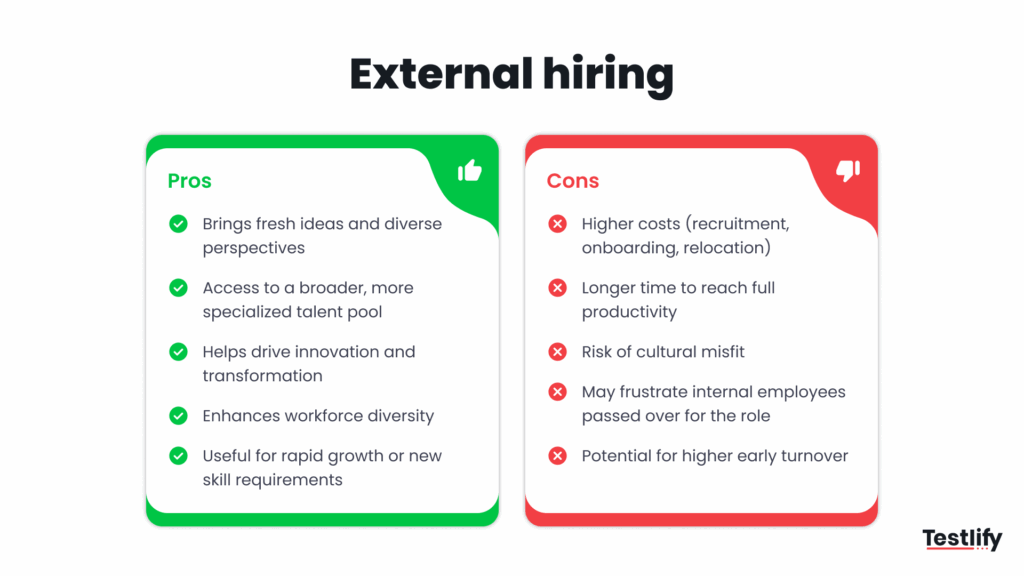
Let’s take a closer look at both the advantages and drawbacks of hiring externally.
Pros of external hiring
1. Fresh perspective
One of the biggest advantages of external hiring is the injection of new ideas and ways of working. People from outside your organization aren’t bound by “how things have always been done.” They bring diverse industry experiences, fresh energy, and often ask the right kinds of questions that challenge outdated assumptions. This can be a breath of fresh air, especially in teams or departments that have become set in their ways.
2. Broader talent pool
When you open your hiring process to external candidates, you dramatically expand the scope of possibilities. You’re no longer limited to your existing workforce; you can search for individuals with highly specialized expertise, technical proficiencies, or emerging skills that your current team may not possess. This is particularly important when filling roles in areas like data science, cybersecurity, or AI, where the internal pipeline might be thin or non-existent.
3. Diversity boost
External hiring provides a valuable opportunity to enhance workforce diversity. Whether it’s diversity in background, experience, thought, or education, bringing in talent from different walks of life can help improve innovation, problem-solving, and decision-making across the organization. More importantly, a diverse workforce better reflects your customer base and enhances your company’s brand in the marketplace.
4. Competitive edge
Sometimes, you need to leapfrog rather than evolve. Whether you’re entering a new market, launching a disruptive product, or undergoing digital transformation, external hires can bring the vision, leadership, and know-how required to compete at a higher level. These are the people who’ve “been there, done that” in other companies or industries, and they can help you move faster and smarter.
Cons of external hiring
1. Higher costs
Let’s not sugarcoat it, external hiring can be expensive. From recruitment agency fees to job advertisements, background checks, relocation packages, and onboarding programs, the costs quickly add up. And that’s before you even factoring in the opportunity cost of having the position vacant for several weeks (or months) during the search. Compared to promoting from within, external hiring can stretch both budgets and timelines.
2. Longer time-to-productivity
Even the most talented new hires need time to get up to speed. They must learn your systems, absorb your company culture, build relationships, and understand internal dynamics all before they can perform at full capacity. This onboarding period varies based on the role and the individual, but it’s rarely instantaneous. If you’re under pressure to see quick results, this delay can be frustrating.
3. Cultural misfit risk
Skills can be taught, but culture fit is harder to predict. A candidate may check every box on paper but still struggle to thrive in their environment. Perhaps they’re used to a more hierarchical structure, and your company values autonomy. Or maybe they’ve come from a fast-paced startup and find your processes too rigid. Cultural mismatches can lead to disengagement, underperformance, and ultimately early turnover.
Also Read: Internal vs external sources of recruitment: which should you prioritize?
Related Read: Top 9 email templates for referrals & internal hiring
4. Employee frustration and disengagement
When internal employees are passed over in favor of an external hire, it can have ripple effects on morale. Team members who were hoping to grow into that role may feel overlooked or undervalued. If they aren’t given feedback or career development support, they might disengage or, worse, leave. That’s why it’s essential to manage communication carefully and ensure transparency around hiring decisions.
When should you hire internally?
Internal hiring isn’t just a reactive measure; it should be a proactive part of your talent strategy. When done right, it strengthens your leadership pipeline, boosts employee retention, and builds a culture where employees feel seen, valued, and motivated to grow. But how do you know when it’s the right move?
Here are some key scenarios where internal hiring makes strategic sense:
You have a succession plan in place
A strong succession plan is a clear indicator that you’re ready to hire internally. When future roles and successors are mapped out, you’re not just filling vacancies, you’re preparing people for them.
Internal hiring in this context is smooth, strategic, and risk-aware. You’ve already identified high-potential employees, invested in their development, and aligned their growth trajectory with business needs. This ensures leadership continuity and minimizes disruptions during transitions.
The role requires deep organizational understanding
Some positions demand more than technical skills they require a nuanced understanding of your company’s inner workings. Whether it’s stakeholder relationships, legacy systems, or internal politics, these insights take years to acquire.
In such cases, an internal hire can make an immediate impact without the learning curve. They already understand the business model, key decision-makers, and historical context, which allows them to contribute meaningfully from day one.
You’re trying to foster a culture of growth and learning
If one of your HR or organizational goals is to build a “grow from within” culture, internal hiring should be a central tactic. Promoting employees into new roles demonstrates that your organization values continuous learning, recognizes effort, and rewards ambition. This creates a virtuous cycle, people are more likely to engage in development opportunities when they see others progressing.
It also helps establish trust between employees and leadership. When people believe there’s a future for them within the organization, they’re more likely to stay and invest their best efforts.
It’s part of your employee engagement and retention strategy
Career stagnation is one of the top reasons employees leave companies. If you’re looking to boost engagement and reduce turnover, internal hiring can be a powerful tool.
Employees want to feel that their careers are advancing, and if they can do that within your company, they’re far less likely to seek opportunities elsewhere. Regularly promoting from within signals that your organization doesn’t just value talent, it nurtures it.
When should you search for an external hire?
While internal hiring can drive loyalty and speed, there are times when looking outside your organization is not only beneficial, it’s essential. External recruitment allows you to access fresh talent, new perspectives, and skills that may be missing in your current workforce.
Here are key situations when external hiring becomes a strategic imperative:
You’re expanding rapidly and need new competencies
Growth is exciting, but it comes with talent challenges. Whether you’re scaling a department, launching a new business unit, or entering international markets, your existing workforce may not have the capacity or capabilities to support that momentum.
In such scenarios, external hiring becomes your growth engine. It allows you to bring in professionals who have experience navigating similar expansions, scaling operations, or leading teams in high-growth environments.
You want to build a more diverse leadership pipeline
Diversity doesn’t happen by accident; it requires intention. If your leadership ranks or specific teams lack diversity in terms of gender, race, thought, or background, external hiring can help reset the balance.
By actively recruiting outside your current network or traditional talent sources, you gain access to broader perspectives and lived experiences. This is not just about representation, it’s about better decision-making, innovation, and employee engagement across the board.
Your internal talent pool isn’t ready or large enough
Sometimes, the talent you need simply doesn’t exist within your walls at least not yet. Maybe you’re a smaller organization without deep succession planning. Or perhaps your internal candidates are still developing the competencies required for a higher-level or more complex role.
In these cases, hiring externally allows you to avoid putting someone in a role they’re not ready for, which could lead to underperformance or burnout. It also gives your internal candidates more time to grow without the pressure of being promoted too soon.
When the position requires a dramatic shift in thinking or skills
Not all jobs are created equal. Some require radical innovation, bold thinking, or a completely different mindset than what exists in your current culture or team. These roles benefit from an outsider’s view, someone who isn’t influenced by “the way things have always been done.”
External hires can challenge the status quo, bring new methodologies, and introduce best practices from other industries or companies. This is especially valuable when you’re undergoing digital transformation, restructuring departments, or trying to build an agile, future-focused organization.
Other types of recruitment
While internal mobility and external hiring are often seen as the two main pillars of talent acquisition, they’re far from the only options. Currently, shifting business needs demand a more flexible, diversified approach to recruitment.
Enter alternative hiring strategies, creative, often hybrid models that allow HR leaders to tap into new talent pools, experiment with different workforce structures, and future-proof their organizations. Let’s explore some of the most effective and increasingly popular types of recruitment beyond the traditional binary.
Contingent or gig hiring
Contingent hiring refers to bringing in freelancers, consultants, or contractors on a temporary basis to fill immediate talent gaps or manage specific projects. This model is perfect for companies needing quick, specialized support without a long-term commitment.
Boomerang hiring
Boomerang employees are former team members who return after leaving the company, often bringing with them new skills, perspectives, and maturity. These hires offer the best of both worlds: they already understand your culture and systems, but also have fresh experience from outside.
Employee referrals
Your current employees can be some of your best recruiters. They understand your culture and values and are likely to refer candidates who will be a good fit both technically and socially.
Referred candidates tend to perform better, onboard faster, and stay longer. Plus, they usually cost less to acquire than candidates from job boards or agencies.
Campus recruitment
Campus hiring involves recruiting students or recent graduates from universities and colleges for internships, entry-level positions, or leadership development programs.
You get to shape talent early in their careers, building a pipeline of future leaders who grow with your organization. It’s also a great way to infuse energy and new ideas into your teams.
Talent communities
Talent communities are pools of pre-qualified, interested candidates who may not be ready to apply right now but are open to opportunities in the future. These could be former applicants, event attendees, or people who’ve engaged with your employer brand online.
Building a talent community helps you nurture long-term relationships with candidates and reduce time-to-hire when roles open up. Think of it as a long game that pays off when timing aligns.
Benefits of other types of recruitment
Exploring beyond the traditional hiring channels doesn’t just diversify your talent strategy it can also deliver real business advantages. Here are some of the standout benefits of these alternative recruitment models:
Flexibility
The modern workforce thrives on flexibility, and so should your hiring approach. Contingent and gig workers allow you to adjust staffing levels based on project demands, seasonal trends, or economic fluctuations.
Lower risk
Hiring is always a risk, especially for strategic roles. But boomerang employees and contract-to-hire models reduce that risk significantly. You already know how they perform or can test the waters before making a long-term offer.
Cost-effective
Not all hiring needs require full-blown recruitment campaigns. Employee referrals, for example, often result in faster, cheaper, and more reliable hires. Plus, referred employees are more likely to stay longer, reducing your turnover costs.
Future-proofing
Hiring with the long term in mind is smart business. Programs like campus recruitment and talent community building create a proactive pipeline of future talent. Even if you’re not hiring today, you’re preparing for tomorrow.
Final thoughts: Creating the right balance
There’s no one-size-fits-all answer when it comes to internal mobility vs. external hiring. The key lies in aligning your hiring strategy with your company’s long-term vision, culture, and immediate needs.
Use internal mobility to reward and retain your people, preserve institutional knowledge, and speed up succession planning. Use external hiring to bring in fresh ideas, drive transformation, and close critical skill gaps.
A balanced approach built on transparency, data, and strategy will help you build a workforce that’s agile, engaged, and ready for the future.

Content Writer
Yashika Khandelwal is a Content Writer with 3+ years of experience creating research-backed content on hiring, talent assessment, and HR technology. She is a registered Organizational Psychologist and subject matter expert who combines behavioral science with practical recruitment insights to produce accurate, evidence-based content.
LinkedInRelated resources
View all
HR & recruitment
Reviving cold talent: The goldmine sitting in your ATS

HR & recruitment
Hiring Funnel Bottlenecks: How to Stop Candidate Ghosting
HR & recruitment
Global hiring challenges and how enterprises are solving them
HR & recruitment
When candidates show their true colors: interview red flags to look out for
HR & recruitment
Tips for conducting your first job interview as an HR intern

HR & recruitment
Optimizing Talent Acquisition: Integrating AI and PPC Strategies
Get started.
Hire on proof, not resumes.
Run your first skills-based assessment free — no credit card required.