
Manager development plan: steps, goals and a free template
How to write a manager development plan that works: skills to cover, six steps, a fill-in template, examples by level and review tips.
A manager development plan is a written agreement between a manager, their own boss and HR or L&D that sets out which management skills the manager will build, how, and by when. A good plan names two or three skill goals, the actions and support behind each one, and the measures that show progress over six to twelve months.
TL;DR / Key Takeaways
- A manager development plan is a short written plan with two or three skill goals, the actions and support for each, a measure of success and review dates.
- The plan matters because managers drive team results, yet Gallup found only 22% of managers worldwide were engaged in 2025.
- Cover six skill areas: communication, people management, coaching, delivery, decision making and personal effectiveness. Pick the two weakest for this cycle.
- Build the plan in six steps: define the role, measure a baseline, set SMART goals, choose actions, agree support, then review on a schedule.
- Start from measured skills, not opinions. Use a skills assessment and 360 feedback at the start, then re-test at month 6 and month 12.
- Review progress monthly inside existing one-to-ones and reset goals every quarter.
- For a new or promoted manager, the assessment results from hiring are the fastest way to set the first 90 days of goals.
 ChatGPT
 Gemini
 Claude
 Grok
 Perplexity
What is a manager development plan?
A manager development plan is a type of individual development plan written for someone who leads people. Where a general development plan might focus on technical or career goals, a manager development plan focuses on the skills of managing: setting direction, giving feedback, coaching, delegating, handling conflict and making decisions.
Most plans share the same parts:
- Skill goals: Two or three specific skills the manager will improve this cycle.
- Actions: On-the-job tasks, training, coaching or mentoring linked to each goal.
- Support: What the manager's boss, HR or L&D will provide, such as time, budget or a mentor.
- Measures: How everyone will know the skill has improved, such as team feedback scores or a re-test result.
- Timeline: Milestones and review dates across six to twelve months.
The plan sits inside wider leadership development work. A management development plan for one person is narrower than a company-wide program: it turns that program into concrete goals for a single manager.

Why does a manager development plan matter?
A manager development plan matters because managers shape how their teams perform, stay and grow, and most managers are not getting the support they need to do that well. A written plan turns vague intentions like "be a better leader" into goals someone can track.
The data from the last two years points the same way:
- Gallup's State of the Global Workplace report found that only 22% of managers worldwide were engaged in 2025, down from 27% a year earlier. In best-practice organizations, 79% of managers were engaged. Gallup State of the Global Workplace
- According to LinkedIn's Workplace Learning Report 2025, only 15% of employees say their manager helped them build a career plan in the past six months, a drop of 5 points from 2024.
- The CIPD Good Work Index 2025 found that only six in 10 UK managers have the training and information (60%) or the time (59%) to manage people well.
For hiring teams, there is a second reason. Many managers are promoted from strong individual contributor roles or hired from outside. Without a plan, the skills that got them the job (technical depth, personal output) are not the skills the new job needs. A plan closes that gap on purpose instead of by trial and error.
What skills should a manager development plan cover?
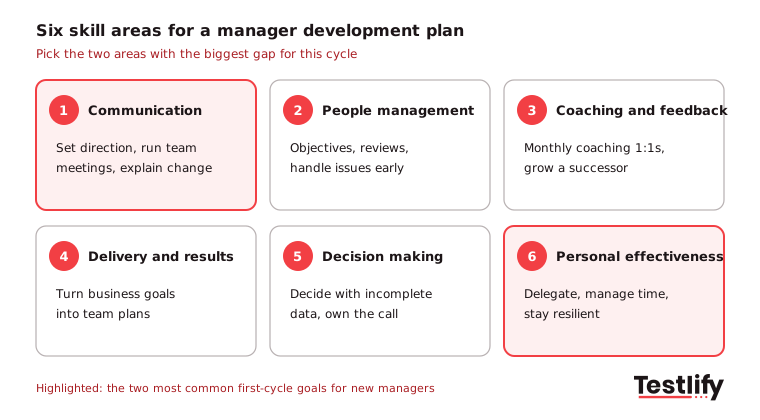
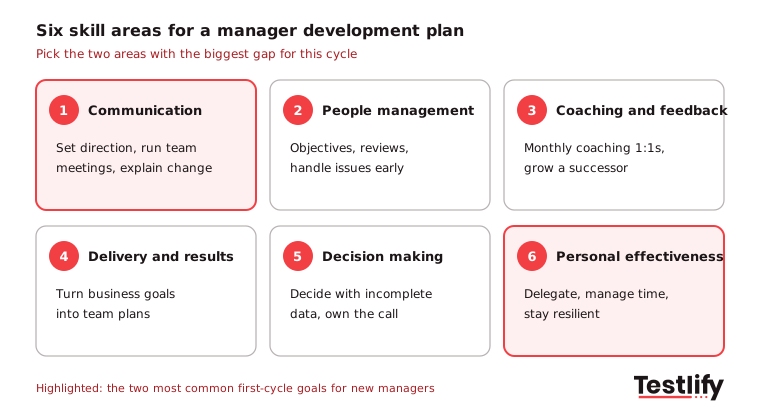
A manager development plan should cover six skill areas: communication, people management, coaching, delivery and results, decision making, and personal effectiveness. No manager needs to work on all six at once. Pick the two areas with the biggest gap for the current role.
Use the people management skills guide to break each area into smaller behaviors if a goal still feels too broad.
Pro tip: Delegation is the most common first goal for a new manager. If a manager is still doing most of the team's work, almost every other goal will stall until that changes.
How do you create a manager development plan?
A manager development plan is built in six steps: define what the role needs, measure where the manager is today, set two or three SMART goals, choose actions for each, agree the support, and set review dates. The whole first draft should take one or two working sessions, not weeks.
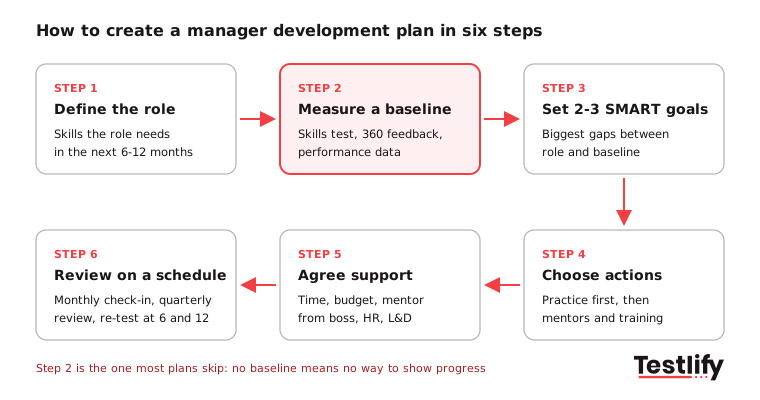
- Define what the role needs: List the management skills this role needs over the next 6 to 12 months. A team lead of five needs different skills from a manager of managers. Use the company's competency framework if one exists.
- Measure a baseline: Collect evidence before setting goals. Combine a skills assessment (leadership, people management, situational judgment), 360 feedback from reports and peers, and recent performance data. This step is where most plans cut corners, and it is why many goals end up as guesses.
- Set two or three SMART goals: Choose the skills with the biggest gap between role needs and baseline. Make each goal specific, measurable, achievable, relevant and time-bound. "Become a better coach" becomes "Hold a 45-minute coaching conversation with each report every month by end of Q3."
- Choose actions for each goal: Mix on-the-job practice (stretch tasks, leading a project), learning from others (a mentor, peer feedback, shadowing) and a small amount of formal training. Practice should carry most of the weight.
- Agree the support: Write down what the manager's boss, HR and L&D will provide: time, budget, a mentor, access to a course or coaching.
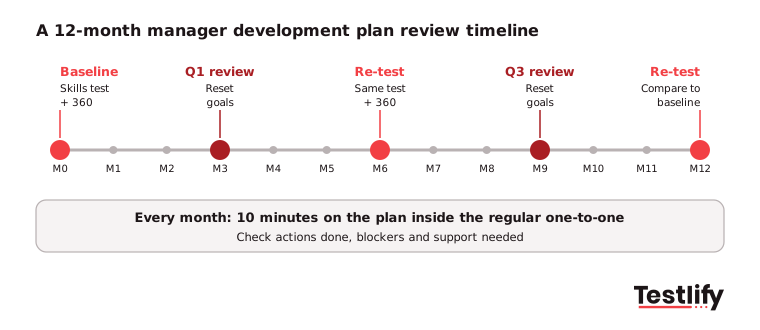
- Set review dates: Put monthly check-ins in the calendar, a fuller review every quarter and a re-test at month 6 and month 12.
The manager owns the plan. Their boss owns the opportunities and feedback. HR or L&D owns the tools and the learning options. Writing those three roles into the plan stops it from quietly becoming nobody's job.
What does a manager development plan template look like?
A manager development plan template is a one-page table with a row per goal and columns for the skill, the goal, actions, support, the measure and the target date. Keep it to one page so the manager and their boss actually use it in one-to-ones.
Copy this manager development plan template and fill one row per goal:
Skill | SMART goal | Actions | Support needed | Measure of success | Target date |
|---|---|---|---|---|---|
Delegation | Fully hand over 3 recurring tasks to team members | List tasks, pick owners, agree handover checklists, step back from approvals | Boss reviews the task list; 30 minutes a week of coaching | Hours spent on hands-on work drop by a third; team rates autonomy higher in pulse survey | Month 3 |
Feedback | Give specific feedback to each report at least twice a month | Use a simple situation, behavior, impact format; log feedback in one-to-one notes | Feedback workshop from L&D; peer manager as practice partner | 360 feedback score on "gives useful feedback" rises at month 6 | Month 6 |
Decision making | Make and document decisions within agreed limits without escalating | Write one-page decision notes; review two past decisions with mentor | Mentor from senior leadership; clear decision limits from boss | Re-test score on decision making improves; escalations fall | Month 12 |
Add a short header above the table with the manager's name, role, plan owner, start date and review dates. That is all the template needs.
What are good manager development plan examples by level?
Good manager development plan examples change with the manager's level: first-time managers focus on the shift from doing to leading, experienced managers on scale and influence, and senior managers on strategy and building the next layer of leaders.
First-time manager development plan
- Goal focus: Delegation, one-to-ones, giving feedback and handling the first difficult conversation.
- Example goal: Set up weekly one-to-ones with every report within 30 days and keep them for the full quarter.
- 30-60-90 day shape: The first 30 days are for learning the team and the work. Days 31 to 60 are for setting team goals and starting regular feedback. Days 61 to 90 are for delegating real work and running the first performance conversations.
Experienced manager development plan
- Goal focus: Cross-team work, commercial awareness, coaching and building a bench.
- Example goal: Co-lead one cross-functional project this year and name two possible successors with their own development plans.
Senior manager development plan
- Goal focus: Strategy, managing managers, change and succession planning.
- Example goal: Build a two-year team plan tied to company goals and make sure every manager below has a written development plan.
For role-specific versions, the same structure works. A project manager development plan might add stakeholder management and risk goals. A sales manager development plan might add pipeline coaching and forecast accuracy. Keep the skill areas, then swap the example goals.
How do you measure progress on a manager development plan?
Progress on a manager development plan is measured by comparing the manager against the baseline at fixed points: a monthly check-in on actions, a quarterly review of goals, and a re-test of skills and 360 feedback at month 6 and month 12. Course completions alone do not show progress.
Measures that link to the skills gap found at the start are the most useful, because they show whether the original gap has closed. CIPD makes a related point in its 2025 report: managers rate better on supporting learning when they have both training and time. CIPD Good Work Index 2025
Key takeaway: Use the same assessment at the start and at each re-test. A different test at month 6 tells you nothing about progress.
What mistakes make manager development plans fail?
Manager development plans usually fail for five reasons: too many goals, vague goals, no baseline, no time to work on them, and check-ins that stop after the first month.
- Too many goals: Six goals means no goal gets real attention. Two or three per cycle is enough.
- Vague goals: "Improve leadership" cannot be measured. Name the behavior, the measure and the date.
- No baseline: Without a starting score, nobody can say whether the manager improved. Measure first, then set goals.
- No time: LinkedIn's 2025 report found that 50% of respondents say managers lack proper support for career development. Protect time for the plan in the manager's week. LinkedIn Workplace Learning Report 2025
- Check-ins that fade: Plans written in January and opened again in December do not change behavior. Put the plan on the agenda of every monthly one-to-one.
Across the teams we talk to, the plans that work are short, reviewed often and tied to one real business problem the manager already owns.
How can hiring teams connect manager hiring and development?
Hiring teams can connect manager hiring and development by using the same skills data for both. The assessment that helped pick a manager, whether hired from outside or promoted from within, already shows their strengths and gaps, so it can seed the first manager development plan instead of starting from a blank page.
A simple way to do this:
- Assess for the role: Test management skills during hiring or before a promotion, for example with a leadership and people management test, an emotional intelligence test and a decision-making test.
- Hand over the results: Share the per-skill results with the new manager's boss and HR on day one.
- Set the first goals: Turn the two lowest skill scores into the plan's first goals for the first 90 days.
- Re-test later: Use the same test at month 6 to show progress.
Testlify supports this flow with 3,500+ tests, including leadership, people management, situational judgment and 360 feedback assessments, and AI candidate insights that break results down by skill. The same tests can spot high-potential employees who are ready for a first management role. For the wider program around individual plans, see how to create a leadership development plan.
If you want a baseline for your next manager development plan, browse the leadership and management tests in the Testlify test library or start a 7-day free trial, no credit card needed.
FAQ

Content Writer
Yashika Khandelwal is a Content Writer with 3+ years of experience creating research-backed content on hiring, talent assessment, and HR technology. She is a registered Organizational Psychologist and subject matter expert who combines behavioral science with practical recruitment insights to produce accurate, evidence-based content.
LinkedInRelated resources
View all
HR & recruitment
How to measure employee productivity: metrics, formulas and steps

HR & recruitment
Gig worker challenges employers face, and how to manage them

HR & recruitment
What are the benefits of using a PEO? A guide for growing teams

HR & recruitment
PEO for startups: what it does and when it pays off

HR & recruitment
Labor forecasting: what it is and how to do it in 2026

HR & recruitment
Payroll advance: what it is, how it works and how to offer one
Get started.
Hire on proof, not resumes.
Run your first skills-based assessment free — no credit card required.