
Gig worker challenges employers face, and how to manage them
The real gig worker challenges for employers: misclassification risk, verifying skill fast, and keeping a flexible workforce staffed.

Most writing about gig worker challenges, including World Economic Forum research on gig work, looks at the problem from the worker's side: unpredictable pay, no benefits, isolation. Employers face a different set of challenges in the same relationship.
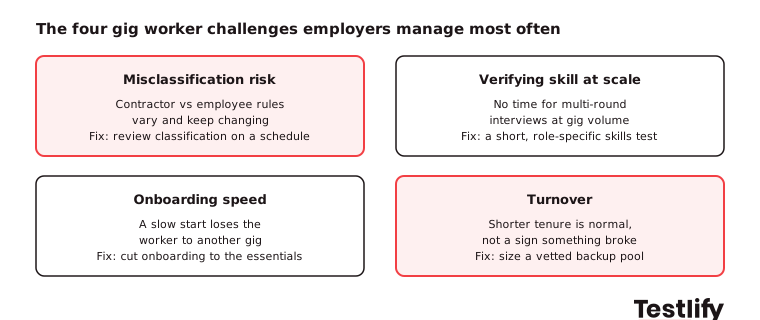
Classifying workers correctly, verifying skill without a traditional hiring process, onboarding fast, and keeping people around long enough to be productive are the problems that actually show up on an HR or operations leader's desk. For the base definition of a gig worker, see Testlify's gig worker glossary entry.
TL;DR / Key Takeaways
- The main gig worker challenges for employers are misclassification risk, verifying skill at scale, onboarding fast, and turnover in a workforce with no long-term contract.
- Misclassification is the costliest risk. A 2026 settlement saw a gig staffing platform pay $2.3 million over worker classification in San Francisco, without admitting wrongdoing.
- Traditional interviews do not scale to gig hiring volume. Skills tests and structured screening fill that gap without adding time to the process.
- Fast onboarding matters more for gig work than for full-time hires, since a slow start often means the worker takes a different gig instead.
- Turnover is normal in gig work, not a failure. Plan staffing levels and backup pools around it instead of trying to eliminate it.
- Compliance rules vary by state and country and keep changing, so review worker classification on a schedule, not only when a law changes.
 ChatGPT
 Gemini
 Claude
 Grok
 Perplexity
Why is managing a gig workforce harder than it looks?
Managing a gig workforce is harder than managing full-time staff because the usual tools, a fixed interview process, a long onboarding period, and a stable headcount to plan around, do not fit the way gig work runs. Workers come and go faster, volume can spike without notice, and the legal line between a contractor and an employee is not always clear.
A SHRM report on managing contingent and gig workers cites survey data showing only about 9% of companies rated themselves excellent at managing gig or contingent workers, which suggests most employers are still figuring this out. Each of the challenges below comes from one of those mismatches.

What is the misclassification risk, and how big is it?
Misclassifying a gig worker as an independent contractor when the law treats them as an employee is the costliest gig worker challenge, since it can trigger back pay, fines, and in some cases a ban from hiring in a given market. the US Department of Labor's guidance on employee vs independent contractor status looks at the economic realities of the working relationship, not just a job title or a 1099 form.
The agency's own enforcement position has shifted more than once in the last two years. Rules also vary by state and country on top of the federal picture, so a classification that is safe in one place is not automatically safe everywhere the company hires.
The risk is not theoretical. In October 2026, a gig staffing platform agreed to pay $2.3 million to settle a misclassification suit brought by a city attorney's office over how it classified its gig workers, without admitting wrongdoing. Review how each role is classified on a regular schedule, not only when a new law passes, and document the reasoning for each decision.
How do you verify skill when there is no time for a normal interview?
You verify skill in a gig workforce by replacing the multi-round interview with a short, structured test or work sample that every candidate takes the same way, since gig hiring volume and speed rarely leave room for a traditional process. A shift that needs filling in days, not weeks, cannot wait for three rounds of interviews with five people each.
The tradeoff is that skipping verification entirely, which many gig employers do under time pressure, lets weak performers through at the exact volume where quality problems are hardest to catch manually.
Approach | Speed | Consistency | Risk |
|---|---|---|---|
Full interview process | Slow | Depends on interviewer | Workers take other gigs while waiting |
No verification | Fast | None | Quality and safety issues surface late |
Short skills test or work sample | Fast | Same criteria for every candidate | Needs a tool built for high volume |
Pro tip: Build the test from the actual task, not a general aptitude measure. A five-minute task-specific check predicts performance on that task better than a long general test does, and it respects the candidate's time.
Why does onboarding speed matter more for gig work?
Onboarding speed matters more for gig work because a slow start costs you the worker, not just their first few productive days. SHRM on balancing gig workers with regular employees notes that gig workers still attend meetings and work alongside full-time staff even on short assignments, so skipping onboarding guidance entirely creates friction later, even when the paperwork itself is fast.
A full-time candidate waiting a week for paperwork usually waits it out. A gig worker comparing several platforms or staffing options at once often does not, since gig work by definition rewards picking up the next available opportunity. Cut onboarding to the steps that actually matter for the role: identity and eligibility checks, the skill or safety check from the section above, and the minimum information needed to start the first shift.
Is turnover in a gig workforce a problem to fix or a fact to plan around?
Turnover in a gig workforce is mostly a fact to plan around, not a problem to eliminate, since gig work by design has shorter tenure than full-time employment. Treating normal turnover as a crisis leads to wasted effort trying to "fix" something structural. Build the roster bigger than the shift actually needs, keep a ready pool of previously vetted workers you can call back, and track time-to-fill for backup slots the same way you track it for the main roster.
How should employers manage these gig worker challenges day to day?
Employers manage gig worker challenges day to day by treating classification, verification, onboarding, and turnover as four separate processes with their own owner and schedule, rather than one general "gig worker problem."
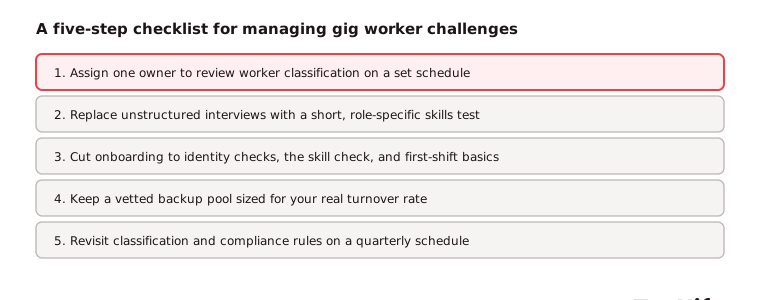
- Assign one person or team to review worker classification on a set schedule, with the reasoning documented for each role.
- Replace unstructured gig interviews with a short, role-specific skills test or work sample every candidate takes.
- Cut onboarding to identity checks, the skill check, and the minimum information needed for the first shift.
- Keep a vetted backup pool sized for the turnover rate you actually see, not the turnover rate you want.
- Revisit classification and compliance rules on a quarterly schedule, since state and country rules change independent of any one lawsuit or headline.
Where does Testlify fit into managing a gig workforce?
Testlify does not solve classification or scheduling, but it solves the verification problem that sits underneath gig hiring volume: proving a candidate can do the work before they start it, without adding days to the process. A hiring team builds a role-specific skills test from the job description, every gig candidate takes the same test, and results are scored and ranked automatically. AI interviews explained
With 3,500+ validated tests and 25+ question types, a team hiring gig workers across multiple roles can build a different short test for each one without starting from scratch each time, and still get a decision out fast enough to beat the next platform the candidate is checking.
Ready to verify gig talent without slowing hiring down?
See how a short, role-specific skills test fits into high-volume gig hiring. Start a 7-day free trial of Testlify, no credit card required, and build your first test from a real job description.
Frequently asked questions

Content Writer
Yashika Khandelwal is a Content Writer with 3+ years of experience creating research-backed content on hiring, talent assessment, and HR technology. She is a registered Organizational Psychologist and subject matter expert who combines behavioral science with practical recruitment insights to produce accurate, evidence-based content.
LinkedInRelated resources
View all
HR & recruitment
What are the benefits of using a PEO? A guide for growing teams

HR & recruitment
PEO for startups: what it does and when it pays off

HR & recruitment
Labor forecasting: what it is and how to do it in 2026

HR & recruitment
Payroll advance: what it is, how it works and how to offer one

HR & recruitment
How to evaluate team performance: a practical guide for 2026

HR & recruitment
How Do Employee Benefits Affect Total Employment Compensation?
Get started.
Hire on proof, not resumes.
Run your first skills-based assessment free — no credit card required.