
Decoding the impact of ISTP personality type in workplaces
Discover how ISTP personalities thrive at work! Learn their strengths, challenges, ideal roles, and HR strategies to hire and manage them effectively.

An ISTP is one of the 16 Myers-Briggs personality types, short for Introverted, Sensing, Thinking, and Perceiving. In plain terms, an ISTP is a quiet, hands-on problem-solver who learns by doing, stays calm when things break, and would rather fix the machine than sit in a meeting about it. At work, that shows up as sharp troubleshooting, real independence, and a low tolerance for busywork.
This guide covers what the ISTP type means, its strengths and weaknesses, how ISTPs behave on a team, and the ISTP-A versus ISTP-T split. It also answers a question the personality blogs skip: what an ISTP label should, and should not, do in your hiring process.
TL;DR
- ISTP means Introverted, Sensing, Thinking, Perceiving, one of the 16 Myers-Briggs types: a practical, independent, hands-on problem-solver.
- Strengths: troubleshooting, technical skill, calm under pressure, and blunt honesty. Weaknesses: boredom, weak long-term planning, and a low tolerance for routine.
- ISTP-A (Assertive) and ISTP-T (Turbulent) are the same core type with different stress wiring, not a ranking.
- ISTPs fit technical, problem-heavy, self-directed roles and struggle in meeting-heavy, politics-first ones.
- Use the type for coaching, not hiring. The Myers-Briggs Foundation calls it unethical to screen applicants with MBTI, so hire on validated skills instead.
 ChatGPT
 Gemini
 Claude
 Grok
Grok Perplexity
What is the ISTP personality type?
The ISTP personality type is a practical, analytical, action-first thinker who processes the world through direct experience rather than theory. ISTPs take in concrete facts (Sensing), decide with logic over feelings (Thinking), keep their options open instead of locking down a plan (Perceiving), and recharge alone (Introverted).
Put those four together, and you get someone who is happiest taking a problem apart with their hands and figuring out how it actually works.
People often call the ISTP the “mechanic” or “virtuoso” of the type system, and the nickname fits. Give an ISTP a broken process, a stalled build, or a system nobody else understands, and they tend to light up. Give them a rigid routine and a wall of meetings, and they check out fast.
ISTP meaning: what the letters stand for
ISTP is an acronym. Each letter is one side of a Myers-Briggs preference pair: I for Introversion (energy comes from solitude, not crowds), S for Sensing (trust what is real and measurable), T for Thinking (decide by logic), and P for Perceiving (stay flexible and adapt as you go).
The type describes how a person prefers to take in information and make decisions. It does not measure skill, intelligence, or how good someone is at their job.

ISTP personality traits and characteristics
ISTPs are practical, independent, and highly adaptable people who prefer solving real-world problems over discussing abstract ideas. They tend to stay calm under pressure, value their autonomy, and learn best through hands-on experience. Six traits show up again and again across the people who share this type.
Independent thinkers
ISTPs prefer the freedom to approach work in their own way. They dislike micromanagement and perform best when given a clear objective with the autonomy to decide how to achieve it.
Hands-on problem-solvers
ISTPs learn by doing. They enjoy experimenting, building, fixing, and testing ideas in real situations rather than relying solely on theory or lengthy instructions.
Adaptable and flexible
Unexpected changes rarely throw an ISTP off course. They adjust quickly, think on their feet, and often find practical solutions when plans do not go as expected.
Action-oriented
ISTPs believe in learning through action. Instead of overanalyzing every possibility, they prefer to take the first step, evaluate the results, and improve as they go.
Reserved and private
ISTPs are naturally quiet and selective about what they share. They often observe before speaking, and their reserved nature should not be mistaken for a lack of interest or engagement.
Calm under pressure
ISTPs remain composed in stressful situations. Their ability to think logically and make quick decisions makes them especially effective during emergencies, high-pressure projects, or unexpected challenges.
ISTP strengths and weaknesses
Every type is a trade-off. The same wiring that makes an ISTP a brilliant troubleshooter can make long-range planning or emotional check-ins feel like a chore. Here is the honest split.
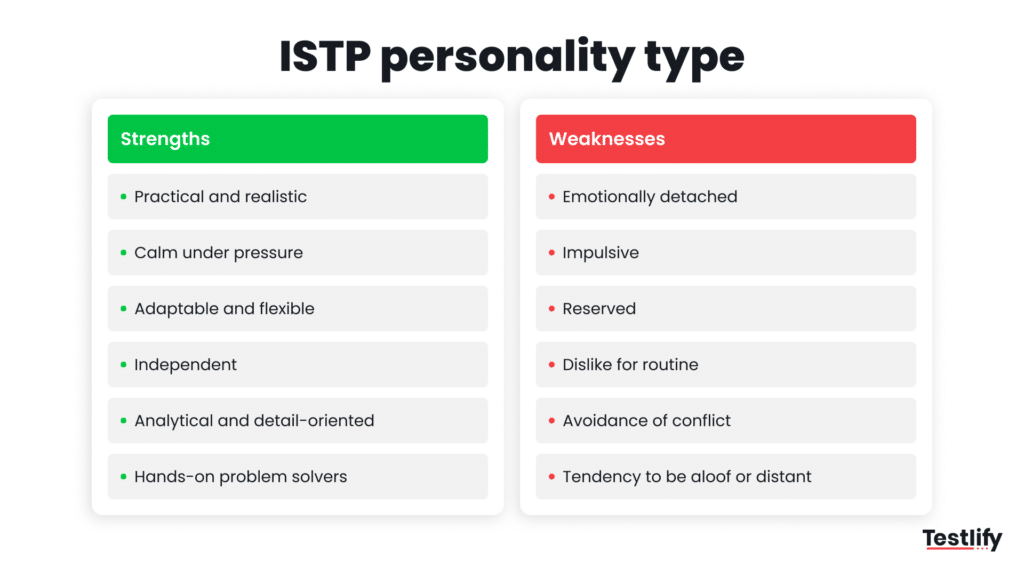
ISTP strengths
- Practical problem-solving: They cut through noise to the root cause and fix it, often faster than anyone expected.
- Technical and mechanical skill: Tools, machines, code, systems. ISTPs pick up how things work quickly and remember it.
- Composure in a crisis: Deadlines and emergencies rattle most people. An ISTP tends to get sharper.
- Direct, honest communication: No sugarcoating. You always know where you stand with an ISTP, which builds a specific kind of trust.
- Self-reliance: Point them at a problem, and they run it down without hand-holding.
ISTP weaknesses
- Gets bored fast: Once the puzzle is solved, interest drops. Routine maintenance and repetitive work are a slog.
- Skips long-term planning: ISTPs live in the now, so career moves and multi-quarter roadmaps can slide unless someone builds the structure.
- Bluntness can sting: Honesty is a strength until it lands as harsh. Not everyone reads directness as respect.
- Guards their space: Heavy collaboration and constant check-ins drain them, so follow-through on group projects can wobble.
- Reluctant with feelings: Emotional conversations are not their comfort zone, which some teammates read as distance.
What is the difference between ISTP-A and ISTP-T?
Some tests split each type into an Assertive (-A) and Turbulent (-T) variant, an add-on that describes identity, or how confident and reactive a person is, not the four core letters. ISTP-A and ISTP-T share the same practical, hands-on core. They differ in how they carry stress and self-doubt.
Trait | ISTP-A (Assertive) | ISTP-T (Turbulent) |
|---|---|---|
Self-confidence | Steady, rarely second-guesses a call | More self-critical, revisits decisions |
Stress response | Shrugs it off, moves on | Feels it more, uses it as fuel to improve |
Feedback | Takes it, does not dwell | Takes it to heart, chases the fix |
Drive | Content with good enough | Pushes for better, can overwork |
Neither variant is better. A turbulent ISTP often improves faster because self-doubt keeps them sharpening. An assertive ISTP stays calmer under a long grind. Both are the same type at the core.
How do ISTPs perform in the workplace?
ISTPs do their best work where the problem is real, the feedback is fast, and nobody is hovering. They shine in roles that reward hands-on skill and quick, logical decisions, and they wilt in ones built on politics, vague goals, or endless process. The best-fit roles usually share a few features.
Technical and hands-on roles
ISTPs are naturally drawn to work that involves building, repairing, analyzing, or improving systems. Careers in engineering, information technology, mechanics, skilled trades, data analysis, and laboratory or field work often match their strengths.
Problem-solving careers
Routine work rarely keeps an ISTP engaged. They excel in roles where each day presents a new challenge to diagnose, troubleshoot, or fix, allowing them to apply logical thinking and practical skills.
Independent work environments
ISTPs prefer clear objectives with the freedom to decide how to achieve them. They are most productive in workplaces that value results over micromanagement and trust employees to work independently.
High-pressure roles
Many ISTPs stay calm when others feel overwhelmed. Careers in emergency response, operations, incident management, technical support, or other fast-paced environments allow them to make quick, logical decisions under pressure.
What careers can be challenging for ISTPs?
ISTPs may find roles less satisfying when success depends more on constant communication, office politics, or relationship management than on practical problem-solving.
Meeting-heavy and administrative roles
Jobs dominated by meetings, long planning sessions, reporting, and process management can feel repetitive and limiting for ISTPs, who generally prefer action over discussion.
Relationship-focused careers
Roles centered on networking, sales relationship management, stakeholder engagement, or continuous client interaction may require more social energy than most ISTPs naturally enjoy. While they can succeed in these positions, they often find them more mentally draining than careers that emphasize technical expertise and independent work.
What does ISTP mean for HR and hiring teams?
Here is the part most ISTP articles leave out, and it matters if you sit in HR. A personality type is a fine lens for coaching, team communication, and self-awareness. It is a poor basis for a hiring decision, and using it that way can get you into trouble.
The Myers-Briggs Foundation is blunt about this. Its code of ethics states plainly that “it is unethical practice to use results on the MBTI instrument to screen job applicants’ employment or positions,” and that type results should never be used to “label, evaluate, or limit an individual in any way”.
What does predict the job is evidence of the actual skills the role needs. That is where hiring is already heading. A majority of US job postings, 52% as of early 2024, no longer mention any formal education requirement, up from 48% in 2019, as employers shift toward what candidates can demonstrate (Indeed Hiring Lab).
And the ground keeps moving: nearly 40% of the core skills workers use on the job are set to change by 2030 (World Economic Forum). A four-letter label from a fixed questionnaire cannot keep up with that. A skills assessment tied to the role can.
The goal is to make hiring decisions based on multiple sources of evidence, not a single data point. Instead of advancing candidates based on a resume, one assessment, or one interviewer’s impression, combine role-relevant signals such as skills assessments, work simulations, structured interviews, and standardized interviewer feedback.
This creates a more balanced view of each candidate and reduces the influence of bias or first impressions.
Dimension | MBTI type (e.g. ISTP) | Validated skills assessment |
|---|---|---|
What it measures | Preferences and self-perception | Demonstrated ability on the actual task |
Best use | Coaching, team talk, self-awareness | Screening and selection |
Approved for hiring? | No, per the publisher’s own ethics code | Yes, when job-relevant and validated |
Changes with the role | Fixed 16 categories | Configured to the competencies that matter |
Pro tip: If you like the ISTP profile of a candidate, do not hire on it. Turn each trait into a testable claim instead. Curious whether they really are a calm, hands-on problem-solver? Give them a short, role-specific personality and skills assessment and a real work sample, then compare the results. That is evidence you can defend, not a hunch dressed up as a label.
Tips for working with an ISTP
Managing or teaming up with an ISTP is not complicated once you drop the instinct to over-communicate. Give them problems, space, and straight talk, and they will give you their best work.
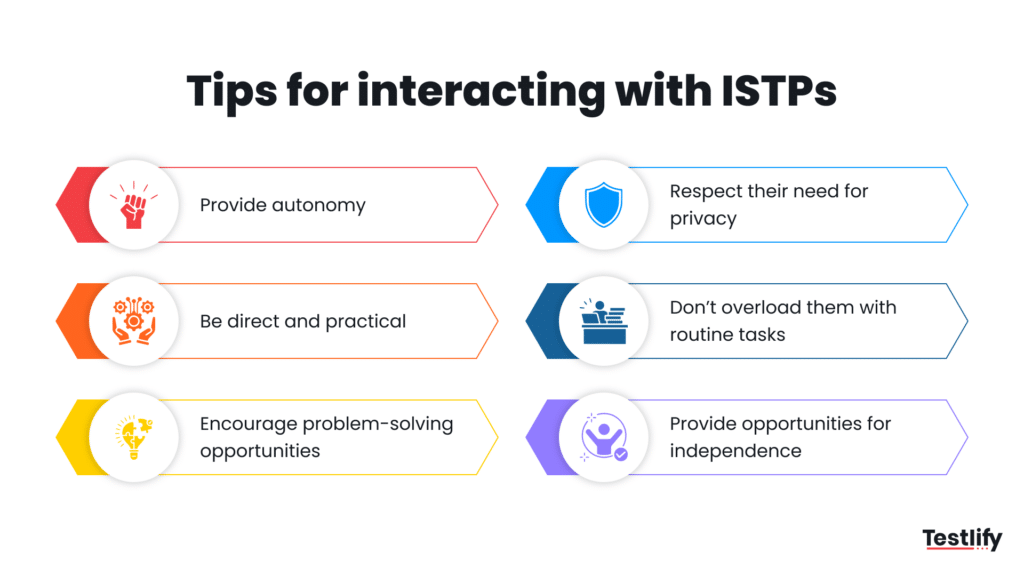
Give them autonomy
Set clear goals, then trust ISTPs to decide how to achieve them. They are highly motivated when they have ownership over their work instead of being closely supervised.
Communicate clearly and directly
ISTPs appreciate concise, practical communication. Focus on the problem, the facts, and the desired outcome rather than long explanations or unnecessary discussions.
Keep them challenged
Meaningful work keeps ISTPs engaged. Give them opportunities to solve real problems, improve processes, or tackle technical challenges instead of assigning repetitive busywork.
Respect their privacy
ISTPs are naturally reserved and prefer to share information on their own terms. Avoid pressuring them to be more outspoken, and give them time to build trust.
Minimize repetitive work
Too much routine or administrative work can reduce an ISTP’s motivation. Whenever possible, rotate repetitive tasks, streamline processes, or automate low-value work so they can focus on solving more meaningful problems.
Watch for signs of disengagement
When ISTPs become bored or feel constrained by excessive rules or micromanagement, they often withdraw rather than complain. Re-engage them by reducing unnecessary friction, giving them greater independence, and assigning work that requires critical thinking and problem-solving.
Hiring for roles where ISTP style skills matter
Testlify’s assessment library lets you screen for hands-on problem-solving, technical skill, and role fit with validated tests, then keep the final decision with your team. See how it works, or book a demo.
Key takeaways
- ISTP stands for Introverted, Sensing, Thinking, Perceiving. It describes a practical, independent, hands-on problem-solver, one of the 16 Myers-Briggs types, and it maps how someone prefers to think, not how capable they are.
- The core strengths are troubleshooting, technical skill, and calm under pressure. Put an ISTP on a real, messy problem with room to work, and they tend to outperform. That is where to point them.
- The weaknesses are boredom, thin long-term planning, and blunt delivery. Knowing this lets a manager build the missing structure and rotate the routine work before an ISTP quietly checks out.
- ISTP-A and ISTP-T are the same type with different stress wiring. Assertive stays steadier, turbulent improves faster. Neither is a better hire, so do not read the variant as a ranking.
- Never hire on the type. The Myers-Briggs Foundation itself calls it unethical to screen applicants with MBTI results. Use it for coaching and team communication, full stop.
- Hire on evidence instead. Combine role-relevant signals with validated assessments used the right way, keep the decision human-led, and you get a call you can defend long after the personality quiz is forgotten.
Frequently asked questions (FAQs)

Head of Assessments
Usha brings a rare depth of expertise to Testlify’s assessment function, over 40 years of multidisciplinary experience spanning banking, insurance, healthcare, automotive, IT services, manufacturing, pharmaceuticals, and enterprise software. At Testlify, she ensures that every assessment, scoring methodology, and competency structure meets the highest standards of enterprise-grade transparency, fairness, and consistency, the kind that holds up under audit and earns the trust of the world’s most rigorous hiring teams.
LinkedInRelated resources
View all
HR & recruitment
Concurrent Validity: Definition, Examples, and Uses (2026)

HR & recruitment
Skills ontology: what it is and how HR leaders use it

HR & recruitment
Implicit vs explicit bias: Difference and impact in workplace

HR & recruitment
What is role mapping? Process, benefits

HR & recruitment
What is recruitment planning and how to create a recruitment plan?

HR & recruitment
An HR’s guide to skills taxonomy
Get started.
Hire on proof, not resumes.
Run your first skills-based assessment free — no credit card required.