
Testlify vs Interviewer.AI: A detailed comparison
Discover the perfect solution for evaluating your candidates’ skills with Testlify. Dive into our comprehensive Testlify vs Interviewer.AI…
Most comparisons of these two tools start from a false premise: that Interviewer.AI is the video interviewing platform and Testlify is the testing platform. That was never quite right, and in 2026 it is simply wrong. Testlify runs one-way video, two-way conversational AI video, and outbound AI phone interviews, alongside the skills and coding assessments it is better known for. So the real question is not video versus tests. It is whether you want the interview on its own, or the interview plus the evidence that the candidate can do the work, in one place.
That choice has got harder to duck. The World Economic Forum's Future of Jobs analysis found nearly 40% of the skills a job needs are set to change by 2030, with 63% of employers naming the skills gap as their single biggest barrier. When the target keeps moving, a read on someone's delivery on camera tells you less and less about whether they can do the work.
 ChatGPT
 Gemini
 Claude
 Grok
Grok Perplexity
TL;DR: Testlify vs Interviewer.AI in 60 seconds
- Both do video. Only one also does the work sample. Interviewer.AI scores recorded video answers and resumes. Testlify does one-way video, two-way conversational AI video and AI phone interviews, plus role-specific skills, coding, cognitive and psychometric assessment.
- The overlap is the interview, not the catalogue. If a video screen is all you need, the two tools genuinely compete. The moment you need to know whether a candidate can write the query, fix the bug or handle the ticket, only one of them has an answer.
- One signal versus several. A video answer is a single, self-reported sample of behaviour. A skills assessment is a work sample. Teams that combine both get a shortlist they can defend; teams that rely on either one alone get a shortlist they have to argue about.
- Candidates do not trust AI scoring yet. Gartner found just 26% of applicants believe AI will evaluate them fairly, and 44% of the reluctant ones point at the missing human factor. That objection lands harder on a camera than on a coding test, whichever vendor runs the camera.
- Buying two tools is the outcome to avoid. A video-only screen cannot assess technical roles, so teams hiring engineers buy an assessment platform within the year. Price that second licence in before you compare monthly fees.

What is Interviewer.AI built for?
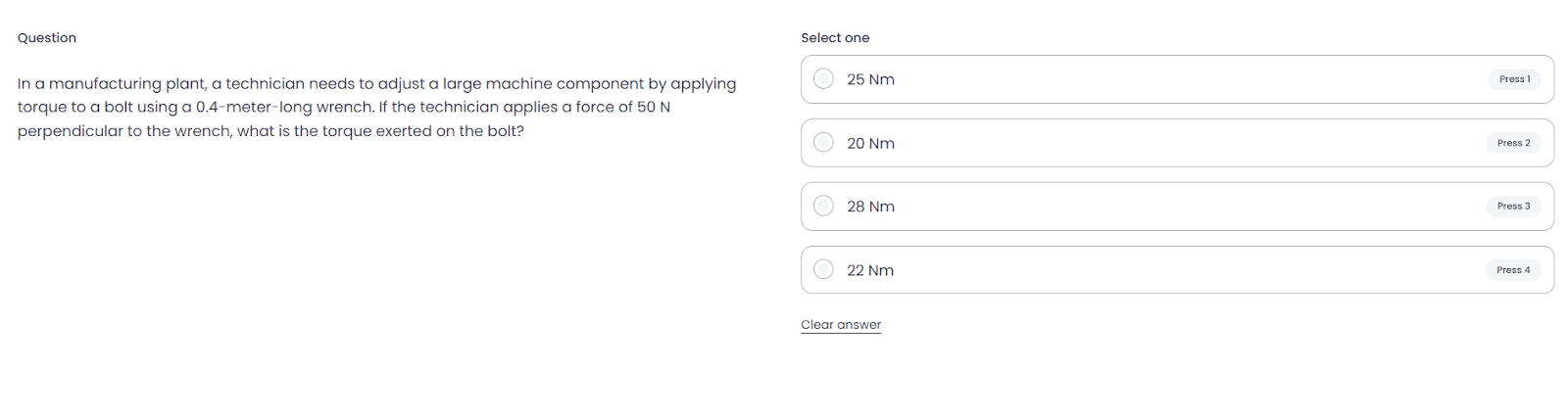
Interviewer.AI is an automated pre-screening platform. You build a set of interview questions, share a link, and candidates record their answers on their own time. The platform scores each response and stack-ranks the applicants, so the shortlisting step that used to eat a recruiter's week happens overnight.
Its scoring model reads three things: the words a candidate says, how they say it, and what their face is doing while they say it. Each gets a score, and those roll up into one number per candidate. Alongside that it does resume scoring, talent-pool browsing and side-by-side candidate comparison, and the pitch is that you can drop the resume screen and the first phone screen entirely.
For high-volume, communication-led roles, that is a real saving. A retail or support team fielding 800 applications for 12 seats does not need a human watching every first answer. Where it gets thin is anything where the job is the work rather than the pitch. A backend engineer who interviews awkwardly and ships clean code will rank below a polished talker every time, because the platform never sees the code.
Does Testlify do video interviews?
Yes, and this is the part most comparisons of the two get wrong. Testlify runs a full interviewing layer, not a token video question bolted onto a test library. It supports one-way asynchronous video, two-way conversational AI video, audio and voice questions, and outbound AI phone interviews billed at $0.18 per minute, with 150+ interview templates to start from.
The AI interviewer is configurable rather than fixed. You choose the avatar, the voice and the persona, write the context and custom prompts it works from, and set the question templates. On the recording side you control the number of attempts, including no limit, the recording and completion time, and auto-start with preparation time so a candidate can read the question before the camera rolls. Maximum duration is 5 minutes per video answer. During a live AI voice interview the candidate is muted while the AI is speaking, which is genuine turn-taking rather than a recorded prompt playing at them.
Afterwards, transcripts generate automatically and multilingually, with the AI detecting the spoken language for any recording of at least 30 seconds. Reviewers can watch or download the video, download the audio and transcript, replay the screen, and regenerate the interview report. Scoring is AI-assisted with a human override built in: displaying AI scores to the reviewer is a toggle, including the AI score in the final average is a separate toggle, and the product ships the disclaimer that AI scores and insights are for guidance only and human judgment should make the final call. For anyone writing an NYC Local Law 144 or EU AI Act policy, that human-in-the-loop switch is the part that matters.
The one thing Testlify genuinely does not do is schedule live human interview panels. There is no calendar coordination for getting four interviewers and a candidate into a room. That is a scheduling product, and it is a different purchase from video interviewing.
Do one-way video interviews predict performance?
A recorded answer measures how someone performs on camera under time pressure, on their own, with no interviewer to read. That is a genuine signal for roles where the job is talking to people. It is a weak proxy for roles where the job is building, analysing or fixing something.
The bigger practical problem is trust. Gartner's 2025 research found just 26% of job applicants trust AI to evaluate them fairly, and among applicants who hesitate to apply where AI is used, 44% name the absent human factor as the reason. Facial and vocal analysis is the sharpest end of that objection. Candidates who have never questioned a coding test will question being scored on their expression, and some will drop out rather than sit it.
That drop-out is not hypothetical spend. Gartner also found 48% of candidates accepted the job offers they received in the fourth quarter of 2025, down from 85% two years earlier. In a market where fewer than half of your offers land, a screening step that quietly costs you applicants at the top of the funnel is a more expensive choice than it looks on the invoice.
The practical answer is not to drop AI scoring but to make it advisory and say so. Turn the AI score into an input a human reads rather than a gate that rejects, and tell candidates that is what you have done.
Pro Tip: If you already run async video, tell candidates in the invite exactly what the AI scores and what a human reviews, and give them a route to a live conversation instead. The teams that publish that up front see far less drop-off than the teams that let candidates guess.
What is Testlify built for beyond the interview?
Testlify measures capability before the interview as well as presentation during it. The library runs to role-specific skills tests, coding assessments across 45+ programming languages, cognitive ability, personality and psychometric instruments, software proficiency tests, typing tests and situational judgment questions, drawn from 3,500+ tests and 180,000+ validated questions across 25+ question types.
Coding is a real environment rather than a code box: an embedded VS Code editor, single-file or multi-file project submissions, up to 20 test cases that can be visible or hidden with per-test-case scoring, and SQLite database test cases. There is also a vibe coding mode, where candidates direct AI tools to reach a working solution instead of writing syntax by hand, which is closer to how a lot of engineering actually gets done in 2026 than a blank editor is.
The gap this closes is a well-documented one. Deloitte's 2025 Human Capital Trends research found 66% of managers and executives said their recent hires were not fully prepared for the role, with experience the most common thing missing. A hire who interviews well and then cannot do the job is the expensive failure mode, and it is the one a video score is least equipped to catch.
Testlify also runs the integrity layer that volume hiring needs, with three presets covering standard, strict and fully custom. Measures include full-screen enforcement, tab-switch detection, face and single-presence verification, photo ID verification with face match, periodic webcam snapshots, session recording, copy-paste tracking, multi-monitor restriction, AI-tool detection, and IP and location checks. The standout is dual-device proctoring, where the candidate's phone acts as a second camera positioned to capture both the candidate and the laptop screen, and the session will not start until that monitoring is active.
What the recruiter gets back is deliberately evidence-first rather than automatic. A green flag means the session followed the rules, yellow means a quick manual review is recommended, and red means cheating was confirmed. Auto-termination is a separate opt-in setting with a threshold the recruiter chooses, not something the flags do on their own.
The framing Testlify uses for this is the Testlify Multi-Signal Talent Evaluation Model: evaluate a candidate on several independent, role-relevant signals rather than one. Skills evidence, cognitive evidence, behavioural evidence, interview evidence and reviewer feedback each cover a blind spot the others leave open. One signal is fragile. Several pointing the same way is a decision you can stand behind in a debrief.
Testlify vs Interviewer.AI: feature comparison
Feature lists are the least interesting part of a vendor decision, but they are the fastest way to see where two products stop overlapping. Read the table below for the shape of each catalogue rather than the row count. A dash means the capability is not documented publicly either way.
Features | Testlify | Interviewer.AI |
|---|---|---|
Video, voice and AI interviewing | ||
One-way async video interview | Yes | Yes |
Two-way conversational AI video | Yes | - |
AI phone and voice interviews | Yes, $0.18 per minute | - |
Selectable AI avatar, voice and persona | Yes | - |
Custom AI prompts and context | Yes | - |
Interview templates | 150+ | - |
Recording attempts per question | Configurable, including no limit | Yes |
Auto-start with preparation time | Yes | - |
Automatic multilingual transcripts | Yes | - |
AI score with human override toggle | Yes | - |
Live human panel scheduling | No | - |
Test library | ||
Role-specific tests | Yes | No |
Coding tests | Yes | No |
Programming languages supported | 45+ | - |
Vibe coding assessment | Yes | - |
Cognitive ability tests | Yes | Yes |
Psychometric and personality tests | Yes | Yes |
Situational judgment tests | Yes | No |
Typing test | Yes | No |
Software and office-app tests | Yes | No |
Total tests available | 3,500+ | - |
Question types | 25+ | - |
Resume scoring | Yes, Greenhouse integration | Yes |
Proctoring and integrity | ||
Proctoring presets | Standard, strict, custom | - |
Dual-device phone monitoring | Yes | - |
Photo ID with face match | Yes | - |
Session recording | Yes | No |
Webcam snapshots | Yes | Yes |
Multi-monitor restriction | Yes | - |
AI-assistance detection | Yes | - |
AI checker on written answers | Human, AI or mixed | - |
Reporting and analytics | ||
Item-level psychometrics | Difficulty and discrimination index | - |
Candidate benchmarking and percentiles | Yes | No |
AI insights per candidate | Yes | Yes |
Exportable reports | PDF, ZIP, CSV, transcripts | - |
Platform and admin controls | ||
ATS integrations | 100+, paid add-on | - |
Built-in hiring pipeline | Simple built-in ATS | No |
SAML SSO and SCIM provisioning | Yes, paid add-on | - |
Audit logs with SIEM streaming | Enterprise and above | - |
White label | Yes, paid add-on | No |
Accommodation request flow | Yes, human reviewed | - |
GDPR compliant | Yes | Yes |
The competitor column reflects what Interviewer.AI documents publicly at the time of writing. Vendor feature sets move, so confirm anything decision-critical directly with them before you sign.
How does Interviewer.AI pricing compare?
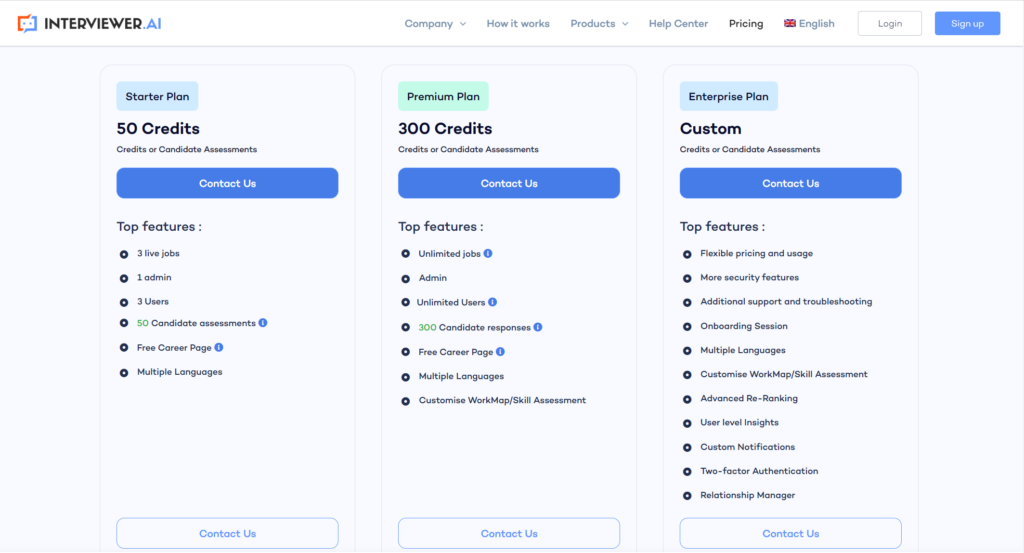
Interviewer.AI publishes entry pricing on its site and quotes the enterprise tier after a sales conversation, so what you pay depends on volume and on which modules you turn on. Third-party directories list figures that disagree with each other, which is normal in this category, so treat the vendor's own page as the only number worth quoting and check it on the day you build the business case.
Testlify publishes its own plans in full. Billed annually, Starter is $139 a month for 100 candidate credits, Basic is $279 a month for 300, and Business is $699 a month for 1,000, with Premium, Enterprise and Custom quoted on contact. Monthly billing carries the same tier names at different credit counts. A credit is consumed when a qualified candidate starts an assessment, credits do not roll over, and additional seats are $15 per seat per month. There is a 7-day free trial with no card required and a 30-day money-back guarantee.
Two things to price honestly. White labeling, SSO and the 100+ ATS integrations are $2,388-a-year add-ons on the self-serve tiers rather than included features, so a like-for-like enterprise comparison should carry them. And if the video tool cannot assess the technical roles you hire for, you will buy a second platform for those roles within the year. Count that second licence into the comparison from the start and the maths usually changes.
Which tool should you choose?
Pick Interviewer.AI if your bottleneck is genuinely first-round volume on communication-heavy roles, if the skills you hire for are hard to test but easy to hear, and if a standalone async video screen is the whole job you need done.
Pick Testlify if you want the video screen and the capability evidence from one platform, or if the roles you hire for have a right answer. Engineering, data, finance, support with a product to learn, anything where the work is a demonstrable skill. Pick it too if you need proctoring you can defend, or if your hiring managers keep pushing back on shortlists because the evidence behind them is thin.
And if you are reading this because a shortlist went wrong, the honest diagnosis is usually not the tool. It is that the shortlist was built on one signal. A candidate who presents well is not the same as a candidate who performs well, and no amount of scoring on a single video answer turns one into the other. If you want the wider view of what else sits in this category, the Interviewer.AI alternatives roundup covers the field.
What does switching from Interviewer.AI involve?
Less than teams expect, because the video round does not have to disappear. It moves into the same platform as the assessment. A typical move looks like this:
- Pick your three highest-volume open roles and write down what actually separates a good hire from a bad one in each. Not the job description. The real thing.
- Map each of those to evidence: a skills test, a coding task, a cognitive measure, a situational judgment set, or an interview question that has to be answered out loud.
- Rebuild your existing video questions as an interview stage, then add the assessment stage in front of it.
- Run both processes in parallel for one hiring cycle. Send the same candidates through the old video screen and the new sequence.
- Compare the two rankings against what your hiring managers say after the interviews. That comparison is the whole decision, and it takes one cycle to get.
The parallel run is the part teams skip, and skipping it is why so many tool migrations end in a quiet rollback six months later. You need evidence about your own funnel, not a vendor's benchmark.
Can you run both tools together?
You can, though the case for it is weaker than it used to be, because the video round no longer requires a second vendor. If you do keep both, the sequence that works is to assess skills first, then send the shortlist to the video round. That way the video step is looking at eight candidates who can definitely do the job, instead of eight hundred who might.
Run it the other way round and the skills test becomes a rubber stamp on a list already filtered by presentation. You have paid for two tools and kept the weaker filter first.
What should you test during a vendor trial?
Four things, in this order. Does the assessment separate your real candidates, or does everyone score in the same band? Do hiring managers read the report without being chased? Does it fit the ATS you already run, or does it create a manual export step someone will abandon? And does the candidate drop-off rate go up when you add it?
That last one is the question almost nobody asks before signing, and it is the one that decides whether the tool survives contact with a live requisition.
Hire on evidence, not on delivery
If you are looking at Interviewer.AI because your screening stage is slow, the idea is right. The question is whether a video score alone is the instrument, because it tells you how a candidate presents, not whether they can do the job.
Testlify answers both questions in one platform: one-way and conversational AI video, voice and phone interviews with transcripts and human-override scoring, plus role-relevant skills tests, coding assessments across 45+ languages, cognitive and situational measures, configurable proctoring, and candidate reports your hiring managers will actually open. Start free with an assessment for one open role, or book a demo and we will map your competencies to evidence with you. If you want the background first, the notes on how AI interviews work for screening pair with the case for pre-hiring assessments in diversity hiring, and there are worked examples of skills assessments in practice if you prefer to see it done.
Key takeaways
- This is not video versus testing. Testlify runs one-way video, two-way conversational AI video and AI phone interviews as well as assessments, so the comparison is a single-purpose screening tool against a platform that covers the same interview plus the work sample. Choosing on the old framing lands you with a second licence you did not budget for.
- One signal is fragile. The Testlify Multi-Signal Talent Evaluation Model exists because a single sample, whether that is a video answer or one test score, leaves blind spots the others would have caught. If your shortlist rests on one measure, the fastest quality improvement available to you is adding a second, independent one.
- Candidate trust is a real cost line. With only 26% of applicants believing AI will judge them fairly, and offer acceptance down to 48% from 85% two years earlier, a screening step that pushes candidates out of the funnel is expensive in a way the licence fee never shows. Say plainly what the AI scores and offer a human route.
- Make the AI advisory and prove it. Testlify lets you show AI scores to reviewers without counting them in the final average, and ships the guidance-only disclaimer in the product. That toggle is what turns an AI screening policy into something you can put in front of a regulator or a works council.
- Test library breadth is the day-to-day difference. Coding, cognitive ability and software proficiency are absent from a video-first catalogue, so teams hiring technical roles buy a second tool anyway. Price that second licence into the comparison up front and the decision usually resolves itself.
- Sequence beats selection. If you run both, screen on skills first and use the video round on the shortlist. Reversed, the video filter does the real cutting and the assessment becomes a formality you paid for.
- Run them in parallel for one cycle before you commit. One hiring cycle of both processes on the same candidates, checked against what your hiring managers said after the interviews, will tell you more than any vendor benchmark or peer-review grid.
FAQs
Related resources
View all
Competitor Comparisons
Testlify vs Hogan: A detailed comparison
Competitor Comparisons
Testlify vs Ensize: A detailed comparison
Competitor Comparisons
Testlify vs CallidusCloud: A detailed comparison
Competitor Comparisons
Testlify vs Brillium: A detailed comparison
Competitor Comparisons
Testlify vs Priority Bridge: A detailed comparison
Competitor Comparisons
Testlify vs Talent Science: A detailed comparison
Get started.
Hire on proof, not resumes.
Run your first skills-based assessment free — no credit card required.