
Testlify vs Hogan: A detailed comparison
Discover the perfect solution for evaluating your candidates’ skills with Testlify. Dive into our comprehensive Testlify vs Hogan…
 ChatGPT
 Gemini
 Claude
 Grok
Grok Perplexity
Looking for a Hogan alternative?
A Hogan alternative is a hiring platform that measures the same personality and behavioural signals Hogan is known for, without the certification course and the quote-only pricing. Testlify is the closest like-for-like swap: personality and cognitive tests, plus skills tests, AI interviews and proctoring, on published per-candidate pricing.
TL;DR:
- Hogan is a psychometric publisher. Testlify is a hiring platform that includes psychometrics, so the comparison is narrower than it looks on paper.
- The friction that sends teams looking is rarely the science. It is the certification workshop, the contact-sales pricing and the fact that a personality report alone does not tell you whether someone can do the job.
- Testlify publishes its prices. Annual plans start at 139 dollars a month for 100 candidate credits, so you can budget before you talk to anyone.
- One personality score is one signal. The stronger move is combining a personality test with a work sample and a structured interview, then scoring them the same way for every candidate.
- Pick Hogan if you are running executive development with a certified coach. Pick Testlify if you are hiring at volume and need evidence a hiring manager can read without a course.

Why do teams look for a Hogan assessment alternative?
Three reasons come up again and again, and none of them is a complaint about the underlying research. Hogan's inventories are well established. The problem is what sits around them.
The certification gate. To interpret Hogan's personality, derailer and motives reports and give feedback on them, someone on your side has to complete a paid certification workshop first. That is a deliberate design choice and it protects interpretation quality. It also means a hiring manager cannot open a report on a Tuesday and act on it. Either you pay to certify people internally, or you pay a consultant every time you want to read a candidate.
Pricing you cannot see. Hogan does not publish a price list. You contact them, describe your volume, and get a quote. For a 40-person company adding four roles this quarter, that is a conversation nobody wants to have before they know whether the tool fits.
A personality score is one signal. This is the substantive one. A 2022 reanalysis of decades of selection research by Sackett and colleagues revised many long-quoted validity estimates downward and placed structured interviews among the strongest predictors of job performance. Read that honestly and it cuts against every single-instrument purchase, ours included. The answer is not a better personality test. It is more than one kind of evidence, combined consistently.
That is the argument behind the Testlify Multi-Signal Talent Evaluation Model: combine several role-relevant signals, such as assessments, interviews, simulations, references and reviewer feedback, rather than advancing a candidate on one strong test score or one polished interview. One signal is fragile. Several pointing the same way is a decision you can defend.
How we compared Testlify and Hogan
Fair comparisons need stated rules, so here are ours. Everything in the Testlify column comes from the live product and the published pricing page. For Hogan we have only described what the company documents publicly: what the instruments measure, that certification is required to interpret them, and that pricing is quote-based. Where Hogan does not publish something, the table says so rather than guessing a No.
That last rule matters. A comparison table full of red crosses against a rival is easy to write and worth nothing, because the reader knows the vendor wrote it.
How do Testlify and Hogan compare feature by feature?
Capability | Testlify | Hogan |
|---|---|---|
Primary category | Hiring platform: assessments, interviews, proctoring | Psychometric publisher: personality, derailers, motives |
Personality and behavioural tests | Yes, in a library covering personality and culture, psychometric and situational judgement | Yes, the core product |
Cognitive ability tests | Yes | Yes |
Role and skills tests | Yes, across blue collar, coding, engineering, language, software and role-specific categories | Not a stated part of the product |
Coding assessment | Yes, single file or multi-file projects in an embedded VS Code editor, up to 20 test cases | Not a stated part of the product |
Question types | 25+, including Google Docs, Sheets, Slides and Microsoft Word, PowerPoint and Excel tasks | Inventory-based questionnaires |
Video interviewing | Yes, one-way async and two-way conversational AI video, with selectable AI avatars and voices | Not a stated part of the product |
Phone and voice interviews | Yes, outbound AI phone interviews billed at 0.18 dollars per minute | Not a stated part of the product |
Live human interview panel scheduling | No, Testlify does not coordinate panel calendars | Not a stated part of the product |
Proctoring | Yes, three presets plus dual-device monitoring using the candidate's phone as a second camera | Not a stated part of the product |
Item-level psychometrics shown to recruiters | Yes, difficulty index, discrimination index and quality-risk flags per question | Not published |
Certification required to read results | No | Yes, a paid certification workshop |
Published pricing | Yes, from 139 dollars a month billed annually for 100 credits | No, quote only |
Free trial | Yes, 7 days, no card required | Not published |
ATS integrations | 100+, sold as a 2,388 dollar a year add-on on the Starter plan and included on Custom | Not published |
Compliance posture | SOC 2 Type II, ISO 27001, GDPR, NYC Local Law 144 | Not published in comparable form |
Pro tip: before you compare vendors, write down the one decision the assessment has to improve. "We keep hiring salespeople who interview brilliantly and miss quota" points at a work sample plus a structured interview. "Our team leads keep burning out their reports" points at a derailer inventory and a coach. Those are different purchases, and a feature table cannot tell you which one you are making.
Testlify: what it does and who it fits
Testlify is an assessment and interviewing platform. You build an assessment from a library that spans cognitive ability, personality and culture, psychometrics, situational judgement, language, software skills, role-specific skills and coding, then invite candidates by link or through your existing hiring system.
The parts that matter most against a psychometric publisher are the ones that cover what a personality report cannot.
Evidence a hiring manager can read without a course
Scoring runs at three levels: question, test and overall assessment. You can weight tests from x0 to x5, so a coding test can count five times what a culture questionnaire counts. Recruiters also see item-level statistics that usually stay inside a test publisher: a difficulty index, a discrimination index, and a quality-risk flag on any question with very low accuracy or a high skip rate. If a question is doing no work, you can see it and cut it.
That transparency is the point. Kuncel and colleagues found that mechanically combining assessment information generally predicts outcomes as well as or better than experts recombining the same information by judgement. Not evidence that machines should decide, and Testlify does not let them. It is evidence that a consistent scoring rule beats an expert re-reading the numbers at the end.
Interviewing in the same tool
Testlify runs one-way async video, two-way conversational AI video, voice and audio questions, and outbound AI phone interviews. The AI interviewer is configurable: avatar, voice, persona, context and custom prompts, drawn from 150+ interview templates. You set attempt limits, recording time and preparation time. Transcripts generate automatically and detect the spoken language on their own, for any recording of at least 30 seconds. Reviewers get the video, the audio, a downloadable transcript and an interview report.
AI scores open-ended answers, and the product ships the disclaimer next to them: AI scores and insights are for guidance only, use human judgment for final decisions. Whether AI scores are shown to reviewers at all, and whether they count toward the final average, are both toggles. A team that wants AI to summarise and humans to decide can configure exactly that. Given that the EU AI Act classifies systems used to recruit, screen and evaluate candidates as high risk, that human-override switch is not a nice-to-have any more.
Proctoring, and the honest version of it
Three presets: standard, strict and custom. The one nobody else offers is dual-device proctoring, where the candidate's phone becomes a second camera pointed at both them and their laptop screen. It is a hard gate, so the assessment cannot start until mobile monitoring is live.
The flag a recruiter sees is deliberately not a verdict. Green means nothing suspicious. Yellow means something was not ideal and a quick manual review is recommended. Red means cheating was confirmed. Auto-termination exists but is separate and opt-in, with a threshold you set. Nobody gets rejected by a flag on its own. Face-verification data is deleted after 30 days and candidates can withdraw consent at any time.
Pricing, published
Annual plans, billed yearly: Starter is 139 dollars a month for 100 candidate credits, Basic is 279 dollars a month for 300, Business is 699 dollars a month for 1,000. Premium, Enterprise and Custom are contact-sales. One credit is spent when a qualified candidate starts an assessment, and credits do not roll over. There is a 7-day free trial with no card, a 30-day money-back guarantee, and the price is locked for 24 months. Non-profits get 25 percent off. See the current tiers on the Testlify pricing page.
Two things to budget for that the headline price does not include: ATS integrations and white labelling are each a 2,388 dollar a year add-on on the self-serve tiers, included only on Custom. AI phone interviews are metered at 0.18 dollars a minute.
Best for
Companies under about 200 people hiring across several roles at once, where the person choosing the tool is often the founder or the ops lead rather than a full-time assessment specialist. Agencies, professional services firms and non-tech operators get more out of it than a large enterprise that already runs a dedicated system of record. If you already use Greenhouse, Workday or Lever, Testlify sits in front of them as the screening and interviewing layer and leaves your system of record where it is. If you have nothing, Testlify also ships a simple built-in hiring pipeline: job requisitions, an application form, job-board publishing and an applied to reviewed to shortlisted to rejected flow. It is deliberately basic, and it is not meant to compete with a dedicated system of record.
Hogan Assessments: what it does and who it fits
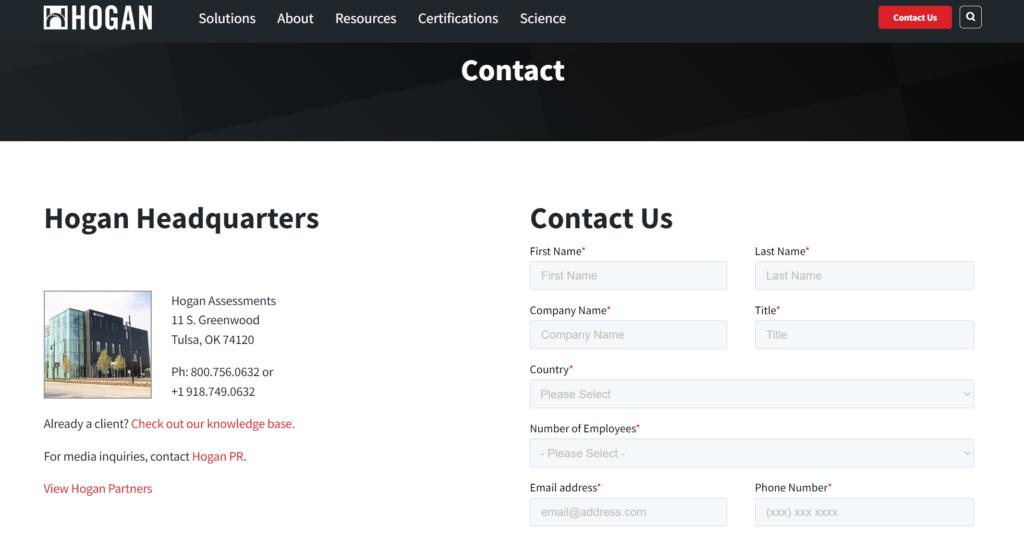
Hogan is a personality assessment publisher with a long research record. Its inventories measure day-to-day personality, the derailers that show up under pressure, and the values and motives that drive fit with a culture. Those are real constructs with decades of literature behind them, and for leadership work they are genuinely useful.
The model is the thing to understand. Hogan sells instruments and the expertise to interpret them, not a hiring workflow. Certification is required before someone can interpret the reports and deliver feedback, which is why the product is so often bought alongside a coach or an internal I/O psychologist. Pricing is quote-based, so cost scales with the conversation you have rather than a published rate card.
Best for
Executive assessment, leadership development, succession planning and coaching engagements, in organisations that already employ or retain someone certified to interpret the output. If your use case is developing the twelve people who run your company, that is Hogan's home ground and a skills platform is the wrong tool.
Where it leaves a gap
Volume hiring. If you are screening 300 candidates for six roles, you need to know whether they can do the work, not only how they behave under pressure. A personality inventory will not tell you if someone can write a SQL query, handle an angry customer, or build the spreadsheet the job runs on. That is the gap a platform fills, and it is why teams end up running both or switching outright.
Which is the better fit for your team?
Choose Hogan when the decision is developmental, the population is small and senior, and you have certified interpretation available. Choose Testlify when the decision is selection, the population is larger, and the people acting on the results are hiring managers rather than psychologists.
A caveat we would rather state than hide: if your hiring rests entirely on executive assessment and you already have a certified coach in the building, switching to a platform buys you very little. The switch pays off when you have breadth to cover, several roles at once, and no appetite to send someone on a course before they can read a report.
Whatever you pick, the compliance floor is the same. The EEOC's guidance on employment tests is clear that a selection procedure has to be job-related and consistent with business necessity, and the federal Uniform Guidelines supply the four-fifths rule as a practical rule of thumb for spotting adverse impact. Both apply to a personality inventory and a coding test alike. Track pass rates by group from the first cycle, not the first complaint.
Worth reading next if you are still scoping: our explainer on what a pre-hire assessment actually covers, the walkthrough on hiring with a Big Five personality test, and the piece on assessing candidates beyond traditional testing.
Ready to try a Hogan alternative?
Start a free trial and build one assessment for the role you are hiring next. Seven days, no card. If you would rather see the multi-signal setup walked through on a live screen, book a demo and bring the job description.
Key takeaways
- The certification gate is the real switching trigger, not the science. Hogan's instruments are well researched, but needing a certified interpreter before a manager can act on a report is a workflow cost. If your hiring managers are the ones making decisions, buy something they can read themselves.
- Published pricing changes how you evaluate. Testlify lists 139, 279 and 699 dollars a month annually for 100, 300 and 1,000 credits. A quote-only vendor forces a sales conversation before a fit conversation, which is a real cost when you are comparing three tools in a week.
- One instrument is a thin basis for a hire. The 2022 Sackett reanalysis moved several long-quoted validity numbers down and put structured interviews near the top. Combine a personality measure with a work sample and a structured interview, and score all three the same way for every candidate.
- Consistent scoring beats expert re-reading. Mechanical combination of assessment data predicts at least as well as experts recombining it by judgement, so set your weights up front and hold them, rather than letting a strong interview overwrite a weak test.
- Match the tool to the population. Small and senior with a coach available points to Hogan. Broad, multi-role, manager-led hiring points to a platform. Running both is a legitimate answer for a company doing executive development and volume hiring at the same time.
- Compliance travels with the decision, not the vendor. Job-relatedness and adverse-impact monitoring apply to whatever you buy, and with candidate-screening AI now classed as high risk in the EU, check that AI scores can be shown as advisory only and kept out of the final average before you sign.
FAQs
Related resources
View all
Competitor Comparisons
Testlify vs Ensize: A detailed comparison
Competitor Comparisons
Testlify vs CallidusCloud: A detailed comparison
Competitor Comparisons
Testlify vs Brillium: A detailed comparison
Competitor Comparisons
Testlify vs Priority Bridge: A detailed comparison
Competitor Comparisons
Testlify vs Talent Science: A detailed comparison
Competitor Comparisons
Testlify vs XBInsight: A detailed comparison
Get started.
Hire on proof, not resumes.
Run your first skills-based assessment free — no credit card required.