
Testlify vs Priority Bridge: A detailed comparison
Discover the perfect solution for evaluating your candidates’ skills with Testlify. Dive into our comprehensive Testlify vs Priority Bridge…
Testlify and Priority Bridge get compared often, and that comparison usually goes sideways fast. Testlify is a pre-hire skills assessment platform, built to measure what a candidate can actually do before anyone books an interview. Priority Bridge positions itself as culture intelligence for executive teams, focused on how an organization prioritizes its values. Same broad market, different jobs.
So the honest answer to "which one is better" is that they are not really competing for the same slot in your stack.
 ChatGPT
 Gemini
 Claude
 Grok
Grok Perplexity
TL;DR
- Testlify measures candidate skills before you interview. Priority Bridge measures organizational culture and values alignment, according to its own public positioning.
- A feature-by-feature race between the two is misleading, because most of the gaps just reflect two different product categories.
- If unqualified candidates keep reaching your interview stage, that is a screening problem, and skills assessment is the lever.
- If people join and leave within a year because the culture was not what they expected, that is a different problem entirely.
- Some teams run both. Skill and fit fail in separate ways, and one tool rarely catches both.

How do Testlify and Priority Bridge differ?
Testlify is a pre-hire assessment platform that scores candidates on job-related skills, cognitive ability, and personality before the interview stage. Priority Bridge describes itself as a culture intelligence product for executive teams, built around measuring organizational culture and values alignment. One evaluates individual candidates. The other looks at the organization.
That distinction matters more than any feature checklist. Buying a culture measurement tool to fix a screening bottleneck will not work, and buying a skills testing platform to diagnose a culture problem will not work either. Both are good products aimed at different questions.
What does Testlify do?
Testlify sits at the screening stage. Candidates take role-relevant assessments, and hiring teams get scored reports they can compare side by side instead of guessing from resumes. The Testlify test library covers role-specific tests, cognitive ability, situational judgment, personality, typing, software skills, and coding tests across 45+ programming languages.
The case for testing skills first is not just a vendor talking point. McKinsey's research on skills-based workforce building found that hiring for skills is 5 times more predictive of job performance than hiring for education, and twice as predictive as hiring for work experience. And the target keeps moving: the World Economic Forum's Future of Jobs Report 2025, built on responses from more than 1,000 employers covering over 14 million workers, projects that 39% of workers' core skills will change by 2030.
Testlify approaches this through the Testlify Multi-Signal Talent Evaluation Model, which combines multiple role-relevant signals (assessments, interviews, simulations, references, and reviewer feedback) rather than betting a hire on one test score. One signal is fragile. Several pointing the same direction is a decision you can defend.
Around the assessment itself, Testlify offers a custom assessment builder, one-way video interview questions, anti-cheating controls like session recording and IP tracking, exportable scorecards, ATS integration, and white-label branding. Typical assessments run 40 to 60 minutes.
What does Priority Bridge do?
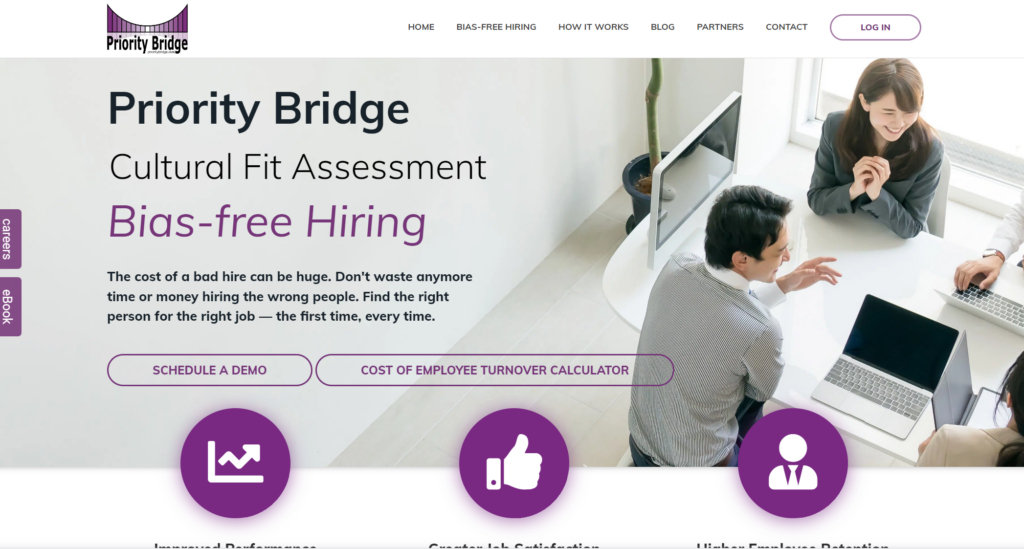
Priority Bridge is a culture measurement product. Its public positioning centers on the Priority Bridge Cultural Fit Assessment and a broader culture intelligence layer for executive teams, measuring how an organization prioritizes cultural dimensions and how employee values line up against them.
The problem it targets is real and badly served. Gallup's organizational culture indicator finds only about 2 in 10 employees feel connected to their workplace culture. That gap shows up in turnover numbers: the U.S. Bureau of Labor Statistics reported 3.2 million quits in June 2026, a quits rate of 2.0%. People do not usually leave because they could not do the work. They leave because of the environment around the work.
Worth stating plainly: Priority Bridge does not publish a public price list or a public feature specification, so anything beyond its own stated positioning is not something a buyer can verify from the outside. Ask them directly rather than trusting a comparison table (including this one) for the fine detail.
Testlify vs Priority Bridge feature comparison
This table compares the two on what each one publicly positions itself to do, not on a scored checklist of features. Rows marked "not positioned for this" mean the vendor does not present it as part of the product, which is different from a tested absence.
Dimension | Testlify | Priority Bridge |
|---|---|---|
Primary job to be done | Measure candidate skills before hiring | Measure organizational culture and values alignment |
Who is assessed | Job candidates during screening | Employees, teams, and leadership |
Core output | Skill scores, candidate reports, benchmarks | Culture insights and values alignment reporting |
Typical buyer | Talent acquisition and hiring managers | Executive and leadership teams |
Skills test library | Role, cognitive, personality, coding across 45+ languages | Not positioned as a skills testing library |
Assessment integrity controls | Session recording, snapshots, IP and location checks | Not positioned as a proctoring product |
Public pricing | Published plans, monthly or annual | Not published, quote on request |
Best fit | Screening candidates on job-related skills at volume | Diagnosing culture at an organizational level |
Which tool should you choose?
Start from the failure you are actually seeing, not from the feature list. If hiring managers complain that candidates look strong on paper and fall apart in the first technical conversation, the screen is the leak. If new hires clear probation comfortably but quit in month nine, screening is fine and something else is wrong.
A rough split that holds up in practice:
- High applicant volume, inconsistent interview quality, or slow technical screening: skills assessment first.
- Low offer acceptance, early attrition, or leadership teams that disagree about what the company values: culture measurement first.
- Both symptoms at once: sequence them. Fix the screen, then measure culture, because a broken screen contaminates any culture data you collect afterwards.
Pro Tip: Before buying either one, pull your last 20 hires and mark which ones failed and why. If most failures trace to capability, a culture tool will not save you. If most trace to expectations and environment, another coding test will not either. That one spreadsheet is cheaper than a year of the wrong subscription.
For a fuller picture of how Testlify stacks up against other assessment-led platforms, the SHL comparison and the breakdown against Predictive Index cover closer like-for-like matchups. The wider evidence base sits in these skills-based hiring statistics.
How do the two compare on pricing?
Testlify publishes its plans, billed monthly or annually, so you can size a rollout without a sales call. Priority Bridge does not list public pricing, so budgeting means contacting their team for a quote.
That difference is worth more than it looks during procurement. Published pricing lets you model cost per candidate against hiring volume before committing. Quote-based pricing usually means the number depends on headcount, scope, and how the conversation goes, which is normal for executive-facing products but harder to plan against.
Ready to test skills before the interview?
If the problem you are solving is unqualified candidates reaching interviews, Testlify is built for exactly that stage. Walk through a role-specific assessment with the team and see the reports against your own hiring bar. Book a Testlify demo and bring one open role to work through.
FAQs
Related resources
View all
Competitor Comparisons
Testlify vs Talent Science: A detailed comparison
Competitor Comparisons
Testlify vs XBInsight: A detailed comparison
Competitor Comparisons
Testlify vs Weirdly: A detailed comparison
Competitor Comparisons
Testlify vs Toggl Hire: A detailed comparison
Competitor Comparisons
Testlify vs Searchlight: A detailed comparison
Competitor Comparisons
Testlify vs SalesDrive: A detailed comparison
Get started.
Hire on proof, not resumes.
Run your first skills-based assessment free — no credit card required.