
Testlify vs CallidusCloud: A detailed comparison
Looking for a reliable way to assess your job applicants’ skills? Testlify is the ultimate alternative to CallidusCloud.
CallidusCloud is not a product you can buy in 2026. SAP acquired Callidus Software in 2018 and folded its tools into SAP Sales Cloud and SuccessFactors, so anyone comparing Testlify to CallidusCloud today is really asking a migration question: what replaced it, and which piece do you actually need back?
The honest answer depends on which part of CallidusCloud you used. If it ran your commissions or your quoting, Testlify is the wrong tool and this page will say so plainly. If you used its hiring and assessment side to screen candidates, that slice is where Testlify replaces it directly.
 ChatGPT
 Gemini
 Claude
 Grok
Grok Perplexity
TL;DR
- CallidusCloud no longer exists as a standalone product. SAP bought it in 2018 for about 2.4 billion dollars and retired the brand.
- Its commissions engine now lives on as SAP SuccessFactors Incentive Management, and its quoting tool as SAP CPQ. Testlify does not replace either one.
- CallidusCloud also sold a hiring and learning cloud. That is the only part Testlify competes with, and it is the part SAP kept least intact.
- Testlify is a pre-hire assessment and interviewing platform: 3,500+ tests, 25+ question types, AI video and voice interviews, and 20+ proctoring measures.
- Public pricing starts at 139 dollars a month on annual billing, against CallidusCloud's quote-only enterprise model.
- If you are mid-migration, decide what evidence each role needs before you shop for a tool. The tool is the easy part.
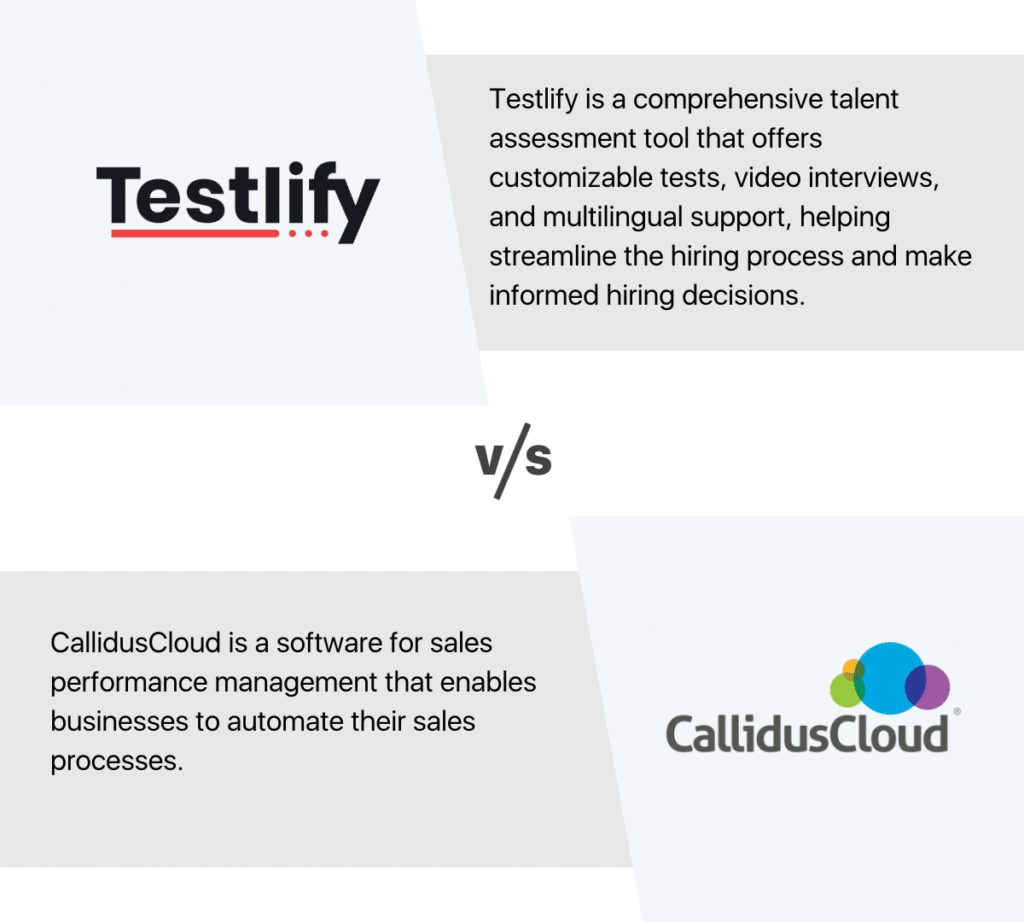

What happened to CallidusCloud?
SAP completed its acquisition of Callidus Software in April 2018 for roughly 2.4 billion dollars, and the CallidusCloud brand was retired over the following years. SAP now lists it among its acquired brands rather than its product line. The technology did not disappear, but the name, the contracts and the roadmap all moved under SAP.
SAP has been open about the path since. Its own account of the move from CallidusCloud into SAP describes a rebuild onto core SAP technology rather than a simple relabel. That matters for anyone still running an old contract, because a rebuild changes migration effort, integration surface and support model all at once.
So the practical position in 2026 is this. There is no CallidusCloud sales team, no CallidusCloud pricing page, and no CallidusCloud renewal. There are SAP products that descend from it, and a market of replacements that grew up while the brand was being absorbed.
That gap is why this comparison exists at all. Buyers keep searching the old name because the old name is what their contract, their invoice or their internal wiki still says.
Is CallidusCloud still available in 2026?
No. CallidusCloud cannot be purchased as a standalone product. Its capabilities are sold as SAP products under different names, with different packaging and different pricing. If a vendor offers you "CallidusCloud" today, they are either reselling an SAP product or describing a legacy contract that predates the rebrand.
What you can still do is keep running an inherited deployment until its contract ends. Plenty of companies are. The problem is that a retired brand stops accumulating the things that make software worth keeping: new integrations, new compliance work, and a support queue that still cares.
Hiring tools feel that decay faster than most categories, because the rules around them keep moving. A screening tool that was compliant in 2020 may not clear an audit in 2026, and nobody is going to backport that work into a retired product.
What was CallidusCloud used for?
CallidusCloud sold what it called a lead-to-money suite. The strongest pieces were sales performance management and incentive compensation, plus configure-price-quote and sales enablement. Those were genuinely good products, which is why SAP paid what it did.
It also marketed hiring and learning clouds alongside the selling tools. Through acquisitions it picked up an assessment product and the Litmos learning platform, and it pitched the combination as a way to manage the whole sales-talent lifecycle: hire the rep, train the rep, pay the rep. Litmos was later sold on again and now sits outside SAP entirely.
That bundle is the root of the confusion this page keeps meeting. CallidusCloud was mostly a revenue-operations company that happened to sell a hiring module. Most people searching for a replacement want the revenue-operations half back. A smaller group wants the hiring half, and that group is who Testlify is built for.
Worth being blunt about the assessment module itself: it was a supporting feature inside a sales suite, not a dedicated assessment platform. It offered custom tests, personality and situational questions, and reports. It did not offer coding assessments, work simulations, or the proctoring depth a dedicated platform carries.
What replaced CallidusCloud?
There is no single replacement, because CallidusCloud was four products wearing one name. Sorting the answer by what you actually used is the only way through it.
- Commissions and incentive compensation. SAP's own successor is SuccessFactors Incentive Management. The independent market here is mature, with Performio, Varicent, Xactly, CaptivateIQ and Everstage all competing for the same migrations. Testlify does none of this.
- Configure-price-quote. SAP CPQ is the direct descendant. Again, not a category Testlify plays in.
- Sales enablement and content. Highspot, Seismic and Showpad took most of this market. Not Testlify either.
- Hiring, assessment and screening. This is the slice Testlify replaces, and replaces with considerably more depth than CallidusCloud ever offered. A shorter side-by-side sits on the CallidusCloud alternatives page if that is all you need.
Being this direct costs a page some traffic. It saves the reader an hour, which is the better trade. If you landed here looking for a commissions engine, the list above is the useful part and you can stop reading.
Testlify vs CallidusCloud: feature comparison
The comparison below covers the hiring and assessment slice only, since that is the only place the two products genuinely overlap. CallidusCloud entries describe the product as it stood before the brand was retired, which is the fairest way to compare something that no longer ships.
Capability | Testlify | CallidusCloud (pre-retirement) |
|---|---|---|
Product status | Active, shipping | Retired brand, absorbed into SAP |
Primary purpose | Pre-hire assessment and interviewing | Sales performance, commissions, quoting |
Test library | 3,500+ tests, 4,500+ roles, 50+ industries | Custom tests within the sales suite |
Coding assessment | Embedded VS Code editor, 45+ languages, hidden and visible test cases | Not offered |
Vibe coding evaluation | Candidates direct AI tools to a working solution | Not offered |
Question types | 25+, including Google and Microsoft office-app tasks | Multiple choice and personality formats |
Video interviewing | One-way async, two-way conversational AI video, voice, and outbound AI phone | Not offered |
AI interviewer setup | Selectable avatars and voices, custom prompts, attempt and recording limits, preparation time | Not offered |
Live human panel scheduling | Not offered | Not offered |
Transcripts | Automatic, multilingual, language auto-detected | Not offered |
Proctoring | 20+ measures, including dual-device phone-as-second-camera | Basic test-integrity controls |
AI scoring | Auto-scoring with human override, advisory by default | Not offered |
Item-level psychometrics | Difficulty index, discrimination index, quality-risk flags | Not surfaced |
Applicant tracking | 100+ ATS integrations, plus a simple built-in pipeline for teams with none | Handled by separate SAP products |
Commissions and CPQ | Not offered | Core strength |
Compliance | SOC 2 Type II, ISO 27001, GDPR, CCPA, NYC Local Law 144 evidence | SAP enterprise compliance |
Pricing | Public tiers from 139 dollars a month, annual billing | Quote only |
Where Testlify fits, and where it does not
Testlify is a pre-hire assessment and interviewing platform. It measures whether someone can do the job before you hire them, using tests, work samples, coding exercises, AI interviews and reference checks, then gives a hiring team structured evidence to decide on.
It is not a commissions engine, a quoting tool, a sales enablement library, an HRIS, a payroll system, a background-check provider or an onboarding suite. It integrates with plenty of those. It does not replace them, and a page claiming otherwise would waste your evaluation cycle.
On applicant tracking the position has two halves, and the order matters. Most teams already run something like Greenhouse, Workday or Lever, and Testlify plugs into it as the screening and interviewing layer through its integration catalogue, leaving that system as the record of truth. Teams with no tracking system at all get a simple built-in pipeline: job requisitions, an application form, job-board publishing, and an applied-to-shortlisted flow. It is deliberately basic, and it is not a substitute for a dedicated enterprise system.
That split matters more than it sounds during a migration off a bundled suite. Teams coming off CallidusCloud often assume they need to replace the whole bundle at once, because that is how it was sold to them. In practice the hiring module and the revenue modules have different owners, different renewal dates and different urgency, and unpicking them is usually the cheapest decision available. A skills-first screening layer can go in months before anyone touches the commissions stack.
One correction worth making, because this page previously got it wrong. Testlify does video interviewing, and a lot of it: one-way async recordings, two-way conversational AI video with selectable avatars and voices, audio and voice questions, and outbound AI phone interviews billed at 18 cents a minute. Reattempt limits, recording time, preparation time and language are all configurable across the async and conversational formats, transcripts generate automatically, and AI scores can be shown to reviewers, excluded from the final average, or turned off. The only genuine gap is scheduling live human interview panels, which is calendar software, not interview software.
How do you replace a retired hiring tool?
Start with the role, not the vendor. The Testlify Multi-Signal Talent Evaluation Model is built on a simple idea: one signal is fragile, several signals agreeing is confidence. A candidate should not advance because of one strong resume or one polished interview, but because assessment evidence, interview evidence and reference evidence all point the same way.
Applied to a migration off a dead tool, that turns into four steps.
- Write down what the old tool actually decided. Not its feature list, its decisions. Which roles did it screen, at what stage, and what did a pass or fail change? Most teams find the tool was doing less than the contract suggested.
- Map each role to the evidence that predicts it. A support hire needs written-communication and situational judgment evidence. A developer needs a real coding artifact. A sales hire needs a live-ish conversation, which is where an AI interview earns its place.
- Pick the signals, then pick the tool. Once the evidence list exists, vendor selection stops being a feature bake-off and becomes a checklist of what can actually produce that evidence.
- Keep a human on the decision. Scores rank candidates. People hire them.
Pro tip: before you migrate anything, export the historical results from the retiring system. Once a legacy contract lapses, that data is usually gone, and it is the only benchmark you have for whether the replacement is picking better people.
What to settle before the legacy contract ends
Migrations off retired software fail on housekeeping far more often than on features. Four items are worth closing while you still have an active login.
- Candidate records and consent. Work out what personal data the old system holds, how long you are required to keep it, and who signs off on deleting the rest. Assessment data is candidate personal data, and a lapsed contract does not end your obligations for it.
- Scoring history. Export raw scores and the cutoffs applied, not just the pass or fail outcome. Without the cutoff, last year's results cannot be compared to this year's.
- Integration inventory. List every system the old tool wrote to. Bundled suites tend to have quiet connections nobody documented, and those are what break silently on switchover.
- Templates and question banks. Anything your team authored is yours and worth recovering, even if you rebuild it. It records what the business decided mattered for each role.
Run the replacement in parallel for at least one full hiring cycle before switching off the old one. Overlap costs a month of double licensing and buys the only proof that matters, which is whether the new tool ranks candidates the way your best hires would have been ranked.
A hypothetical worth walking: a 90-person agency replacing an inherited hiring module for 12 roles a year could run a 25-minute skills assessment before any call, add a short AI video interview for client-facing roles, and cut screening calls to the shortlist only. Nothing about that requires the commissions half of the old suite, which is the point.
What should you look for in a replacement?
Three things separate a hiring tool that lasts from one that ages into another migration.
Evidence that survives a skills shift. The World Economic Forum's Future of Jobs Report 2025 estimates that 39% of workers' existing skill sets will be transformed or become outdated between 2025 and 2030. A test library that only covers the roles you hire for today has a short shelf life. Breadth and the ability to author custom assessments both matter more than they look on a demo.
Compliance that is already built, not promised. New York City's Local Law 144 has required an annual independent bias audit for automated employment decision tools since July 2023, along with candidate notice at least 10 business days before use. In Europe, the AI Act classifies systems used for recruitment and candidate evaluation as high-risk under Annex III. A retired product is not going to grow into either requirement.
A hiring rate the tool can absorb. Hiring volume has settled rather than collapsed: US employers recorded 7.3 million job openings and 5.1 million hires in July 2026, according to the Bureau of Labor Statistics job openings and labor turnover summary. Credit-based pricing behaves very differently at 12 hires a year than at 200, so model your real volume before comparing list prices.
Anti-cheating deserves a mention too, since it changed shape recently. Candidates now have AI assistants, which makes take-home work harder to read at face value. Testlify's answer is a classifier that labels a response as human, AI generated or mixed, plus dual-device proctoring where the candidate's phone acts as a second camera showing both them and their screen. The session will not start until that second device is live.
What does Testlify cost compared to CallidusCloud?
CallidusCloud was quote-only enterprise software, so a like-for-like number does not exist. Testlify publishes its pricing, which is the more useful comparison for a team sizing a replacement.
On annual billing, Starter is 139 dollars a month for 100 assessment credits a year and 3 seats. Basic is 279 dollars a month for 300 credits and 5 seats. Business is 699 dollars a month for 1,000 credits and 10 seats. Premium, Enterprise and Custom tiers run on contact-sales pricing. Monthly billing carries different credit counts and higher per-credit rates, so the annual toggle is worth checking before you compare.
One credit is consumed per started assessment by a qualified candidate, and credits do not roll over. Extra seats are 15 dollars per seat per month on every tier. There is a 7-day free trial with no card required, a 30-day money-back guarantee, prices locked for 24 months, and a 25% non-profit discount.
Two things to budget for separately, because they are add-ons on the self-serve tiers rather than included: ATS integrations and white labeling are each 2,388 dollars a year, and SAML SSO with 2FA is also priced separately. Metered items sit outside the credit model too, including AI phone interviews at 18 cents a minute. Full current figures are on the Testlify pricing page.
Ready to run evidence-based hiring?
If the hiring half of CallidusCloud is what you are replacing, the fastest way to judge the fit is to run one real role through it. Build an assessment from the test library, send it to three candidates you have already interviewed, and see whether the ranking matches what you learned the slow way. Start with the free trial, or book a demo and have someone walk your role through it.
Key takeaways
- CallidusCloud is a migration question, not a product comparison. The brand was retired after SAP's 2018 acquisition, so every buyer researching it is really deciding what to replace and when. Treat the renewal date as the deadline, because a retired product stops earning new compliance work.
- Sort your replacement by which module you used. Commissions, quoting, enablement and hiring went four different directions. Buying one tool to cover all four is how migrations overrun; scoping to the module you actually depended on is how they land.
- Testlify replaces the hiring slice only, and says so. It does assessment, interviewing, proctoring and screening evidence. It does not do commissions or quoting, and a vendor that claims coverage of all of it is selling you an integration project.
- Depth in the overlap is not close. Coding assessments with a real editor, 25+ question types, conversational AI video interviews and item-level psychometrics were never part of the old sales suite, so a migration here is an upgrade rather than a like-for-like swap.
- Compliance is now a selection criterion, not paperwork. Local Law 144 audits and the EU AI Act's high-risk classification for recruitment systems both apply to the tool you pick next, and evidence of human override matters as much as the score itself.
- Model your hiring volume before comparing prices. Credit-based pricing rewards accurate forecasting, and the add-ons that are not bundled, ATS integrations, white labeling and SSO, are usually what moves a quote.
FAQs
Related resources
View all
Competitor Comparisons
Testlify vs Brillium: A detailed comparison
Competitor Comparisons
Testlify vs Priority Bridge: A detailed comparison
Competitor Comparisons
Testlify vs Talent Science: A detailed comparison
Competitor Comparisons
Testlify vs XBInsight: A detailed comparison
Competitor Comparisons
Testlify vs Weirdly: A detailed comparison
Competitor Comparisons
Testlify vs Toggl Hire: A detailed comparison
Get started.
Hire on proof, not resumes.
Run your first skills-based assessment free — no credit card required.