
Testlify vs Talent Science: A detailed comparison
Discover the perfect solution for evaluating your candidates’ skills with Testlify. Dive into our comprehensive Testlify vs Talent science…
Testlify and Talent Science both score candidates before you interview them, but they answer different questions. Talent Science (an Infor product) predicts behavioral fit by benchmarking applicants against your own top performers. Testlify measures what a candidate can actually do across skills, coding, cognitive, and personality tests, then combines those signals into one shortlist score.
So the choice is not really about feature counts. It is about whether your hiring bottleneck is predicting who will stay and thrive or proving who can do the work. This comparison covers how each platform works, what they cost in 2026, how long they take to roll out, and where each one genuinely falls down.
Trusted by 1,500+ talent teams, from fast-scaling startups to enterprise TA functions.
 ChatGPT
 Gemini
 Claude
 Grok
Grok Perplexity
TL;DR
- Talent Science predicts behavioral fit using Behavioral DNA, a profile built by benchmarking your current high and low performers. It is built for large, repeatable roles.
- Testlify tests demonstrated ability first: 3,500+ tests across 5,000+ roles, plus coding, cognitive, personality, and AI interviews, scored together.
- Talent Science pricing is quote-only and enterprise-weighted. Testlify publishes its Standard plan at $139 a month, billed annually at $1,668 for 100 candidate credits.
- Talent Science needs a benchmarking phase before it can score anyone. Testlify runs a role-based assessment the same day you sign up.
- Pick Talent Science if you hire hundreds into the same role and already have clean performance data. Pick Testlify if roles vary, skills matter more than profile fit, or you need to start this week.

What is Talent Science?
Talent Science is Infor's predictive talent analytics platform. It uses a proprietary measure called Behavioral DNA: employees take behavioral and cognitive surveys, and those results become a profile of what success looks like in a specific role at your company. Candidates then take the same survey and get scored on how closely they match that profile.
The output is a fit score plus interview prompts for the hiring manager. It is a genuinely serious piece of industrial-organizational psychology, and it is aimed squarely at enterprises with 1,000 or more employees, high-volume roles, and enough historical performance data to build a reliable benchmark.
What is Testlify?
Testlify is a pre-hire talent assessment platform. It covers skills tests, role-based assessments, cognitive ability, personality and psychometric tests, coding assessments, AI-generated interview questions, conversational AI interviews, proctoring and anti-cheat, multi-reviewer scoring, and reference checks. The library runs to 3,500+ tests mapped to 5,000+ roles, with 25+ question formats and 100+ ATS integrations.
Testlify is not an ATS, an HRIS, or a background-check provider. It plugs into those. What it owns is the screening slice: deciding, on evidence, who is worth an interview. You can see how the tests are built and validated on the assessment science page.
Testlify vs Talent Science at a glance
Capability | Testlify | Talent Science |
|---|---|---|
Primary method | Multi-signal skills and ability testing | Behavioral benchmarking against top performers |
Role-specific skills tests | Yes, 3,500+ tests | Not offered |
Coding and technical assessments | Yes, 45+ languages | Not offered |
Cognitive ability testing | Yes | Yes |
Personality and psychometric testing | Yes | Yes, and it is the core of the product |
Custom assessment builder | Yes | Not offered |
One-way video interviews | Yes | Not offered |
Conversational AI interviews | Yes, chat, voice, and video | Not offered |
Proctoring and anti-cheat | Yes, session recording, snapshots, browser controls | Not offered |
Team and leadership analytics | Limited to assessment reporting | Yes, a genuine strength |
Benchmarking against your employees | Not offered | Yes, the core method |
Time to first scored candidate | Same day | Weeks, benchmarking comes first |
Published pricing | Yes, from $139 a month | No, quote only |
Free trial | 7-day trial, no card required | Not published |
ATS integrations | 100+ | Yes, Infor-centric |
Best-fit company size | Startup through enterprise | 1,000+ employees |
The honest read on that table: Testlify wins on breadth and speed, Talent Science wins on depth of behavioral prediction for one role at a time. A hiring team that needs both usually runs behavioral profiling for a handful of critical roles and skills testing for everything else.
How does Behavioral DNA work?
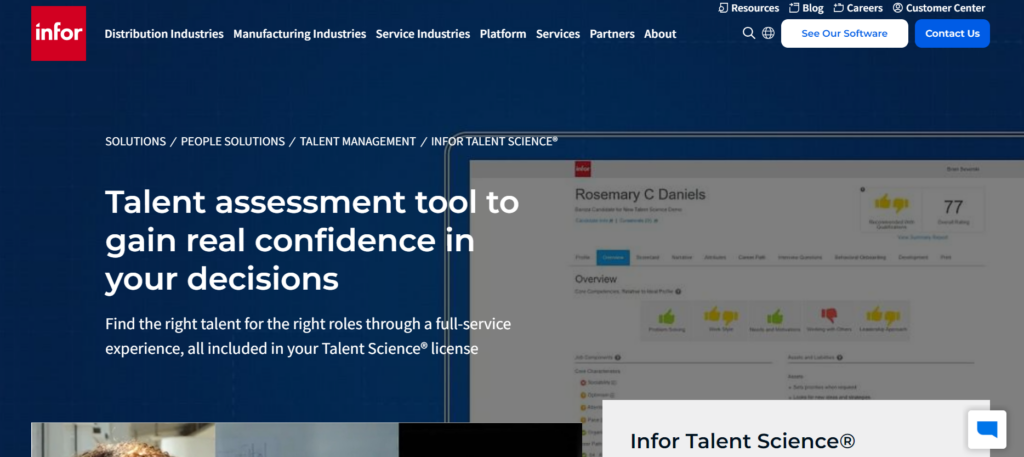
Behavioral DNA works in three steps. Your current employees in a role take a behavioral and cognitive survey. Infor pairs those results with your performance data to build a profile of what separates strong performers from weak ones. New candidates take the same survey, and the system reports how closely each one matches.
The logic is sound, and it is why the platform suits call centers, retail, and other roles where you hire many people into the same job. But the method has a hard dependency most buyers underestimate: it only works if you already have enough people in that role, and performance data clean enough to separate them. Hire five salespeople a year and there is nothing to benchmark against.
There is a second catch. A profile built on today's top performers encodes today's team. If that team is homogeneous, the benchmark can quietly reward sameness. Infor builds controls for this, and reviewers still raise it, so treat adverse-impact monitoring as a standing task rather than a solved problem.
Which one fits your hiring volume?
Volume is the cleanest way to split these two. Talent Science needs a population to learn from. Testlify needs a job description.
- High volume, one role, stable job: 200 customer service agents a year, consistent duties, existing performance data. Talent Science has the stronger case.
- Mixed roles, moderate volume: 40 hires a year across engineering, sales, support, and finance. Benchmarking each role separately is impractical. Skills testing wins.
- Technical hiring: behavioral fit tells you little about whether someone can write working code. You need a coding assessment.
- First 50 hires: no performance history exists yet, so there is nothing to build a profile from.
This is where the Testlify Multi-Signal Talent Evaluation Model matters. The model combines multiple role-relevant signals, including assessments, interviews, simulations, references, and reviewer feedback, to help teams make more confident hiring decisions. One signal is fragile. A candidate should move forward when several independent signals point the same way, not because one profile match looked good.
How do the pricing models compare?
Talent Science does not publish pricing. It is quote-based, sold annually, and third-party directories place entry pricing in the enterprise bracket with implementation charged separately. Expect a procurement cycle, not a credit card.
Testlify publishes its numbers:
Item | Testlify | Talent Science |
|---|---|---|
Standard plan | $139 a month, billed at $1,668 a year | Quote only |
What that includes | 100 candidate credits a year, about $16.68 per candidate | Not published |
Extra credits | $21 per credit | Not published |
Extra user seats | $15 a month each | Not published |
Enterprise | Custom, for 25,000+ candidates a year | Custom |
Trial | 7 days, no card required | Not published |
Guarantee | 30-day money-back | Not published |
Put that against what hiring already costs you. SHRM's benchmarking puts average cost per hire at $4,129, and Gallup estimates that replacing an employee costs one-half to two times their annual salary, with voluntary turnover costing US employers more than $1 trillion a year. Against those numbers, both platforms are cheap. The real cost is picking the one that does not match how you hire.
How long does each take to set up?
Testlify: pick a role, pick tests, send invites. A team can have scored candidates the same day. The 7-day trial exists precisely so you can test that claim before paying.
Talent Science: build the benchmark first. Current employees complete surveys, Infor validates the profile against performance data, then the profile goes live. That is weeks of work, and it needs IT involvement for provisioning and integration. Reviewers consistently name implementation effort as the platform's biggest friction point.
Neither timeline is wrong. A benchmark that takes six weeks and then predicts retention for 300 hires a year is a fine trade. The same six weeks to hire four people is not.
Recommended: Testlify vs The Talent Games: Which Is Best for HR Teams?
Where does each platform fall short?
Talent Science: no skills or coding tests, so it cannot tell you whether a candidate can do the job, only whether they resemble people who do it well. Setup is heavy. Pricing is opaque. Assessment length draws candidate drop-off complaints. And it works best inside the Infor ecosystem, which narrows its appeal if your stack sits elsewhere.
Testlify: it does not do what Talent Science does best. There is no benchmarking engine that learns from your existing workforce, and no team-dynamics or leadership-succession analytics. Testlify scores candidates against role requirements, not against your top performers. For a company hiring at scale into one role with rich performance data, that is a real gap.
Pro Tip: ask both vendors for a scored sample of five candidates you have already hired, two who worked out and three who did not. If a platform cannot separate them retrospectively, it will not separate them prospectively either. This takes an afternoon and tells you more than any feature grid.
How do the two handle cheating?
This is the sharpest split between them, and it is getting sharper as candidates reach for AI help mid-assessment. A skills test is only worth the trust you put in it, so the controls around the test matter as much as the test.
Testlify runs proctoring on the assessment itself: session recording, snapshot capture during the test, mouse and tab tracking, copy-paste disabling, microphone and camera access, IP and location checks, and randomized question order so two candidates do not see the same sequence. Reviewers get the session evidence alongside the score, so a flagged result is a prompt to look, not an automatic rejection.
Talent Science has no equivalent, and that is by design rather than an oversight. A behavioral survey asks how you tend to work, not whether you can solve a problem, so there is far less to gain from cheating and far less to police. The exposure shows up elsewhere: candidates can answer how they think the employer wants them to answer. Benchmark-based scoring absorbs some of that, but a motivated applicant can still shade their responses.
The practical difference: if you are hiring engineers, analysts, or anyone whose output you can measure, an unproctored test tells you little. If you are profiling temperament for a high-volume role, proctoring was never the point.
What about compliance and fair-hiring risk?
Any tool that scores candidates creates legal exposure, and enterprise buyers get asked about it long before they get asked about features.
Testlify lists SOC 2 and ISO 27001 for security, GDPR, CCPA and the Data Privacy Framework for data handling, and builds its assessments to be EEOC-defensible, meaning the scoring is documented and consistent enough to explain if a rejected candidate challenges it. Structured, job-relevant scoring is easier to defend than an interviewer's recollection, which is much of the argument for testing in the first place.
Talent Science carries Infor's enterprise compliance posture and employs industrial-organizational psychologists to validate its instruments, which is genuine rigor. The open question is the one raised earlier: a profile trained on your current high performers inherits whatever that group looks like. Run adverse-impact analysis on the scores before you let a benchmark gate a pipeline, and re-run it whenever the profile is rebuilt. That advice applies to whichever platform you pick, but it bites harder on benchmark-derived scores.
How to choose between them
- Count your hires per role over the last 12 months. Under 20 in any single role, benchmarking has too little to learn from.
- Check whether your performance data is usable. Ratings that cluster at "meets expectations" cannot separate strong from weak.
- Decide what your interviews keep getting wrong. Wrong skills, or wrong temperament? Fix the one that is actually breaking.
- Test the candidate experience yourself. Take the assessment end to end and time it. Long assessments cost you applicants.
- Run one live role through both. Ten real candidates beat any demo.
Skills are the moving target here. The World Economic Forum's Future of Jobs Report 2025 found employers expect 39% of workers' core skills to change by 2030, and projects 78 million net new jobs over the same period. A behavioral profile built on 2026's top performers ages as the role changes. Skills testing re-anchors to whatever the job needs now, which is why most teams end up wanting both signals rather than one.
Ready to see Testlify in action?
Start a 7-day trial with no card, or book a demo and walk through a role-specific assessment with someone who has set up a few hundred of them. If you are still shortlisting vendors, the Talent Science alternatives guide covers the wider market, and the Big Five personality assessment shows what a validated psychometric test looks like inside Testlify.
Key Takeaways
- These platforms answer different questions. Talent Science predicts behavioral fit against your top performers. Testlify measures demonstrated ability. Buying the wrong one is not a feature problem, it is a diagnosis problem, so name your actual bottleneck before you shortlist.
- Volume decides more than features. Benchmarking needs a population to learn from. Under roughly 20 hires a year in a single role there is not enough signal, which means most mid-market teams get more out of skills testing.
- Setup time is a real cost. Talent Science needs weeks of benchmarking and IT involvement before it scores anyone. Testlify scores candidates the same day. Factor that gap into any ROI case, because six weeks of unfilled roles is expensive.
- Pricing transparency cuts both ways. Testlify publishes $139 a month and a 30-day guarantee. Talent Science quotes privately, which usually signals enterprise-sized commitment and a procurement cycle you should budget time for.
- Skills move, profiles do not. With 39% of core skills expected to change by 2030, a benchmark built on today's team ages. Re-validate whichever method you choose at least once a year.
- Test both on real candidates. Score people you already hired and see whether the platform separates the ones who worked out. That single check beats every comparison table, including this one.
FAQs
Related resources
View all
Competitor Comparisons
Testlify vs XBInsight: A detailed comparison
Competitor Comparisons
Testlify vs Weirdly: A detailed comparison
Competitor Comparisons
Testlify vs Toggl Hire: A detailed comparison
Competitor Comparisons
Testlify vs Searchlight: A detailed comparison
Competitor Comparisons
Testlify vs SalesDrive: A detailed comparison
Competitor Comparisons
Testlify vs Paradox: A detailed comparison
Get started.
Hire on proof, not resumes.
Run your first skills-based assessment free — no credit card required.