
Testlify vs Ensize: A detailed comparison
Discover the perfect solution for evaluating your candidates’ skills with Testlify. Dive into our comprehensive Testlify vs Ensize…
Testlify and Ensize both put an assessment in front of a person, and that is roughly where the overlap ends. Ensize measures behavioral style and motivation so people who already work together can communicate better. Testlify measures whether a candidate can actually do the job, before anyone signs an offer. So the choice between them is not really a feature fight. It is a question about which decision you are trying to make.
That distinction matters more every year. The World Economic Forum's Future of Jobs analysis found nearly 40% of skills required on the job set to change by 2030, with 63% of employers already naming the skills gap as their biggest barrier. When the skills you are hiring for keep moving, knowing a candidate's communication style tells you less and less about whether they can do the work.
 ChatGPT
 Gemini
 Claude
 Grok
Grok Perplexity
TL;DR: Testlify vs Ensize in 60 seconds
- Different jobs. Ensize is a development and coaching platform built around DISC behavioral profiles and driving-forces assessments. Testlify is a pre-hire assessment platform built around role-specific skills, cognitive ability, and proctored testing.
- The evidence favors job-specific measures for hiring. The most recent recalibration of selection research puts structured interviews at 0.42 and job knowledge tests at 0.40 for predicting job performance. Overall conscientiousness, a personality trait measure, lands at 0.21.
- Test library depth is the practical gap. Ensize covers behavioral, motivational, team and survey instruments. Testlify covers role-specific skills tests, coding in 45+ languages, cognitive ability, software tools, personality and situational judgment.
- Pricing transparency differs. Ensize prices by quote after a sales conversation. Testlify publishes plans and lets you start without one.
- They are not mutually exclusive. Plenty of teams screen with skills evidence, hire, then use a behavioral profile for onboarding and team development. That sequence is usually the right one.

What is Ensize and what is it built for?
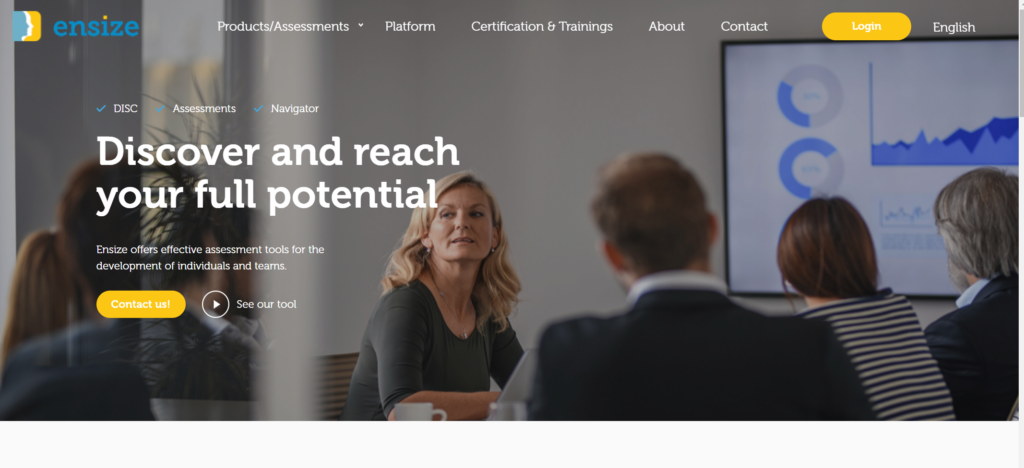
Ensize is a Swedish assessment company that has been running since 1992. It sells behavioral and motivational instruments to coaches, consultants, trainers and internal HR teams, and it certifies those practitioners to interpret the results. The catalogue centers on DISC-style behaviour profiles, Driving Forces motivation assessments, GAP assessments, team assessments and employee surveys. Everything runs through Navigator, its practitioner platform, which handles distribution, reporting and access to training material.
Read that list again and the design intent is obvious. These are instruments for people who are already inside the organization. A DISC profile is useful for a manager trying to work out why two direct reports keep talking past each other, or for a sales trainer coaching someone through a difficult account. It is a language for describing how someone tends to behave, not a measurement of what they can produce.
Ensize is upfront about serving communication, sales, leadership, team development and coaching. Recruitment appears in its list of application areas, and DISC profiles do get used in hiring by plenty of organizations. But the instrument was designed to explain ordinary human behaviour, and that origin shapes what it can and cannot tell you about a candidate you have never worked with.
Across the teams we work with, the pattern is consistent: behavioral profiles earn their keep after the hire, in onboarding, team design and manager coaching. Used as a screening filter, they tend to narrow a shortlist along lines that have very little to do with performance.
What is Testlify built for?
Testlify is a pre-hire talent assessment platform. The core job is evidence: give a hiring team defensible proof of what a candidate can do, before the first real interview, so the shortlist is ranked on something better than a resume and a gut read.
The library is built around the work itself. Role-specific assessments for named jobs, coding tests across 45+ programming languages, cognitive ability, software and tool proficiency (including spreadsheet and document work), language proficiency, typing, personality, and situational judgment questions that put a candidate inside a realistic work scenario. Teams can build custom assessments, write their own coding questions, add one-way video responses, and set qualifier questions that filter before anyone invests time.
Around that sits the machinery a hiring team needs at volume: proctoring and anti-cheating controls, candidate reports and benchmarking, bulk invites, ATS integrations, white-label branding, and role and access management.
Being precise about scope matters as much as the feature list. Testlify is not an applicant tracking system, not a sourcing tool, not an HRIS, and not a background-check vendor. It sits at the assessment and screening slice of the hiring stack and integrates with the rest. Any comparison that implies otherwise is selling you something.
Do behavioral style tests predict job performance?
Not on their own, and the research on this got sharper recently. For twenty-five years the field worked from a 1998 meta-analysis that ranked general cognitive ability as the standout predictor of job performance. In 2022 a team led by Paul Sackett re-examined those numbers and found decades of estimates had been systematically over-corrected for range restriction. The corrected table changes the ranking, and it is worth reading closely if you are choosing an assessment.
In the updated validity estimates, structured employment interviews come first at 0.42, followed by job knowledge tests at 0.40, empirically keyed biodata at 0.38, work sample tests at 0.33, and general cognitive ability tests at 0.31. Overall conscientiousness, the personality trait with the strongest track record in selection, sits at 0.21.
Two things follow from that table. First, the predictors that win are job-specific. They ask a candidate to demonstrate knowledge, judgment or work product tied to the actual role. Second, a decontextualized trait score, which is what a behavioral style profile produces, carries real but modest predictive weight when it stands alone. It is not noise. It is just a much weaker signal than a work sample, and it is a poor foundation for a shortlist decision.
There is a legal dimension too, and US employers ignore it at their cost. The EEOC's position on employment tests is that any instrument used to make a selection decision must be job-related and consistent with business necessity, and that an employer carries the burden of showing it. The federal Uniform Guidelines on Employee Selection Procedures (29 CFR Part 1607) set out what validation evidence has to look like. A behavioral profile that was built to describe communication style, and was never validated against performance in the role you are hiring for, is a hard thing to defend if a rejected candidate asks how the decision was made.
None of this makes DISC bad. It makes it the wrong instrument for one specific job. A tool that helps a team of eight understand why their stand-ups keep running long is doing something genuinely useful. Asking it to rank forty applicants for a data analyst role is asking it to do work it was never built for.
The honest caveat runs the other way as well. Skills tests have their own failure mode: they measure what a person can do today, not what they will learn, and a team that screens on skills alone can end up with a shortlist of competent people who cannot work with each other. That is exactly why the two categories are complementary rather than competing.
Testlify vs Ensize: feature comparison
The table below compares the two platforms across test library, assessment building, candidate experience, anti-cheating, reporting, enterprise controls and support. It is the fastest way to see where the category difference shows up in practice.
Features | Testlify | Ensize |
|---|---|---|
Test Library | ||
Role-specific tests | ✓ | ✗ |
Cognitive ability tests | ✓ | ✗ |
Programming Tests | ✓ | ✗ |
No. of programming languages supported | 45+ | ✗ |
Situational judgment tests | ✓ | ✓ |
Typing test | ✓ | ✗ |
Software skills tests | ✓ | ✗ |
Non-technical tests | ✓ | ✗ |
Psychometric tests | ✓ | ✗ |
Personality tests | ✓ | ✓ |
Motivation test | ✓ | ✓ |
Assessment templates | ✓ | ✗ |
Custom assessments creation | ✓ | ✗ |
Test recommendations for different job roles | ✓ | ✗ |
Coding tests | ✓ | ✗ |
Assessments | ||
Custom assessment builder | ✓ | ✓ |
Custom coding questions | ✓ | ✗ |
Multiple-choice questions | ✓ | ✓ |
Descriptive questions | ✓ | ✗ |
Video interview questions | ✓ | ✗ |
Assessments curated by I/O psychologists | ✓ | ✓ |
Google doc | ✓ | ✗ |
Google sheets | ✓ | ✗ |
Google slides | ✓ | ✗ |
Audio questions | ✓ | ✗ |
Qualifier questions | ✓ | ✓ |
File upload questions | ✓ | ✗ |
Quality check | Extensive process incl. peer reviews, sample testing, review by psychometrician & more | Not stated |
Video interview questions | ||
One-way video interview | ✓ | ✗ |
Custom video questions creation | ✓ | ✗ |
Candidate's recording attempts per question | ✓ | ✗ |
Live video interview | ✗ | ✗ |
Candidate experience | ||
Fully customizable email templates | ✓ | ✗ |
Custom invitation and rejection email | ✓ | ✓ |
Mobile-friendly | ✓ | ✓ |
Candidate support | ✓ | ✗ |
Instructions before assessment | ✓ | ✓ |
Average assessment length | 40-60 minutes | ✗ |
Anti-cheating features | ||
Session recording | ✓ | ✗ |
Snapshot capturing | ✓ | ✗ |
Mouse tracking | ✓ | ✗ |
Copy-paste disabled | ✓ | ✗ |
Microphone and camera access | ✓ | ✗ |
Location access | ✓ | ✗ |
IP address tracking | ✓ | ✗ |
Randomization of question sequence | ✓ | ✗ |
Time limit on tests | Yes, typically 10 minutes | Not stated |
Reporting and analytics | ||
Detailed reports | ✓ | ✓ |
Easy to share reports and scorecards | ✓ | ✗ |
Exportable/downloadable reports | ✓ | ✓ |
Recruiting analytics | ✓ | ✗ |
Candidate benchmarking | ✓ | ✗ |
Completion rate and response insights | ✓ | ✗ |
Enterprise friendly | ||
White label feature | ✓ | ✗ |
Custom branding | ✓ | ✗ |
ATS integration | ✓ | Not stated |
User, role, and access management | ✓ | ✓ |
Bulk candidate invite | ✓ | ✗ |
Share public link invite to candidates | ✓ | ✗ |
Candidate pipeline management | ✓ | ✗ |
Internationalization | ✓ | ✓ |
Campus hiring support | ✓ | ✗ |
Dedicated account manager | ✓ | Not stated |
GDPR compliant | ✓ | ✓ |
Multilingual abilities | ✓ | ✓ |
Customer support | ||
24/7 support | ✓ | ✗ |
On-call support | ✓ | ✓ |
Email support | ✓ | Not stated |
Product demo | ✓ | ✗ |
Training & onboarding tour | ✓ | ✗ |
Read the table as a map of intent rather than a scoreboard. The rows where both platforms tick (personality, motivation, situational judgment, custom invitation emails, GDPR compliance, multilingual support) are the overlap zone: describing a person. The rows where only one ticks (coding tests, cognitive ability, software skills, session recording, candidate benchmarking, campus hiring) are the parts of a hiring workflow Ensize never set out to build. A checkmark count is not the story. The clustering is.
How does Ensize pricing compare?
Ensize does not publish pricing. You contact the company, describe your needs, and receive a quote. Assessments are then purchased through the Navigator platform. That model is normal for a business built around certified practitioners, where the product is partly the instrument and partly the training and interpretation that comes with it.
It does carry a cost that rarely shows up on a comparison table: evaluation time. A quote-based model means you cannot size the spend, run a pilot, or compare two vendors on a spreadsheet without booking calls first. For a talent team trying to make a decision inside one quarter, that is often three weeks gone before anyone has seen a single candidate report.
Testlify publishes its plans and bills monthly or annually, and you can build and send an assessment without a sales conversation. If you are running a genuine bake-off, that difference decides how much of the evaluation you get to do with real candidates instead of slide decks.
One caveat worth stating plainly, because it cuts against us. Quote-based pricing is not automatically worse. If your requirement is fifteen certified practitioners running facilitated team sessions across four countries, a scoped quote with training attached is a more honest structure than a per-seat price. Match the pricing model to what you are actually buying.
Which tool should you choose?
Skip the feature matrix for a moment and answer one question: what decision does the output need to support?
Choose Ensize if the people you are assessing already work for you. Team development, manager coaching, communication training, sales enablement, leadership programs, employee surveys. You want a shared vocabulary for behaviour and a certified practitioner network to help teams use it. That is the job Ensize was designed for, and it does it with more than thirty years of practice behind it.
Choose Testlify if you are deciding who to hire. You need to rank candidates on role-relevant evidence, screen at volume without drowning your recruiters, verify technical ability, keep remote assessment honest, and produce a record of how each decision was made. Skills-first screening is also the more defensible position when someone asks why one candidate advanced and another did not.
Run both if you have the budget and a real use case at each end. Assess skills to decide who joins. Profile behaviour to help them work well once they have. The sequence matters: skills evidence first, because that is the decision with legal exposure and the one that is expensive to get wrong; behavioral insight second, where it informs coaching rather than gatekeeping.
A rough sizing rule from what we see: if more than half your assessment spend is going toward people who do not yet work for you, a development-first platform is the wrong center of gravity for your stack.
What does switching from Ensize involve?
Less than teams expect, because the two tools rarely occupy the same slot in a process. Most organizations are not migrating an assessment; they are adding a screening stage that did not exist and moving behavioral profiling to a later point in the journey.
Three practical things to plan for. Historical data does not transfer. A DISC profile and a skills score are not the same unit and there is no sensible conversion between them, so treat the existing profiles as an archive for the people who already work for you rather than something to import. Certification does not carry over either. If your HR team holds practitioner certifications, that training keeps its value for coaching work; it just does not apply to reading a skills report, which is designed to be interpreted by a hiring manager without any certification at all. Your ATS integration is the piece worth scoping first. Assessment results only save recruiter time if they land in the system where shortlisting happens, so confirm the integration path before the pilot rather than after it.
The sequencing question people get wrong is when to switch. Mid-requisition is the wrong moment: candidates already in the pipeline were evaluated one way, and changing criteria partway through is both unfair and hard to defend. Start with one new open role, run the full loop end to end, and compare the shortlist quality against how the last two hires for that role went. One clean comparison is worth more than a broad rollout that nobody can read.
How do you run both without duplicating work?
This is where the Testlify Multi-Signal Talent Evaluation Model is useful. The idea is simple: one signal is fragile, several independent signals create confidence. Rather than betting a hire on a single test score or one strong interview, you combine role-relevant signals (skills assessments, coding evidence, cognitive measures, structured interview feedback, reference checks, reviewer scoring) and advance a candidate when they point the same direction. Behavioral data has a place in that model. It just is not the gate.
Here is how the sequence usually plays out. Take an illustrative case: a 600-person software company hiring twelve customer success managers in a quarter, currently screening 40 resumes per hire.
- Define the competencies first. Not "good communicator" but the specific things the role needs: writing a clear escalation summary, reading an account health signal, handling a renewal conversation under pressure.
- Map each competency to evidence. A written scenario for the escalation summary. A situational judgment set for the renewal conversation. A cognitive measure for the pattern-reading. This is the part most teams skip, and it is why so many assessments feel arbitrary to candidates.
- Screen on that evidence, before the first call. Forty applicants become a ranked shortlist of eight, and the recruiter's first conversation starts from data rather than a resume skim.
- Interview structured, against the same competencies. Structured interviews are the strongest single predictor in the corrected validity table, so this is not a formality.
- Decide with humans, on the record. Multiple reviewers, consistent criteria, a written rationale.
- Profile behaviour after the offer. Now a DISC-style profile earns its money: onboarding plans, manager pairing, team composition. Nobody is being screened out on communication style.
Run that way, the expensive human hours land on eight candidates instead of forty, and every one of those conversations starts from evidence rather than a resume skim. The saving is not magic. It is just interview time spent on the right people.
Pro Tip: if you already run behavioral profiling in hiring, do not rip it out. Move it. Keep collecting the same profile, but shift it to a post-offer step and stop letting it influence advance decisions. You keep the onboarding value, you drop the hardest part to defend, and you can measure whether shortlist quality changes over the next two quarters.
Two things break this sequence in practice, so plan for them. Assessment length is the first: past roughly 40 to 60 minutes, completion rates fall and you start losing strong candidates who have other offers. The second is integrity. If assessments run remotely and unsupervised, results drift, and by the time you notice you have been ranking candidates on noise. Proctoring controls exist for that reason, and they should be tuned to the role rather than switched to maximum by default.
What should you test during a vendor trial?
Most assessment trials measure the wrong things. Teams check the test library size and the report design, then discover the real problems in month three. Four checks that actually predict how the tool will behave in production:
- Completion rate on a real requisition. Send the assessment to actual applicants, not to your own team. Watch how many start it and how many finish. If completion sits below roughly 70%, the assessment is too long or too poorly explained, and you are quietly filtering for patience rather than skill.
- Whether a hiring manager can read the report unaided. Hand a candidate report to a manager with no briefing and ask what they would do next. If they need an analyst to translate it, the tool will not survive contact with a busy team.
- Score spread across your applicant pool. A test where everyone lands between 70 and 80 tells you nothing. You want a distribution wide enough to rank people, which usually means the difficulty is calibrated to the role rather than set generically.
- Time from invite to ranked shortlist. Measure the whole loop, including the bits that are your fault: how long approvals take, how long the invite sits unopened. That number is the one your hiring managers will judge you on.
Run those four checks against any assessment vendor, including this one. A tool that comes through all four is worth buying; a tool that fails two of them will get quietly abandoned within a year no matter how good the demo looked.
Hire on evidence, not on style
If you are evaluating Ensize because you need to make better hiring decisions, the honest answer is that you are looking at the right idea and the wrong shelf. Behavioral profiles will tell you how someone tends to work with others. They will not tell you whether they can do the job.
Testlify covers the second question: role-relevant skills tests, coding assessments across 45+ languages, cognitive and situational measures, proctoring you can tune, and candidate reports your hiring managers will actually read. Start free with an assessment for one open role, or book a demo and we will map your competencies to evidence with you. If you want to see how skills screening compares to resume review before you commit, the breakdown of resumes against online assessments is a good place to start, and the notes on structured versus unstructured interviews pair with it.
Key takeaways
- These platforms answer different questions. Ensize measures behavioral style and motivation for people already inside the organization; Testlify measures role capability in people you have not hired yet. Choosing between them on feature count misses the point, because the feature gaps follow directly from what each was designed to decide.
- Job-specific evidence beats trait scores for selection. The corrected validity estimates put structured interviews at 0.42 and job knowledge tests at 0.40, against 0.21 for overall conscientiousness. If your screening rests mainly on a personality profile, you are ranking candidates on your weakest available signal, and swapping in a role-relevant assessment is the highest-return change you can make.
- Validation is a legal requirement, not a nice-to-have. US selection procedures have to be job-related and defensible under the Uniform Guidelines. An instrument built for coaching, never validated against performance in your role, is difficult to justify after the fact, which makes it a compliance exposure as well as a quality one.
- Test library breadth is the practical difference day to day. Coding, cognitive ability, software proficiency and role-specific content are absent from a development-focused catalogue, so teams hiring technical or specialist roles end up buying a second tool anyway. Counting that second purchase into the comparison usually changes the answer.
- Pricing transparency shapes how fast you can decide. Quote-only pricing costs evaluation weeks you may not have; published pricing lets you pilot with real candidates. Neither model is inherently better, but the mismatch matters if you are trying to close a vendor decision inside one quarter.
- Sequence beats substitution. The strongest setup is skills evidence before the offer and behavioral profiling after it, so shortlists stay defensible while onboarding still gets the insight. Teams that make that single change usually keep everything they liked about behavioral data and lose the part that was hardest to justify.
FAQs
Related resources
View all
Competitor Comparisons
Testlify vs CallidusCloud: A detailed comparison
Competitor Comparisons
Testlify vs Brillium: A detailed comparison
Competitor Comparisons
Testlify vs Priority Bridge: A detailed comparison
Competitor Comparisons
Testlify vs Talent Science: A detailed comparison
Competitor Comparisons
Testlify vs XBInsight: A detailed comparison
Competitor Comparisons
Testlify vs Weirdly: A detailed comparison
Get started.
Hire on proof, not resumes.
Run your first skills-based assessment free — no credit card required.