
HR workplace failures: What’s breaking your culture?
Discover the causes, impacts, and solutions for HR workplace failures. Learn how to rebuild trust and create a thriving organizational culture.

Human resource management failures are breakdowns in the way a company hires, pays, listens to and promotes its people, and they show up as distrust long before they show up in a report. The pattern is almost never one bad HR hire. It is a company that hands HR a decision after the decision has already been made, then asks HR to own the fallout.
That gap between who decides and who absorbs the consequences is what breaks a culture. A policy nobody was consulted on. A manager promoted for billing hours who has never run a one-to-one. A hiring call made on gut feel in week one and defended for two years. None of those start in the HR inbox. All of them end there.
TL;DR
- Most HR failures are decision-rights failures. HR gets handed the outcome of a choice it never got to shape, so fixing the org chart matters more than fixing the HR process.
- Eight failures do most of the damage: no written policy, one-way communication, tech bought before the problem is named, feedback collected but never acted on, untrained managers, leadership misalignment, no training transfer, and purely reactive HR.
- The cost is measurable. Engagement sits at 20% worldwide, incivility alone drains billions a day, and 42% of people who quit say someone could have stopped them.
- HR software is usually the symptom, not the cure. Only about a quarter of HR functions say they get full value from the tools they already own.
- The fix is cheap and unglamorous: write the policy down, give managers a script, and put structured evidence where gut feel used to sit.
- Run the 10-signal audit in this article before you buy anything.
 ChatGPT
 Gemini
 Claude
 Grok
Grok Perplexity
What are human resource management failures?
A human resource management failure is any break in the systems that govern hiring, pay, performance, grievance handling or development that leaves employees worse off and the business exposed. It is a systems problem, not a personality problem. The test is simple: if the same bad outcome keeps happening with different people in the chair, the system failed, not the person.
That distinction matters because it changes what you fix. A manager who mishandles a complaint once has made a mistake. A company where three managers in a row mishandle complaints has no complaint process, and no amount of coaching the individuals will touch it. The second case is a failure of what the HR function owns, and it compounds quietly.
Scale changes the shape too. Under about 50 people, most of this runs on relationships and nobody notices the missing process. Between 50 and 200, the relationships stop scaling and everything that was never written down starts breaking at once. That is the window where these failures get expensive, and it is also the window where almost nobody has a dedicated HR team to catch them.

The 8 failures that quietly break a culture
These eight account for most of what gets called a culture problem. Each one is paired with the number that makes it real, because a failure you cannot measure is a failure you will argue about instead of fixing.
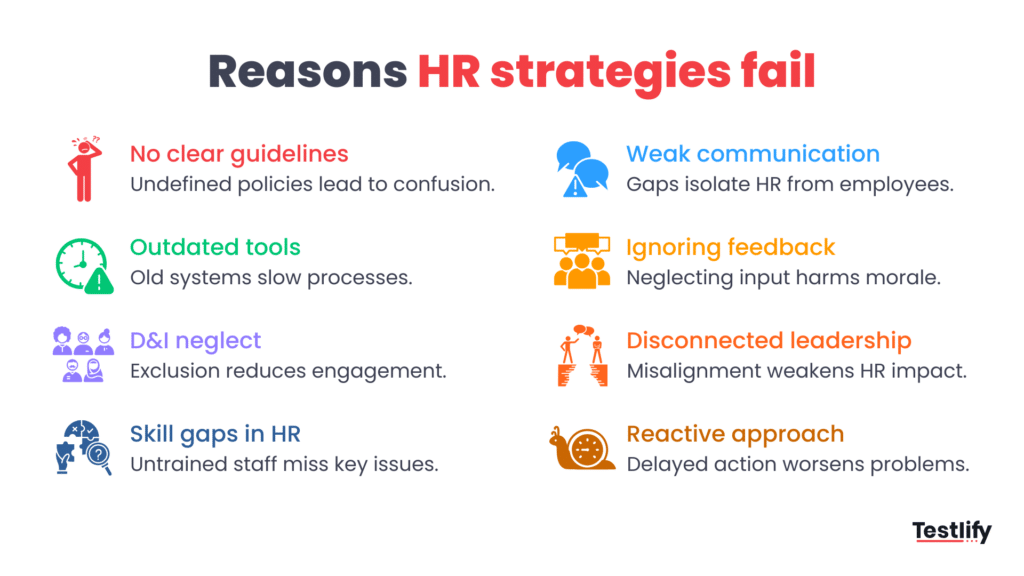
1. No written policy, so every decision is a precedent
When leave, expenses, promotion or remote work live in somebody's head, each decision silently becomes the rule for next time. Two people get different answers to the same question, both tell their teams, and now you have a fairness problem you did not choose. Write it down even if it runs to three paragraphs. Three written paragraphs beat a verbal promise every time.
2. Communication runs one way
Announcing a change is not communicating it. The return-to-office wave is the clearest case: among workers who can do their job remotely, 46% would be unlikely to stay if the option were taken away, and that figure was knowable before any mandate was written. Companies that asked first kept their people. Companies that announced first lost some and were surprised.
3. Technology arrives before the problem is named
New systems get bought to fix a feeling rather than a defined failure. Adoption stalls, the rollout runs long, and the tool ends up as the thing people point at when they say HR wastes money. The software was never the problem, and replacing it with different software will not help.
4. Feedback is collected and then ignored
An engagement survey with no visible action is worse than no survey, because it teaches people that speaking up changes nothing. The pattern repeats in exit data: 42% of voluntary leavers say their manager or company could have done something to keep them, and 45% say nobody discussed their satisfaction or future with them in the three months before they left. The information was available. Nobody asked for it.
5. Managers are promoted, then left alone
Most first-time managers get a title, a team and no instruction on how to run a difficult conversation. The damage is measurable in ordinary rudeness: US businesses collectively lose $2.7 billion a day to workplace incivility through lower productivity and absence, against more than 222 million acts of incivility a day. Small discourtesies, at that volume, are a budget line.
6. Leadership and HR want different things
If the leadership team is chasing headcount this quarter and HR is measured on retention this year, those two goals will fight, and the fight will be settled in favor of whoever sits closer to the money. The failure is not that HR lost. It is that nobody noticed the two scorecards contradicted each other.
7. Training happens but nothing changes
People attend, enjoy it, return to a job that still rewards the old behavior, and revert within weeks. The course was fine. What was missing was a manager asking about it afterwards and a workflow that made the new habit easier than the old one. So buy less training and spend the difference on the four weeks after it.
8. HR is purely reactive
A function that only moves when something breaks will always look like overhead. Complaints are the clearest signal here. The EEOC processed 88,201 discrimination charges in fiscal year 2025 and recovered $660 million for 17,680 people, and inquiries to the agency rose almost 9% to nearly 270,000. Most of those conversations started as something a manager could have handled in week one.
Pro tip: pick the two failures above that you can name a real example of from the last 90 days. Fix those. The other six are probably downstream of them, and a company that tries to fix all eight at once fixes none.
Why does HR software become a conflict?
HR software becomes a source of conflict when it is bought to signal progress rather than to remove a named bottleneck. The tool then needs data nobody owns, workflows nobody agreed to and training nobody scheduled, so the people it was meant to help end up maintaining it. The conflict is real, and it is not about the software.
The numbers back the suspicion up. Only 24% of HR functions say they get the maximum business value out of the HR technology they already own. The other three quarters are leaving part of what they bought on the table.
There's a sequence that avoids this, and it is boring on purpose:
- Name the bottleneck in one sentence, with a number attached. "Shortlisting 40 applicants takes nine days" is a bottleneck. "We need to modernize hiring" is not.
- Try to fix it with the tools you have. Half the time a shared spreadsheet and an agreed deadline do it.
- If it is still broken, buy narrowly for that one job, and name the person who owns the data in it.
- Set a date to check whether the number moved. Put it in a calendar, not in a plan.
Step two is the one everybody skips, and it is where most of the savings live. If a tool needs a project to roll it out, it needs a named owner after rollout too, and most companies fund the first and forget the second. Then set the date.
How do HR failures damage culture?
Each failure has a specific route into the culture, and naming the route is what makes it fixable. Vague damage cannot be assigned to anyone.
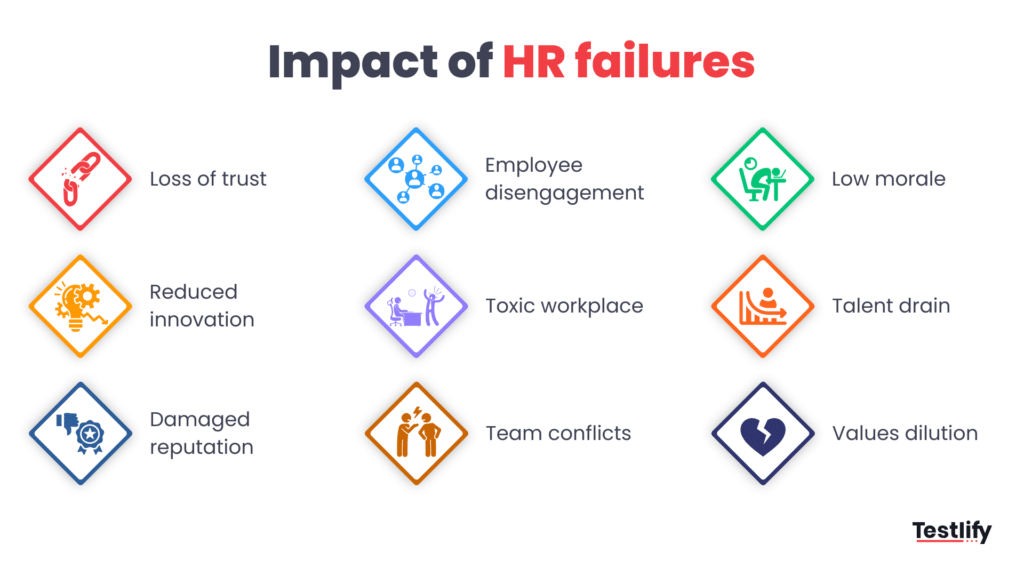
Failure | What it does to culture | What the evidence shows |
|---|---|---|
No written policy | Fairness becomes a matter of who you ask | Half of US workers are satisfied with their job overall, and only 30% with their pay |
One-way communication | People stop raising problems early | 46% of remote-capable workers would likely leave if the option ended |
Tech before problem | HR is seen as a cost, not a partner | Only 24% of HR functions get full value from their HR technology |
Ignored feedback | Surveys become theater | 42% of leavers say they could have been kept |
Untrained managers | Daily friction, quiet attrition | $2.7 billion lost per day to incivility in the US |
Leadership misalignment | Teams get contradictory priorities | Global engagement fell to 20% in 2025, manager engagement to 22% |
Training with no transfer | Development is seen as a perk | Transfer depends on the manager and workflow after the course |
Reactive HR | Small issues become formal complaints | 88,201 EEOC charges and $660 million recovered in FY2025 |
The aggregate figure is the one that should worry a leadership team. Worldwide, engagement fell to 20% in 2025, its lowest since 2020, manager engagement dropped to 22%, and low engagement was put at roughly $10 trillion in lost productivity, about 9% of global GDP. Read that as a correlation across business units rather than a promise that lifting a survey score lifts your profit. The direction is solid. The mechanism in your company is yours to find.
Health data points the same way. In the UK, absence reached 9.4 absence days per employee per year in 2025, the highest in more than 15 years. The detail worth sitting with: 64% of organizations are taking steps to reduce workplace stress, and only 50% think their efforts work. Activity is not the same as impact, and HR is frequently measured on the first.
What are the signs your HR is failing?
Ten signals, each with something you can actually check this week. If four or more land, the problem is structural and no amount of goodwill will clear it.
Signal | What to check | Worth acting on when |
|---|---|---|
Short-tenure exits | Share of leavers inside 12 months | Above 25% |
Policy answered verbally | Ask two managers the same leave question | Answers differ |
Survey with no follow-up | Date of the last action taken from feedback | Older than 6 months |
Grievances arriving formal | How many skipped the informal step | More than half |
Manager one-to-ones skipped | Calendar check across 4 weeks | Under 70% held |
Hiring on gut feel | Share of hires with a written scorecard | Below 50% |
Unused software seats | Login counts in the last 30 days | Under 60% active |
Training without follow-through | Any behavior change named 30 days after | None named |
Rising sick days | Absence per head, year on year | Up 2 days or more |
HR absent from planning | Was HR in the last headcount decision | No |
Two caveats, because this audit fails in two predictable ways. It is useless if the leadership team will not act on the result, and running it anyway just adds a document to the pile. And it reads harshly in a company under 30 people, where several of these signals are normal and the honest answer is "not yet, and that's fine". Use it where the relationships have stopped scaling.
How do you fix a failing HR function?
Start with decision rights, not process. Write down which people decisions HR gets to shape before they are announced, and which it only administers after. That single document resolves more friction than any new system, and it costs an afternoon.
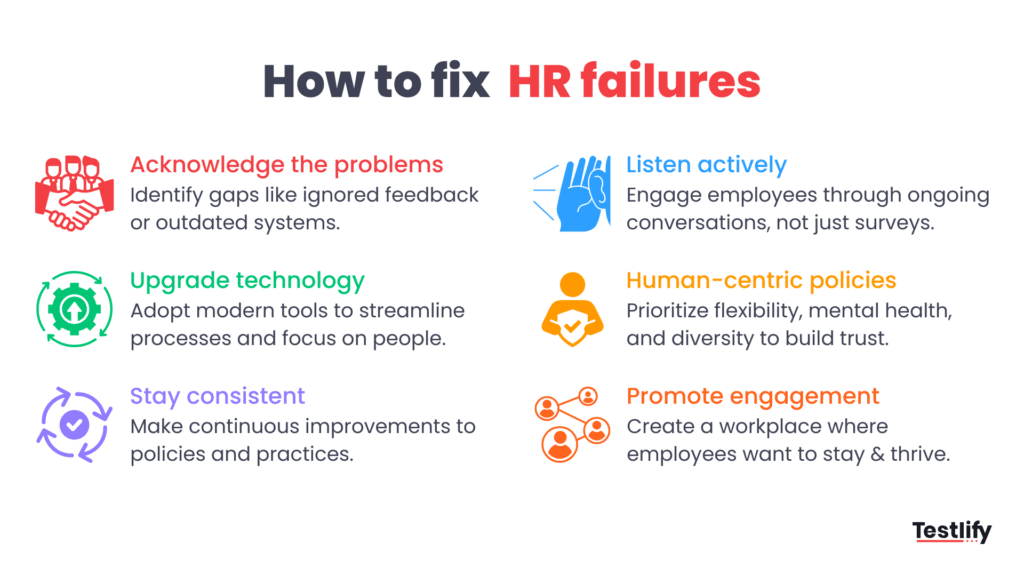
- Put the three riskiest policies in writing. Leave, grievance, promotion. Short and plain beats thorough and unread.
- Give managers a script, not a workshop. One page on how to run a one-to-one, and one on how to receive a complaint. A workshop ends; a page stays on the desk. Pair it with somebody senior who asks a month later how it went.
- Close one feedback loop in public. Pick a single thing people asked for, do it, and say that it came from the survey. Credibility is rebuilt by one visible action, not by a better questionnaire.
- Replace gut feel in hiring with written evidence. This is the one place where the evidence is clear enough to act on without argument: structured interviews predict performance better than unstructured ones, and the ranking survives every reanalysis of the data even where the exact coefficients are argued over. Agree the criteria before you meet anyone, and score against them.
- Measure the thing you are fixing. Not engagement in general. The one number from the audit table, re-checked on a date you have already put in the calendar.
On performance reviews, a word of caution. After a century of appraisal research, reviewers of the field still cannot show that appraisal systems reliably improve performance, and the open questions there are still basic ones. So do not rebuild your review cycle first. Fix the one-to-ones underneath it, which is where the feedback that changes behavior actually happens.
The Testlify Human+AI Evidence-Based Hiring Framework is the approach behind step four. It combines AI-assisted evaluation with human judgment, using structured evidence instead of resumes, intuition or inconsistent interviews. The point is not that software decides. It is that the criteria are written before the conversation, several reviewers score the same evidence, and the final call still belongs to the hiring team. A skills assessment can show at the shortlist stage what a CV cannot, which takes one of the eight failures off the table. Testlify integrates with the applicant tracking system you already run and leaves it as the system of record, and it ships a basic tracking pipeline for teams that have none. If you want the wider picture first, start with common HR mistakes and the HR issues behind them.
Here is how that plays out. Picture a 70-person accounting firm, hypothetically, that loses two of its four new hires inside a year and blames the market. The audit says something narrower: no written scorecards, managers running one-to-ones in under half their scheduled slots, and a survey from last spring with no action attached. None of that needs a budget. It needs a one-page scorecard, a calendar rule, and one visible response to the survey. The market was not the problem.
What happens if you ignore this?
You pay for it in turnover, and turnover is priced into the labor market whether or not you track it. US employers were seeing around 3.1 million quits a month, a quits rate of 1.9%, in August 2026. Meanwhile the median tenure of 4.1 years in January 2026 drops to 3.0 years for workers aged 25 to 34, so the people you are most likely to be hiring are the ones least likely to stay by default.
And the baseline is not loyalty. Just half of workers are satisfied with their job overall, with 30% satisfied with their pay, down from 34% a year earlier. A company that gets the basics right is not competing against excellence. It is competing against a field where half the people are indifferent, which is a lower bar than most leadership teams assume and a better opportunity than it sounds. Early conflict handling is a large part of it, and resolving conflict early costs less than any policy rewrite. So does building a supportive environment that people describe accurately to their friends.
Hire on evidence, not hope
If hiring on gut feel is one of your eight, that one is fixable this quarter. See how structured assessments and scored evidence fit the process you already run, and keep your tracking system where it is: book a demo with the team.
FAQs

B2B SaaS Content Writer
Rishav Kumar is a B2B SaaS content writer with 4 years of experience. He loves crafting engaging content. Always exploring fresh ideas, he's passionate about helping businesses grow through impactful writing.
LinkedInRelated resources
View all
HR & recruitment
Leveraging paraphrasing tools to enhance recruitment strategies

HR & recruitment
7 steps to master candidate profiling for top talent
![How to perform a talent review in 2026 [in 5 simple steps]](/wp-content/uploads/2025/01/How-to-perform-a-talent-review.png?dpl=dpl_6Z8Gzi5dgny5ePrnCfPbRPCRYCA7)
HR & recruitment
How to perform a talent review in 2026 [in 5 simple steps]

HR & recruitment
Boolean search in recruitment: How to use it with examples?

HR & recruitment
Compensatory off: What is it, types of leaves

HR & recruitment
An HR’s guide to human capital analytics
Get started.
Hire on proof, not resumes.
Run your first skills-based assessment free — no credit card required.