
Compensatory off: What is it, types of leaves
Learn everything about compensatory off: its meaning, benefits, legal aspects, policies, and tips to implement it effectively in your workplace.

Comp off is short for compensatory off: a paid day, or half day, that an employee earns by working on a weekly off, a public holiday, or well past normal hours, and takes later instead of extra pay. The name carries the whole idea. Someone gave up a rest day, so the company owes one back.
That part is simple. The part that causes arguments is everything after it: who qualifies, how long the day stays in the bank before it expires, and whether a company is even allowed to hand out time instead of overtime wages. The answer to that last one is not the same in every country, and getting it wrong is expensive.
TL;DR
- Comp off is time off earned for working on a rest day or a holiday, taken later instead of overtime pay.
- It is almost always a company policy, not a legal right, so the written rules decide what employees actually get.
- Comp off and overtime pay are not interchangeable. In the US, comp time in place of cash overtime is a state and local government mechanism, not a private-sector one.
- Most comp off dies on a clock. A 30 to 90 day expiry is the usual company rule, and unused days are the most common complaint.
- A policy needs five things: who earns it, at what rate, how to claim it, when it expires, and who approves it.
 ChatGPT
 Gemini
 Claude
 Grok
Grok Perplexity
Comp off meaning
Compensatory off is leave granted in exchange for extra work already done. An employee works a Sunday to close a release, and instead of paying that Sunday at an overtime rate, the company gives back an equivalent day off later. No extra money changes hands. The account is settled in time.
It matters most where work arrives in bursts: retail through a festival season, accounting through a close, a services team covering a client launch. Salaried staff in those teams often sit outside overtime rules anyway, so time is the only currency the company has left to repay them with.
What does compoff mean?
Compoff, comp-off and comp off all mean the same thing. It is a clipped, spoken form of compensatory off that spread through Indian and South Asian workplaces and then into HR software menus, which is why people type it as one word when they search for it. There is no difference in meaning between the spellings.
Compensatory off meaning and the terms people confuse
Three terms get used as if they were the same, and they are not. Compensatory off is the company-policy version: a day back for a day worked. Time off in lieu, common in the UK and Australia, is the contractual cousin, usually calculated in hours rather than days. And comp time in the American sense is a narrow legal instrument with rules attached, covered further down. Mixing them up in a policy document is how companies end up promising something they cannot legally deliver.

How does comp off leave work?
A comp off cycle runs in four steps. The employee works on a designated off day or past a defined hour threshold. A manager, or a timesheet, records the extra work. The employee raises a request against that record. Someone approves it, and the day comes out of the balance before its expiry date.
The rate is where policies differ. Some companies credit a full day for any work on a holiday, even three hours of it. Others credit in proportion, so four hours earns a half day. Proportional credit is fairer and harder to game, but it needs real time records, which is exactly what most teams do not have on a Sunday.
Types of comp off: full day, half day and encashment
- Full day credit: any qualifying work on a rest day earns one full day back. Simple to run, generous, and easy to abuse when nobody checks how long the person actually worked.
- Half day or proportional credit: hours worked convert to hours off. Fairer, and it needs a timesheet people trust.
- Encashment: some companies let an unused comp off convert to pay at the end of a quarter instead of lapsing. This is the one type that quietly turns a leave policy into a payroll liability, so finance should approve the rule before HR publishes it.
Comp off leave meaning, and how it differs from paid leave
Comp off leave has to be earned by a specific extra shift. Annual leave is granted up front as part of the employment terms, accrues on a schedule, and usually carries forward. Comp off is the opposite on every count: it exists only because of work already done, it is tracked against that event, and it typically expires within weeks. Treating it as just another leave bucket in a spreadsheet is how balances get lost.
Who is eligible for comp off?
Eligibility is set by policy, and the usual dividing lines are role, level and whether the work was asked for. Three rules do most of the work in practice.
- The work must be approved in advance. Without this, anyone can log a Saturday and claim a day back. Nearly every dispute over comp off starts with work that nobody authorised.
- A minimum-hours floor applies. Answering two emails on a holiday is not a working day. Most policies set a floor of four hours before anything is credited.
- Employees covered by overtime law are often excluded. Where the law requires cash for extra hours, a company cannot swap that for a day off, so those staff are paid instead.
Senior salaried staff are the group most often left in the gap: too senior for overtime rules, too busy to take the day back. If a policy is going to be generous anywhere, this is where it should be.
Comp off vs overtime pay: what is the legal difference?
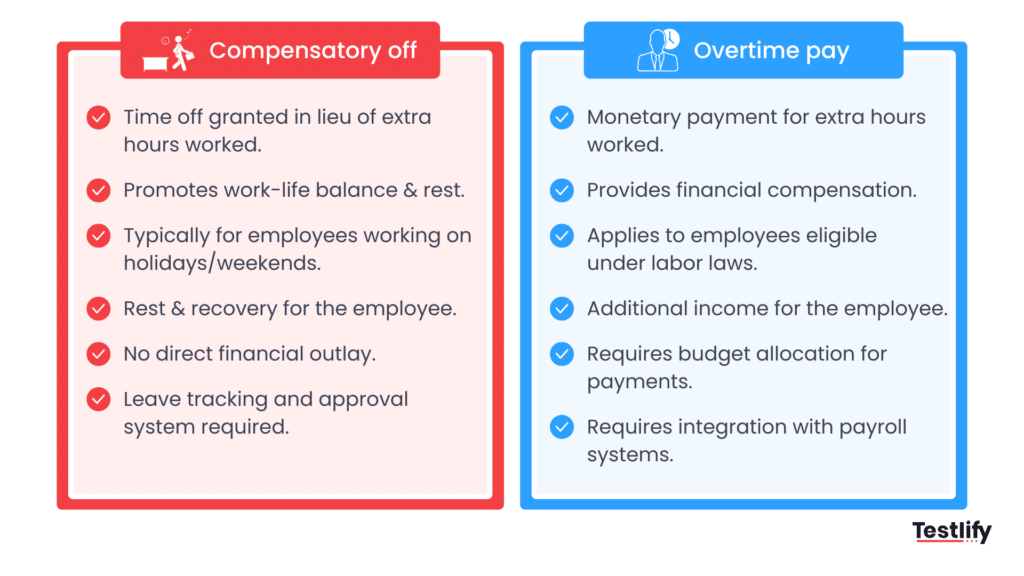
The difference is not just cash versus time. It is that one of them is regulated and the other is mostly a company promise. In the United States, the Fair Labor Standards Act requires that non-exempt workers be paid overtime at not less than one and one-half times their regular rate after 40 hours in a workweek. Comp time exists as a legal substitute for that cash, but in a narrow lane: the Department of Labor describes it for state and local government employees, earned at not less than one and one-half hours for each overtime hour worked, capped at 240 hours for most staff and 480 hours for police, fire, emergency response and seasonal workers.
India runs on a different logic. Under the Factories Act, 1948, Section 52 lets a factory substitute a weekly holiday, with notice, and bars anyone from working more than 10 days in a row without one. Section 53 then requires compensatory holidays equal in number to those lost, taken within that month or the two months after it. Section 59 keeps overtime separate, at twice the ordinary rate beyond nine hours a day or 48 hours a week. Read together, they say something companies frequently miss: for covered factory workers, a comp off does not cancel the overtime wages owed.
Dimension | Comp off | Overtime pay |
|---|---|---|
What the employee gets | Time back, later | Money, in the next pay run |
Where it comes from | Company policy, in most cases | Statute or contract |
Typical rate | 1:1, or proportional to hours | 1.5x in the US, 2x for covered factory work in India |
Expires? | Yes, commonly in 30 to 90 days | No |
Cost to the company | Lost capacity on the day taken | Direct payroll cost |
Main risk | Days lapse unused, trust erodes | Budget, and unplanned cost spikes |
How long is comp off valid?
Company policy decides, and 30 to 90 days from the date it was earned is the common band. Short windows keep the liability small and push people to rest sooner. They also produce the single loudest complaint about comp off, which is that the day expired during the exact busy period that created it.
That is the tradeoff worth naming honestly. A 30 day expiry looks disciplined on paper and quietly cancels itself in a team that is busy for a quarter. A 90 day window costs more to carry and is far more likely to be used. Where the work comes in long waves, the longer window is the better policy, not the softer one.
How do you apply for comp off?
The mechanics are short, and every step exists to prevent one specific argument later.
- Get the extra work approved before doing it, in writing.
- Record the date and the hours worked against that approval.
- Raise the comp off request naming the date earned and the date to be taken.
- Get the manager's approval before the expiry date, not on it.
- Check the balance updated after the leave, because silent tracking failures are common.
For a written request, keep it to three lines: the date worked, the approval it sat under, and the date being requested. Anything longer invites a negotiation that the policy has already settled.
What belongs in a compensatory off policy?
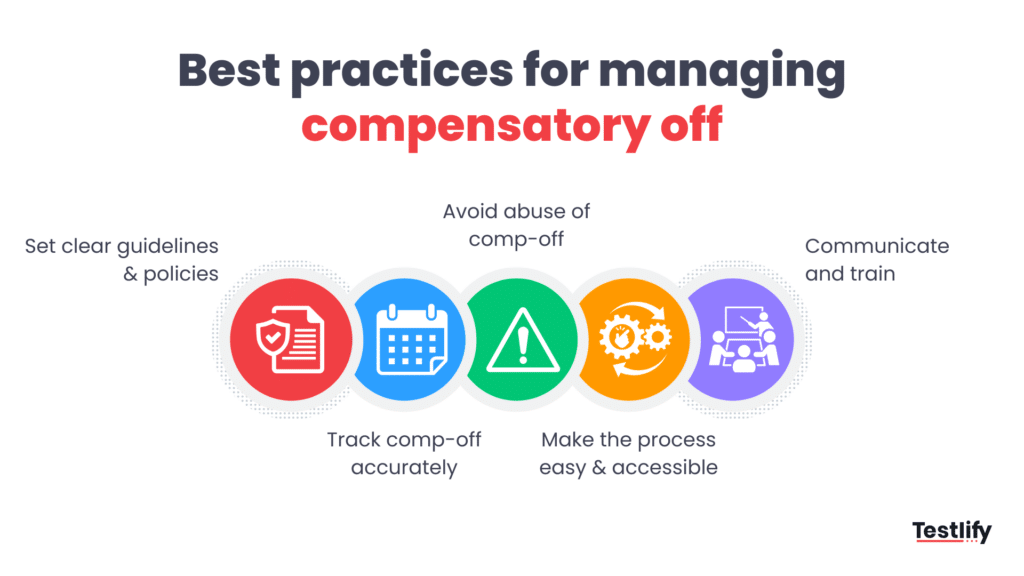
A workable policy answers five questions and stops. Who is eligible, at what rate time is credited, how a request is raised and approved, when the credit expires, and what happens to an unused day. Most policies fail not because they are missing a clause, but because they never say which system holds the balance, so nobody can check it.
Two rules are worth borrowing. Cap how many comp offs anyone can hold at once, usually at five, because a large private balance is a sign the team is understaffed rather than hard-working. And publish the expiry date on the credit itself, so it is visible in the same place as the balance.
Pro Tip: Run a monthly report of comp off earned against comp off taken, by team. A team that keeps earning and never taking is not a policy problem. It is a staffing problem the leave system happened to detect first, and it will show up as attrition a quarter later.
It is worth being clear about what comp off cannot fix. Gallup's 2023 research found about three in four US employees experience workplace burnout at least sometimes, and about one in four feel it very often or always. A day off returns the hours. It does not change the workload that consumed them, and a policy sold internally as a wellbeing programme will be judged, fairly, on whether the work got lighter.
The benefit floor underneath the policy matters too, and it is less even than most people assume. US Bureau of Labor Statistics data from March 2025 shows access to paid sick leave among private industry workers ranging from 55 percent in leisure and hospitality to 97 percent in information and in finance and insurance. In the industries at the low end, a comp off policy is carrying far more weight than its authors realise, and deserves the care of a pay decision. And where the extra hours are a seasonal pattern rather than a surprise, the holiday calendar is the better place to fix it: plan the coverage before the season instead of repaying it afterwards.
Hire on proof, not on hours logged
Comp off is a repayment mechanism. It tells a team how to settle up after a heavy week, which is useful, and says nothing about whether the team was the right size or the right shape to begin with. Chronic comp off balances usually trace back to a hiring gap, not a scheduling one.
That is where the Testlify Human+AI Evidence-Based Hiring Framework applies: combine AI-assisted evaluation with human judgment, using structured evidence instead of resumes, intuition, or inconsistent interviews. Across the teams we work with, a chronic comp off balance tends to be a symptom rather than a cause, and the cause is usually a role filled for availability instead of proven skill. Testlify helps you assess the skills a role actually needs before the offer, with role-based assessments, coding and cognitive tests, and AI interviews that are scored with human override. Book a demo to see how a skills-first shortlist changes the staffing math, or measure work-life balance first to find out how deep the problem runs.
FAQs

Content Writer
Yashika Khandelwal is a Content Writer with 3+ years of experience creating research-backed content on hiring, talent assessment, and HR technology. She is a registered Organizational Psychologist and subject matter expert who combines behavioral science with practical recruitment insights to produce accurate, evidence-based content.
LinkedInRelated resources
View all
HR & recruitment
An HR’s guide to human capital analytics

HR & recruitment
Intercultural competence: skills and how to hire for it

HR & recruitment
65 key skills-based hiring statistics for 2026

HR & recruitment
Employee poaching: Is it illegal, and how to prevent it

HR & recruitment
7 HR statutory compliance rules you must know

HR & recruitment
Employee Vetting: Steps, Checks, and Best Practices for 2026
Get started.
Hire on proof, not resumes.
Run your first skills-based assessment free — no credit card required.