
7 steps to master candidate profiling for top talent
Discover 7 steps to master candidate profiling, reduce time-to-hire, and make data-driven hiring decisions to build a productive and aligned workforce.

Do you know that 74% of businesses admit to hiring the wrong candidate for a role? How much could a misstep like that cost your organization? Candidate profiling is the answer to this challenge. It provides a structured, data-driven approach to finding the correct talent more efficiently.
Understand soft skills, career goals, and desired personality traits and go beyond resumes to discover the best fit for your team. This guide’ll outline seven practical steps to help you master candidate profiling. Are you ready to hire top talent without uncertainty? Let’s dive in!
 ChatGPT
 Gemini
 Claude
 Grok
Grok Perplexity
What is candidate profiling?
Candidate profiling defines a job candidate’s ideal attributes, qualifications, and characteristics for a specific role. It includes technical skills, job requirements, soft skills, desired personality traits, and alignment with company culture.
This profiling ensures a good fit between the individual and the organization by focusing on a holistic view of candidates. The approach makes data-driven hiring decisions for hiring managers and streamlines the recruitment process. Additionally, it reduces the time and effort spent finding the right talent.

Why is candidate profiling important?
Candidate profiling is important because it allows hiring teams to make informed, strategic decisions throughout the hiring process. With clear qualifications, soft skills, and personality traits, organizations can ensure that each new hire aligns well with both the role and the company’s objectives.
One of the most significant advantages of candidate profiling is the reduction in time to hire. With a clear understanding of what the role requires, sourcing and shortlisting the candidates become efficient. Further, it helps align the candidate with the company’s culture and career goals. This helps boost the chances of long-term employee retention.
Explore more: What is cultural alignment and why is it important in 2025?
Profiling provides a data-driven foundation for making impactful hiring decisions in a competitive talent market. It reduces the risk of bad hires and enhances team performance, ensuring that all steps of the recruitment process align with organizational success.
The 7 steps to master candidate profiling
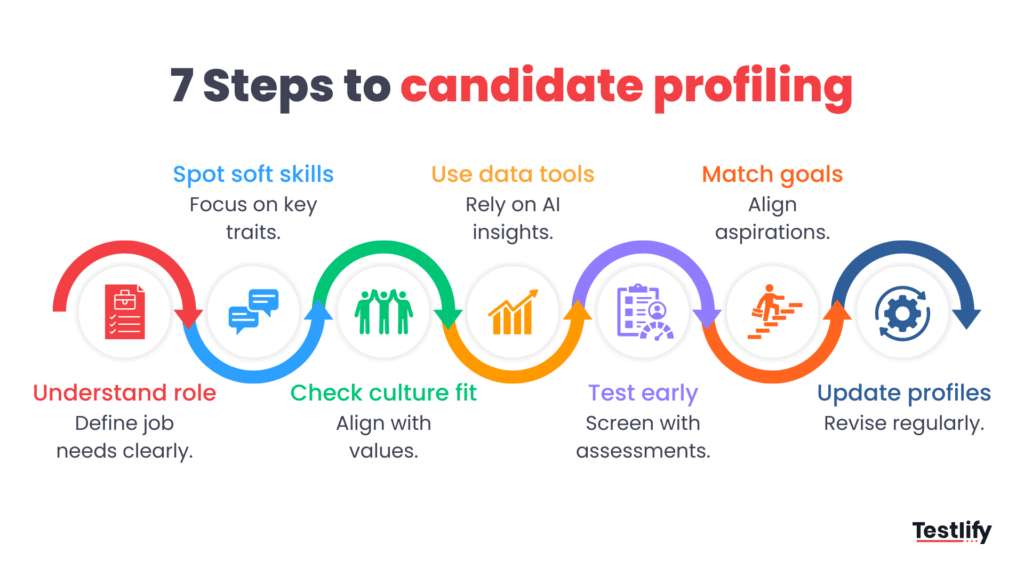
Candidate profiling is more than listing qualifications—it’s about defining the perfect hire. These seven steps will help you effectively align candidates with job requirements and make data-driven hiring decisions.
Step 1: Analyze and understand the role requirements
Start by thoroughly analyzing the role you are hiring for. Look into the fundamental job requirements, such as technical skills, qualifications, and experience. Ensure you involve the hiring manager so that the job description reflects the team’s real needs. This foundation will be critical in providing clarity throughout the recruitment process.
Once the role requirements are defined, integrate role-specific assessments like coding tests for technical roles or communication skill tests for client-facing positions. Testlify’s customizable library allows precise alignment with job descriptions.
Step 2: Identify key behavioral and soft skills
While technical skills are essential, soft skills such as communication, adaptability, and teamwork often make the difference between a good and a great hire. Describe the behavioral traits that fit the role and how they correlate with the organization’s values.
For example, problem-solving might be critical for leadership roles, while attention to detail is necessary for technical roles.
Use behavioral and cognitive assessments from Testlify to evaluate traits like adaptability, problem-solving, and teamwork. These assessments provide measurable insights into soft skills, ensuring alignment with job expectations.
Step 3: Integrate cultural fit into the profile
A candidate’s compatibility with the company culture strongly indicates their survival within the organization. Current top performers can be used as informants to identify traits and values that align with your workplace dynamics. This approach ensures that new hires excel in their roles and flourish in your work environment.
Deploy cultural fit assessments from Testlify to evaluate candidates’ alignment with organizational values and team dynamics. These assessments can provide data-backed insights into cultural compatibility.
Step 4: Use data-driven tools and insights
Utilize modern recruitment tools to create accurate and objective profiles. AI-powered platforms and data analytics can assess historical hiring trends and predict the required personality traits for success. All this allows for data-driven hiring decisions that reduce bias and lead to better outcomes.
Step 5: Screen applicants using pre-employment testing
Pre-employment assessments are useful in checking technical skills, cognitive skills, and behavioral tendencies. Platforms like Testlify help you assess a candidate based on the job description. Testing also accelerates the process as it eliminates many unqualified applicants at an earlier stage.
Utilize Testlify’s wide range of test libraries, such as technical assessments, aptitude tests, and behavioral evaluations, to ensure candidates meet your specific requirements. These assessments make the screening process efficient and effective.
Step 6: Align career goals with organizational growth
Recognizing a candidate’s career aspirations ensures a mutually beneficial relationship. Profiles should reflect how the position aligns with the candidate’s goals. This might develop a win-win scenario for both employers and employees.
This approach boosts engagement and retention as employees perceive personal and professional development opportunities.
Step 7: Review and revise profiles continuously
Candidate profiling is not a task that is done once. Based on recruitment results and feedback from the hiring team, continuously review the effectiveness of your profiles. The profile should be updated when changes occur in the organization or when the job requirements have changed.
You can utilize Testlify’s analytics and reporting tools to evaluate the effectiveness of your hiring process and refine profiles based on data-driven insights.
Practical benefits of mastering candidate profiling
Mastering candidate profiling turns hiring from a game of chance to a strategic advantage. With perfect identification of the ideal technical skills mix, soft skills, and cultural fit, organizations can make accurate hiring decisions that reduce time-to-hire and improve the overall efficiency of the entire process.
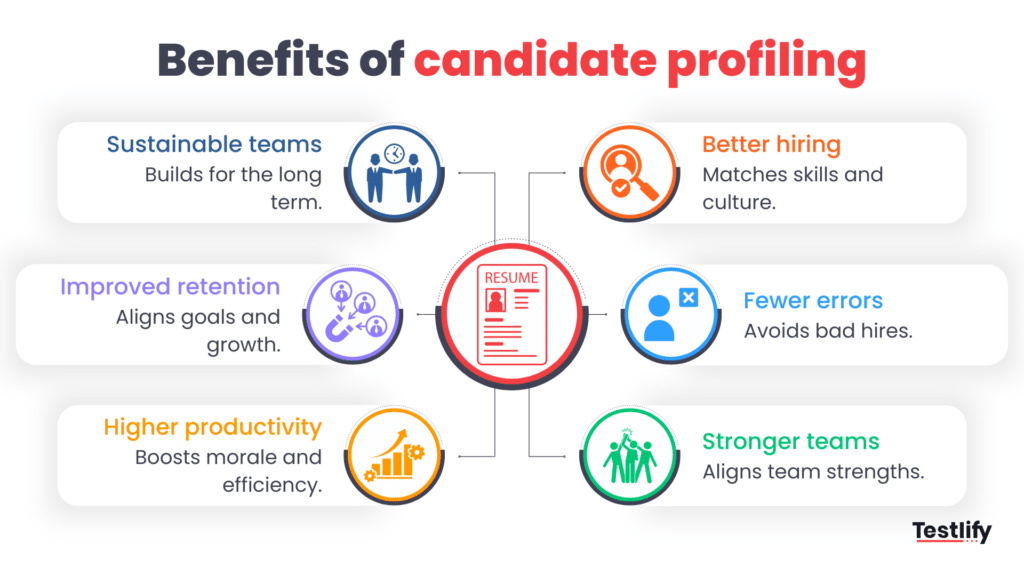
This structured process reduces hiring errors, therefore saving businesses from the costly repercussions of bad hires. Candidate profiling allows for a better team dynamic, because it puts the individual strengths into the right places within the team. Profiling can ultimately drive productivity and morale.
Profiling also improves employee retention, as candidates’ career goals align with the organization’s growth opportunities. Profiling is no longer about finding the right fit; it’s about creating a sustainable workforce in today’s competitive talent landscape.
Common mistakes to avoid in candidate profiling
Even with the best intentions, candidate profiling can go wrong if not approached carefully. The most common mistake is relying only on technical qualifications while ignoring soft skills and cultural fit. A candidate might tick all the technical boxes but fail to align with your company culture, which can lead to poor team dynamics and high turnover.
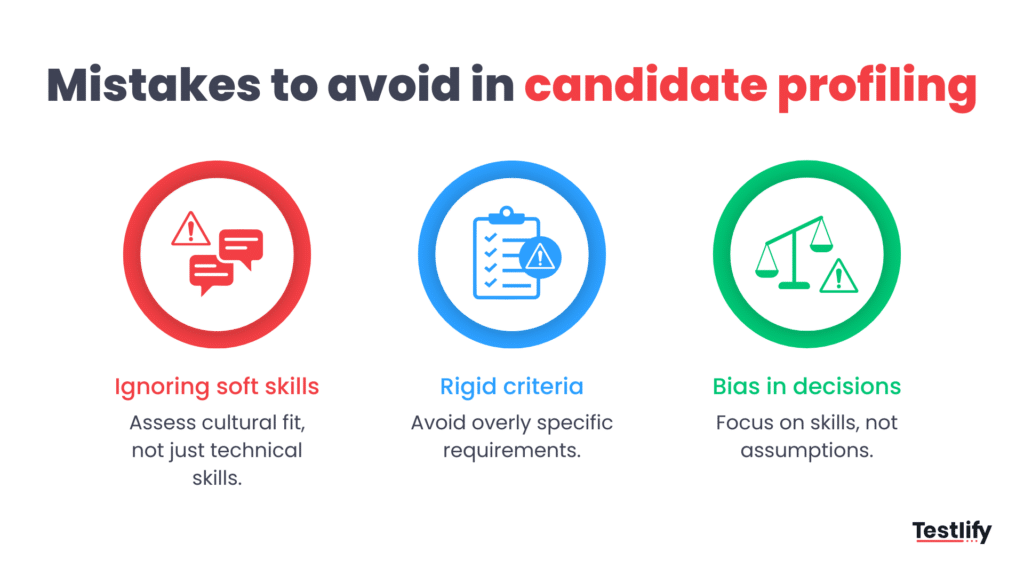
Another pitfall is developing overly rigid, flexible, or diverse profiles. Too specific requirements can shut out talented people who can offer new ideas or adjust easily to the position.
Lastly, unconscious biases can creep into the profiling process and affect fair decision-making. Focus on objective criteria such as skills and problem-solving abilities rather than making assumptions based on a candidate’s background or personal characteristics.
How can Testlify help you develop the perfect candidate profile?
Testlify makes candidate profiling quite easy with its AI-driven assessments, which cover data on hard and soft skills. The customizable tests gauge problem-solving, cognitive ability, and cultural fit to ensure the candidates fit the job description and the company culture.
With features such as auto-scoring and anti-cheating checks, Testlify can help you streamline the entire recruitment process. You can integrate Testlify into building a workforce that perfectly fits your organization’s goals while reducing time-to-hire.
Final thoughts
Mastering the art of candidate profiling is the key to hiring success. Focus on building profiles that balance technical competence, soft skills, and cultural fit to create the workforce that drives long-term success. Start refining your profiling strategy today and watch your recruitment outcomes transform.
Frequently asked questions (FAQs)

B2B SaaS Content Writer
Rishav Kumar is a B2B SaaS content writer with 4 years of experience. He loves crafting engaging content. Always exploring fresh ideas, he's passionate about helping businesses grow through impactful writing.
LinkedInRelated resources
View all![How to perform a talent review in 2026 [in 5 simple steps]](/wp-content/uploads/2025/01/How-to-perform-a-talent-review.png?dpl=dpl_6Z8Gzi5dgny5ePrnCfPbRPCRYCA7)
HR & recruitment
How to perform a talent review in 2026 [in 5 simple steps]
HR & recruitment
Boolean search in recruitment: How to use it with examples?

HR & recruitment
Compensatory off: What is it, types of leaves

HR & recruitment
An HR’s guide to human capital analytics

HR & recruitment
Intercultural competence: skills and how to hire for it

HR & recruitment
65 key skills-based hiring statistics for 2026
Get started.
Hire on proof, not resumes.
Run your first skills-based assessment free — no credit card required.