
Boolean search in recruitment: How to use it with examples?
Learn how Boolean search can streamline recruitment, improve candidate quality, and save time with actionable tips and examples.

As an HR professional, you’re always looking for the best talent. Whether it is reviewing resumes, browsing LinkedIn profiles, or going through countless job boards, finding the perfect candidate can often seem like searching for a needle in a haystack. But what if there was a way to make this search more efficient, precise, and faster? Boolean search—a tool that can revolutionize the way you recruit.
Let’s see what boolean search in recruitment exactly is.
 ChatGPT
 Gemini
 Claude
 Grok
Grok Perplexity
What is a boolean search in recruitment?
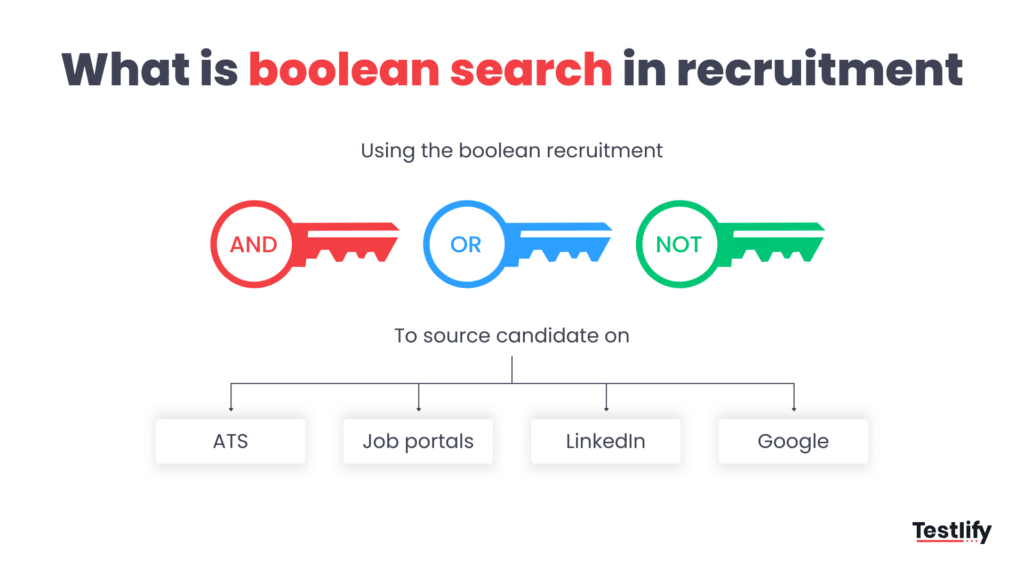
Boolean search in recruitment is the use of logical operators such as AND, OR, and NOT in combining or excluding specific keywords when searching for potential candidates.
This method helps you to create highly targeted search queries that help narrow down a large pool of resumes, profiles, or databases to identify the best-fit candidates. Boolean search can be used on any job board, LinkedIn, or even Google to find candidates with very specific skills, qualifications, and experience.
For instance, if you are targeting a data scientist having experience with machine learning as well as Python, you can filter your search query as a Boolean query to only bring forth candidates with both requirements. This eliminates irrelevant profiles and makes the recruitment process much easier.
That being said, let us break it down. Boolean search allows you to specify particular conditions by combining or excluding keywords using operators.
- AND narrow down your search.
- OR broadens it.
- NOT excludes certain terms.
Let’s dive deeper into how this search methodology can benefit you.

Why is boolean search in recruitment important?
Recruitment is, in many cases, a time-sensitive process. 80% of HR professionals indicated that recruitment is a very time-consuming because there are too many resumes to sift through.
Boolean search allows you to filter and adjust your search results with great precision, enabling you to focus solely on the very best candidates. That makes all the difference between efficiency, accuracy, or total failure in hiring.
But efficiency is not the only advantage. Boolean search can provide better results, saving time and money.
1. Improves candidate quality
Boolean search enables you to narrow your search to find candidates matching specific criteria. Instead of manually sifting through hundreds of resumes, Boolean search filters help you find profiles that meet exact qualifications.
This results in a more targeted approach and higher-quality candidate pools. In fact, 55% of HR professionals say that Boolean search has helped them find better candidates faster.
2. Saves time and resources
Time management is one of the major pain points in recruitment. You do not want to waste hours reviewing resumes that are irrelevant to the position at hand. Boolean search narrows down the searches to the most relevant profiles. This eliminates unnecessary time spent on irrelevant candidates and, consequently, saves time to fill a position.
In fact, research shows that 38% of recruiters believe that Boolean search has helped them save at least 10 hours per week in recruitment efforts, allowing them to focus on more high-level aspects of the hiring process.
3. Reduces hiring costs
Recruitment can be costly. If you are paying for job advertisements or outsourcing recruitment, every bit of inefficiency adds to the cost. Boolean search can help you reduce costs by making your search process more effective. You can reduce the number of paid job board postings and focus more on finding candidates directly, which leads to lower recruiting costs.
How to use boolean search in recruitment
Even though Boolean search is very effective, it’s also important to know how to use the right operators and tactics to get the most out of it.
1. The AND operator
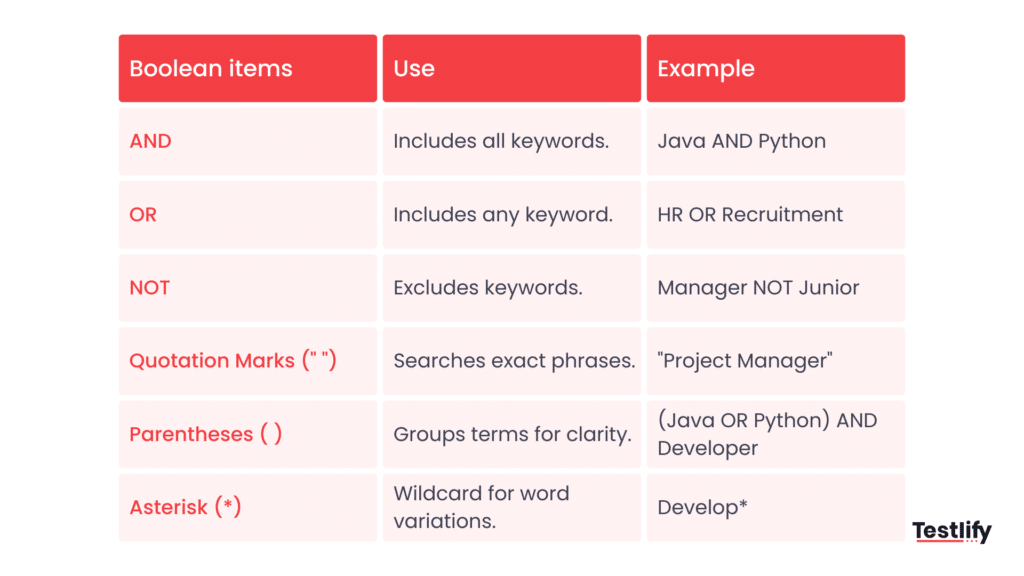
The AND operator narrows your search by ensuring that both keywords must appear in a candidate’s profile. It helps you focus on candidates who meet all of your required criteria.
For instance, when hiring a digital marketing manager specializing in SEO and content marketing, you may want to type in this search string:
That way, you’re sure of only getting the people who can actually handle tasks such as both SEO and content marketing and not only one of the two.
2. The OR operator
The OR operator broadens your search. It’s useful when you’re open to finding candidates with various skills or qualifications. Using OR ensures that your search will return results for either one keyword or the other.
Example: If you’re looking for a software engineer who has experience in Python or JavaScript, your Boolean query could look like:
This search will return candidates who have experience in either Python or JavaScript.
3. The NOT operator
The NOT operator lets you exclude specific keywords from your search, which is very useful when you want to avoid candidates with certain qualifications that aren’t relevant to the job.
For instance, if you are hiring for a digital marketing role but want to exclude candidates who have expertise in paid search advertising, you could use:
This would make you concentrate on those candidates with other forms of digital marketing experience.
4. Use of quotation marks
If you want to find an exact phrase or a job title, use quotation marks so that the search engine will look for the exact words in that order.
For example, if you want to find a “Product Manager” with Agile experience, your query would be:
This narrows your search for candidates who specifically have a background as a “Product Manager” and must be aware of Agile methodologies.
5. Use of parentheses
Parentheses facilitate grouping terms or operators together to search for more advanced queries. You can rest assured that these operators work with the right ordering.
Example: If you’re searching for a candidate that is experienced with either Python or Java, and would like to add cloud computing expertise, then use:
This will return hits, including candidates with Python or Java experience combined with cloud computing expertise.
Boolean search process for recruitment on Google
Google is an incredible tool in recruiting, and this is very powerful when you don’t have paid job boards or resume databases to access. Boolean search on Google works similar to how it does on the job boards but with a few tricks to enhance the search result.
1. Use quotation marks: To search for exact phrases or job titles, use quotes to ensure accuracy.
Example: “Software Developer” AND “ReactJS”
2.Include job titles and skills: Use Boolean operators like AND, OR, and NOT to narrow or expand your search based on qualifications, job titles, or specific skills.
Example: “Marketing Manager” AND SEO AND “Content Strategy”
3. Exclude unwanted results: If you’re seeing irrelevant results, use the NOT operator to exclude certain terms.
Example: “Data Analyst” AND Python NOT “Intern”
4. Use Site-Specific Searches: You can also limit your search to specific websites or domains using the site: modifier.
For example, to search for resumes on GitHub: site:github.com “Software Engineer” AND JavaScript
Boolean search process for recruitment on LinkedIn
The widely used LinkedIn is one of the most powerful sources of finding candidates. Both active and passive candidate lists in the pool will increase the quality of search result when Boolean search is applied to LinkedIn.
1. Use 1uotation marks: For job titles, certifications, or specific skills, always enclose them in quotes.
Example: “Data Scientist” AND Python AND “Machine Learning”
2. Use AND for multiple skills: Use the AND operator to combine multiple qualifications that a candidate must have.
“Digital Marketing Manager” AND SEO AND PPC
3. Use OR for alternative terms: If you’re open to multiple job titles or skill variations, use the OR operator.
“Full Stack Developer” OR “Software Engineer” AND JavaScript
4. Exclude irrelevant results: If you’re looking for specific candidates but want to exclude certain roles or keywords, use the NOT operator.
“Project Manager” AND Agile NOT “Junior”
5. Advanced filters: LinkedIn offers advanced filters that can help refine your search based on location, industry, and experience level. Combine these filters with Boolean search for more targeted results.
Best practices for boolean search in recruitment
Yes, Boolean search can be really effective. Yet, there are some best practices you should follow to make sure that you get the best result:
1. Know Your keywords
It is essential to know the appropriate keywords to use. Different job titles, skills, and industries use different terminologies. For example, a software engineer can be called a developer, programmer, or coder based on the region or company. The correct combination of keywords increases the precision of your search.
Statistically, 90% of recruiters using Boolean search state that the correct use of keywords brings more relevant and higher-quality candidates.
2. Experiment with different combinations
The beauty of Boolean search is its flexibility. Don’t be afraid to experiment with different combinations of operators and keywords to refine your search. You might have to tweak your query a few times to get the best results.
3. Stay updated on trends
The landscape of recruitment is always changing. New skills keep popping up regularly, and the job titles change. Being on top of trends in your industry will allow you to be sure that you are using the most relevant terms in your Boolean searches.
4. Use boolean search across multiple platforms
Boolean search is not only limited to job boards like Indeed or Monster. It is a very useful tool on platforms like LinkedIn, GitHub, or even Twitter. This way, you can cast a wider net and find candidates in a variety of places.
Recent surveys indicate that 65% of recruiters use LinkedIn’s search capabilities, but fewer than 25% know how to fully leverage Boolean search on that platform. Learning Boolean search will give you an edge in the competition to find the best candidates.
Conclusion
It’s not just some technical skill on the list—Boolean search can be a real game-changer in optimizing the recruitment process. Whether one is looking to save time, improve candidate quality, or decrease hiring costs, a Boolean search stands to benefit a lot. You get to narrow searches down to better matches for that role, where you can better focus your energies on what really matters in hiring: high-quality talent.
Mastery of Boolean search makes you more efficient, saving resources and thus making better hiring decisions. So, the next time you sit down to search for candidates, remember the power of Boolean search—your future successful hires may just be one search away.
FAQs

Content Writer
Yashika Khandelwal is a Content Writer with 3+ years of experience creating research-backed content on hiring, talent assessment, and HR technology. She is a registered Organizational Psychologist and subject matter expert who combines behavioral science with practical recruitment insights to produce accurate, evidence-based content.
LinkedInRelated resources
View all
HR & recruitment
Compensatory off: What is it, types of leaves

HR & recruitment
An HR’s guide to human capital analytics

HR & recruitment
Intercultural competence: skills and how to hire for it

HR & recruitment
65 key skills-based hiring statistics for 2026

HR & recruitment
Employee poaching: Is it illegal, and how to prevent it

HR & recruitment
7 HR statutory compliance rules you must know
Get started.
Hire on proof, not resumes.
Run your first skills-based assessment free — no credit card required.