
HR to employee ratio: 2026 benchmarks, formula and sizing guide
Most companies run about 2 HR staff per 100 employees. Learn how to calculate your HR to employee ratio, compare it and size your team.

The HR to employee ratio is the number of HR staff a company has for every 100 employees. It shows how much HR capacity sits behind each person in the business. In 2025 the median US ratio was 1.98, so roughly two HR people per 100 employees, but the right number for you depends on how much you hire, what HR owns and how much of the work is automated.
 ChatGPT
 Gemini
 Claude
 Grok
 Perplexity
TL;DR / Key Takeaways
- The average HR to employee ratio is about 2 HR staff per 100 employees. SHRM's 2025 CHRO benchmarking put the median at 1.98, up from 1.58 in 2017.
- Calculate it as HR FTEs divided by total employee FTEs, times 100. Use full-time equivalents, not a raw headcount.
- A company of 200 employees typically runs about 4 HR staff, with a healthy range of 3 to 9.
- ADP Research data reported by SHRM puts the sweet spot at 1.5 to 4.5 HR staff per 100 employees. Turnover drops once you pass 1 HR person per 200 employees and climbs again above 9 per 200.
- Small companies run higher ratios and large companies lower ones, because HR work scales better than headcount.
- Hiring volume is the biggest hidden driver. Two companies with the same ratio can have very different HR loads if one hires five times more people.
- Automate screening, scheduling and self-service before you add HR headcount, then recalculate the ratio every quarter.

What is the HR to employee ratio?
The HR to employee ratio is a workforce metric that compares the number of people working in human resources with the total number of employees they support, usually shown as HR staff per 100 employees. A ratio of 2.0 means two HR full-time equivalents for every 100 employees, or one HR person for every 50.
Most companies count everyone whose main job is HR work: HR generalists, HR business partners, recruiters and talent acquisition staff, payroll and benefits specialists, HR operations, learning and development, and people analytics. Leaders who spend part of their time on people tasks, such as a line manager running interviews, do not count.
The ratio is one of the core numbers in HR analytics. It tells leadership whether HR is lean, about right or heavy for the size of the business. It does not tell you whether HR is good at its job, which is why you should read it next to quality and speed measures.
HR is a large profession to benchmark against. The US Bureau of Labor Statistics counts about 939,700 human resources specialist jobs in 2025 and expects 6% growth from 2025 to 2035.
How do you calculate the HR to employee ratio?
The HR to employee ratio is calculated by dividing the number of HR full-time equivalents by the total number of employee full-time equivalents, then multiplying by 100. The result is the number of HR staff per 100 employees. Use FTEs, not a raw headcount, so part-time staff count for the hours they work.
HR to employee ratio = (HR FTEs / total employee FTEs) x 100
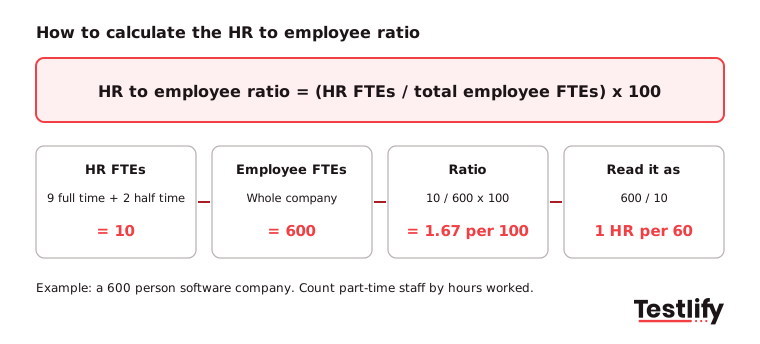
Here is a worked example. A software company has 600 employee FTEs. Its HR team has 9 full-time staff and two people who work half time, so HR FTEs = 9 + (2 x 0.5) = 10.
- Step 1, count HR FTEs: 10
- Step 2, count all employee FTEs: 600 (include the HR team in the total)
- Step 3, divide and multiply: 10 / 600 x 100 = 1.67 HR staff per 100 employees
- Step 4, flip it if that is easier to read: 600 / 10 = 1 HR person for every 60 employees
Decide once whether contractors, interns and outsourced HR services count, write the rule down, and keep it the same each time. A changing definition is the most common reason a ratio jumps from one quarter to the next.
What is the ideal HR to employee ratio?
The ideal HR to employee ratio for most companies sits between 1.5 and 4.5 HR staff per 100 employees, with the typical company close to 2. There is no single correct number. Your target should come from your hiring plans, what HR owns and how much of the work runs on software.
The main benchmarks agree on the middle of the range:
Benchmark | HR staff per 100 employees | Source and year |
|---|---|---|
Median HR to employee ratio, US | 1.98 | SHRM CHRO benchmarking, 2025 |
Median before the pandemic | 1.58 | SHRM CHRO benchmarking, 2017 data |
Sweet spot linked to lower turnover | 1.5 to 4.5 | ADP Research Institute, reported by SHRM, 2024 |
Average across HR functions | about 1.7 (1 HR FTE per 58 employees) | Gartner, as reported by AIHR, 2026 |
According to SHRM's 2025 CHRO benchmarking insights, HR budgets also grew, with the median up 9.1% from 2024, and the median HR expense to operating expense ratio reached 2.4%, double the 2017 level.
The old "one HR person per 100 employees" rule is out of date. MRA calls it a myth, and the 2025 median is roughly double that figure.
How many HR staff do you need for 100, 200, 500 or 1,000 employees?
The number of HR staff you need is roughly 2 for 100 employees, 4 for 200, 10 for 500 and 20 for 1,000 at the 2025 median ratio. The table below applies the median and the 1.5 to 4.5 range to common company sizes, so you can see where your team sits today.
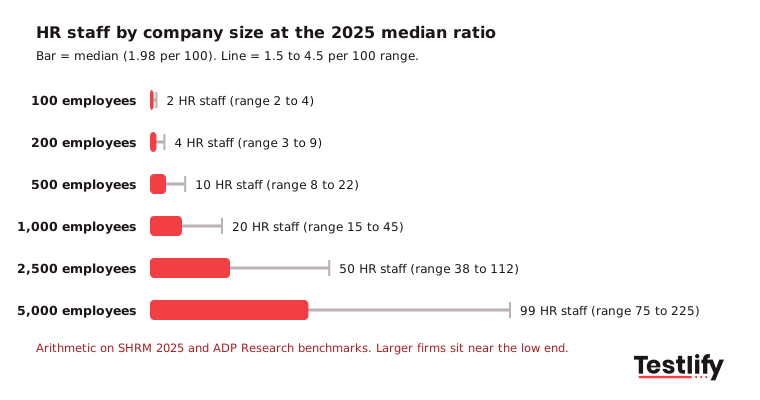
These figures are arithmetic on the published benchmarks, not a target. A 1,000 person company that hires 400 people a year needs more recruiting capacity than one that hires 50, even though both have the same headcount.
Pro tip: Plan HR headcount for the size you will be in 12 months, not the size you are today. Recruiting, onboarding and payroll work all arrive before the new employees show up in your headcount report.
How does the HR to employee ratio change by company size and industry?
The HR to employee ratio is usually highest in small companies and falls as companies grow. A business of 40 people still needs payroll, benefits, hiring, compliance and employee relations covered, so even one HR person produces a high ratio. Larger companies share systems, policies and specialist teams across far more employees.
ADP Research data reported by SHRM shows the gap is narrowing. Ratios at larger companies grew faster and more steadily between 2018 and 2023, while the smallest employers rose 4.7%.
Industry matters as much as size:
- Lower ratios: Leisure and hospitality, manufacturing and construction tend to run leaner HR teams, often with large frontline workforces and standard roles.
- Higher ratios: Finance and professional services tend to run more HR staff per employee, with more complex pay, regulation and career paths.
- Regulated and high-turnover sectors: Healthcare, BPO and contact centers carry heavy compliance and hiring loads, which push recruiting headcount up.
When you compare your number, compare it with companies of similar size, industry and hiring volume. A national average across every sector tells you little about a 3,000 person contact center.
Why does the HR to employee ratio matter?
The HR to employee ratio matters because it links HR capacity to outcomes the business cares about: turnover, hiring speed, employee experience and HR cost. Too few HR staff and issues go unresolved, hiring slows and people leave. Too many and HR becomes a cost that the rest of the business questions.
The clearest evidence is on turnover. In a study of payroll data covering more than 25 million employees, ADP Research data reported by SHRM found that turnover starts to fall once a company has at least one HR staff member for every 200 employees. Above about 9 HR staff per 200 employees, turnover starts to rise again. ADP's researchers note that the link still needs more work to prove cause and effect.
The ratio also gives HR a shared language with finance. Paired with HR cost per employee and the HR budget, it turns a request for headcount into a business case instead of a complaint about workload.
What affects the right ratio for your company?
The right HR to employee ratio for your company depends on six factors: hiring volume, what HR owns, HR technology, outsourcing, workforce complexity and regulation. A company that changes any one of them should expect its ideal ratio to move.
- Hiring volume: Fast-growing companies, seasonal employers and high-turnover sectors need more recruiting capacity per employee.
- Scope of HR: Some HR teams own payroll, facilities, internal communications or office management. Others do not. Compare like with like.
- HR technology: An HRIS with employee self-service, automated onboarding and AI screening removes a large share of routine work.
- Outsourcing: Payroll providers, PEOs and recruitment agencies move work outside the ratio. Count the cost, not just the headcount.
- Workforce complexity: Multiple countries, unions, shift work and many job families all add HR work per employee.
- Regulation: Healthcare, finance and government contractors carry more compliance, audits and record keeping.
The span of control inside HR matters too. If one HR business partner supports 400 managers and employees, the ratio might look healthy while that person is overloaded. Review span of control alongside the headline number.
How does recruiting load change the ratio?
Recruiting load changes the HR to employee ratio more than any other factor, because recruiting work grows with the number of hires, not the number of employees. A company that adds 300 people this year needs far more recruiting hours than one of the same size that adds 30, even with identical ratios.
Across the teams we work with, recruiting is where HR capacity runs out first. Screening resumes, scheduling interviews and chasing feedback take the most hours, and they peak exactly when the business is growing.
To size the recruiting share of your HR team, use your own data:
- Count planned hires: Take next year's hiring plan by role, plus expected backfills from turnover.
- Measure recruiter output: Use your ATS to find how many hires one recruiter closed last year, by role type. Technical and senior roles take longer than volume roles.
- Divide: Planned hires divided by hires per recruiter gives the recruiters you need. For example, 240 planned hires at 40 hires per recruiter means 6 recruiters.
- Add the rest of HR: Size HR operations, payroll and HR business partners on headcount, then add the two together.
Splitting the ratio this way shows where to invest. If recruiting drives the gap, faster screening may close it without new hires. Track time to hire and cost per hire to see whether the extra capacity pays off.
What are the signs your HR team is understaffed?
The signs of an understaffed HR team are rising time to hire, slow answers to employee questions, overdue compliance tasks, rushed onboarding and HR staff working long hours. Any of these combined with a ratio below 1 per 100 is a strong signal that capacity is short.
The problem is common. SHRM's 2025 State of the Workplace report found that 62% of HR professionals worked beyond their capacity in 2024 and 57% said their department was understaffed. Understaffed teams also rated themselves less effective: 66% called their HR function effective, against 76% of teams that were not understaffed.
Watch for these signals in your own data:
- Open roles sit longer than your normal time to fill, and candidates drop out between stages.
- Managers start running their own hiring because HR cannot keep up.
- Employee tickets and requests wait days for a first answer.
- Training, performance reviews or audits keep slipping.
- HR staff turnover or sick leave rises, a sign of recruiter burnout.
How can you improve your HR to employee ratio without hiring?
You can improve the HR to employee ratio without hiring by removing routine work before you add people: automate screening and scheduling, move simple requests to self-service, outsource transactional tasks and cut duplicate processes. Each hour saved lets the same team support more employees.
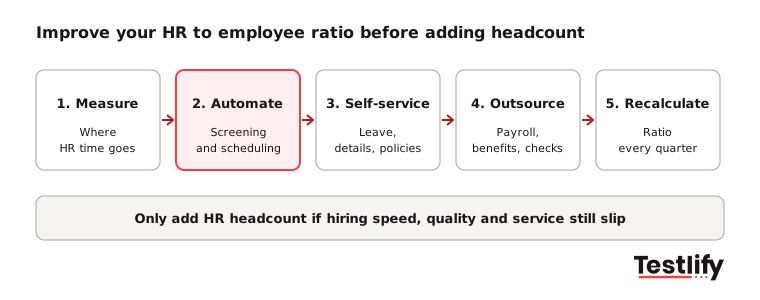
- Measure where HR time goes: Track a typical month by task. Most teams find hiring admin and repeat employee questions at the top.
- Automate early screening: Replace manual resume reviews with skills assessments and AI screening, so recruiters only spend time on qualified candidates. Testlify's AI resume screener scores resumes against the job and syncs results back to your ATS.
- Add employee self-service: Let employees update details, book leave and find policies in the HRIS without raising a ticket.
- Outsource transactional work: Payroll, benefits administration and background checks are often cheaper to buy than to staff.
- Recalculate and review: Rerun the ratio each quarter and compare it with your key HR metrics, such as time to hire and turnover.
Key takeaway: A lower ratio is only a win if hiring speed, quality of hire and employee experience hold steady. Cut work first, then headcount, never the other way round.
What mistakes should you avoid when benchmarking your HR to employee ratio?
The most common mistakes when benchmarking an HR to employee ratio are comparing against the wrong peer group, counting HR inconsistently, ignoring hiring volume and treating the benchmark as a target. Any of these can make a healthy team look bloated or an overloaded team look fine.
- Using a national average: A blended figure across all industries hides the real range. Benchmark against your size band and sector.
- Mixing headcount and FTEs: Count both HR and the total workforce in FTEs, every time.
- Leaving out outsourced work: If a PEO or agency does the work, your ratio looks lean while your HR cost does not.
- Ignoring growth: Size for the hiring plan, not last year's headcount.
- Chasing a number: The ratio is a starting point for a conversation about capacity, not a verdict. Pair it with HR KPIs and your workforce planning before you change headcount.
Cutting HR roles to hit a benchmark often backfires: if time to hire and turnover climb, the roles come back within months. A quarter of tracking first is cheaper.
Keep a lean HR team without slowing hiring
Most HR teams feel the ratio in recruiting first, so that is where automation pays back fastest. Testlify helps hiring teams screen candidates on skills from day one, with 3,500+ tests across tech and non-tech roles, 25+ question types, 20+ proctoring checks and support for 15+ languages. Candidates are scored automatically and ranked, so recruiters spend their time on the shortlist, not the inbox.
Browse the Testlify test library or start a 7-day free trial, no credit card needed.
Frequently asked questions

Content Writer
Yashika Khandelwal is a Content Writer with 3+ years of experience creating research-backed content on hiring, talent assessment, and HR technology. She is a registered Organizational Psychologist and subject matter expert who combines behavioral science with practical recruitment insights to produce accurate, evidence-based content.
LinkedInRelated resources
View all
HR Statistics
Employer concerns survey 2026: What the data means for hiring

HR Statistics
Time management statistics: 30 facts for hiring teams in 2026

HR Statistics
Soft skills statistics for 2026: the data hiring teams can trust

Talent assessment
Enneagram type 8: the challenger at work and how to manage one

Workplace culture
Enneagram type 6: the Loyalist at work and in life

Workplace culture
Enneagram type 9: how the Peacemaker handles conflict, decisions and work
Get started.
Hire on proof, not resumes.
Run your first skills-based assessment free — no credit card required.