
Employer concerns survey 2026: What the data means for hiring
AI rules, scarce skills and fake candidates top employer worries in 2026. Here is what the surveys found and what it means for hiring.

The main employer concerns survey 2026 results agree on one shift: AI has moved from a productivity topic to the top legal and hiring worry. Littler's annual poll of 303 US executives, in-house lawyers and HR leaders found 84% expect AI policy or regulation to affect their business in the next year, double the 2025 share. Other 2026 surveys add three more pressures: skills that are still hard to find, candidate fraud, and retention.
TL;DR / Key Takeaways
- 84% of employers expect AI policy or regulation to affect their business, and 79% worry about AI-related lawsuits (Littler).
- 72% of employers report hiring difficulty, and AI skills are the hardest to find (ManpowerGroup).
- 67% of hiring managers suspected a candidate used AI to misrepresent themselves (Checkr).
- 52% of employers name keeping staff as their top priority (Monster).
- Employers need to prove each hiring decision was fair, based on real skills, and made about the real person.
 ChatGPT
 Gemini
 Claude
 Grok
 Perplexity
What are employers most concerned about in 2026?
Employers in 2026 are most concerned about AI regulation and AI-related lawsuits, data privacy, finding people with the right skills, keeping the people they have, rising costs, and candidates who are not who they claim to be. AI leads the legal surveys, while skills and retention lead the hiring surveys.

The surveys ask different people different questions, so the table shows who was asked before what they said.
Survey (2026 edition) | Who was asked | Top concern it found | Headline number |
|---|---|---|---|
Littler Annual Employer Survey | 303 US executives, in-house lawyers and HR leaders, March 2026 | AI policy and regulation | 84% expect AI rules to affect their business |
ManpowerGroup Global Talent Shortage | 39,063 employers in 41 countries, October 2025 | Hard-to-find skills, led by AI skills | 72% report hiring difficulty (69% in the US) |
Monster Hiring WorkWatch | 800 US hiring decision-makers | Retention ahead of hiring | 52% name retention as their top priority |
Express Employment Professionals and Harris Poll | US hiring decision-makers | Applicants without relevant experience | 50% say applicants lack relevant experience |
SHRM State of the Workplace and CHRO Priorities | 1,856 HR professionals, 2,079 workers, 129 CHROs | Economic uncertainty, leadership | 92% of CHROs expect more AI in workforce operations |
Checkr Hiring Hoax | 3,000 US hiring managers, September 2026 | Candidate fraud | 67% suspected a candidate used AI to misrepresent themselves |
Ciphr HR challenges | 300 UK HR decision-makers | Recruiting enough qualified talent | 29% name recruitment as their biggest challenge |
Three of these come from vendors that sell hiring or HR services (Checkr, Monster and Ciphr), so treat their numbers as a direction of travel rather than a census.

Why did AI become the top employer concern in 2026?
AI became the top employer concern in 2026 because adoption has run ahead of the rules and the controls. Employers now use AI across HR, IT and sales, while state laws on automated hiring decisions keep multiplying and federal policy points the other way. That gap leaves employers carrying the legal risk for tools they did not build.
The Littler Annual Employer Survey 2026 shows the size of the swing. In 2025, DEI was the top area where employers expected policy changes to hit them. In 2026, 84% chose AI, data privacy rose from 31% to 53%, and DEI fell from 84% to 38%.
Governance is improving but is uneven:
- 68% have a formal policy on AI use at work, up from 38% in 2025.
- 55% have a formal review or approval process for AI tools.
- 54% limit what information people can enter into AI tools.
- 45% run due diligence on third-party AI vendors.
- 13% have no AI governance measures at all.
Hiring sits at the center of this. Littler found HR is an AI use case for 54% of respondents, and 79% are worried about AI-related lawsuits in the next year. The top reasons are data privacy, including candidate data and AI-scored video (49%), discrimination or bias (45%), and state or local AI laws (43%). Another 35% worry about recordkeeping and being able to explain how an AI-assisted decision was reached.
Pro tip: Ask every hiring vendor two questions before renewal: what exactly does the AI score, and can you show a candidate, in plain words, why they got that score? A vendor that cannot answer both adds legal risk instead of removing it.
Are employers hiring less because of AI?
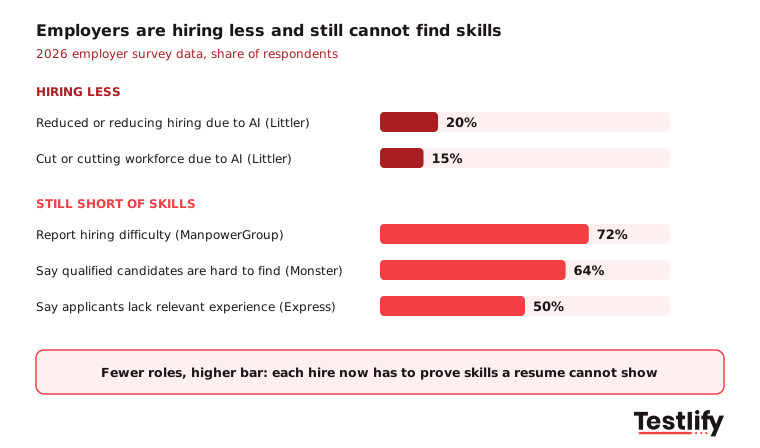
Employers are hiring somewhat less because of AI, but far fewer have cut than are thinking about it. Littler found 20% have reduced hiring or are doing so because of actual or expected AI use, and another 22% are considering it. Workforce reductions tied to AI are lower, at 15%.
The bigger change is quieter. Littler found 37% have reassessed job responsibilities or are doing so, and another 37% are considering it. Large employers are further along: 29% have already reassessed roles, and 17% have reduced hiring.
Other surveys show hiring has slowed down rather than stopped. Express Employment Professionals and Harris Poll, reported by HR Dive in January 2026, found two-thirds of US hiring decision-makers planned to grow headcount in the first half of 2026. Among those planning cuts, 39% named increased use of technology as a reason.
The practical result for TA teams is fewer requisitions with a higher bar. When a role survives an AI review, the hiring manager expects the new hire to do work the tools cannot, so the skills being tested change as well.
Why are skills still so hard to find in 2026?
Skills are still hard to find in 2026 because demand has shifted toward skills that few candidates can prove yet, such as building with AI and using it well in everyday work. Employers are hiring fewer people overall, but the people they need are rarer, and resumes say little about whether a candidate really has those skills.
The ManpowerGroup 2026 Global Talent Shortage survey found 72% of employers report hiring difficulty, down only slightly from 74%. In the US the figure is 69%. For the first time, AI skills top the list: AI model and application development (20%) and AI literacy (19%) are the hardest skills to find. Employers also want communication and teamwork (39%) and adaptability (34%), which a resume cannot show at all.
US hiring surveys say the same thing in their own words:
- 64% of employers in Monster's 2026 Hiring WorkWatch, reported by HR Dive in February 2026, say qualified candidates are hard to find.
- 50% in the Express and Harris Poll survey say applicants lack relevant experience, and 26% struggle to evaluate informal or self-taught skills.
- 29% of UK HR decision-makers in Ciphr's 2026 challenges survey call recruiting enough qualified talent their biggest challenge.
The 26% figure is the one hiring teams should circle. A candidate who learned Python from projects, or picked up AI tools on the job, will not look qualified on paper. Teams that only screen on degrees and titles miss exactly the people the talent shortage says they need. Our skills-based hiring statistics collect more data on skills-first screening.
Why is candidate fraud now an employer concern?
Candidate fraud is now an employer concern because AI makes it cheap to fake a resume, an answer or even a face on a video call. Remote hiring removed the in-person checks that used to catch impostors, and most teams still verify identity late in the process.
The Checkr Hiring Hoax 2026 survey of 3,000 US hiring managers shows how fast the problem grew in one year:
- 67% have suspected a candidate of using AI to misrepresent themselves, up from 59% in 2025.
- 60% say AI has made virtual interviews harder to trust, up from 51%.
- 67% have run into interview proxy fraud, where someone else sits the interview, up from 35%.
- 40% have interviewed someone later found to be using a fake identity.
- Only 23% are extremely confident their process would catch a fraudulent candidate.
- 28% knowingly moved a suspect candidate forward because the role was urgent.
Checkr sells background checks, so its framing favors more screening. Even so, the year-on-year jumps are large enough to take seriously. The Littler survey, which mostly polls lawyers, does not ask about fraud at all, which is why legal-led recaps miss it. For the patterns to watch, see our guides on proxy interviews and HR habits that raise hiring fraud risk.
What does the employer concerns survey 2026 data miss?
The employer concerns survey 2026 data misses how connected the concerns are. Each report lists AI rules, privacy, skills gaps and fraud as separate items for separate owners: legal, IT, TA. In hiring, they are one problem. Every concern comes down to whether you can show, after the fact, that a decision was fair, based on real skills and made about the real person.
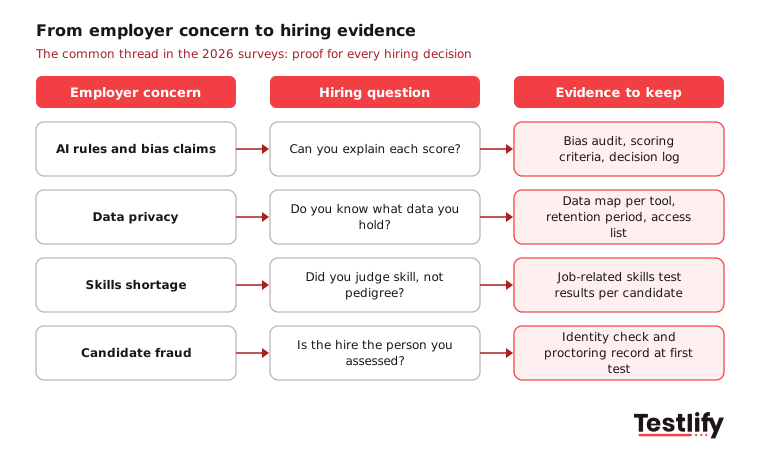
Look at the concerns side by side:
- AI regulation and bias claims ask: can you show your hiring tool treats groups fairly and explain each score?
- Data privacy asks: do you know what candidate data you collect, where it goes and why?
- The skills shortage asks: did you judge the candidate on what they can do, or on where they worked?
- Candidate fraud asks: was the person you assessed the person you hired?
A hiring process built on resumes and unstructured interviews struggles with all four at once. A resume cannot prove skill, an unstructured interview cannot be explained to a regulator, and neither one proves identity.
[AKASH INPUT: confirm or replace with a first-hand example] Across the teams we speak with at Testlify, the CHROs most worried about AI are often the ones with the least record of how their own human screeners decide. In my work with TA leaders, the fix that calms legal and the fix that improves quality of hire usually turn out to be the same one: a structured, skills-based first round with a written record of why each candidate moved on.
This is our view, not a survey finding: 2026 is the year hiring proof becomes a requirement rather than a nice extra. The surveys show the pressure. What they do not say is that the answer to most of it sits in TA, not in legal.
Key takeaway: The 2026 employer surveys read like a list of separate risks. For hiring teams, they are one requirement: keep evidence of skill, fairness and identity for every decision.
What should hiring teams do about these concerns in 2026?
Hiring teams should respond to the 2026 employer concerns by auditing AI tools in their hiring stack, moving screening from resumes to job-related skills, checking identity earlier, and keeping a clear record of how each decision was made. None of these needs a new budget line; most need a decision and an owner.
Concern from the surveys | What it means for hiring | What to do this quarter |
|---|---|---|
AI regulation and lawsuits (Littler: 84%, 79%) | Every AI score in hiring may need to be explained | List every AI tool in the hiring stack, ask each vendor for its bias audit and scoring logic |
Data privacy (Littler: 53%) | Candidate data and video are in scope | Map what candidate data each tool collects, how long it is kept, and who can see it |
Skills shortage (ManpowerGroup: 72%) | Resumes hide capable candidates | Replace resume filters with a short job-related skills test for the must-have skills |
Candidate fraud (Checkr: 67%) | The person assessed may not be the person hired | Check identity at the first assessment, not after the final interview |
Retention (Monster: 52%) | A bad hire costs twice | Track early attrition against first-round scores to see what predicts who stays |
The SHRM 2026 State of the Workplace release supports the first row: 57% of CHROs expect efforts to reduce bias in AI hiring tools to become more common this year, and 92% expect more AI in workforce operations overall.
If you use Testlify, skills tests from the test library come with 20+ proctoring checks, and the matching model completed a third-party NYC Local Law 144 bias audit in June 2023. Whatever tool you use, ask for the same proof.
What else did the 2026 employer surveys find?
The 2026 employer surveys also found that hybrid work has settled, mental health leave keeps rising, and financial pressure still tops the boardroom agenda. These matter for hiring because they shape which roles get approved and what candidates expect.
- Hybrid is the default: Littler found 77% offer some hybrid arrangement for roles that can be done remotely, 16% are fully on site and 6% fully remote. Monster found 54% say return-to-office mandates made hiring harder.
- Leave and accommodation are rising: 67% of Littler respondents saw more mental health leave and accommodation requests, and concern about accommodation lawsuits rose from 50% to 67%.
- Money comes first in the boardroom: Littler found financial conditions are the top board concern (52%), ahead of technology change (46%) and regulatory uncertainty (42%). SHRM found economic uncertainty has overtaken wage inflation as the top CHRO worry.
- DEI and immigration have not gone away: The share expecting DEI policy impact fell to 38%, but 73% still expect immigration enforcement by DHS and ICE to affect their workplace.
[AKASH INPUT: optional] We have seen the same split in demo calls this year: budget holders ask about cost per hire first, while TA leaders ask about fraud and fairness first.
FAQ: employer concerns survey 2026

Content Writer
Yashika Khandelwal is a Content Writer with 3+ years of experience creating research-backed content on hiring, talent assessment, and HR technology. She is a registered Organizational Psychologist and subject matter expert who combines behavioral science with practical recruitment insights to produce accurate, evidence-based content.
LinkedInRelated resources
View all
HR Statistics
Soft skills statistics: the 2026 numbers that matter

Workplace culture
How to create an employee recognition program in 9 steps

HR Toolkit
Email marketing specialist job description: duties, skills and a sample

Workplace culture
How to communicate with Gen Z workers: 9 tips for managers

Talent Acquisition
Hiring military veterans: a practical guide for employers in 2026

Talent Acquisition
Should job ads still list the years of experience qualified candidates need?
Get started.
Hire on proof, not resumes.
Run your first skills-based assessment free — no credit card required.