
7 innovative HR initiatives you must know in 2026
Discover how to create impactful HR initiatives with this comprehensive guide. Boost engagement, retention, and culture with actionable insights!

An HR initiative is a focused program with one goal, one owner, one measure of success, and an end date. A 90-day push to cut first-year attrition is an initiative. A wellbeing benefit that runs forever is a policy. Most of what gets called an initiative is really the second thing, which is why so few of them can show a result.
This guide covers what HR initiatives are, examples that hold up, ideas employees notice, the ones that shift engagement, the process fixes that free up HR's week, and how to tell whether any of it worked. It is written for the person who owns HR at a company under a few hundred people. That is often a founder, an operations lead, or an HR generalist covering hiring, payroll queries, and culture in the same afternoon.
 ChatGPT
 Gemini
 Claude
 Grok
Grok Perplexity
TL;DR
- An HR initiative is time-boxed and measurable. Programs and policies run indefinitely; initiatives finish and get judged.
- Start from a problem you can state as a number, such as 9.4 sick days per employee or a 22% first-year exit rate, then work backwards to the fix.
- Run two or three at a time. Six half-finished initiatives beat nothing, but they beat it by very little.
- The manager relationship decides whether an engagement initiative works. Perks layered on top of a weak manager do almost nothing.
- Measure with a baseline taken before launch, one primary metric, and one guardrail metric that tells you if the fix broke something else.
- Hiring is the cheapest place to start, because a better-screened hire keeps paying back through every other initiative on the list.

What are HR initiatives?
An HR initiative is a focused program HR runs to change something specific about how people are hired, developed, paid, supported, or kept. It has a start date, an owner, a target, and a finish. The word covers a lot of ground, from a hiring redesign to a mental health benefit, but the test is always the same: can you say what it is meant to move, and by how much?
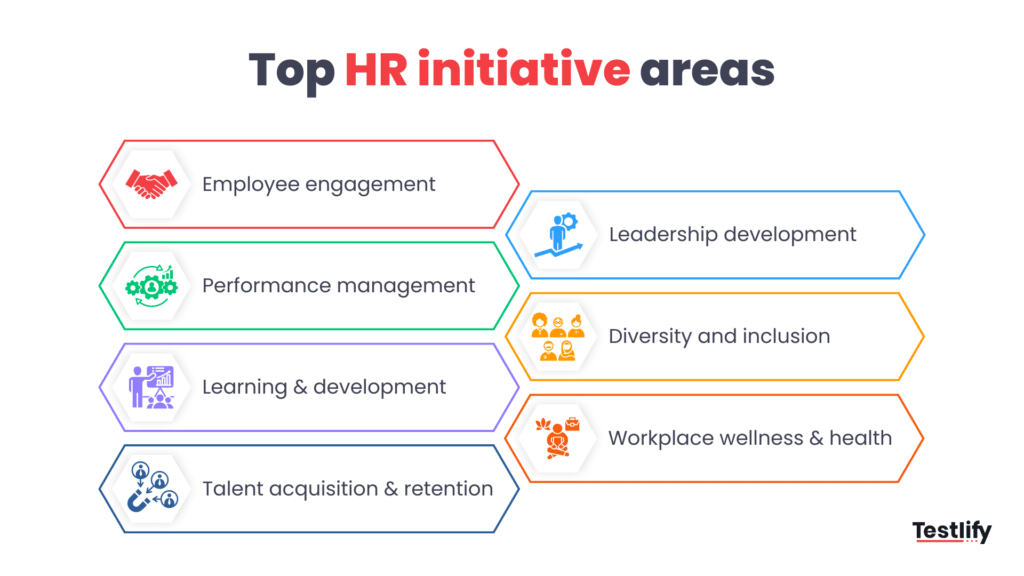
Most HR initiatives fall into one of these areas:
- Hiring and selection
- Onboarding and early tenure
- Learning, development, and internal mobility
- Employee engagement and recognition
- Wellbeing, mental health, and flexible work
- Diversity, equity, and inclusion
- Performance and performance management
- HR operations and process improvement
A single HR initiative is not the same as a program or a policy, and the confusion is expensive. A policy is a standing rule (parental leave, expenses, remote work). A program is an ongoing service (the learning catalog, the benefits package). An initiative is a change effort with a deadline. Once you finish it, it either becomes a program, becomes a policy, or gets switched off. Teams that never make that call end up with a dozen live commitments, no capacity, and no evidence.
Why human resources initiatives matter now
The case for human resources initiatives is not sentimental. Gallup puts the cost of low engagement at roughly $10 trillion in lost productivity worldwide, about 9% of global GDP, and each percentage point of engagement represents around 21 million employees. Gallup also traces much of the recent decline to managers rather than individual contributors, which is a useful clue about where to spend.
The labor market has cooled but not frozen. In July 2026, 3.1 million people in the US quit their jobs, a quits rate of 1.9%, so voluntary exits are still the largest single source of open roles for most employers. Replacing them is where the HR budget quietly goes.
Meanwhile the tooling has moved. SHRM's 2025 survey of 2,040 HR professionals found AI use in HR tasks at 43%, up from 26% a year earlier, with recruiting the most common application at 27%. Smaller teams can now run initiatives that used to need headcount. That changes what is realistic to attempt, and it changes which HR priorities belong at the top of the list this year.
What makes HR initiatives strategic?
Strategic HR initiatives pass four tests. They connect to a business outcome someone outside HR cares about. They have a named owner with time protected for the work. They carry a metric with a baseline. And they have an end date, so the organization finds out whether the idea was any good.
Calling something strategic does not make it so. A values refresh with no measure attached is a communications exercise. A hiring redesign that cuts a six-week screening loop to about ten days, and can prove it, is strategy, because it changes what the business can do next quarter. The honest version of this work is narrower and duller than the version in most HR decks, and it survives contact with a CFO.
One caveat worth stating early. Some good work resists measurement in a single quarter, culture being the obvious case. Do not fake a number for it. Run those as programs with qualitative review points, and reserve the initiative label for work you can actually judge.
What are HR initiatives examples that work?
Here are HR initiatives examples matched to the problem each one solves. Pick by the problem you have, not by what sounds good in an all-hands.
HR initiative | Problem it solves | Metric to watch | First step this month |
|---|---|---|---|
Structured skills-based screening | Wrong candidates reaching interviews; slow hiring | Time-to-hire, interview-to-offer ratio | Score one open role on skills before the first call |
First-90-days onboarding plan | Early attrition and slow ramp | 90-day exit rate, time to full productivity | Write one checklist with the hiring manager |
Manager conversation cadence | Weak engagement, surprise resignations | Engagement score, voluntary exits | Set a monthly one-to-one template for all managers |
Mental health and absence support | Rising sickness absence, presenteeism | Days lost per employee, return-to-work time | Publish what support exists and how to use it |
Skills and upskilling program | Capability gaps as roles change | Internal fill rate, skills coverage | Map the five skills your roles will need in two years |
Inclusive hiring redesign | Narrow pipelines, inconsistent decisions | Pipeline mix, offer rate by stage | Strip identifying detail from the first screening stage |
Recognition rhythm | Good work going unseen | Participation rate, engagement score | Give managers a 5-minute weekly recognition slot |
Two of those deserve more than a table row. The first is skills. The World Economic Forum expects 39% of key job skills to change by 2030, and 85% of employers say they will prioritize upskilling. For a 150-person company that does not mean a learning platform. It means picking the five skills the business will need in two years and building a way to measure who has them, which is also how you find the internal candidate you were about to advertise for. Building employee development programs around measured gaps beats buying a course library nobody opens.
The second is inclusion. McKinsey's 2023 study of 1,265 companies found those in the top quartile for ethnic representation on executive teams were 39% more likely to outperform financially than those in the bottom quartile. That correlation has been challenged by researchers who could not reproduce the result, so treat it as a reason to look, not as proof of causation. The stronger argument for an inclusive workplace is closer to home: consistent, job-relevant evaluation produces decisions you can defend when a candidate or a regulator asks how you chose. Start with the recruitment stage, where the pipeline is set.
HR initiatives: ideas employees notice
These HR initiative ideas for employees are the ones people actually notice, ordered roughly by effort against return for a team under 200 people.
- A recognition rhythm, not a scheme. Five minutes in the weekly manager meeting for specific praise, named and public. Costs nothing, works when it is specific.
- Flexible hours with clear core times. Vague flexibility creates anxiety about being seen. Written flexible work policies beat an unwritten culture of trust.
- A named mental health route. Most people cannot say what their employer offers. Publishing the route is a bigger step than buying more cover.
- A small learning budget with a deadline. An unused annual allowance is a promise, not a benefit. A quarterly one with a manager conversation gets spent.
- Internal-first hiring. Advertise open roles internally for a week before they go out. It surfaces people who were about to leave.
- Stay interviews. Fifteen minutes asking why someone stays, run at six and eighteen months. Cheaper than an exit interview and it arrives in time to matter.
- A working environment that supports focus. For distributed teams that means kit and norms, not more calls, as in these remote work environment ideas.
On wellbeing, the numbers argue for prevention over perks. The CIPD's 2025 survey recorded UK sickness absence at 9.4 days per employee a year, the highest in over a decade, with mental ill health cited by 41% of employers as a top-three cause of long-term absence. The same survey shows organizations under 50 people losing 4.5 days per employee against 13.2 days in those with 50 to 249, which is a reminder that these programs get harder as you grow, not easier. Workload and manager quality drive more of that number than the benefits catalog does, and both are within your control before renewal season. Fixing them does more for job satisfaction than another app.
Which HR initiatives for employee engagement work?
HR initiatives for employee engagement work when they change what a manager does on a Tuesday. They fail when they add a survey. Gallup's finding that the engagement decline sits largely with managers points the same way: the person who sets expectations, gives feedback, and decides who gets the interesting work has more effect on engagement than any central program.
So the shortlist is short. Give every manager a simple monthly one-to-one structure and check it is happening. Teach them to set clear expectations, which is the single item most engagement surveys score worst. Add recognition as a weekly habit rather than a quarterly award. Then use the survey to check your work, not to start it. More ways to boost employee engagement sit in that guide, but the order matters more than the list.
Pro tip: before launching an engagement initiative, look at where your voluntary exits cluster. If they sit under two or three managers, you have a management development problem wearing an engagement costume, and a company-wide program will not touch it.
Which HR process improvement ideas save time?
These HR process improvement ideas give a small team its week back, which is what makes the rest of this list possible.
- Cut the approval chain. Count the approvals on a leave request or an offer. Two is usually enough. Every extra one adds days and no judgment.
- Score candidates before the first call. Structured skills assessment moves the sift from CV reading to evidence, and it is the change that most reliably shortens a hiring loop.
- Template the repeatable writing. Offer letters, rejections, job ads, onboarding notes. Write once, edit per role.
- Automate the reminders, not the judgment. Probation dates, right-to-work checks, review cycles. SHRM's data shows recruiting as the top area of HR AI use at 27%, and reminders are the safest place to begin.
- Kill one report a quarter. Ask who reads it. If nobody answers in a week, stop producing it.
- Put policies on one page each. A policy nobody can find is a policy nobody follows, and it generates the questions that eat HR's day.
Hiring deserves the first slot because of what it compounds. Testlify's Human+AI Evidence-Based Hiring Framework describes the approach: combine AI-assisted evaluation with human judgment, using structured evidence instead of resumes, intuition, or inconsistent interviews. In practice that means role-relevant skills assessments, AI-assisted interviews with human review and override, multiple reviewer scoring, and results that sync into the ATS a team already runs. Consider a 150-person services firm hiring 20 people a year, purely as an illustration: scoring shortlists on job skills before the first conversation cuts interview time spent on candidates who were never going to fit, and gives every later initiative a stronger starting cohort to work with.
How do you measure an HR initiative?
Take a baseline before you launch, pick one primary metric, and add one guardrail metric that tells you whether the fix broke something else. Set the review date at launch. If you cannot name the number today, you will not be able to claim the win in six months, and the initiative will quietly become a program nobody evaluates.
Worked example. The problem is that 22% of new hires leave within a year. The primary metric is the 12-month retention rate for hires made after the change. The guardrail is time-to-hire, because a slower process that produces better hires still has a cost the business must accept knowingly. The baseline is last year's cohort. The review is at nine months, when the first affected group crosses the risky window.
Two habits make this easier. Report the same numbers every time, in the same order, so trends are visible. And separate the metric from the anecdote: the story of one great hire is useful in a board meeting and useless as evidence. The same discipline that governs performance management measurement applies here.
How do you implement HR initiatives?
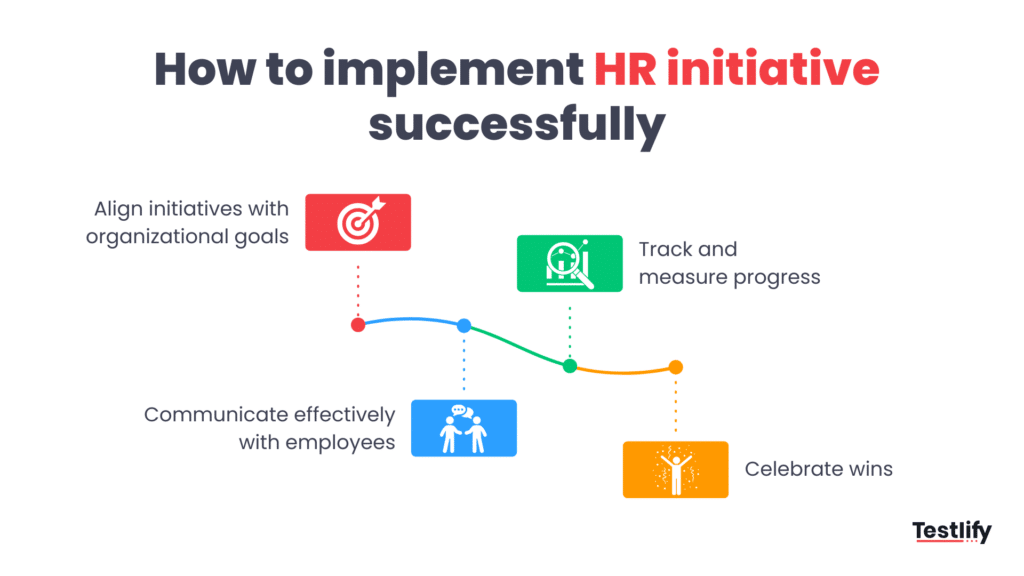
- Name the problem in a number. Not "improve culture" but "cut 90-day attrition from 18% to 10%".
- Get one executive sponsor. Someone who will defend the time it takes when a quarter gets busy.
- Scope it to one quarter. Anything longer is a program. Break it up.
- Tell people what changes for them. Most initiatives fail at this step, not at design. State what is different, when, and what is expected of managers.
- Instrument it before launch. Baseline captured, metric agreed, review date in the calendar.
- Decide at the end. Keep it, fix it, or stop it, and say which. Then start the next one.
Two or three initiatives at a time is the practical ceiling for a small HR team. A longer list of HR programs can run in the background, but a change effort needs attention, and attention is the constrained resource.
Hire on evidence, not guesswork
If hiring is where you start, start with the evidence. Testlify runs role-relevant skills, cognitive, and personality assessments, AI-assisted interviews with human scoring and override, anti-cheat controls, and integrations with the ATS you already use, so shortlists arrive scored rather than sorted by CV. Book a demo and bring one open role to work through.
Key takeaways
- Time-boxing is the whole difference. An initiative that never ends becomes a program by default, and programs are rarely evaluated. Giving the work an end date forces a verdict, which is how HR builds a track record executives believe. Put the review date in the calendar on day one.
- Pick the problem by its number, not its popularity. A 9.4-day absence average, a 22% first-year exit rate, or a six-week hiring loop each point at a different fix. Starting from the metric keeps you from running the initiative that was easiest to sell internally.
- Managers are the delivery mechanism. Gallup ties much of the engagement decline to managers, so an engagement initiative that does not change manager behaviour is decoration. Budget for manager time and coaching before perks.
- Two or three at once, no more. Attention is the constraint in a small HR team. A short list finished beats a long list abandoned, and finished work is what earns the budget for the next round.
- Hiring compounds. Every other initiative works on the people selection brought in, so structured, skills-based screening improves the starting cohort for engagement, development, and retention work alike.
- Write down the caveat. Some work, culture especially, resists a clean quarterly number. Say so, run it as a program with qualitative checkpoints, and protect the credibility of the numbers you do report.
FAQs

Content Writer
Yashika Khandelwal is a Content Writer with 3+ years of experience creating research-backed content on hiring, talent assessment, and HR technology. She is a registered Organizational Psychologist and subject matter expert who combines behavioral science with practical recruitment insights to produce accurate, evidence-based content.
LinkedInRelated resources
View all
HR & recruitment
Quiet hiring: A bold solution or a hidden workplace problem?

HR & recruitment
Different recruitment types: Pros, cons, & what works best

HR & recruitment
HR workplace failures: What’s breaking your culture?

HR & recruitment
Leveraging paraphrasing tools to enhance recruitment strategies

HR & recruitment
7 steps to master candidate profiling for top talent
![How to perform a talent review in 2026 [in 5 simple steps]](/wp-content/uploads/2025/01/How-to-perform-a-talent-review.png?dpl=dpl_6Z8Gzi5dgny5ePrnCfPbRPCRYCA7)
HR & recruitment
How to perform a talent review in 2026 [in 5 simple steps]
Get started.
Hire on proof, not resumes.
Run your first skills-based assessment free — no credit card required.