
Top 8 HR priorities to look at in 2026
Discover the ultimate guide to HR priorities, focusing on talent, engagement, well-being, tech, and more to elevate your HR strategies in 2025.

Human Resources, at the heart of every organization, ensures that the people driving the business forward are supported, developed, and engaged. More than recruitment and payroll, however, HR is more than just recruiting and paying employees. It has evolved into a strategic function that plays a critical role in determining the future of organizations.
An SHRM report highlighted, 45% of employees experienced burnout due to organizational changes, highlighting the need for effective change management.
In this blog, we dive deep to bring you the most important priorities HR should focus on. Regardless of whether you are an HR manager, director, or specialist, understanding and embracing these priorities will be able to build a successful workplace that attracts and retains top talent, fosters innovation, and contributes to organizational success.
 ChatGPT
 Gemini
 Claude
 Grok
Grok Perplexity
Why are HR priorities important?
Before delving into the specifics of HR priorities, let’s first understand why these priorities matter. In today’s fast-paced, ever-changing world, HR is not just a support function. It’s a key driver of organizational success. The right HR priorities can:
- Improve employee engagement and productivity.
- Foster a positive organizational culture.
- Enhance the employer brand, making the organization attractive to top talent.
- Help retain employees and reduce turnover.
- Support business goals and drive strategic initiatives.
When HR aligns its priorities with the company’s overall objectives, it creates a seamless and effective approach to managing people. Let’s look at the core HR priorities that should be on every HR professional’s radar.

Top 8 HR priorities to look at in 2025
Being an HR professional is no small task. You juggle multiple responsibilities-from hiring and onboarding to employee engagement and compliance-while also shaping the overall organizational culture.
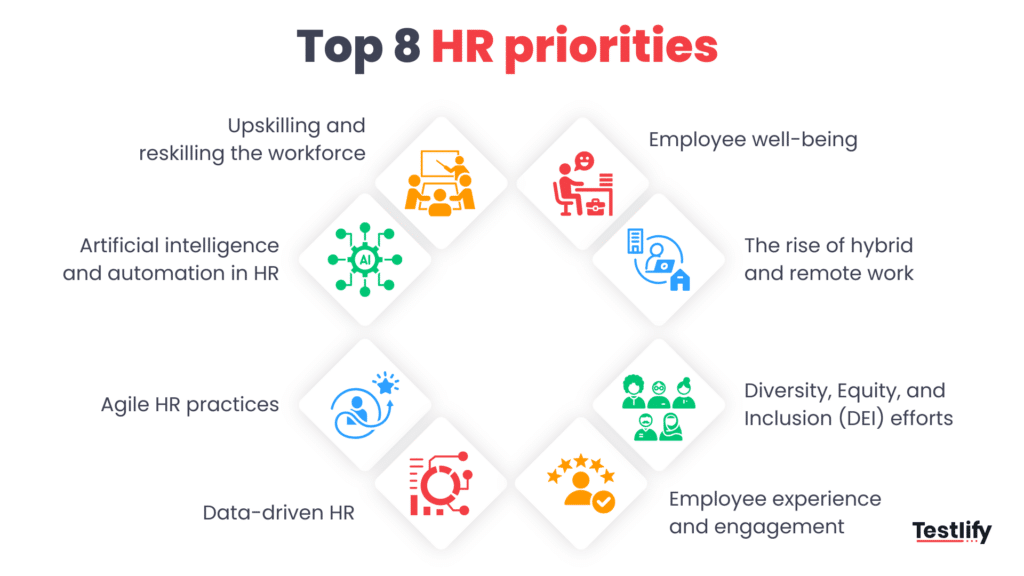
1. Employee well-being
Employee well-being has been gaining traction for a few years now, but in 2025, it’s more important than ever. With the residual impact of the pandemic, remote work, and growing consciousness about mental health challenges, it becomes essential for HR professionals to take a holistic approach to employee well-being.
It is no longer merely a matter of providing perks like gym memberships or counseling services; it’s about establishing an environment that supports and values employees in their personal and professional lives, hence fostering healthy work-life balance.
What you can do?
- Offer mental health resources: More than ever, employees are looking for workplaces that offer mental health support. Whether it’s therapy services, stress management workshops, or access to mental health apps, HR can help employees by removing the stigma around mental health and providing the tools they need to thrive.
- Flexible work arrangements: Flexible hours and hybrid work models are becoming standard. Offering flexibility allows employees to better manage their work-life balance and reduces stress levels.
- Physical health initiatives: Promoting physical health goes hand in hand with mental well-being. Encouraging employees to take breaks, offering wellness programs, and making health screenings available are all ways to show that you care about their physical health too.
2. The rise of hybrid and remote work
The pandemic accelerated this trend of remote work; it is here to stay. Recent studies reveal that the majority of employees have already expressed a desire for such setups, indicating that even if they leave their organizations, it will be due to the lack of remote options. As an HR person, it’s important to develop strategies to balance both the needs of the organization and the desires of wanting to work remotely.
What you can do?
- Create clear communication channels: With employees working from different locations, communication is key. Implement tools like Slack, Microsoft Teams, or Zoom to help teams stay connected, regardless of where they are.
- Focus on results, not hours: Shift the focus from how many hours employees work to the results they deliver. This creates a more results-driven culture and helps employees feel trusted and valued.
- Invest in technology: The right tools can make a huge difference in a remote or hybrid environment. 83% of HR professionals cited lacking the right HR technology as a challenge. You should ensure that employees have the technology and resources they need to be productive, whether that’s project management software, cloud-based collaboration tools, or reliable internet access.
3. Diversity, Equity, and Inclusion (DEI) efforts
Diversity, equity, and inclusion (DEI) efforts remain at the top of HR priorities in 2025. It is important to create a workplace that embraces people of all backgrounds and perspectives for innovation, employee satisfaction, and talent attraction. However, it is not just about quotas or checking boxes; DEI efforts must be authentic, long-term, and integrated into the company culture.
What you can do?
- Revise hiring practices: Ensure that your hiring process is fair and unbiased. Use blind recruitment practices, where possible, to remove unconscious bias. Implement training for hiring managers to make sure they understand the importance of diversity in the workplace.
- Inclusive training and policies: Develop training programs that focus on cultural competency, unconscious bias, and inclusivity. Regular workshops and discussions about DEI will help employees better understand these issues and create a more open, respectful work environment.
- Measure progress: It’s important to track the success of your DEI initiatives. Use metrics to measure representation, retention, and engagement. Make adjustments as needed to ensure that DEI goals are being met.
4. Employee experience and engagement
Employee experience is becoming a central HR priority quickly. It’s no longer enough to just focus on job satisfaction. In 2025, the focus will be on creating a holistic experience that encompasses every aspect of an employee’s journey from recruitment to onboarding, development, and beyond.
What you can do?
- Improve onboarding: The first few weeks of employment set the tone for the entire employee experience. Streamline your onboarding process to ensure that new hires feel welcomed, valued, and prepared for their roles.
- Regular feedback and recognition: Employees want to feel heard and appreciated. Implement regular feedback systems, such as one-on-one check-ins, and celebrate achievements big and small.
- Promote work-life balance: Encourage employees to take time off and disconnect from work. Support them in maintaining a healthy work-life balance by respecting their time outside of working hours.
5. Upskilling and reskilling the workforce
Upskilling and reskilling are important for growth, both for the employee and the organization, in the fast-changing work environment today. The skills required by most industries are constantly changing, and HR needs to take the lead in facilitating continuous learning and development.
What you can do?
- Offer learning and development opportunities: Provide employees with access to training resources, workshops, and courses that help them build new skills. Partner with online platforms like LinkedIn Learning or Coursera to offer flexible learning options.
- Identify skill gaps: Use data-driven approaches to identify areas where employees may be lacking the necessary skills. This will help you focus your training efforts on the areas that will have the most significant impact.
- Encourage career growth: Encourage employees to take ownership of their careers by setting development goals and providing regular coaching and mentorship. This will help employees feel more engaged and motivated.
6. Artificial intelligence and automation in HR
Artificial intelligence and automation are now entering the world of HR, and that is a good thing because they can help in automating administrative tasks, streamlining hiring processes, and improve employee engagement. HR professionals should be ready to tap into the power of AI and automation to boost efficiency and make better, data-driven decisions.
What you can do?
- Automate administrative tasks: Use AI-powered tools to automate time-consuming tasks like payroll processing, employee data management, and leave requests. This will free up HR professionals to focus on more strategic initiatives.
- Use AI for recruitment: AI can help streamline the recruitment process by analyzing resumes, assessing candidate suitability, and even conducting initial interviews. This can save time and ensure that hiring decisions are based on data rather than gut feeling.
- Improve employee experience: AI can also be used to create personalized employee experiences, such as chatbots that assist employees with HR-related questions or AI-driven feedback tools to track employee satisfaction.
7. Agile HR practices
Agility will be one of the most important traits for HR teams in 2025. Organizations need to pivot quickly in response to changes in the market, economy, or workforce. Agile HR practices help HR teams adapt to shifting priorities while maintaining employee engagement and productivity.
What you can do?
- Foster a culture of flexibility: Encourage an agile mindset within your HR team and across the organization. Be open to change, embrace experimentation, and iterate on processes quickly to find what works.
- Focus on short-term goals: Instead of rigidly sticking to long-term plans, focus on shorter-term goals that can be adapted as the situation changes. This allows HR to respond more effectively to immediate challenges.
- Empower employees: Allow employees to take ownership of their work and contribute ideas to help the company navigate change. An empowered workforce is more engaged and resilient.
8. Data-driven HR
Data will continue to play a central role in HR decision-making. From tracking employee performance to understanding turnover trends, HR professionals must leverage data to make informed, evidence-based decisions that benefit the entire organization.
What you can do?
- Implement HR analytics tools: Use software that provides insights into employee behavior, performance, and engagement. This data can help HR make more informed decisions about recruitment, training, and employee retention.
- Measure employee satisfaction: Regularly survey employees to gauge their satisfaction and identify potential issues before they become major problems. Use this data to improve the employee experience and make necessary adjustments to policies and practices.
- Predict future trends: HR analytics can also be used to predict future trends, such as turnover or skill gaps. By analyzing past data, HR professionals can take proactive steps to address potential challenges before they arise.
Conclusion
As HR professionals, we are key players in shaping the future of work. By concentrating on these top HR priorities and trends for 2024, we can create workplaces that are supportive, innovative, and adaptable. Whether it is the focus on employee well-being, remote work, or data use to make smarter decisions, it’s all about empowering employees, fostering inclusion, and driving organizational success.
Stay ahead of the curve, keep evolving, based on changing needs of your work force and organization.
Frequently asked questions (FAQs)

Related resources
View all
HR & recruitment
Recruiting active candidates: How and where to find?

HR & recruitment
Key compliance trends in 2026-27

HR & recruitment
What is a job aggregator? A recruiter’s guide
HR & recruitment
Candidate persona: A complete guide for recruiters

HR & recruitment
Why and how to choose the right recruitment CRM?
HR & recruitment
Compassionate leave: A guide for HR and employees
Get started.
Hire on proof, not resumes.
Run your first skills-based assessment free — no credit card required.