
50+ Core Values Examples for Companies, Teams and Hiring
A list of 50+ core values with real company examples, values by team, personal values, and how HR teams can write and hire for each.
Most companies have core values. Far fewer have values that change who they hire, promote or let go.
Core values are the few principles that guide how a company, team or person makes decisions, especially when the right choice is not the easy one. This guide gives you 50+ core values examples, including integrity, ownership, customer focus, curiosity and teamwork. You will also see the value sets real companies publish, values by team, and the behaviors that make each one visible at work. Use it to pick, write and hire for values your people can act on.
TL;DR: - This guide lists 50 common core values grouped into six themes. - It shows real company value sets from Amazon, Walmart Global Tech, Toast and others. - It suggests values for sales, support, engineering and other teams. - It covers personal core values and why values matter for hiring and retention. - It explains how to write values people can act on. - It shows how HR teams can turn each value into interview questions and scored evidence.
 ChatGPT
 Gemini
 Claude
 Grok
 Perplexity
What are core values?
Core values are a short set of beliefs that an organization or person commits to and uses to make choices. For a company, they describe how people are expected to work with customers, colleagues and each other. For a person, they describe what matters most when priorities clash.
Company core values usually sit next to the mission and vision. The mission says what the company does, the vision says where it is going, and the values say how people behave on the way. A good set has three to six values, each with a clear behavior attached. For the difference between a values list and a written statement, see the values statement definition.
There are two main kinds of core values:
- Company or workplace core values: shared standards for everyone in the business, used in hiring, reviews and promotions.
- Personal core values: the beliefs one person lives by, such as honesty, family or growth, which shape career choices and how they work.

What are the most common core values examples?
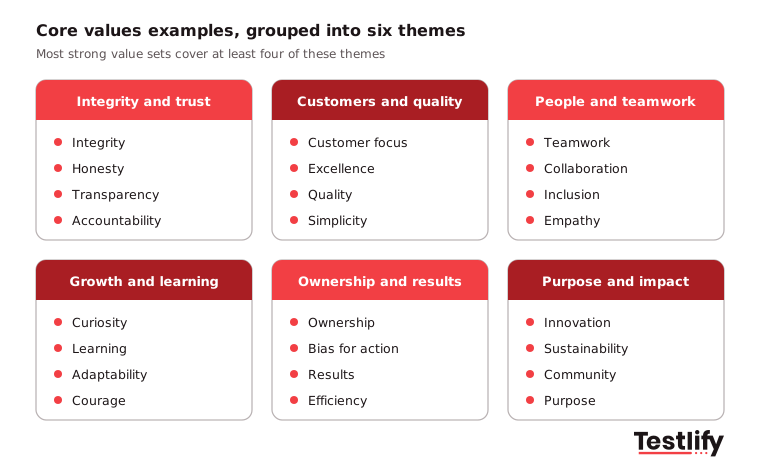
The most common core values examples are integrity, honesty, accountability, teamwork, respect, customer focus, innovation, excellence, curiosity and ownership. The 50 values below are grouped into six themes so you can see which areas your list covers and which it leaves out.
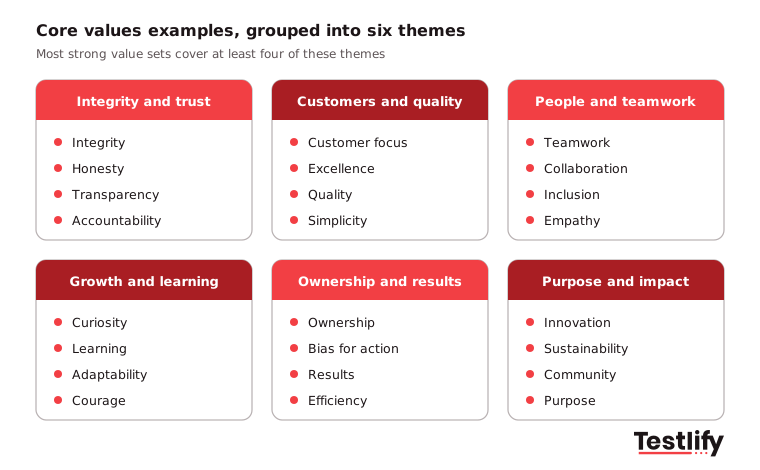
Recruiters should focus on the values that match how the role actually works, not on every value on the list. Integrity, ownership, customer focus, curiosity and teamwork matter in almost every job, so start there. For each one, look for past behavior:
- Integrity: the candidate admits a mistake and explains how they fixed it.
- Ownership: the candidate finishes what they start, even when it gets hard.
- Curiosity: the candidate learns new skills without being told to.
- Teamwork: the candidate shares credit and helps colleagues.
- Customer focus: the candidate solves the real need behind the request.
Ask for a specific example. Listen for what the person did, not what the team did. Score the answer against the behavior you defined before the interview. Then add one or two values that matter most for the role, such as resilience in sales or accuracy in finance.
How leading companies define their core values
Leading companies define their core values in short, specific statements written in their own voice, and each one points to a behavior people can see. The seven examples below come from the companies' own pages or from Built In's published company profiles.
Company | Core values | What stands out |
|---|---|---|
Amazon | 16 Leadership Principles, including Customer Obsession, Ownership, Bias for Action, Earn Trust and Deliver Results | Each principle opens with a behavior, such as "Leaders start with the customer and work backwards" |
Walmart Global Tech | Service to the customer, Respect for the individual, Strive for excellence, Act with integrity | Four classic values, each written as an action |
Toast | We're all in customer success, We embrace an ownership mindset, We're one team, We lead with humility, We raise the bar | First-person "we" statements that read as promises |
CAIS | Overcommunicate, Own it, Success is a team sport, Find a way, Find a better way | Short, memorable and easy to test in an interview |
Vertafore | Bias to action, Win together, Show up curious, Say it, do it, We love insurance | Mixes general values with one tied to its industry |
Enova | Customer first, Best answer wins, Operate as an owner, Accountable for results | "Best answer wins" tells people how debates end |
Qualtrics | Transparency, All in, Customer obsessed, One team, Scrappy (TACOS) | An acronym that makes the set easy to remember |
Sources: Amazon Leadership Principles and Built In's core values examples, both checked October 2026.
Two patterns repeat across these sets. Most include one value about customers and one about ownership. And the memorable ones describe a behavior ("Overcommunicate", "Say it, do it") rather than a trait.
What are examples of core values in the workplace by team?
Examples of core values in the workplace change by team, because each team faces different trade-offs. Company values apply to everyone, but hiring managers can name the two or three values that matter most for a role and describe what they look like in that job.
Team | Values that matter most | What the value looks like day to day |
|---|---|---|
Sales | Honesty, ownership, resilience | Forecasts deals as they are, follows up without being chased, recovers fast from a lost deal |
Customer support | Customer focus, empathy, reliability | Solves the problem behind the ticket, keeps promised callback times |
Engineering | Quality, curiosity, open feedback | Writes tests, asks why before building, takes code review comments without defending |
Operations and finance | Accuracy, accountability, cost-consciousness | Checks the numbers twice, flags errors early, questions spend that does not pay back |
People managers | Fairness, transparency, care for wellbeing | Explains decisions, gives the same standards to everyone, notices burnout early |
Leadership | Integrity, long-term thinking, courage | Makes the unpopular call, admits mistakes in public, plans past the next quarter |
Pro tip: When you open a role, ask the hiring manager to pick the two company values that matter most for it. Write one sentence on what each looks like in that job, and use those sentences in the job ad, the interview and the 90-day review.
What are personal core values examples?
Personal core values examples include honesty, family, growth, independence, health, security, adventure, faith, loyalty and creativity. Personal values guide life choices, such as which job to take or how to spend time, so they are often broader than company values.
Common personal core values:
- Honesty: telling the truth even when it costs you.
- Family: putting the people closest to you first.
- Growth: choosing challenges that stretch your skills.
- Independence: wanting control over how and when you work.
- Health: protecting physical and mental wellbeing.
- Security: valuing stability for yourself and others.
- Creativity: making new things and finding new approaches.
- Loyalty: staying committed to people and promises.
- Achievement: setting high goals and meeting them.
- Kindness: treating people well, even when it is not expected.
To find your own, start with a long list, keep the words that feel true, group similar ones, and cut to three to five. Then test each against a real decision you made.
Personal values also come up in interviews. "What are your core values?" is a common question, and the strongest answers name two or three values and give one short story for each. For HR teams, that question works best when the interviewer knows which company values the story should map to.
Why are core values important?
Core values are important because they shape who joins, who stays and how people make decisions when no rule covers the situation. Clear values give hiring teams a shared standard, and lived values make people more likely to stay.
The data points the same way:
- Retention. SHRM's State of Global Workplace Culture 2024 surveyed 17,234 workers in 19 countries. Only 15% of workers who rate their culture good or excellent are job hunting or plan to soon, against 57% of those who rate it poor or terrible.
- Values fit. The 2025 EY US Generation Survey of 5,000 full-time employees found that 94% say workplace culture affects their decision to stay. Of those planning to leave within a year, 22% say it is because their employer's values do not match their own.
- Attraction. An iHire survey reported by HCAMag in May 2026 found that 81% of job seekers are more likely to apply when a job posting includes the employer's core values.
For HR and TA teams, values matter most at three points: the job ad (who applies), the interview (who gets hired) and performance reviews (who gets promoted). Values that appear in none of these are a poster, not a standard. To check whether values are lived, see how to measure workplace culture.
How do you write strong core values?
Writing strong core values starts with how your best people already behave, not with a list of nice words. Collect examples of the best decisions people have made, find the patterns, and write each value as a short phrase with one sentence on the behavior it expects.
- Collect real stories. Ask employees, managers and customers for moments when the company was at its best and its worst.
- Find the patterns. Group the stories and name what the good ones have in common.
- Pick three to six. More than six is hard to remember and harder to hire for.
- Add the behavior. Write one or two sentences on what the value looks like in practice, and what it rules out.
- Test the trade-off. A real value costs something. If no one would ever disagree with it, it is too vague to guide a decision.
- Wire it into the people process. Put each value into job ads, interview scorecards, onboarding and reviews within the first quarter.
Here is how generic values become usable ones:
Weak value | Stronger version | Why it works |
|---|---|---|
Integrity | Say it, do it: we deliver what we promised by the date we gave, or flag it early | Names a behavior you can check |
Teamwork | Help first: we answer a colleague's blocker before starting new work | Sets a priority when time is short |
Innovation | Ship, then improve: we release early and fix what users tell us | Shows the trade-off (speed over polish) |
Customer focus | Best answer wins for the customer, not for the most senior person | Tells people how debates end |
Transparency | Bad news travels fast: problems are raised the day we see them | Easy to spot and reward |
Key takeaway: A core value is only useful if two people would agree on whether someone lived it. If you cannot describe the behavior, you cannot hire, coach or promote for it.
How do you hire for core values?
Hiring for core values works when each value is turned into a behavior, a structured interview question and a scoring guide that every interviewer uses the same way. Without that structure, "values fit" becomes gut feel, which favors people who look and talk like the current team.
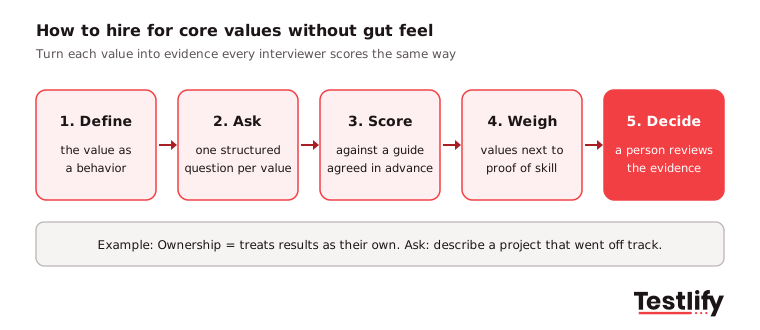
- Define the behavior. Use the one-sentence behavior from your values list, not the single word.
- Write one question per value. Ask for a past example ("Tell me about a time...") or a realistic scenario ("What would you do if...").
- Agree on what good looks like. Write what a strong, average and weak answer contains before the first interview.
- Score each value separately. Interviewers score on their own before the debrief, so the loudest voice does not set the score.
- Weigh values next to skills. Values decide between candidates who can do the job. They do not replace proof of skill.
Value | Behavior to look for | Interview question | A strong answer shows |
|---|---|---|---|
Integrity | Does the right thing when no one is watching | Tell me about a time you found a mistake that would not have been noticed. What did you do? | Raised it, owned the fix, no blame |
Ownership | Treats results as their own | Describe a project that went off track. What did you do to recover it? | Specific actions taken, not just reported |
Customer focus | Solves the real need, not just the request | Tell me about a time a customer asked for one thing but needed another. | Asked questions, changed the plan, checked the result |
Curiosity | Learns before acting | What is something you learned recently to do your job better? How did you learn it? | Self-started, applied the learning |
Teamwork | Puts team results ahead of personal credit | Tell me about a time you helped a colleague hit a deadline at a cost to your own work. | Clear trade-off, shared credit |
Open feedback | Gives and takes feedback well | Tell me about feedback that was hard to hear. What did you change? | Named the change, no defensiveness |
Culture fit and values fit are not the same thing. Culture fit asks "would I enjoy a drink with this person?" Values fit asks "would this person make the decisions we expect?" For more on the difference, read our article on culture fit vs skill fit.
How can Testlify help you hire for core values?
Testlify helps HR teams check values-related behaviors with the same structure they use for skills. The test library of 3,500+ tests includes situational judgment tests that put candidates in realistic work scenarios, integrity tests, and personality tests such as Big Five and DISC.
- Scenario-based tests: situational judgment tests show how a candidate handles ethical calls, conflict and priorities, which maps well to values like integrity and teamwork.
- Integrity and personality: the integrity test and personality tests add a structured view next to the interview.
- Structured AI interviews: role-based questions, including the values questions above, are asked and scored the same way for every candidate, with a reviewer making the final call.
Use these results as evidence for the interviewer, not as the decision. Values are best confirmed in a structured conversation, backed by test data. To see how values show up after the hire, read how to measure workplace culture.
Ready to hire for the values that matter?
Pick two values for your next open role, write one question for each, and score every candidate the same way. To add scenario-based evidence, browse the Testlify test library and start a 7-day free trial, no credit card required.
Book a demo to learn how Testlify can help you identify top talent with the values you are looking for.
Frequently asked questions

People and Talent Partner
Arushi Shah runs day-to-day talent acquisition and candidate experience at Testlify. She writes on interviewing, structured hiring, and giving candidates a fair, fast process.
LinkedInRelated resources
View all
Workplace culture
How HR can support managers in layoff communication

Workplace culture
What is cultural alignment and why is important in 2026?

Workplace culture
How Toxic Company Culture Drives Employee Attrition

Workplace culture
5 most pressing issues in the workplace (with solutions)

Workplace culture
5 methods to improve team dynamics and employee behaviors

Workplace culture
How to bridge the generation gap in employee communications
Get started.
Hire on proof, not resumes.
Run your first skills-based assessment free — no credit card required.