
What is regretted attrition and how to reduce it?
Discover how HR can tackle regretted attrition, retain top talent, and improve engagement with actionable strategies and expert insights.

The resignation you did not see coming usually lands from someone you were counting on. Regrettable attrition is the voluntary loss of an employee you wanted to keep: a strong performer, a hard-to-replace specialist, or the person who quietly holds knowledge that walks out the door with them. It is the expensive kind of turnover, and most of it is avoidable. This guide covers what regrettable attrition means, how it differs from regretted and unregretted attrition, what it costs, why it happens, and the hiring and retention moves that bring it down.
TL;DR
- Regrettable attrition is when a high performer or hard-to-replace employee leaves voluntarily and you wish they had stayed.
- Unregretted attrition is the opposite: a departure that does not hurt the team, and sometimes helps it.
- Replacing that person is costly. Gallup puts the bill at one-half to two times their annual salary.
- Gallup also finds 42% of turnover is preventable, so this is a problem you can actually act on.
- Many regrettable exits trace back to the hire itself. A wrong-fit hire tends to leave sooner and cost more.
- Track a regrettable attrition rate, run stay interviews, and hire on real skills to keep your best people.
 ChatGPT
 Gemini
 Claude
 Grok
Grok Perplexity
What is regrettable attrition? Meaning and definition
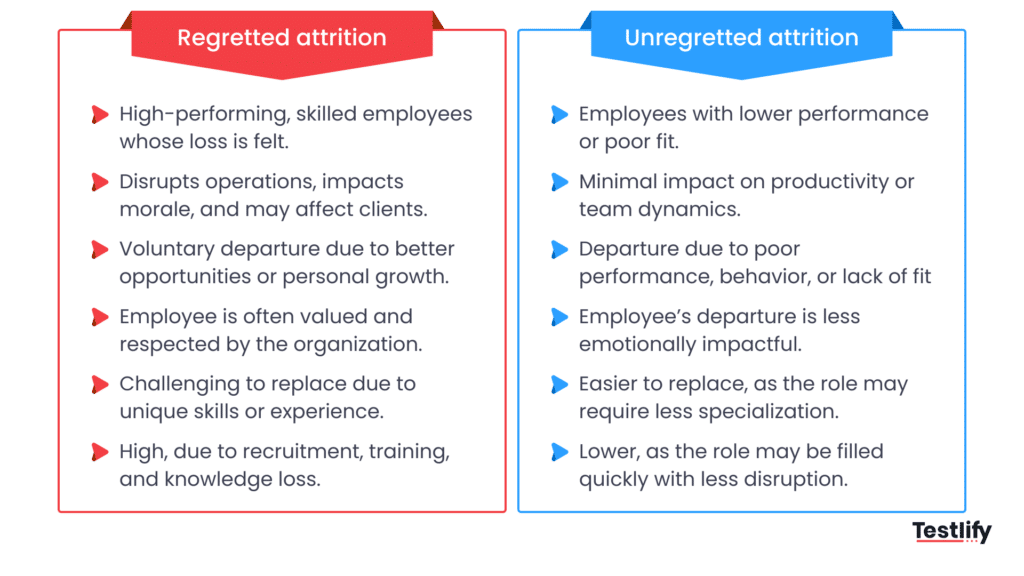
Regrettable attrition is the voluntary departure of an employee the company wanted to keep. Think of your top engineer, a manager who holds the team together, or a specialist whose knowledge is hard to replace. When that person quits, the loss stings, and the cost lands on hiring, ramp time, and lost output. It is the turnover that keeps a Head of TA up at night.
The word “regrettable” is the signal. Not every exit is a setback. This one is, because you would have fought to keep the person if you had seen it coming. That is why measuring it separately from your overall employee attrition rate matters: a healthy-looking headline number can still hide a steady drain of exactly the people you could least afford to lose.
Regretted attrition meaning: is it the same term?
Yes. Regretted attrition and regrettable attrition mean the same thing, and most HR teams use them interchangeably. Both describe a wanted employee choosing to leave. You will see “regretted attrition” more often in engagement surveys and “regrettable attrition” more often in workforce-planning decks, but the metric behind them is identical: exits you wish had not happened.
“Regretted loss” and other terms for the same problem
A few other labels point at the same idea. “Regretted loss” shows up in finance and workforce reports for the same concept: a departure the business did not want. Some teams say “regrettable turnover” or “high-value attrition.” The vocabulary shifts by department, but the question underneath never changes. Did you lose someone you needed, and could you have kept them?

What is unregretted attrition?
Unregretted attrition is the voluntary or planned exit of an employee whose departure does not hurt the team, and sometimes helps it. Think of a persistent underperformer, a poor culture fit, or a role the business no longer needs. Losing them frees up budget, opens a seat for a better-fit hire, and can lift the morale of the people who stay.
Here is the catch: a high exit count is not automatically bad, and a low one is not automatically good. If most of your leavers are unregretted, your headline turnover number can look alarming while your team gets stronger. If most are regrettable, a calm-looking number can hide a real problem. Split the two before you judge any attrition figure.
Regrettable turnover vs non-regrettable turnover
Regrettable turnover and non-regrettable turnover are the turnover-side names for the same split. Regrettable turnover is the loss of people you wanted to keep. Non-regrettable turnover is the loss of people whose exit does not set you back. Sorting every departure into one bucket or the other is the single most useful thing you can do with your exit data, because it tells you whether to worry or to move on.
Signal | Regrettable turnover | Non-regrettable turnover |
|---|---|---|
Who leaves | High performers, critical-role and hard-to-replace staff | Underperformers, poor-fit or redundant roles |
Effect on the team | Lost knowledge, slower delivery, morale dip | Neutral to positive, opens a better-fit seat |
What you should do | Investigate the cause and fix it fast | Backfill thoughtfully or reallocate the budget |
Why does regrettable attrition happen? Common causes
Regrettable attrition rarely comes down to pay alone. Most wanted employees leave because of a slow build-up of reasons a manager could have caught. That is the useful part: Gallup research finds that 42% of employee turnover is preventable, yet most of it gets ignored until the resignation lands. The common drivers below are worth an honest audit.
- No path forward. Strong people leave when they cannot see the next role. If growth stalls for a year, they start looking, and the best ones get offers first.
- A manager problem. People join companies and quit managers. A boss who does not coach, recognize, or listen is the fastest route to a regretted exit.
- Below-market pay. Money is rarely the only reason, but a clear pay gap gives a wavering employee the final push and an easy story to tell.
- Burnout and workload. The people you rely on most absorb the most work. Pile it on without relief and you burn out exactly the staff you cannot replace.
- A culture that grinds. A toxic workplace culture drives out high performers first, because they have the most options.
- The wrong hire from day one. Some regrettable exits were mis-hires all along: someone sold well in interviews but never fit the role, so they disengage and leave.
What is the true cost of regrettable attrition?
The true cost of regrettable attrition is far more than a recruiter fee. Gallup estimates that replacing an employee costs one-half to two times their annual salary once you add hiring, onboarding, lost productivity, and the ramp time before a new hire is fully effective. For a senior person, that easily runs into six figures before the replacement writes a line of useful work.
The bill climbs with seniority. Lose a frontline worker and you feel it; lose a leader and you feel it for a year. The rough shape, drawn from Gallup’s replacement-cost work, looks like this.
Who leaves | Typical replacement cost (share of annual salary) |
|---|---|
Frontline or entry-level role | About 40% |
Skilled or technical professional | About 80% |
Manager or leader | Up to 200% |
Scale makes it real. BLS data shows the U.S. quits rate has held around 2% of the workforce every month, meaning millions of people leave voluntarily each month. Not all of that is regrettable, but a slice of it always is. And SHRM’s 2025 benchmarking puts median voluntary turnover at 9% across more than 2,300 organizations. If even a third of your share is people you wanted to keep, the cost compounds fast.
How to calculate the regrettable attrition rate
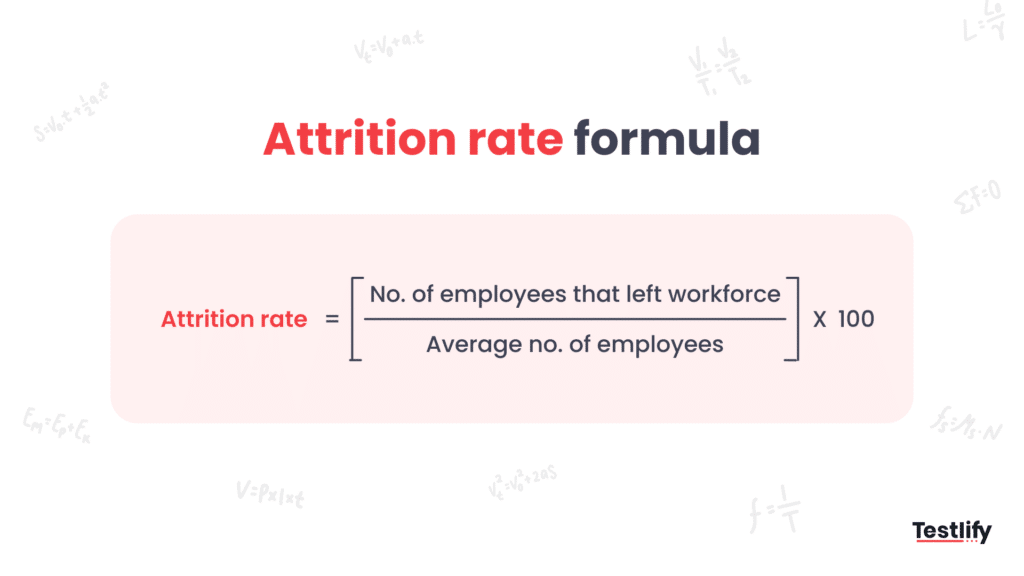
Flag each voluntary exit as regretted or unregretted (managers usually know within a beat), then divide. As a share of exits: regretted exits divided by total exits, times 100. As a share of the workforce: regretted exits divided by average headcount, times 100. Say a 500-person team loses 40 people in a year and 18 were people you wanted to keep. That is 45% of exits regrettable, or 3.6% of the whole workforce. An attrition rate calculator handles the base math so you can focus on the regretted split.
Can better hiring reduce regrettable attrition?
Yes, and this is the lever most retention advice skips. A share of regrettable attrition is set before the person ever starts: hire for the wrong signals and you get someone who looks great on paper, struggles in the role, disengages, and leaves inside a year. Fix the hire and you remove a chunk of the problem at the source, not after the exit interview.
Skills are the reason this matters more each year. The World Economic Forum projects that 39% of workers’ core skills will change by 2030. Hire on a resume and a good interview, and you are betting on signals that age quickly and predict fit poorly. Hire on demonstrated skills, and you keep people who can actually do the evolving job, which is the same reason they tend to stay.
This is the idea behind the Testlify Quality-of-Hire Learning Model: connect the evidence you gather before a hire (skills tests, work samples, structured interviews) to what happens after (performance, retention, manager feedback), then feed that back into who you screen in next time. Over a few cycles you learn which pre-hire signals actually predicted the people who stayed, and you stop repeating the hires that turned into regretted exits. A 500-person company hiring 20 support reps a quarter could, for example, run a skills assessment before the first interview, keep only candidates who clear the bar, and watch first-year regrettable attrition on that team fall as fit improves.
How do you reduce regrettable attrition?
You reduce regrettable attrition by catching the signals early and acting before the resignation, not after. These five moves do most of the work.
- Run stay interviews, not just exit interviews. Ask your strongest people what would make them leave, and what keeps them, while you can still act on the answer. Exit interviews only tell you why it is already too late.
- Give every strong performer a visible next step. A named growth path, a stretch project, or a clear promotion timeline. People rarely leave a job where they can see themselves in two years.
- Fix the manager layer first. Train managers to coach and recognize, and remove the ones who cannot. This is the highest-return retention move because so many regretted exits are really manager exits.
- Benchmark pay for critical roles. You do not have to top the market everywhere, but a clear gap on a hard-to-replace role is a standing invitation for a competitor to poach.
- Hire for fit and skill up front. Use structured, skills-based screening so the people you bring in can do the role and want to stay in it. Fewer mis-hires means fewer regretted exits a year later.
Pro Tip: Do not average your regrettable and unregretted attrition into one number. Report them side by side every quarter. A rising regretted line with a flat headline rate is the early warning most dashboards bury, and it is the one worth a same-week response.
See who will actually stay before you hire them. Testlify scores candidates on the real skills the role needs, so your shortlist is built on evidence instead of a good interview. Fewer mis-hires means fewer regretted exits a year later.
Key Takeaways
- Regrettable attrition is the turnover that costs you. It is the voluntary loss of people you wanted to keep, so it deserves its own metric, separate from your headline rate that treats every exit the same.
- Split every exit into regretted and unregretted. The same turnover number can mean a stronger team or a quiet crisis. Only the split tells you which, and whether to act or move on.
- The cost is real and rises with seniority. Replacing a wanted employee runs one-half to two times their salary, so a handful of regretted exits a year is a six-figure problem, not an HR footnote.
- Most of it is preventable. With 42% of turnover avoidable, the resignation you did not see coming was usually signalled months earlier by a stalled career, a weak manager, or burnout you could have eased.
- A lot of it starts at the hire. Wrong-fit hires become regretted exits. Screening on real skills up front removes part of the problem before anyone is even onboarded, which is cheaper than any retention program.
- Measure, then act on the signals. Track the regrettable attrition rate, run stay interviews, fix the manager layer, and benchmark pay for critical roles so you catch a flight risk while you can still change the outcome.
Frequently asked questions

Content Writer
Yashika Khandelwal is a Content Writer with 3+ years of experience creating research-backed content on hiring, talent assessment, and HR technology. She is a registered Organizational Psychologist and subject matter expert who combines behavioral science with practical recruitment insights to produce accurate, evidence-based content.
LinkedInRelated resources
View all
HR & recruitment
16 HR skills every professional need

HR & recruitment
5 Essential HR goals and objectives for a thriving 2026

HR & recruitment
101 guide to using the 9-box matrix

HR & recruitment
Modern recruitment hacks and pitfalls to avoid in 2026

HR & recruitment
7 innovative HR initiatives you must know in 2026

HR & recruitment
Quiet hiring: A bold solution or a hidden workplace problem?
Get started.
Hire on proof, not resumes.
Run your first skills-based assessment free — no credit card required.