
Learning trends for 2026: what HR and L&D teams need to know
The learning trends shaping 2026: AI personalization, flow-of-work training, upskilling and team-based learning, and how to act on them.

Spending per employee on training is falling, yet the pressure to close skills gaps keeps rising. Learning trends for 2026 point to one shift: training is moving off the course calendar and into daily work.
AI now does more of the personalizing, and managers do more of the reinforcing. Below are six learning trends and what to do about each, so every program can move a number, not just a completion rate.
TL;DR:
- AI-powered personalization is the top learning trend, but early returns are mixed, so pilot one role first.
- Learning is moving into the flow of work, with short prompts inside the tools people already use.
- Upskilling and reskilling are the top priority as skills change faster than training catalogs.
- Mentorship and team-based learning matter more as leaders see performance as a collective outcome.
- Microlearning and simulation give people short, practiced formats that stick.
- Measuring impact means tying training to promotions, retention and skill scores, not completion rates.
 ChatGPT
 Gemini
 Claude
 Grok
 Perplexity
What is driving learning trends in 2026?
Learning trends in 2026 are driven by three forces: AI is changing which skills a job needs, budgets are tightening, and employees are disengaged. A SHRM benchmarking study of more than 4,600 organizations found median L&D spending per employee fell 28% from 2025.
Median training hours per employee held flat at 8 hours. A World Economic Forum projection cited by Whatfix expects 44% of core skills to change by 2028, with half the workforce needing reskilling.
That gap between flat hours, lower spend and faster skills change shapes every trend below. Each one is about doing more with each training hour: personalizing it with AI, embedding it in work and proving it changed something.

Why is AI-powered personalization the top learning trend for 2026?
AI-powered personalization is the top learning trend for 2026 because it is the one most L&D teams are already testing, with mixed early results. In LinkedIn's Workplace Learning Report, 71% of L&D professionals said they were experimenting with or integrating AI into their programs.
Early results are uneven: one analysis found close to 95% of businesses have seen little return from in-house AI learning tools so far. Platforms built specifically for AI-optimized training report efficiency gains of around 57% and 20 to 30% lower training costs.
AI personalization shows up in three places for most teams: content recommendations that match a role and skill gap, auto-generated practice material, and adaptive paths that change difficulty based on how someone performs. The organizations seeing a return tend to use AI for a narrow, well-defined job (recommend the next module, generate a quiz) rather than a general-purpose tutor.
Pro tip: Start AI personalization with one skill area and one role, measure the completion and performance change, then expand. A narrow pilot is easier to prove and easier to kill if it does not work.
How is learning moving into the flow of work?
Learning is moving into the flow of work because employees want training that fits the task in front of them, not a separate session later. A LinkedIn Workplace Learning Report found 94% of employees would rather learn while working than step away for a course.
Microlearning drives much of this shift: a Brandon Hall Group study found it can lift knowledge retention by up to 70%. Separate research on digital learning formats found retention climbing from 8 to 10% with passive formats to 25 to 60% with active, in-context practice.
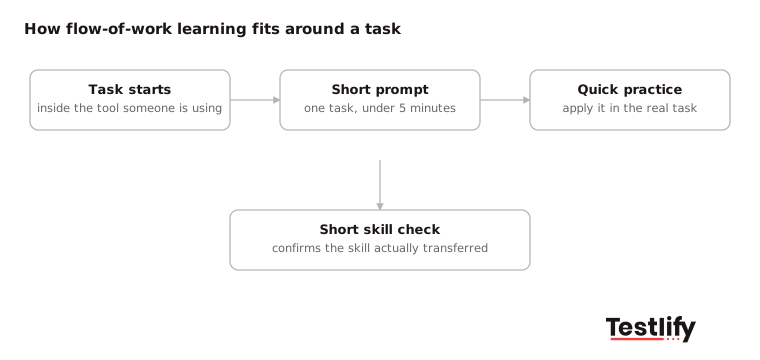
In practice, flow-of-work learning means short prompts inside the tool someone already uses, a two-minute video linked from a ticketing system, or a checklist that appears at the moment a task starts. how to create a learning and development plan walks through building this kind of plan around real tasks instead of a course catalog.
Why are upskilling and reskilling top L&D priorities in 2026?
Upskilling and reskilling are top L&D priorities in 2026 because the skills a role needs are changing faster than most training catalogs can keep up. SHRM's 2026 benchmarking found only 32% of organizations offered AI training that went beyond basic compliance, even though critical thinking, judgment, and decision-making rose to the top of the skills employers expect to need over the next five years.
That gap between what is prioritized on paper and what is actually trained is where most reskilling programs stall.
Upskilling and reskilling cover the difference between the two and how to plan for both. A practical starting point is a skills gap analysis before any new program launches.
That way, training targets a real gap rather than a trend. Explore our article on the benefits of skills gap analysis for how to run one.
2026 learning trend | What is changing | What to do about it |
|---|---|---|
AI personalization | 71% of L&D teams testing AI, but most see little ROI yet | Pilot one role and skill, measure before scaling |
Flow of work | 94% prefer learning while working over separate sessions | Build short, in-context prompts, not new courses |
Upskilling and reskilling | 44% of core skills may change by 2028 | Run a skills gap analysis before building programs |
Mentorship and team learning | 13% of L&D leaders now prioritize team-building skills, up from zero | Pair formal training with manager and peer reinforcement |
Microlearning and simulation | Retention up to 70% higher with short, active formats | Replace long modules with short, practiced tasks |
Measuring impact | Spend per employee down 28% even as hours hold flat | Track promotions, retention and skill tests, not completions |
What role do mentorship and team-based learning play in 2026?
Mentorship and team-based learning play a bigger role in 2026 because training alone is not closing the engagement gap. SHRM's 2026 research found the share of leaders naming team-building a top management priority rose to 13%, up from zero.
SHRM researcher Aaron Hollinger noted that more leaders now see performance as a collective outcome rather than an individual one.
Across the teams Testlify works with, the pattern is consistent: a course someone finishes alone rarely changes behavior, but the same content reinforced by a manager in a one-on-one or practiced with a peer usually does. If managers are not coached to reinforce what their reports just learned, the learning mostly stays on paper.
To build that habit, see how to foster a culture of continuous learning across the organization.
Why are L&D teams using microlearning and simulations more?
L&D teams are using microlearning and simulations more because short, practiced formats beat long lectures on both time and retention. The shift fits a broader move toward skills-first, modular training. Instead of one long onboarding course, employees work through small pieces tied to a task, then practice it in a simulation close to the real job.
Simulation-based training adds a practice step that passive content skips: trying a task, failing safely, and trying again. For technical and process-heavy roles, that practice step is also where skills testing adds the most value, since a short assessment after a module shows whether the skill actually transferred.
The guide to learning and development activities breaks down 16 formats, including microlearning and simulation, with notes on when each one fits.
How are L&D teams measuring the business impact of training in 2026?
L&D teams are measuring the business impact of training in 2026 by tying programs to promotions, retention and skill scores instead of completion rates. SHRM's benchmarking found the share of budget spent on external training fell from 25% to 15%.
Median training hours stayed flat at 8 per employee, with the steepest budget drops at small and midsize organizations. Leaders are being asked to defend every dollar that is left.
In my work with HR and L&D leaders this year, the programs that survive budget reviews are the ones with a before-and-after number: a skill score, a time-to-productivity figure, or a retention rate for people who completed a program versus those who did not. human resource development covers how L&D fits into the wider HRD function that leadership is asking to prove its value.
Key takeaway: Pick the trend that fits a real gap in your organization, measure it with a number leadership already tracks, and expand from there.
How can skills tests support these 2026 learning trends?
Skills tests support these 2026 learning trends by turning "did the training work" into a measurable answer instead of a guess. Testlify's test library covers 3,500+ validated tests and 25+ question types.
A team can check whether a skill improved after a microlearning module or a mentorship cycle, not just whether someone attended. For more on running that check, see skills gap analysis tools.
SHRM and LinkedIn both flag AI literacy as a 2026 priority. A short assessment before and after an AI upskilling push shows whether it closed the gap.
Ready to measure your 2026 learning programs? Book a demo to see how Testlify's 3,500+ validated tests check skills before and after training, or browse the test library.
Frequently asked questions (FAQs)

Human Resources Lead
Snehi Parmar leads People at Testlify, owning hiring, culture, performance, and retention for a 90-person team. She writes on practical HR strategy and building people processes that scale.
Related resources
View all
Workplace culture
50+ Core Values Examples for Companies, Teams and Hiring

Workplace culture
What is cultural alignment and why is important in 2026?
Workplace culture
How Toxic Company Culture Drives Employee Attrition

Workplace culture
5 most pressing issues in the workplace (with solutions)

Workplace culture
5 methods to improve team dynamics and employee behaviors

Workplace culture
Workplace Communication: How to Build Team Harmony
Get started.
Hire on proof, not resumes.
Run your first skills-based assessment free — no credit card required.