
Interior designer interview questions: 40 to ask in 2026
A hiring team's guide to 40 interior designer interview questions, what good answers sound like, how to review portfolios and score fairly.
Interior designer interview questions help a hiring team check whether a candidate can turn a client brief into a space that works. That space must also look right, meet code and land on budget. The strongest interviews mix technical, process, behavioral and situational questions, then add a portfolio review and a short practical task. Every answer is then scored the same way. This guide gives you 40 questions grouped by skill area, with notes on what strong answers include. It also covers seniority levels, red flags and a simple scoring scale, so taste alone does not decide who you hire.
TL;DR / Key Takeaways
- General, technical, design process and client, behavioral and situational, each with notes on what a strong answer includes.
- Design and space planning, technical and software skill, client communication, budget and project control, collaboration, and judgment under pressure.
- Junior, mid-level and senior or lead designers each need a different focus.
- Focus on the candidate's own role and decisions, not only the finished photos.
- Keep it short, close to the real work, and paid if it takes more than about two hours.
- Use one 1, 3, 5 scale for every interviewer and write down the evidence.
- Spot signs a candidate cannot explain or own their work, and follow a five-stage hiring process so taste does not decide alone.
 ChatGPT
 Gemini
 Claude
 Grok
 Perplexity
What should interior designer interview questions assess?
Interior designer interview questions should assess six things: design and space planning, technical and software skill, client communication, budget and project control, collaboration with contractors and architects, and judgment under pressure. A good portfolio shows taste. The interview has to show how the candidate got there and whether they can repeat it on your projects.
The day-to-day work explains why. The US Bureau of Labor Statistics profile of interior designers lists duties such as working out the client's goals, planning how people move through a space, specifying lighting, finishes and fixtures, building a timeline and cost estimate, and coordinating with general contractors. Most drawings are done in CAD software, and BIM software is used for 3D work.
The role is also in steady demand. The BLS reports a median pay of $67,190 in May 2025, about 97,100 jobs, and roughly 7,700 openings a year through 2035. The ASID 2025 State of Interior Design report puts the average salary at $71,430 in 2024 and counts 17,447 active CIDQ certificate holders as of October 2024. Good designers have options, so a slow or vague interview loses them.

What general interior designer interview questions should you ask?
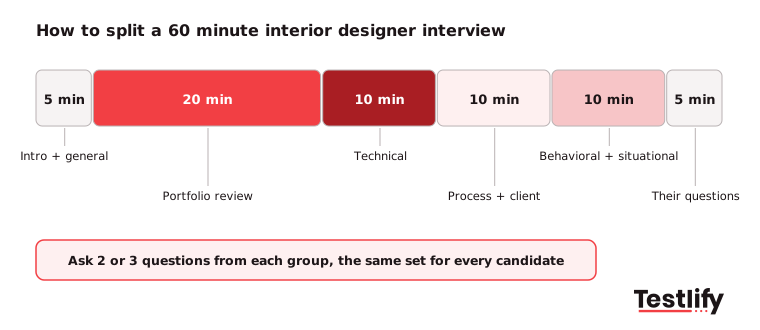
General interior designer interview questions open the conversation and show how the candidate thinks about their own work. Use them in the first 10 minutes.
- Walk me through your background and the types of projects you have worked on most: residential, commercial, hospitality or retail.
- Why interior design, and why our firm or team in particular?
- Which project in your portfolio best reflects how you work, and why that one?
- How do you keep up with materials, trends and codes? Name a recent source or event.
- What kind of project do you want more of in the next two years?
What a strong answer includes: specific project types and sizes, a clear reason for choosing your team, and named sources of learning such as trade shows, suppliers, CEU courses or design publications. Vague answers like "I just love design" tell you little.
What technical interior design interview questions should you ask?
Technical interior design interview questions test whether the candidate can draw, specify and plan to a standard your team can build from. Match these to the software and project types you actually use.
- Which CAD and 3D tools do you use daily, such as AutoCAD, SketchUp, Revit or 3ds Max, and what do you produce in each?
- How do you take a site survey and turn it into a measured floor plan?
- Explain the difference between ambient, task and accent lighting, and how you would layer them in a small office.
- How do you choose finishes for a high-traffic area, and what do you check beyond looks?
- Which building codes, fire ratings and accessibility rules come up most in your projects, and how do you check them?
- How do you plan space for a small room with several uses, such as a home office that doubles as a guest room?
- What goes into a full specification package for a contractor?
- How do you factor sustainability into material and furniture choices?
What a strong answer includes: named tools tied to real outputs (construction drawings, renders, schedules), a clear method for measuring and checking, and an understanding that codes, clearances and durability come before style. Strong candidates mention accessibility clearances and fire-rated materials without being prompted.
Pro tip: Do not ask candidates to rate their own AutoCAD skill out of 10. Ask them to describe the last drawing set they produced and who built from it. A short AutoCAD skills test or SketchUp Pro test before the interview settles the question faster.
What design process and client questions should you ask?
Design process and client questions show whether the candidate can lead a project from first brief to handover. Interior design is a client service job, so these answers often matter more than the portfolio.
- What is your process from first client meeting to final installation?
- What questions do you ask a client before you start designing?
- How do you present concepts: mood boards, renders, samples or walkthroughs?
- How do you set and protect a budget, and how much contingency do you plan for?
- How do you choose and manage vendors and suppliers?
- How do you track timelines when furniture or materials have long lead times?
- Do you put more weight on function or on looks, and when have you had to trade one for the other?
What a strong answer includes: a repeatable process with clear stages (brief, concept, design development, documentation, procurement, installation), questions about how the client lives or works and not only what they like, and a habit of discussing budget early. Listen for how often the candidate checks in with the client. Indeed's interior designer hiring guide gives similar advice: good answers to client questions focus on budget, timeline and a structured approach.
What behavioral interview questions work for interior designers?
Behavioral interview questions ask for real past examples, so you hear what the candidate did, not what they would like to do. Ask for the situation, their action and the result.
- Tell me about a time a client rejected your design. What did you do next?
- Describe a project that went over budget. What caused it and how did you handle it?
- Tell me about a time you fell behind schedule.
- Describe a disagreement with an architect, contractor or another designer. How was it resolved?
- Tell me about a time you persuaded a client to try an idea they did not start with.
- Describe a mistake in a drawing or order that reached site. How did you fix it?
- Tell me about a team project. What was your part, and what did others do?
What a strong answer includes: a specific project, the candidate's own actions (not "we"), honest ownership of mistakes, and a result with a number where possible, such as days recovered or cost saved. The LinkedIn interior designer interview guide makes the same point about team projects: look for clear, specific contributions.
What situational interview questions should you ask an interior designer?
Situational interview questions give the candidate a realistic problem and ask how they would handle it. Situational questions work well for junior candidates with less history to draw on.
- A client wants a look that will not work for how the space is used. What do you do?
- A client with a tight budget insists on an expensive feature. How do you respond?
- A key supplier tells you a sofa will arrive six weeks late, two weeks before handover. What are your next steps?
- The contractor says your lighting plan will not work with the ceiling height. How do you handle it?
- A client keeps changing their mind after sign-off. How do you protect the timeline and the fee?
- You notice a code issue in a design your manager has already approved. What do you do?
- A client refuses to pay the final invoice, saying they are unhappy with the result. How do you respond?
What a strong answer includes: a calm, ordered plan, early communication with the client, options with costs attached instead of a flat "no", and escalation when safety or code is at stake.
Which interior designer interview questions fit each level?
Interior designer interview questions should change with seniority. Juniors need to show fundamentals and coachability, mid-level designers need to run projects, and senior or lead designers need to run people, clients and the business side.
Level | Focus | Questions to add |
|---|---|---|
Junior or intern | Fundamentals, software, attitude to feedback | Which course or studio project was hardest and why? How do you take critique on your work? |
Mid-level | Running full projects, client contact, documentation | Which project did you lead from brief to handover? How do you check drawings before they go out? |
Senior or lead | Team, client relationships, fees and growth | 35. How do you review and develop junior designers' work? 36. How do you scope and price a project? 37. How do you win repeat work from a client? |
Add three more for senior hires who manage studios: 38. How do you decide which projects to say no to? 39. How do you keep a team's design quality consistent across several live projects? 40. What would you change about how our portfolio presents us?
How do you review an interior designer's portfolio?
An interior designer's portfolio review should focus on the candidate's role and decisions, not only the finished photos. Photos show the result of a whole team. Ask the candidate to walk you through two projects for 10 minutes each and use this checklist:
- Their part: What did they design, draw or specify themselves? Who else worked on it?
- The brief: What did the client ask for, and what limits were there (budget, site, timeline)?
- Before and after: What did the space look like before, and what problem did the design solve?
- Drawings, not only renders: Can they show floor plans, elevations, lighting plans or specification sheets?
- Change under feedback: What changed after the client or the contractor pushed back?
- Range: Do the projects show more than one style or space type, if your work needs it?
We have seen hiring managers fall for a beautiful portfolio and only later learn that the candidate produced the mood board while someone else did the documentation. The "their part" question prevents that.
What practical task should you give an interior designer?
A practical task for an interior designer should be short, paid if it takes more than about two hours, and close to the work the role will do. A good task gives a small, real-looking brief: a floor plan of a 12 by 15 foot room, a client profile, a budget and two constraints, such as a fixed window and a need for storage.
Ask for three things: a furniture layout, a material and finish board with rough costs, and a one-page note explaining the choices. Give 48 hours and a clear time guide so candidates with day jobs are not put off. Score the result against the same rubric for every candidate.
To check fundamentals before you ask for a task, the Interior Designer test covers space planning, color and materials, furniture and fixture layout, lighting, 3D visualization and client communication in 20 minutes.
How do you score interior designer interview answers fairly?
Interior designer interview answers are scored fairly when every interviewer uses the same scale, agreed before the first interview. Taste-led hiring is common in design, and without a scale the candidate whose style matches the interviewer's often wins. A simple 1, 3, 5 scale with anchors works well.
Skill area | 1: weak | 3: solid | 5: strong |
|---|---|---|---|
Space planning | Layout ignores circulation or clearances | Workable layout, minor issues | Clear zones, circulation and clearances explained |
Technical and software | Names tools, no real outputs | Produces drawings with some help | Full drawing sets and specs used on site |
Client communication | Talks only about own taste | Listens, presents options | Draws out needs, handles pushback with options |
Budget and timeline | No clear method | Tracks costs and dates | Plans contingency, flags risk early |
Collaboration | Blames others | Works well with the team | Resolves conflicts with contractors and architects |
Judgment | Ignores code or safety | Spots issues when asked | Raises code and safety issues unprompted |
Write a one-line note of evidence next to each score. An interview scorecard keeps the notes and the scores in one place so the debrief compares like with like.
The data supports this approach. LinkedIn's Future of Recruiting 2025 found that 93% of talent acquisition professionals say assessing candidate skills accurately is crucial to quality of hire, and companies that search most on skills are 12% more likely to make a quality hire.
Key takeaway: Agree the scale before the interviews, score each area separately, and write the evidence down. A scored interview is easier to defend and fairer to candidates whose style differs from yours.
What are the red flags in an interior designer interview?
Red flags in an interior designer interview are signs the candidate cannot explain, repeat or own their work. Watch for these:
- Cannot say which parts of a portfolio project they did themselves.
- Talks about style but never about budget, timeline, code or the client's needs.
- Blames clients, contractors or past managers for every problem.
- Shows only renders and no drawings, when the role needs documentation.
- Has no method for checking measurements or drawings before they go out.
- Treats every client change as a battle instead of a cost and schedule question.
- Claims a credential or license that does not match your state or country's rules.
Licensing varies by location. In some US states only licensed designers may do the work, in others only the title is protected, and in some there is no restriction, according to the BLS. Check the rules where the role is based and confirm any credential the candidate lists.
How should you structure the interior designer hiring process?
The interior designer hiring process works best in five stages: screen, skills test, portfolio review, structured interview and practical task. Testing skills before the portfolio review means you spend interview time on the candidates who can do the work, and the portfolio conversation can go deeper.
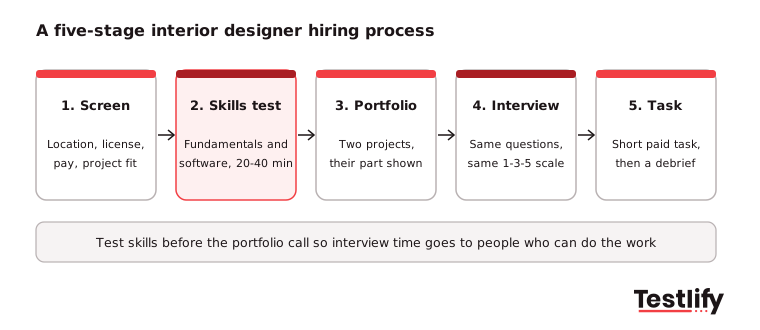
- Screen: Check location, licensing needs, salary range and project type fit. Use a clear interior designer job description so the right people apply.
- Skills test: A 20 to 40 minute test on design fundamentals and the software you use.
- Portfolio review: Two projects, with the checklist above.
- Structured interview: The same core questions for every candidate, scored on the same scale. Our guide to structured interviews covers how to run one.
- Practical task and debrief: A short, paid task, then a debrief where interviewers compare scores and evidence, not impressions.
Across the teams we work with, the biggest time saving comes from stage 2. When candidates are tested before anyone books a call, interviewers stop spending hours on portfolios from people who cannot produce the drawings the role needs.
How can Testlify help you hire interior designers?
Testlify helps hiring teams test interior designers on skills before the interview. You can combine the Interior Designer test with software tests such as Autodesk Revit and 3ds Max, and add your own questions from 25+ question types, including file upload so candidates can submit a floor plan or material board. Candidates get the same test, scored the same way, with 20+ proctoring checks and support for 15+ languages.
Browse more roles in the Testlify test library, which holds 3,500+ tests, or see more role guides in the interview questions bank.
Frequently asked questions
Ready to test interior designers before the interview?
Start with the Interior Designer test, add the software tests your team uses, and invite your next shortlist. Testlify offers a 7-day free trial, no credit card required, so you can see scored results on a real role before you commit.

Content Writer
Yashika Khandelwal is a Content Writer with 3+ years of experience creating research-backed content on hiring, talent assessment, and HR technology. She is a registered Organizational Psychologist and subject matter expert who combines behavioral science with practical recruitment insights to produce accurate, evidence-based content.
LinkedInRelated resources
View all
Interview questions
40 electrician interview questions and what good answers sound like

Interview questions
25 accounting clerk interview questions and answers

Interview questions
25 Zendesk Software Engineer Interview Questions (2026)

Interview questions
7 interview questions to check if the candidate is tech-savvy

Interview questions
60 HRIS Analyst interview questions to ask job applicants

Interview questions
Employee Relations Specialist Interview Questions: 60 to Ask (2026)
Get started.
Hire on proof, not resumes.
Run your first skills-based assessment free — no credit card required.