
40 electrician interview questions and what good answers sound like
Forty interview questions for electricians across safety, code, troubleshooting and teamwork, with what to listen for and how to score them.

Electrician interview questions are the questions a hiring team asks to check whether a candidate can wire, troubleshoot and maintain electrical systems safely and to code. A good set covers five areas: background and license, technical knowledge, safety habits, behavior on the job, and the level of the role. Each question should come with a clear idea of what a strong answer includes. This guide gives you 40 questions in those areas, with what to listen for, red flags to watch and a simple 1 to 4 scale, so every interviewer scores candidates the same way.
TL;DR / Key Takeaways
- General background, technical knowledge, safety, and behavior.
- Extra questions for apprentice, journeyman, master and industrial electricians.
- Specific, ordered, safety-first answers that name the steps, tools and code references.
- Working live as a habit, skipping the test before touching, vague license answers and no real mistakes owned.
- Rate every answer on the same 1 to 4 scale so all interviewers score candidates the same way.
 ChatGPT
 Gemini
 Claude
 Grok
 Perplexity
What should electrician interview questions cover?
Electrician interview questions should cover five areas: license and experience, technical knowledge of code and circuits, safety habits, how the candidate works with customers and crews, and the skills specific to the level you are hiring. Missing any one of them is how teams end up hiring a skilled electrician who cuts corners on safety.

The stakes are high because good electricians are scarce. The US Bureau of Labor Statistics counts about 821,000 electrician jobs in 2025 and projects about 72,700 openings a year through 2035, with employment growing 9 percent. Associated Builders and Contractors, reported by EC&M, estimates construction must attract 349,000 new workers in 2026, says demand for electricians who can do precision wiring has surged with data center construction, and notes that roughly one fifth of electricians are over 55.
When candidates are scarce, a slow or vague interview loses them. A short, structured set of questions lets you decide fast without lowering the bar.

What general electrician interview questions should you ask?
General electrician interview questions confirm the basics before you spend time on technical depth: license status, type of work done, and why the candidate wants this job. Most states require electricians to hold a license, and most electricians learn the trade through a 4 or 5 year apprenticeship, so start by checking both.
- What licenses and certifications do you hold, and in which states are they valid?
- Where did you do your apprenticeship, and what kind of work did it cover?
- Is most of your experience residential, commercial or industrial?
- Tell me about the largest or most complex job you worked on. What was your part in it?
- Why do you want to leave your current role, and why this company?
- Which tools and test instruments do you bring to a job, and which do you expect us to supply?
Listen for: a license number the candidate can share for verification, specific job types rather than "a bit of everything", and a clear role on the projects they describe. "I ran the rough-in on a 40 unit apartment build" tells you far more than "I've done lots of big jobs".
What technical electrician interview questions should you ask?
Technical electrician interview questions test whether the candidate understands the code, the circuits and the diagnostic process well enough to explain them. The goal is not to quiz trivia but to hear a clear method. A candidate who can explain why a step matters usually knows how to do it.
- How do you check whether an outlet is properly grounded?
- What is the difference between grounding and bonding?
- When would you use 14/3 cable instead of 14/2?
- What is the difference between a GFCI and an AFCI, and where does each one belong?
- How do you size a conductor for a new circuit?
- A breaker keeps tripping on the same circuit. Walk me through how you find the cause.
- How do you use a multimeter to check for voltage, continuity and resistance?
- What is voltage drop, and how do you account for it on a long run?
- Which edition of the National Electrical Code (NEC) does our area enforce, and what changed in it that affected your work?
- How do you read a wiring diagram or blueprint before you start a job?
Listen for: a step-by-step troubleshooting method (confirm the symptom, isolate the circuit, test, fix, retest), references to the NEC and local amendments rather than "how we always did it", and correct use of test instruments. On question 11, a strong answer mentions the load, ampacity tables, the breaker size, temperature rating and the length of the run.
Pro tip: If no one on the panel is an electrician, send a short technical test before the interview, then use these questions to ask the candidate to explain two or three of their test answers. The test checks knowledge, and the conversation checks they can apply it.
What electrical safety interview questions should you ask?
Electrical safety interview questions show how the candidate behaves when no one is watching: whether they verify a circuit is dead, follow lockout/tagout, and stop work when something is unsafe. Safety answers matter more than any technical answer, because one shortcut can injure someone or burn a building.
- Walk me through your lockout/tagout steps before you work on equipment.
- How do you verify that a circuit is de-energized before you touch it?
- What PPE do you wear for energized work, and how do you decide what level you need?
- When, if ever, is it acceptable to work on a live circuit?
- What would you do if a coworker got an electric shock in front of you?
- Tell me about a time you stopped a job because something was unsafe.
- What would you do if a supervisor asked you to skip a safety step to finish faster?
Listen for: "test before you touch" (test the meter on a known live source, test the circuit, test the meter again), a lock and tag the candidate applies personally, and a clear willingness to say no. Lockout/tagout is not a box-ticking topic: control of hazardous energy was the fourth most cited OSHA standard in fiscal year 2025, with 2,562 violations, according to Safety+Health magazine's report on OSHA's final Top 10.
What behavioral and situational questions work for electricians?
Behavioral and situational questions for electricians ask about real past events or realistic job scenarios: an unhappy customer, a clash with another trade, a mistake on site. Electricians often work alone in customers' homes or alongside several crews, so communication and honesty matter almost as much as technical skill.
- Tell me about a mistake you made on a job. What happened, and what did you change afterwards?
- A customer disagrees with your diagnosis and wants a cheaper fix that you think is unsafe. What do you do?
- Describe a time you had to coordinate with another trade, such as HVAC or plumbing, on the same job.
- Your instructions for a job are incomplete and the foreman is unreachable. How do you proceed?
- Tell me about a day when three service calls overran. How did you decide what came first?
- How have you explained a technical problem to a customer with no electrical knowledge?
- What have you learned in the last year to keep your skills current?
Listen for: answers with a situation, the action the candidate took, and the result, in that order. Strong candidates own their mistakes, explain what they changed, and never trade safety for a happy customer. Vague answers ("I always get along with everyone") usually mean there is no real example behind them.
Which questions fit apprentice, journeyman, master and industrial electricians?
Questions for apprentice, journeyman, master and industrial electricians should match what the role is trusted to do alone. Apprentices are judged on attitude and basics, journeymen on independent work, masters on design, permits and leading crews, and industrial or maintenance electricians on motors, controls and keeping a plant running.
Role level | Questions to add | What a strong answer shows |
|---|---|---|
Apprentice | 31. Why do you want to become an electrician? 32. What basic electrical concepts, like Ohm's law, can you explain? 33. How do you take correction from a journeyman on site? | Real interest in the trade, sound basics, and coachability |
Journeyman | 34. Which jobs have you completed without supervision, start to finish? 35. How do you prepare for an inspection? | Independent work that passes inspection the first time |
Master | 36. How do you plan a service upgrade, from load calculation to permit? 37. How do you train and check the work of apprentices? 38. How do you estimate time and materials for a bid? | Design, permitting and estimating, plus leading people |
Industrial or maintenance | 39. How do you troubleshoot a three-phase motor that will not start? 40. What experience do you have with PLCs, motor controls or variable frequency drives? | Systematic diagnosis on live production equipment and controls knowledge |
For maintenance roles that mix electrical with mechanical work, combine this table with the maintenance technician interview questions.
What does a strong answer sound like?
A strong answer to an electrician interview question is specific, ordered and safety-first. The candidate names the steps, the tools and the code reference, and explains why each step matters. Three sample answers below show the level of detail a hiring team should expect from an experienced journeyman.
Question 12: A breaker keeps tripping. How do you find the cause? "First I ask what was running when it tripped and how often it happens. Then I check whether it is an overload, a short or a ground fault. I unplug the loads, reset, and add them back one at a time. If it trips with nothing connected, I isolate the circuit and test the wiring for a short or a ground fault with my meter. I also check the breaker itself, because breakers do fail."
Question 17: Walk me through your lockout/tagout steps. "I tell everyone affected, shut the equipment down, and isolate every energy source, not just the main disconnect. I put my own lock and tag on, release any stored energy, then test that the circuit is dead with a meter I have just checked on a live source. Only then do I start work."
Question 25: The customer wants a cheaper, unsafe fix. "I explain the risk in plain terms, for example that the cheaper fix could overheat the wire, and give them a written quote for the safe option. If they still want the unsafe one, I don't do it. I'd rather lose the job than put my license and their house at risk."
What are the red flags in an electrician interview?
Red flags in an electrician interview are answers that show shortcuts on safety, weak fundamentals or a habit of blaming others. One serious safety red flag should end the interview, however strong the technical answers are, because the cost of a bad electrical hire is far higher than a slow hire.
- Working live as a habit. "I just work it hot, it's quicker" on routine jobs.
- No verification step. Skipping the test before touching, or trusting the breaker label.
- Vague license answers. Unwilling to share a license number or unclear about where it is valid.
- No real mistakes. Every story ends with someone else at fault.
- Code by memory only. Cannot name the NEC edition or local rules they work to.
- Unable to explain a method. Gets the right answer but cannot say why.
How should you score electrician interview answers?
Electrician interview answers should be scored with the same questions, in the same order, against the same rating scale for every candidate. The US Office of Personnel Management's structured interview guidance describes exactly this: predetermined questions and one rating scale with agreed standards for acceptable answers.
Score | Meaning | Example for "How do you verify a circuit is dead?" |
|---|---|---|
4 | Strong: complete, ordered, explains why | Tests the meter on a live source, tests the circuit, retests the meter, and explains why |
3 | Good: correct, minor gaps | Tests the circuit with a meter but does not mention checking the meter itself |
2 | Weak: partly correct, no method | Turns off the breaker and uses a non-contact tester only |
1 | Unsafe or wrong | Trusts the panel label or works it live |
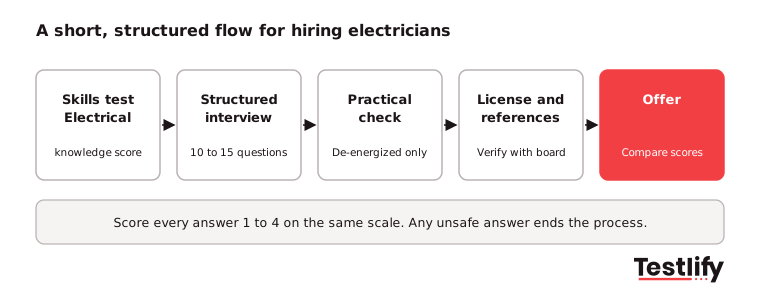
A practical flow keeps the interview short and focused:
- Skills test first: A short electrical knowledge test filters candidates before anyone spends an hour on calls.
- Structured interview: Ask 10 to 15 questions from this list, matched to the level, and score each one on the 1 to 4 scale.
- Practical check: Ask the finalist to talk through a wiring diagram or a supervised task on de-energized equipment.
- Licence and reference check: Verify the license with the state board and ask past supervisors about safety habits.
- Decide together: Compare scores, not impressions, in a short debrief.
Speed matters as much as rigor. SHRM's 2025 Talent Trends found 69% of organizations still struggle to fill full-time roles, and in skilled trades a candidate who waits a week often takes another offer. For the full process, from sourcing to offer, see how to hire an electrician and the guide to structured interviews.
Key takeaway: The best electrician interview is short, structured and safety-first. Test knowledge before the interview, use the interview to hear the candidate's method, and treat any unsafe answer as a deal breaker.
How can skills tests make electrician interviews faster?
Skills tests make electrician interviews faster by checking technical knowledge before the first call, so the interview time goes on method, safety and fit. Recruiters who are not electricians get an objective score to work from, and the hiring manager only meets candidates who already know the fundamentals.
Testlify's library of 3,500+ tests includes an electrician technical knowledge test, an electrician intermediate test and a fundamentals of electricity test for apprentice roles.
Tests run in 15+ languages, which helps when skilled trades candidates are stronger in their first language than in English, and 20+ proctoring checks help confirm the answers are the candidate's own. You can add your own questions from this list as one-way video or audio questions, so candidates answer them in their own time before a live interview.
See the full set of trades tests on the blue-collar hiring page, and pair the interview with a clear electrician job description template.
Frequently asked questions
Ready to screen electricians before the first call?
Pick an electrician test from the library, add your own interview questions, and send it to your next candidates. Start a 7-day free trial of Testlify, no credit card required, and see who knows the fundamentals before you book a single interview.

Content Writer
Yashika Khandelwal is a Content Writer with 3+ years of experience creating research-backed content on hiring, talent assessment, and HR technology. She is a registered Organizational Psychologist and subject matter expert who combines behavioral science with practical recruitment insights to produce accurate, evidence-based content.
LinkedInRelated resources
View all
Interview questions
25 accounting clerk interview questions and answers

Interview questions
25 Zendesk Software Engineer Interview Questions (2026)

Interview questions
7 interview questions to check if the candidate is tech-savvy

Interview questions
60 HRIS Analyst interview questions to ask job applicants

Interview questions
Employee Relations Specialist Interview Questions: 60 to Ask (2026)

Interview questions
60 Warehouse Operator interview questions to ask job applicants
Get started.
Hire on proof, not resumes.
Run your first skills-based assessment free — no credit card required.