
Illegal interview questions: what hiring teams can't ask
Interview questions that put employers at legal risk, what to ask instead, and how to train interviewers to keep every question job-related.

One friendly question, such as "Do you have kids?", can hand a rejected candidate evidence of bias. Illegal interview questions ask about a protected trait with no link to the job, such as age, religion, pregnancy or disability.
This guide shows which questions to avoid, what to ask instead, and how to train interviewers to keep every question job-related. You will also see which questions become legal after a job offer.
TL;DR:
- Illegal interview questions ask about protected traits: age, race, color, religion, sex (including pregnancy, sexual orientation and gender identity), national origin, disability and genetic information.
- Federal law flatly bans two kinds of question before an offer: disability and medical questions, and requests for genetic information, including family medical history.
- Most other risky questions are not banned word for word, but the EEOC says they can be treated as evidence of intent to discriminate.
- Some states and cities ban questions outright. California, for example, bars employers from asking about salary history.
- Ask about the job need instead: "Can you work the required shifts?" rather than "Do you have kids?"
- Structured interviews, a shared question guide and interviewer training stop most illegal questions before they are asked.
 ChatGPT
 Gemini
 Claude
 Grok
 Perplexity
What are illegal interview questions?
Illegal interview questions are questions about a candidate's protected characteristics that are not needed to judge whether the person can do the job. They cover topics such as age, ethnicity, faith, pregnancy, marriage, children, health and family medical history.
The word "illegal" is shorthand, because federal law mostly bans hiring decisions based on a protected trait, not the question itself. The trouble is that once you ask, you cannot prove you ignored the answer.
The EEOC's guidance for small businesses warns that such questions may be treated as evidence of intent to discriminate. Not collecting the information at all makes a complaint easier to defend.
A few questions are banned outright: disability questions before an offer, requests for genetic information, and some that state and city laws prohibit. Treat every topic in this guide as off limits unless you have a clear, job-related reason that applies to every candidate.
The Testlify glossary explains the related terms protected class and disparate treatment.

Which federal laws make interview questions illegal?
Federal anti-discrimination laws make interview questions risky or illegal in the US, led by Title VII, the ADA, the ADEA and GINA. The EEOC enforces all four, and each applies only above a minimum headcount, as the table shows.
Law | What it protects | Applies to | Interview impact |
|---|---|---|---|
Title VII of the Civil Rights Act | Race, color, religion, sex (incl. pregnancy, sexual orientation, gender identity), national origin | Employers with 15+ employees | Questions on these traits can be used as evidence of bias |
Americans with Disabilities Act (ADA) | Disability | Employers with 15+ employees | Disability and medical questions banned before a job offer |
Age Discrimination in Employment Act (ADEA) | Age 40 and over | Private employers with 20+ employees | Age and birth-date questions signal age bias |
Genetic Information Nondiscrimination Act (GINA) | Genetic information, incl. family medical history | Employers with 15+ employees | Asking for genetic information is itself prohibited |
Immigration law (IRCA) | Citizenship status and national origin | Most employers | Ask about work authorization, not citizenship |
USERRA | Military service | All employers | Do not hold service or reserve duty against a candidate |
GINA is unusual because the request itself breaks the law: the EEOC says covered employers may not request, require or purchase genetic information, and family medical history counts.
State and local laws often cover smaller employers and add more traits, such as marital status, so a small business is rarely free to ask anything it likes.
What are examples of illegal interview questions?
Examples of illegal interview questions include "How old are you?", "Are you pregnant?", "Which church do you attend?", "Where are you originally from?" and "Do you have any health conditions?" Each one asks about a protected trait rather than the candidate's ability to do the work.
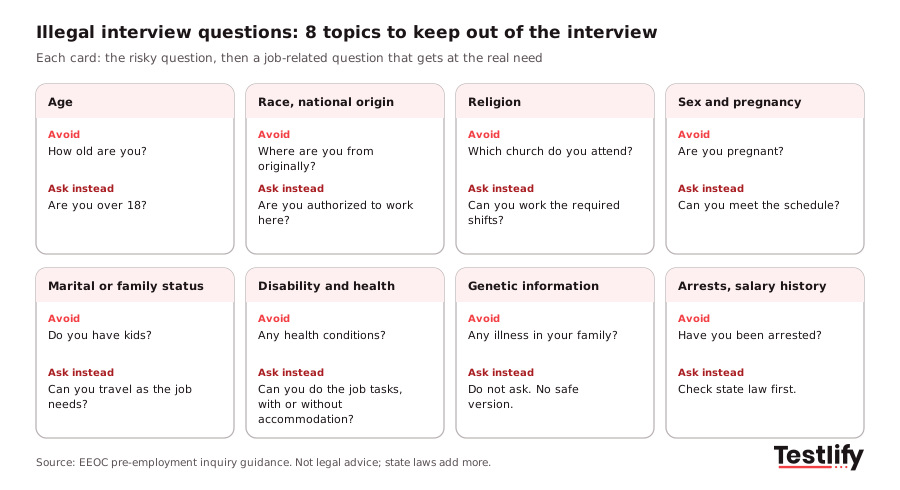
Here are common illegal interview questions, grouped by topic:
- Age: "How old are you?", "What year did you graduate from high school?", "When do you plan to retire?"
- Race, color and national origin: "Where are you from originally?", "Are you biracial?", "What language do you speak at home?", "Where were your parents born?"
- Religion: "Which church do you attend?", "Which religious holidays do you observe?"
- Sex, pregnancy, sexual orientation and gender identity: "Are you pregnant?", "Do you plan to start a family?", "Are you gay?", "What does your husband do?"
- Marital and family status: "Are you married?", "How many children do you have?", "Who looks after your kids while you work?"
- Disability and health: "Do you have any disabilities?", "What medications do you take?", "How many sick days did you take last year?", "Have you ever filed a workers' compensation claim?"
- Genetic information: "Does heart disease run in your family?", "Has anyone in your family had cancer?"
- Citizenship: "Are you a US citizen?" before an offer.
- Other risky topics: "Have you ever been arrested?", "What is your current salary?" (banned in some states), "Do you own a car?", "Can you send a photo with your application?"
Watch the indirect versions too. A graduation year reveals age, a spouse's job reveals marital status, and a club membership can reveal religion or ethnicity.
The EEOC treats questions that may indicate a protected trait, including questions about clubs and societies, the same way as direct ones.
What can you ask instead?
Hiring teams can almost always ask a legal question that gets at the real business need. Ask about the job, not the person: the schedule, travel, physical tasks and right to work, the same way for every candidate.
What you really need to know | Illegal or risky question | Legal question to ask instead |
|---|---|---|
Can they work the schedule? | "Do you have young children?" | "This role needs evening shifts twice a week. Can you meet that schedule?" |
Can they work weekends? | "Which religious holidays do you observe?" | "The job needs some Saturday work. Are you available?" |
Can they travel? | "Will your spouse mind you travelling?" | "The role involves travel about one week a month. Is that workable for you?" |
Can they legally work here? | "Are you a US citizen?" | "Are you legally authorized to work in the US?" |
Do they meet a legal age rule? | "How old are you?" | "Are you 18 or older?" (only when the job has a legal minimum age) |
Can they do the physical tasks? | "Do you have any health problems?" | "Can you perform the essential tasks of this job, with or without reasonable accommodation?" |
Do they speak the language the job needs? | "What is your native language?" | "This role supports Spanish-speaking customers. How fluent is your Spanish?" |
Will they show up? | "How many sick days did you take last year?" | "Can you meet the attendance requirements for this job?" |
What pay do they expect? | "What do you earn now?" | "What salary range are you looking for in this role?" |
Can they get to work? | "Do you own a car?" | "Do you have reliable transport to the site for 8 am starts?" |
Pro tip: If you struggle to write the legal version of a question, the question probably is not about the job, so drop it. Read more about the reasonable accommodation wording used in the disability question above.
Which questions become legal after a job offer?
Some questions that are illegal in an interview become legal after a conditional job offer. Medical questions, spouse and dependant details for benefits, and work authorization documents all move to the post-offer stage, as long as every new hire in the same role is asked.
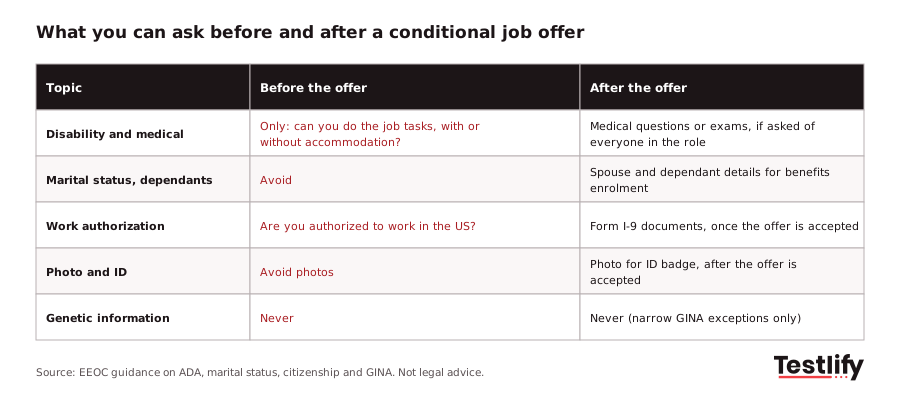
- Medical questions and exams: The EEOC's ADA guidance on pre-employment questions says employers may not ask disability-related questions or require medical exams before an offer, even if they plan to look at the answers only later. After a conditional offer, medical questions are allowed if every entering employee in the job category gets them, and the answers must be kept confidential and stored apart from the personnel file.
- Family details: Questions about a spouse or dependants can be asked after an offer is made and accepted when you need them for insurance or benefits.
- Right to work documents: Form I-9 and E-Verify checks start only after the candidate accepts the offer. Before that, ask only whether the candidate is authorized to work.
- Photos: The EEOC advises against asking for a photo before hiring. If you need one for an ID badge, take it after the offer is accepted.
Genetic information stays off limits at every stage, apart from narrow exceptions under GINA such as voluntary wellness programs.
Do state and city laws add more banned questions?
State and city laws add more banned questions, and many of them prohibit the question itself, not just its use. The most common are salary history bans and "ban the box" rules that delay questions about criminal records until later in hiring.
- Salary history: California's Labor Code section 432.3 says an employer may not ask about an applicant's salary history, in person or through an agent. The California Labor Commissioner's Equal Pay Act covers the rule. Employers can still ask about the candidate's pay expectations for the role. Many other states and cities have similar bans, so check every location you hire in, including remote hires.
- Criminal history: Many states and cities have ban-the-box laws that stop employers asking about convictions on the application or before an offer. According to the EEOC, an arrest is not proof of a crime, and that convictions should be weighed against the job, the offense and how long ago it happened.
- More protected traits: Several states protect traits that federal law does not name, such as marital status, so a question that is only risky federally can be clearly unlawful under state law.
For multi-state teams, the safe default is the strictest rule you hire under. The Testlify legal compliance checklist for hiring covers the wider set of checks.
What happens if an interviewer asks an illegal question?
An illegal interview question can lead to a discrimination charge, a lawsuit, back pay and damages, and harm to the employer brand. Even when the company did not use the answer, a rejected candidate can point to the question as evidence that a protected trait shaped the decision.
Charges are common, and the EEOC's fiscal year 2024 results show 88,531 new charges of discrimination, up more than 9% on the year before. The agency secured almost $700 million for over 21,000 people.
Those figures cover all employment discrimination, not only interviews, but hiring is where many claims start.
The cost is not only legal. A candidate who is asked about pregnancy or religion is likely to tell others, post about it or drop out, and you lose a person who may have been the strongest fit.
SHRM's August 2024 guidance on interview questions that get HR in trouble gives the fix. Tie every question to the knowledge, skills and abilities the job needs, and ask every candidate the same ones.
How do you stop interviewers from asking illegal questions?
Hiring teams stop illegal interview questions with structure: a fixed question guide per role, scorecards tied to job skills, short interviewer training and a review of every new question before it is used. Most illegal questions come from small talk and improvised follow-ups, not from the written guide.
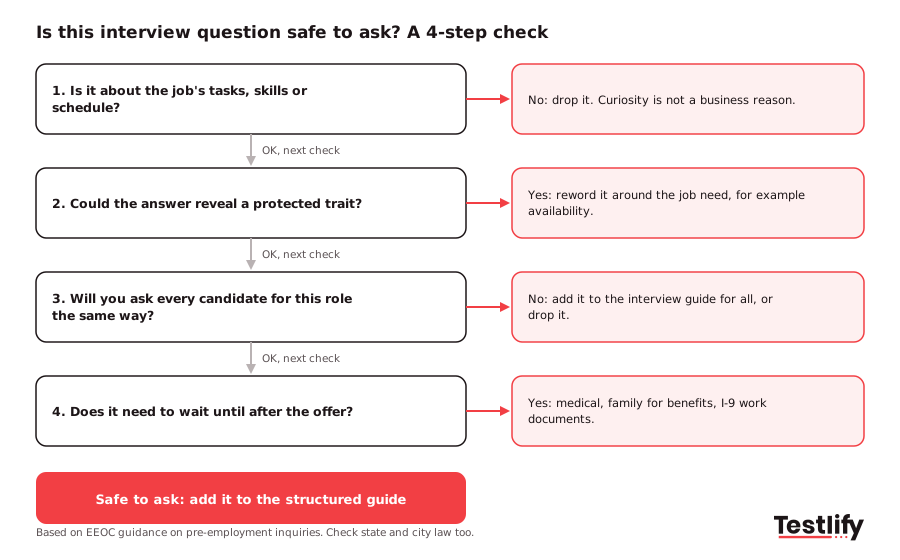
- Write the guide before the first interview: List the skills the job needs, then write questions that test each one. Run every question through the check above. A structured interview keeps the conversation on those questions.
- Score answers, not people: Use an interview scorecard with criteria for each skill. When the scorecard has no box for family plans or age, nobody has a reason to ask.
- Train for small talk: Most slips happen in the friendly minutes before and after the interview, over lunch or on the walk to the room. "Where are you from?", "Any plans for the holidays?" and "Do you have kids?" feel polite but touch protected traits. Give interviewers safe openers about the commute, the role or the candidate's last project.
- Use one script for scheduling: Describe the job's hours, travel and physical demands to every candidate the same way, then ask if they can meet them.
- Test skills before the interview: Job-related skills tests give every candidate the same questions and scoring, so the interview starts from evidence of ability rather than open-ended chat.
- Review AI interview questions too: If you use AI or one-way video interviews, check the question set the same way. An AI interviewer should ask only job-related questions and should not infer age, ethnicity or health from video or voice.
- Keep clean notes: Record answers to the job questions only. Never note protected details a candidate shares, such as "mentioned she is pregnant".
Key takeaway: The easiest way to avoid illegal interview questions is to decide every question in advance, tie it to the job, and ask it of everyone. Improvised questions carry most of the risk.
What should you do if a candidate shares protected information?
Candidates often volunteer protected information, such as a pregnancy, a religious holiday or a health condition. The interviewer should not follow up, should not write it down, and should steer back to the job.
Volunteered information does not make it legal to use in the decision.
- Do not probe: Avoid "When are you due?" or "What condition is it?" A follow-up turns a passing comment into your question.
- Redirect politely: "Thanks for sharing. Let's come back to how you handled the vendor migration."
- Leave it out of notes and the debrief: If it is not in the notes, it cannot shape the scores.
- Handle accommodation requests properly: If a candidate asks for an adjustment to the interview or a test, such as extra time, that is a request you must consider. Route it to HR rather than discussing the condition in the interview.
How should candidates respond to an illegal interview question?
Candidates asked an illegal interview question have three main options: answer it if they are comfortable, address the concern behind it without sharing the detail, or ask how the question relates to the job. Candidates who believe they were discriminated against can file a charge with the EEOC or their state agency.
- Answer it: Some candidates choose to answer a harmless-sounding question to keep the conversation moving.
- Answer the need, not the question: To "Do you have kids?", a candidate can say "I can meet the schedule and travel this role needs."
- Ask about relevance: "Can you help me understand how that relates to the role?" often makes the interviewer realise the mistake.
For employers, an interview where a candidate has to use these tactics is already a failed interview. Fix the guide and train the interviewer.
How does Testlify help keep interviews job-related?
Testlify helps hiring teams keep every candidate on the same job-related questions. Teams can build role-specific skills assessments from a job description, choose from 3,500+ tests, and run structured AI interviews that score every answer against the same criteria, with human review of the results.
- Same questions for every candidate: Assessments and AI interviews give every applicant for a role the same tasks and scoring, which keeps first-round screening focused on skills.
- Interview templates: 150+ interview templates and an interview questions bank help teams start from job-related questions.
- Bias audit: Testlify's matching model completed a third-party bias audit under New York City's Local Law 144 on June 16, 2023. See the NYC bias audit page.
A tool does not replace legal advice. Have your employment counsel review your interview guides, especially if you hire across several states or countries.
Ready to build interviews around the job?
Replace improvised questions with skills evidence. Browse the Testlify test library or start a 7-day free trial, no credit card required, and build a role-specific assessment from your own job description.
Prefer a walkthrough? Book a demo and see how structured assessments and AI interviews fit your hiring process.
Frequently asked questions (FAQs)

People and Talent Partner
Arushi Shah runs day-to-day talent acquisition and candidate experience at Testlify. She writes on interviewing, structured hiring, and giving candidates a fair, fast process.
LinkedInRelated resources
View all
Employment and labor laws
AI Hiring Laws in 2026: What Employers Need to Know
Employment and labor laws
Maryland employment and labor laws
Employment and labor laws
Indiana employment and labor laws 2026
Employment and labor laws
Virginia employment and labor laws 2026
Employment and labor laws
New Jersey employment and labor laws 2026
Employment and labor laws
New Mexico employment and labor laws 2026
Get started.
Hire on proof, not resumes.
Run your first skills-based assessment free — no credit card required.