
9-box matrix: what it is, the nine boxes and how to use it
A practical guide to the 9-box matrix: what each box means, how to run a fair talent review, how to judge potential and which tools to try.

Gallup reports that 64% of CHROs use the 9-box matrix for succession planning, yet only 9% strongly agree it works for their organization. The gap usually comes from rushed ratings, vague potential calls and labels that stick to people for years.
The 9-box matrix plots each person on current performance and future potential, rated low, moderate or high. This guide covers the nine boxes, how to run a fair talent review and how to judge potential on evidence.
TL;DR:
- The 9-box matrix plots each employee on performance and potential, which creates nine boxes with clear talent actions.
- Build the grid in six steps and run a calibrated talent review meeting.
- Judge potential on evidence from more than one source, not gut feel.
- Watch for bias, sticky labels and grids that end without actions.
- Use the alternatives, the copyable template and the FAQ at the end of the guide.
 ChatGPT
 Gemini
 Claude
 Grok
Grok Perplexity
What is the 9-box matrix?
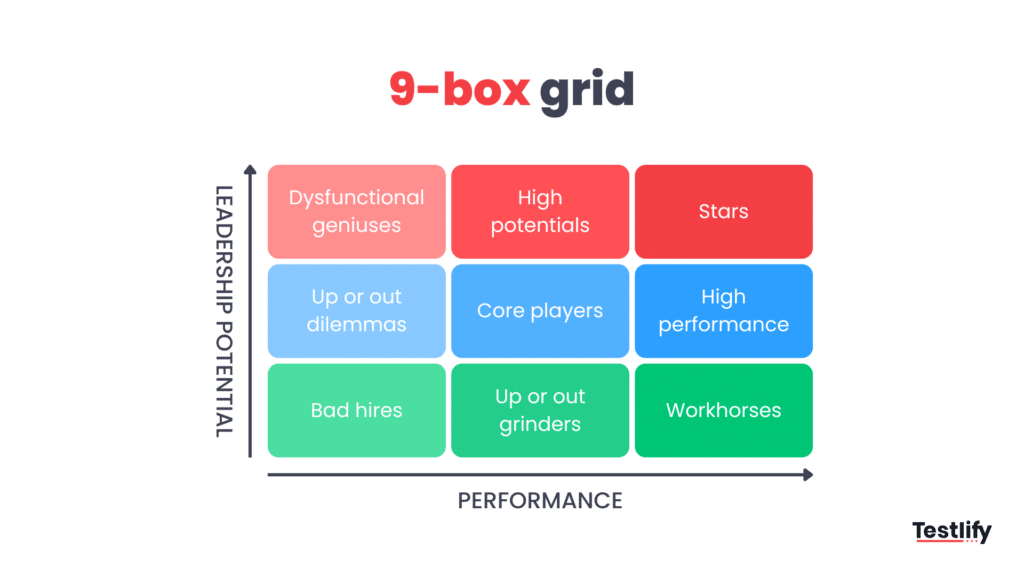
The 9-box matrix is a grid that compares how well a person does their job today with how far they could grow. Performance runs along the horizontal axis and potential along the vertical axis.
Where the two ratings meet, the employee lands in one of nine boxes, and each box points to a different talent action.
The grid is used mainly in three places:
- Talent reviews, where managers and HR compare their people against one shared standard.
- Succession planning, to see who could step into critical roles and when.
- Development planning, to decide where training, coaching and stretch work will pay off most.
The model is usually traced back to the GE and McKinsey portfolio grid of the 1970s, which HR teams later borrowed. That history is loosely documented, so treat it as background rather than fact.
What matters today is that the grid is still widely used for succession planning.

How does the 9-box matrix work?
The 9-box matrix works by giving every person two separate ratings and reading them together. Performance answers "what is this person delivering in the current role?"
Potential answers "how ready is this person to take on a bigger or different role?" A high performer is not automatically high potential, and the grid exists to keep those two questions apart.
Rating | Performance (horizontal axis) | Potential (vertical axis) |
|---|---|---|
Low | Misses goals or core job requirements over the review period | Not expected to grow beyond the current scope soon, by ability or by choice |
Moderate | Meets most goals and job requirements | Can grow inside the current role or take a similar-sized next step |
High | Exceeds goals consistently, with results others can point to | Ready for a larger or more complex role, usually within one to two years |
Two points trip up most teams:
- Performance should be measured, potential should be argued. Performance has data behind it: goals, sales numbers, quality scores, project delivery. Potential is a forecast, so it needs the most evidence and the most challenge.
- Potential is not the same as ambition or likeability. A person who wants a promotion, or who reminds a manager of themselves, is not high potential by default. Gallup points out that the grid often does not make a clear distinction between the two dimensions, and that is where bad placements start.
What do the nine boxes of the 9-box matrix mean?
The nine boxes of the 9-box matrix are the nine combinations of low, moderate and high performance with low, moderate and high potential. Companies name and number the boxes differently, so agree on your own labels before the review.
The names below are common across HR guides and describe the person's situation, not their worth.
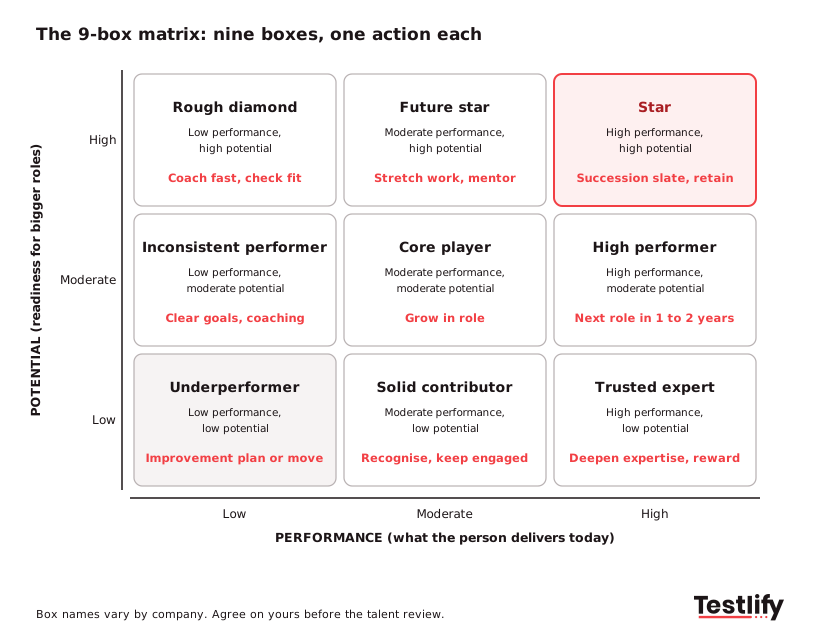
Box | Performance | Potential | What it usually looks like | What to do next |
|---|---|---|---|---|
Star | High | High | Delivers strong results and handles new scope well | Put on the succession slate, give visible stretch work, check pay and retention risk |
Future star | Moderate | High | Learning fast, results catching up with ability | Mentoring, stretch projects, a clear 12-month goal |
Rough diamond | Low | High | Strong ability but results not there yet, often new to the role | Find the blocker (fit, manager, skills, workload) and coach quickly |
High performer | High | Moderate | Very good in the role, next step is one level up rather than two | Prepare for a next role in one to two years, widen exposure |
Core player | Moderate | Moderate | Reliable, meets expectations, the backbone of most teams | Grow in role, targeted skills training, recognition |
Inconsistent performer | Low | Moderate | Some good results, some misses, unclear goals are common | Reset goals, coaching, check-in after 60 to 90 days |
Trusted expert | High | Low | Deep specialist who prefers to stay on the expert path | Reward expertise, use as a mentor, create an expert career track |
Solid contributor | Moderate | Low | Steady work in a stable role | Keep engaged, recognise, offer lateral learning if wanted |
Underperformer | Low | Low | Missing goals with no sign of change | A clear performance improvement plan, a better-fit role or an exit |
Pro tip: Keep box names inside the HR team and the talent review, because a label like "solid contributor" tends to stick long after the facts change. Share the development action with the employee instead of the label.
How do you create a 9-box matrix step by step?
Creating a 9-box matrix takes six steps, from defining criteria to reviewing progress. Most of the value comes from steps 2 and 4.
A grid filled in by one manager in an afternoon is a list of opinions, while a calibrated grid is a shared decision.
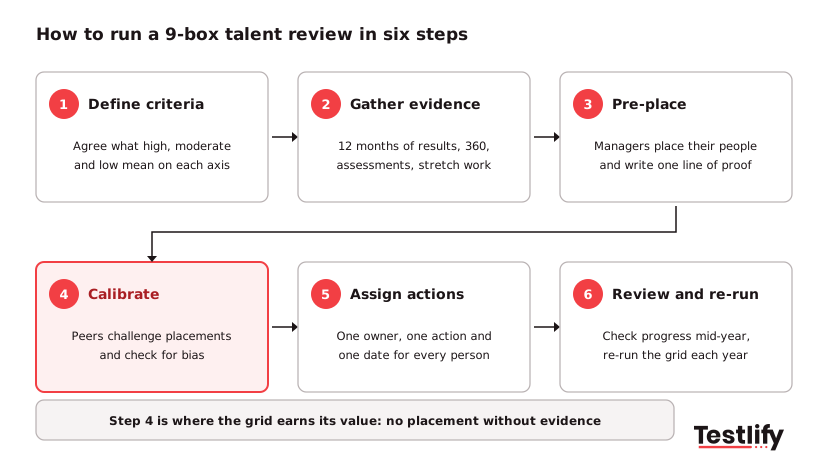
- Define the criteria. Write down what low, moderate and high mean on each axis for your company. Use the same definitions in every team, and tie performance to the goals people were actually given.
- Gather evidence. Collect at least 12 months of data so the most recent quarter does not decide the rating: goal results, review notes, 360-degree feedback, stretch assignment outcomes and, for potential, structured assessment results.
- Pre-place. Each manager places their own people on the grid and writes one sentence of evidence for each rating. No evidence, no placement.
- Calibrate. Managers and HR meet, compare placements across teams and challenge the ones that do not hold up. This is the step that makes ratings comparable.
- Assign actions. Every person leaves the meeting with one development action, one owner and one date. A grid with no actions is just a sorting exercise.
- Review and re-run. Check progress on the actions at mid-year and re-run the full grid once a year. People move between boxes, and they should.
A simple spreadsheet is enough to start: one row per person, with columns for performance rating, potential rating, evidence, box, action, owner and date. HR software helps once you run the grid across hundreds of people.
How do you assess potential on the 9-box grid?
Potential on the 9-box grid is best assessed as readiness for a defined next role, backed by evidence from more than one source. "Has potential" is too vague to calibrate.
"Could lead a team of eight within 18 months, based on these three signals" can be challenged and checked.
Signals that hold up well in a talent review:
Signal | What it shows | Where the evidence comes from |
|---|---|---|
Learning agility | How fast the person picks up new skills and applies them | Stretch assignments, new-scope results, a learning agility test |
Judgment in new situations | How the person handles problems they have not seen before | Project reviews, situational judgment tests |
Leadership behaviours | Influence, ownership, developing others | 360 feedback, peer input, a leadership potential test |
Aspiration | Whether the person wants a bigger role | A direct career conversation, not an assumption |
Track record of growth | Movement in scope and results over time | Two or more years of review history |
Gallup recommends the same direction: use objective talent assessments, combine them with manager judgment, and look at where the two agree or disagree. In my work with HR teams, the disagreements are the most useful part, because they show which ratings rest on impressions.
Many teams swap "potential" for "readiness": ready now, ready in one to two years, or best on the expert path. Readiness is easier to define per role and easier to explain to the employee.
For a deeper look at spotting future leaders, see how to identify and assess potential leaders.
How do you run a 9-box talent review meeting?
A 9-box talent review meeting brings managers of one function or level together with HR to agree on placements and actions for their people. The meeting works best with a fixed agenda, advance pre-work and an HR facilitator whose job is to challenge, not to rate.
For the wider process around it, see the guide to running a talent review.
Who attends: the managers whose teams are being reviewed, their own manager, an HR business partner as facilitator and, for senior roles, someone from the executive team. Keep it to 6 to 10 people so every placement gets discussed.
A 90-minute agenda that works:
- 10 minutes: restate the definitions for each axis and the rules (evidence for every rating, no labels outside the room).
- 20 minutes: agree the clearest cases first, the stars and the underperformers, to set the standard.
- 40 minutes: work through the middle boxes, where most disagreement sits.
- 10 minutes: look at the whole grid for patterns by team, gender, tenure and location.
- 10 minutes: confirm one action, owner and date per person.
Questions the facilitator should ask:
- What did this person deliver, and what number or example shows it?
- Would you rate them the same if they had joined a year ago?
- Is this high potential, or high performance in a role they have mastered?
- What would they need to do in the next six months to move up a box?
- Do we have more stars in one team than another, and is that real?
I have seen calibration move several placements in a single session. That is not a failure of the managers; it is the meeting doing its job.
What are the pros and cons of the 9-box matrix?
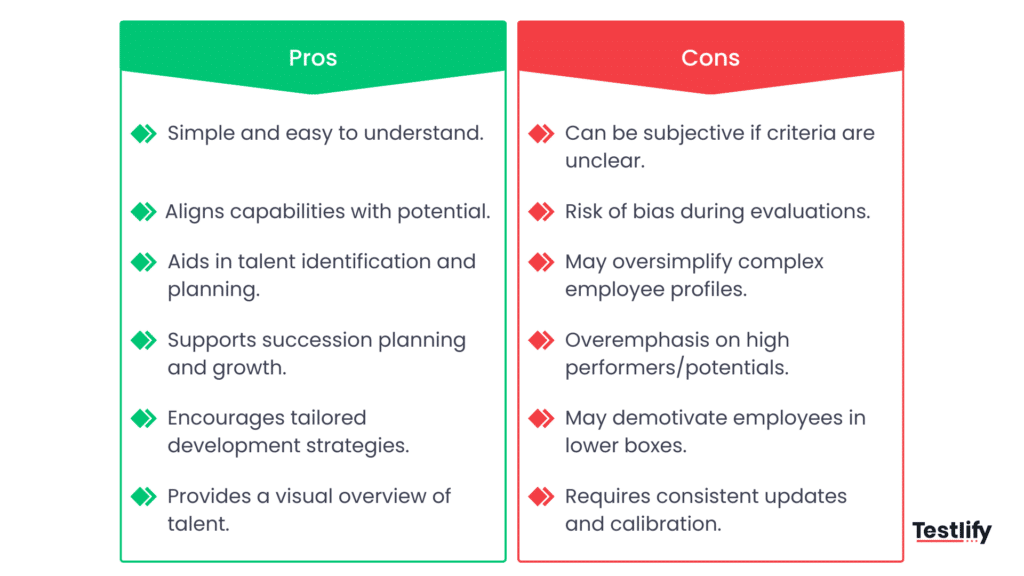
The pros of the 9-box matrix are simplicity, a shared language and a fast view of the talent bench. The cons are that potential is hard to rate fairly, labels stick, and the grid can end in sorting rather than action.
The format is not the problem on its own; how teams fill it in is.
In Gallup's 2024 review of succession methods, 64% of CHROs said their company uses the 9-box grid for succession planning. Only 9% strongly agreed that it is an effective approach for their organization.
Gallup's view is that the grid "may be doing more harm than good" when criteria are subjective and the two axes blur together.
How do you reduce bias in a 9-box assessment?
Bias in a 9-box assessment is reduced by fixing the criteria before anyone is rated, requiring evidence for every placement, and checking the finished grid for patterns. Most of the damage happens on the potential axis, where managers tend to favour people who look, talk and work like them.
A bias checklist to run in every review:
- Recency: rate on 12 months of evidence, not the last project.
- Halo: do not let one standout skill lift both ratings.
- Similarity: ask whether the same evidence from a different person would get the same rating.
- Distribution: compare the share of people in the top three boxes by gender, ethnicity, age, tenure, team and location. Large gaps need an explanation.
- Role mix: compare people with peers in similar roles, not across very different jobs.
- Pay separation: use the grid to plan development and succession, and make pay decisions in their own process with their own data.
- Labels: keep box names out of performance reviews and employee files.
Rules now apply when software does the scoring. Under the EU AI Act, AI used for promotion decisions or performance evaluation is listed as high-risk in Annex III.
High-risk status brings duties on human oversight and transparency. In New York City, Local Law 144 requires a bias audit within one year before an employer uses an automated employment decision tool.
If an AI tool suggests placements on your grid, ask the vendor for its bias audit and keep a person accountable for every final placement. Testlify publishes the summary of a third-party NYC bias audit of its matching model.
How does the 9-box matrix support succession planning?
The 9-box matrix supports succession planning by showing, on one page, who could step into critical roles now, who could be ready in one to two years and where there is no internal successor at all. Stars and high performers usually form the "ready now" list, while future stars form the "ready next" pipeline.
Gartner's 2026 CHRO survey via Evanta ranks leader and manager development as the top CHRO priority for the second year running. The survey is based on 430 CHRO responses.
At the same time, the Gallup State of the Global Workplace report found manager engagement fell from 27% to 22% in 2025.
Promoting the wrong people into those roles is expensive, and Gallup also reports that organizations fail to choose the candidate with the best talent fit for manager roles 82% of the time.
To make the grid useful for succession:
- Start from critical roles, not people. List the roles where a vacancy would hurt most, then look for names.
- Name two or three successors per role with a readiness date for each.
- Mark the gaps. A critical role with no internal successor is a hiring or development plan, not a blank cell.
- Check the slate for diversity. See the guide to inclusive succession planning for how to widen it.
- Feed the pipeline. Development plans for future stars are how you build a leadership pipeline instead of hiring externally every time.
Is the 9-box matrix outdated, and what are the alternatives?
The 9-box matrix is not outdated as a format, but the way many companies use it is. A once-a-year grid built on manager opinion, with no actions attached, is what critics mean when they call it outdated.
A calibrated grid with evidence for potential and a follow-up plan still does its job. Where it does not fit, these alternatives are worth a look:
Alternative | What it measures | Best for | Main limit |
|---|---|---|---|
4-box grid | Performance and potential, high or low only | Small teams, a first talent review | Too coarse for large populations |
Ability and motivation for a task | Coaching and delegation by line managers | Task-level, not a succession tool | |
Readiness grid | Ready now, ready next, expert path | Succession for named critical roles | Needs clear role profiles |
Skills matrix | Skill levels per person against role needs | Workforce planning and reskilling | Says little about leadership growth |
Continuous check-ins | Progress against goals through the year | Teams moving away from annual reviews | Harder to compare across the company |
Many companies keep the 9-box for senior succession and use a skills matrix or check-ins for everyone else. The grid works best for the people decisions it was built for: who to grow, who to promote and where the bench is thin.
It also pairs well with an internal mobility programme, because the grid shows who is ready to move.
Where do skills assessments fit in a 9-box review?
Skills assessments fit on the potential axis of a 9-box review, where evidence is thinnest. A structured test of learning agility, judgment or leadership behaviours gives every employee the same questions and the same scoring, which is something manager opinion cannot offer.
Testlify has a library of 3,500+ validated tests, including leadership, learning agility, situational judgment and cognitive ability tests. Test scores can sit next to the manager's rating in the calibration meeting as one input, not the decision.
A score starts a better conversation about why a rating is high or low. Tests can be delivered in 15+ languages, which helps global teams rate everyone on the same standard.
Free 9-box matrix template
The 9-box matrix template below can be copied into any spreadsheet. Use one row per employee and fill it in before the calibration meeting.
Employee | Role | Performance (L/M/H) | Performance evidence | Potential (L/M/H) | Potential evidence | Box | Action | Owner | Due date |
|---|---|---|---|---|---|---|---|---|---|
Name | Current role | H | Beat 4 of 5 goals; led launch | M | 360 strong on ownership; learning agility above role median | High performer | Lead a cross-team project | Manager | 2027-03-31 |
Key takeaway: The 9-box matrix is only as good as the evidence behind each placement and the action after it. Define the axes, rate potential on evidence, calibrate as a group, check for bias and give every person a next step.
Book a demo: See how Testlify's 3,500+ validated tests can add evidence to your next 9-box review. Book a demo with Testlify today.
Frequently asked questions (FAQs)

Content Writer
Yashika Khandelwal is a Content Writer with 3+ years of experience creating research-backed content on hiring, talent assessment, and HR technology. She is a registered Organizational Psychologist and subject matter expert who combines behavioral science with practical recruitment insights to produce accurate, evidence-based content.
LinkedInRelated resources
View all
HR & recruitment
Modern recruitment hacks and pitfalls to avoid in 2026

HR & recruitment
HR initiatives: 12 examples that work and how to run them

HR & recruitment
Quiet hiring: A bold solution or a hidden workplace problem?

HR & recruitment
Different recruitment types: Pros, cons, & what works best

HR & recruitment
HR workplace failures: What’s breaking your culture?

HR & recruitment
Leveraging paraphrasing tools to enhance recruitment strategies
Get started.
Hire on proof, not resumes.
Run your first skills-based assessment free — no credit card required.