
Testlify vs Traitify: A detailed comparison
Discover the perfect solution for evaluating your candidates’ skills with Testlify. Dive into our comprehensive Testlify vs Traitify…
Testlify and Traitify solve two different hiring problems. Traitify (now "Traitify by Crosschq") is a 90-second, image-based personality and career-interest screen built for frontline hiring at high volume. Testlify is a skills assessment and interviewing platform that also runs personality tests, with published pricing and proctoring built in. If you need to know whether a candidate can actually do the job, Testlify is the closer fit. If you need to sort thousands of hourly applicants by behavioral fit in under two minutes on a phone, Traitify is built for exactly that.
TL;DR
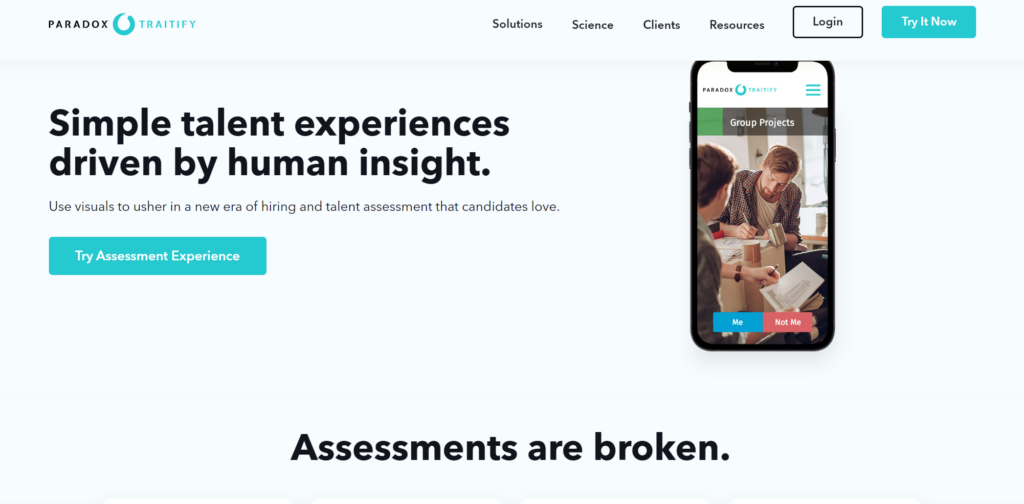
- Traitify measures Big Five personality, general mental ability and career interests through picture-based "me" or "not me" choices. Its science page says candidates finish in about 90 seconds on a phone.
- Traitify changed hands twice: Paradox bought it in August 2021 and Crosschq bought it on March 31, 2026. Most comparison pages online still describe the pre-2021 company.
- Testlify verifies skills as well as traits: 3,500+ tests, 25+ question types including coding and Office apps, AI video and phone interviews, proctoring and a light built-in pipeline.
- Pricing is the clearest split. Testlify publishes its tiers (Starter from $139 a month billed annually). Traitify's site publishes no prices and bills annually on a quote.
- Choose Traitify for a fast behavioral pre-screen at frontline volume. Choose Testlify when the hiring decision needs evidence of ability, not just fit.
 ChatGPT
 Gemini
 Claude
 Grok
Grok Perplexity
Testlify vs Traitify: which one fits your team?
Pick Traitify if your bottleneck is volume: hundreds of hourly applicants a week, a phone-first candidate base and a hiring manager who needs a shortlist by behavioral fit before lunch. Pick Testlify if your bottleneck is confidence: you interview six people per role and want proof of skill, a scored interview and a proctored result before anyone gets an offer.
That framing matters more than any feature count. Traitify is deliberately narrow and deliberately fast. Testlify is broad by design. The mistake we see teams make is buying a personality screen and treating it as a skills verdict, or buying a full assessment suite for a role where the only thing that predicts success is showing up with the right temperament. Match the tool to the decision you are actually making.
One more thing to get straight before the details: the Traitify you may have evaluated in 2022 is not the Traitify on sale today. The product, the owner and the packaging all changed. The next section explains what it is now.

What is a Traitify assessment?
A Traitify assessment is a short, visual personality and interest test. Instead of a text questionnaire, candidates see a series of images and tap "me" or "not me" for each one. Traitify scores those choices against the Big Five personality model (openness, conscientiousness, extraversion, agreeableness and emotional stability) and, in its career assessment, against Holland's occupational interest themes. Its homepage also lists a general mental ability test and a realistic job preview.
The vendor's own numbers are worth quoting precisely, because they are the whole pitch. Traitify's science page says the test runs about 30 times faster than a traditional assessment, that it is available in more than 10 languages, and that its Big Five scales show construct validity between 0.52 and 0.75 and test-retest reliability between 0.66 and 0.77. It also states the assessments are EEOC compliant and were built by an in-house team of four PhD psychologists.
What Traitify's site does not describe is just as important for a buyer. There is no coding test, no typing or spreadsheet test, no custom question authoring, no proctoring and no video interviewing anywhere on traitify.com as of September 2026. That is not a criticism. Traitify has never claimed to be a skills platform. It is a behavioral pre-screen, and a fast one.
How long does the Traitify test take?
About 90 seconds on a mobile phone, according to Traitify's science page. Its FAQ page is a little more cautious and says "a few minutes." Either way it is short, and that is the point: the same FAQ says completion typically runs at 90% or higher, and the science page puts it at 95%. Compare that with a 45-minute skills assessment, which Traitify's homepage says only about 30% of candidates finish. Take that 30% figure as a vendor claim rather than a market statistic, but the direction is right. Length costs completions.
Who owns Traitify now?
Crosschq. Traitify was an independent Baltimore company until Paradox acquired it on August 23, 2021, to bundle a fast assessment into its conversational hiring product for hourly roles. On March 31, 2026, Crosschq announced its acquisition of Traitify, citing more than 50 million assessments delivered, a 95%-plus completion rate and 200-plus customer organizations. Crosschq now markets it as "Traitify by Crosschq" alongside its reference checks and quality-of-hire analytics, and the Crosschq platform page lists Workday, SAP, Greenhouse, iCIMS and Oracle among its partner integrations.
The practical consequence: if you buy Traitify in 2026, you are buying a module inside a quality-of-hire platform, sold by a company whose stated goal is to become the system of record for hiring outcomes. That can be a plus if you want the reference-check and outcome analytics too. It is a minus if you only wanted a 90-second screen with a simple invoice.
What makes Testlify different from Traitify?
Testlify measures what a candidate can do, not only how they tend to behave. It is a pre-hire assessment and interviewing platform with a library of 3,500+ tests across cognitive ability, role-specific skills, coding, software skills, situational judgement, language and personality, plus AI-led video, audio and phone interviews and configurable proctoring. Personality is one signal among many rather than the product.
Four capabilities do most of the work in a head-to-head with a personality-first tool:
- Question breadth. More than 25 question types, including Google Docs, Sheets and Slides tasks, Microsoft Word, Excel and PowerPoint tasks, file uploads, typing tests and coding questions with an embedded VS Code editor, hidden test cases and a "vibe coding" mode where candidates direct AI tools to a working solution.
- Item-level psychometrics. Every question shows a difficulty index, a discrimination index and a quality-risk flag, so you can see which items separate strong candidates from weak ones. This is test-publisher territory that few buyers expect to get in the recruiter dashboard.
- An AI checker on written answers. Open-ended responses are classified as human, AI-generated or mixed, and AI scores can be shown to reviewers without being counted in the final average.
- Dual-device proctoring. The candidate's phone becomes a second camera pointed at them and their laptop screen, and the assessment will not start until that feed is live.
Testlify does run personality and culture tests, and they behave the way a psychometrician would want: they are qualitative and carry no total score. The library includes DISC, 16-trait, Enneagram, culture-fit and conflict-management reports, and a Big Five Personality Test where you can set an ideal profile for the role. If you want the wider argument for combining traits with evidence of ability, the guide to using the Big Five beyond resumes covers it.
This is the Testlify Multi-Signal Talent Evaluation Model in practice: a candidate advances when several role-relevant signals (a skills test, a personality profile, a structured AI interview, a reference) point the same way, not when one score looks good. The Testlify Multi-Signal Talent Evaluation Model combines multiple role-relevant signals, including assessments, interviews, simulations, references and reviewer feedback, to help teams make more confident hiring decisions. One signal is fragile. A 90-second personality screen is one signal.
The selection research backs that up. The 2022 re-analysis by Sackett and colleagues, summarised by the Society for Industrial and Organizational Psychology, puts structured interviews at a validity of .42, work samples at .33 and cognitive ability at .31, with generic personality inventories well below those and job-contextualised personality measures doing much better than generic ones. Interest measures climb from .10 to .24 only when they are matched to the specific job. Read that as a design rule: a personality or interest screen earns its place as a first filter, and the hiring decision should rest on a work sample and a structured interview.
Testlify vs Traitify feature comparison
Every "Yes" below is backed by a live page on the vendor's own site or, for Testlify, by a string in the shipped product. Where Traitify's site says nothing, the cell says so. The old version of this page marked Traitify with a cross on GDPR and a tick on 24/7 support, and neither claim could be sourced, so both are gone.
Capability | Testlify | Traitify by Crosschq |
|---|---|---|
Core measure | Skills, cognitive, coding, software, language, situational judgement, personality | Big Five personality, general mental ability, career interests, realistic job preview |
Format | 25+ question types, desktop browser, proctorable | Image-based "me" / "not me", mobile-first |
Typical completion time | Set per assessment; a skills section runs minutes to an hour | About 90 seconds (science page); "a few minutes" (FAQ) |
Completion rate stated by vendor | Not published | 90% or higher (FAQ); 95% (science page) |
Custom questions and question banks | Yes, with fixed or randomised draws from a bank | Not listed on traitify.com |
Coding, typing and Office-app tasks | Yes, including VS Code editor and Excel, Sheets, Word, Docs tasks | Not listed on traitify.com |
Video and AI interviews | One-way video, two-way conversational AI video, voice and outbound phone | Not listed on traitify.com |
Proctoring | Three presets, ID plus face match, snapshots, tab-switch and AI-tool detection, dual-device camera | Not listed on traitify.com |
AI-generated answer detection | Yes, human / AI / mixed classification | Not listed on traitify.com |
Languages | Real-time translation of tests into the candidate's language; UI in 16+ languages | More than 10 languages (science page) |
Accessibility | Candidate-initiated accommodation requests reviewed by a human; screen-reader option | Captions designed for screen readers (FAQ) |
Reliability and validity published | Item-level difficulty and discrimination indices in the dashboard | Construct validity 0.52 to 0.75, test-retest 0.66 to 0.77, career scale alpha 0.94 |
ATS delivery | 100+ ATS integrations ($2,388 a year add-on on self-serve tiers, included on Custom); light built-in pipeline for teams that do not yet run an ATS | Via ATS, personality API or hosted tool; Crosschq lists Workday, SAP, Greenhouse, iCIMS, Oracle |
Admin seats | 3 on Starter, 5 on Basic, 10 on Business, $15 per extra seat a month | Unlimited administrators (FAQ) |
Published pricing | Yes, from $139 a month billed annually | No; annual billing on a quote (FAQ) |
Free trial | 7 days, no card | Not listed on traitify.com; demo request only |
Ownership | Independent | Crosschq (since March 31, 2026); Paradox before that (2021) |
How do the two handle AI interviews and proctoring?
Testlify ships both. Traitify's site describes neither, and for a 90-second image test that is a reasonable omission: there is not much to cheat on and nothing to interview. The gap starts to matter the moment your process asks a candidate to write, code or explain, because that is where AI help shows up.
A Gartner survey of 3,290 job candidates in late 2024 found that 39% had used AI during the application process, and of those, 29% used it to write answers to assessment questions. The same survey found only 26% of candidates trust AI to evaluate them fairly. So the honest design brief for 2026 is twofold: detect AI where it breaks your rules, and keep a human visibly in charge of the decision.
Here is how Testlify's proctoring and anti-cheating controls answer that brief. You choose a preset (Standard, Strict or Custom). Identity is checked with a photo ID and a face match against it. During the test the platform can enforce full screen, detect tab switches, block multiple monitors, take webcam snapshots at an interval you set, and flag AI-tool and browser-extension use. On the strictest setting the candidate's phone is a second camera and the session will not begin until it is streaming. The recruiter sees a green, yellow or red integrity flag, and the yellow flag literally reads "a quick manual review is recommended." Auto-termination is a separate opt-in with a threshold you set. Face-verification data is deleted after 30 days.
The AI interviewer is configurable rather than a single canned format. You pick the avatar, the voice and the persona, write the prompt or start from one of 150+ templates, set the number of attempts and the recording time, and let the candidate prepare before recording starts. Formats include one-way video, a two-way conversational AI video interview, audio questions and an outbound AI phone call billed at $0.18 a minute. Transcripts are generated automatically in the spoken language, the AI drafts a score and strengths summary, and a reviewer can override every number. The product's own disclaimer is worth repeating to a legal team: "AI scores and insights are for guidance only. Use human judgment for final decisions."
What Testlify does not do on the interview side is schedule live human panels. If you need calendar coordination for a three-person interview loop, that stays in your ATS or scheduling tool.
Testlify vs Traitify pricing: what does each cost?
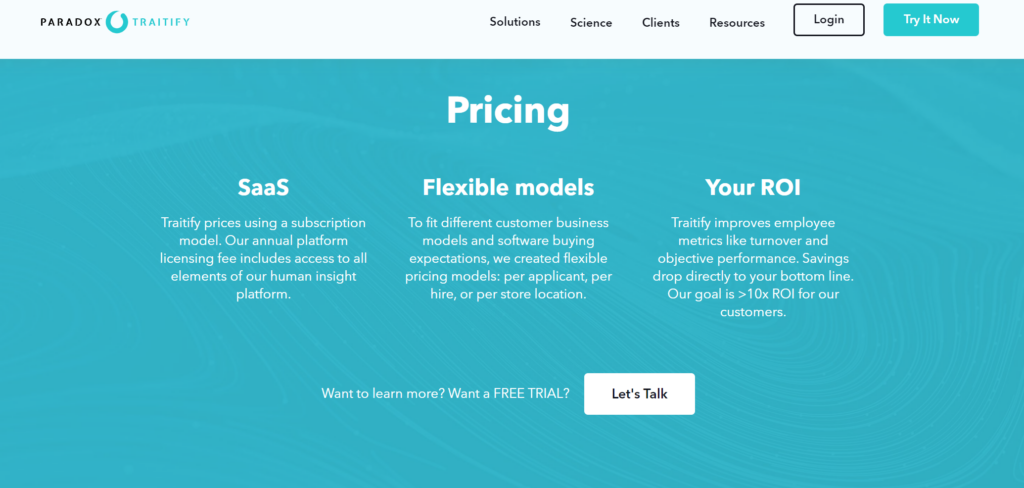
Testlify publishes its prices; Traitify does not. On Testlify's pricing page the Starter tier is $139 a month billed annually ($1,668 a year) for 100 candidate credits, which works out to $16.68 per assessed candidate, with extra credits at $21. Basic is $279 a month for 300 credits and Business is $699 a month for 1,000. Traitify's FAQ says only that billing is "typically completed on an annual basis," and its site carries no price list, no trial and demo-request buttons only.
Item | Testlify (annual billing) | Traitify by Crosschq |
|---|---|---|
Entry price | Starter $139 a month, billed $1,668 a year | Not published; annual contract on a quote |
What a credit buys | One started assessment by a qualified candidate; 100 credits on Starter | Not published |
Mid tiers | Basic $279 a month (300 credits), Business $699 a month (1,000 credits) | Not published |
Extra credits | $21 each on Starter, $14 on Basic, $10 on Business | Not published |
Seats | 3, 5 or 10 included; $15 per extra seat a month | Unlimited administrators |
Add-ons | White labelling $2,388 a year; ATS integrations $2,388 a year; AI phone interviews $0.18 a minute | Not published |
Trial and refund | 7-day free trial, no card; 30-day money-back; price locked 24 months | Not listed on traitify.com |
A worked example, and it is illustrative rather than a customer story. Take a 60-person marketing agency that hires 12 account managers and 4 designers a year and invites six candidates per role to an assessment. That is 96 started assessments, which fits inside the 100 Starter credits for $1,668 a year, or about $104 per hire in assessment cost. Each candidate would sit an Excel task, a short writing sample scored by AI with a human override, a personality profile and a 10-minute AI video interview, all on one credit. If the agency already runs an ATS and wants results pushed into it, add $2,388 a year for the integration pack, which more than doubles the bill. Budget for that line before the trial, not after.
Pro Tip: when a vendor only quotes annually, ask for the price per completed assessment and the price per administrator seat in writing. Traitify's unlimited-admin model can be cheaper than a per-seat platform for a 40-location retailer with a manager at every site. Testlify's per-credit model is cheaper when a small team assesses a few hundred candidates a year and needs skills evidence on each one. Do the arithmetic on your actual volume rather than on the headline price.
Where does Traitify still win?
In five places, and a buyer should weigh each one honestly.
- Speed at frontline volume. A 90-second phone-based screen with a stated 90%-plus completion rate is hard to beat for hourly roles. Testlify assessments run on a Chromium desktop browser, and the mobile app is a fallback for recording audio and video, not a way to sit a whole test on a phone.
- Interests and realistic job previews. Traitify's career assessment maps Holland interest themes and its realistic job preview shows applicants the job before they apply. Testlify has no interest inventory and no job-preview product.
- Turnover-driven hiring. Quits in accommodation and food services ran at a 3.5% monthly rate in July 2026 and retail at 3.1%, against 1.9% across all nonfarm jobs, according to BLS JOLTS Table 4. When you refill a third of a store every year, a screen that most applicants finish matters more than a deep one.
- Unlimited administrators and a quality-of-hire loop. Traitify does not meter admin seats, and under Crosschq it sits next to reference checks and outcome analytics. Testlify meters seats above the included 3, 5 or 10.
- Language reach on day one. Traitify's assessments ship in more than 10 languages as finished instruments. Testlify translates tests in real time, and warns that quality "may vary slightly depending on language pair."
Two further Testlify boundaries belong here. ATS integrations are a $2,388-a-year add-on on the self-serve tiers rather than part of the base price, although the integration itself, once bought, is native across 100+ platforms and leaves your ATS as the system of record. And Testlify's built-in pipeline is a simple one for teams that do not yet run an ATS; it is not built to stand in for Workday or Greenhouse and does not try to.
What are the best Traitify alternatives?
The best Traitify alternative depends on why you are leaving. If the reason is "we need to know if they can do the job," you want a skills-first platform with personality as one module, which is where Testlify sits. If the reason is "we want personality data inside our ATS with no separate login," look at what your ATS already bundles before buying anything. If the reason is price transparency, shortlist only vendors that publish a tier table.
A five-point check keeps the shortlist honest, whichever direction you go:
- Ask what the tool measures and match it to the decision. A behavioral fit score is a first filter; a hiring decision needs a work sample or a structured interview, which is exactly what the validity figures above say.
- Ask for completion rates by device and by role, not one blended number. A 95% completion rate on a 90-second test tells you nothing about a 40-minute one.
- Ask how the vendor handles AI-assisted answers and what the recruiter sees when something is flagged. "We detect cheating" is not an answer; "we show a yellow flag and recommend a manual review" is.
- Ask for the price per assessed candidate and per admin seat, plus every add-on, in writing before the trial.
- Ask who owns the vendor and what its roadmap is tied to. Traitify has changed owners twice in five years, and that changed what the product is packaged with each time.
On the last point, Testlify has stayed independent, and the platform you would be comparing today includes the assessment library, the AI interviewer, proctoring and a light hiring pipeline under one login. Read the wider Traitify alternative page if you want the shorter product-led version of that case, or the psychometric tests library if personality data is the part you want to keep.
Skills-first hiring is the direction of travel. SHRM's October 2025 fieldwork with 1,184 HR professionals found 34% of organisations often or almost always use skills-first hiring methods, and 85% said they would regard a candidate as meeting job requirements, degree or not, if there were a reliable way to assess their skills. That "reliable way" is the gap a personality-only screen leaves open.
The clock is also running against long processes. Gartner reported in June 2026 that just 48% of candidates accepted their most recent job offer in the fourth quarter of 2025, down from 85% two years earlier. Whichever platform you choose, the winning setup in 2026 is a short first screen, one substantive skills step and a decision within days. Traitify optimises the first part. Testlify is built for the second.
Ready to see the difference on your own roles? Start a 7-day free trial on the Testlify Starter plan with no card, run one test from the skills test library and one AI interview against a live requisition, and compare the evidence with what a personality score alone told you. Or book a demo and walk through the proctoring presets and the AI interview setup for high-volume roles with someone who has configured them for a team your size.
Key Takeaways
- Traitify is a 90-second behavioral screen, not a skills platform. It measures Big Five traits, general mental ability and career interests through images, which is why its stated completion rate is 90% or higher. Use it as a first filter for high-volume hourly hiring, and do not expect it to tell you whether someone can write, code or work a spreadsheet.
- Traitify is now Crosschq's, after Paradox before it. Two ownership changes in five years mean the packaging, integrations and roadmap have moved each time. Ask what you are buying it bundled with, and price the bundle, not the module.
- Testlify wins when the decision needs evidence of ability. 3,500+ tests, 25+ question types including Office and coding tasks, a configurable AI interviewer, three proctoring presets and an AI checker cover the steps a personality screen leaves out. Personality tests are in the library too, scored qualitatively.
- Pricing transparency is the sharpest difference. Testlify prints its tiers, from $139 a month billed annually with $16.68 per assessed candidate on Starter. Traitify's site prints no price and bills annually on a quote. Get per-candidate and per-seat prices in writing from any vendor before a trial.
- Selection science favours a work sample plus a structured interview. Structured interviews (.42), work samples (.33) and cognitive tests (.31) predict performance better than generic personality inventories. Build your process so the personality score opens the door and the skills evidence decides.
- Testlify has real limits. It needs a Chromium desktop browser, meters admin seats above the included allowance, sells ATS integrations as an add-on on self-serve tiers and does not schedule live interview panels. Frontline teams hiring at retail quit rates may find the 90-second phone screen worth more than depth.
FAQs
Related resources
View all
Competitor Comparisons
Testlify vs Wired2Perform: A detailed comparison
Competitor Comparisons
Testlify vs Verensics: A detailed comparison
Competitor Comparisons
Testlify vs Journeyfront: A detailed comparison
Competitor Comparisons
Testlify vs FurstPerson: A detailed comparison
Competitor Comparisons
Testlify vs Caliper Essentials: A detailed comparison
Competitor Comparisons
Testlify vs TeamGlide: A detailed comparison
Get started.
Hire on proof, not resumes.
Run your first skills-based assessment free — no credit card required.