
Testlify vs TeamGlide: A detailed comparison
Discover the perfect solution for evaluating your candidates’ skills with Testlify. Dive into our comprehensive Testlify vs Teamglide…
Testlify and TeamGlide both screen candidates before anyone books an interview, and that is roughly where the overlap stops. TeamGlide bundles pre-employment tests with an applicant tracking system and a job board. Testlify does one job, pre-hire assessment, in a lot more depth. The bigger issue for a 2026 buyer sits underneath both: TeamGlide's own domain no longer serves a product site.
That last point changes the shape of this comparison, so it gets stated plainly rather than buried. Everything below was checked against a live source on 29 August 2026, and anything that could not be checked was removed rather than repeated.
 ChatGPT
 Gemini
 Claude
 Grok
Grok Perplexity
TL;DR
- TeamGlide is a bundle: a small test library plus an applicant tracking system, a job board and team performance tracking. Testlify is a dedicated assessment platform with a much larger library.
- As of 29 August 2026, teamglide.com loads a domain parking page instead of a product site. The product is still listed by SE Technology, so this is a flag to check, not proof of anything.
- The monthly prices this page used to quote for TeamGlide no longer match any reachable source, so they are gone. SE Technology lists the product from $162 for a year.
- Testlify publishes its price openly: $139 a month, or $1,668 a year for 100 candidate credits, which works out at $16.68 per candidate.
- Whichever tool you buy, the legal responsibility for what a test score decides stays with you, not with the vendor.
- Vendor continuity is a data question, not just a support question. Candidate records outlive the contract.

What is TeamGlide, and who is it for?
TeamGlide is an employee performance and pre-employment testing platform. It pairs a test library with an applicant tracking system, analytics, a global job search engine and team performance forecasting. SE Technology's own product listing counts 69 tests: 59 skill tests, 5 academic, 4 personality and 1 aptitude test.
That shape suits a small team with no ATS that wants posting, tracking and a bit of testing in one place. The trade is depth. Sixty-nine tests cover a handful of common roles, and there is no published detail on custom assessment building, coding challenges or proctoring controls, which are the three things that usually decide an assessment purchase at volume.
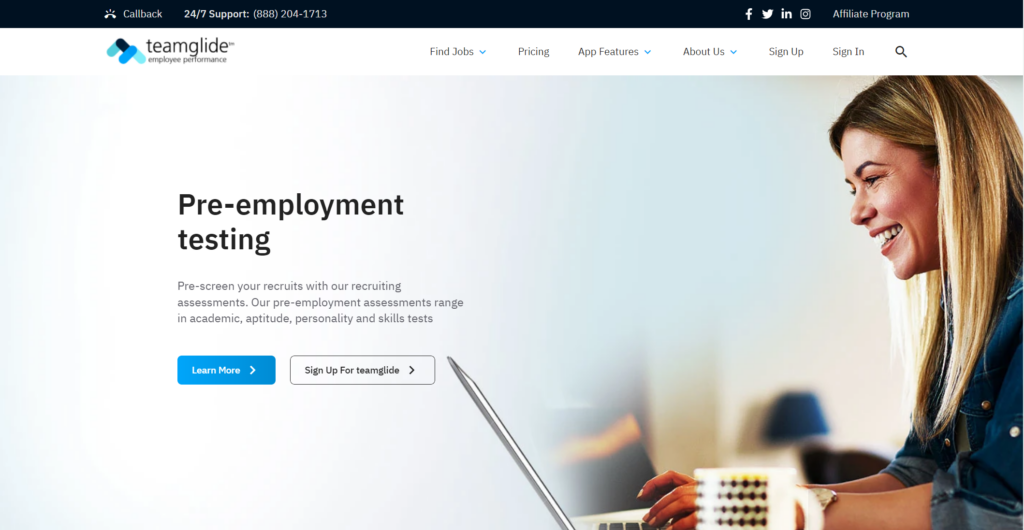
Is TeamGlide still available in 2026?
Partly, and the honest answer needs both halves. As of 29 August 2026, Teamglide return to a page whose only instruction is a redirect to a parking lander served by GoDaddy's domain-parking system. The product still appears on SE Technology's site and on third-party software directories. Nothing here says the company has closed, and this page does not claim it has.
What it does mean is that a buyer cannot read current documentation, current pricing or a current security posture from the vendor's own site. Every figure a directory shows you is a description someone wrote at some point, not a live signal.
Pro Tip: Before you renew or sign anything, load the vendor's own domain in a browser rather than trusting a directory listing. Then ask for the security page and the data processing agreement by URL. If those cannot be produced, that is your answer.
The reason this matters more for assessment tools than for, say, a scheduling app: candidate records are personal data, and they do not evaporate if a business changes hands. They become an asset in the sale. When one retailer tried to sell customer records in a way its own privacy policy ruled out, the Federal Trade Commission asked the bankruptcy court to step in. Test scores, ID checks and proctoring video sit in exactly that category.
Testlify vs TeamGlide: feature comparison
The table below only covers dimensions where at least one of the two vendors actually publishes something. Where a vendor says nothing, the cell reads Not published, because an absent claim is not the same as a missing feature. The previous version of this table marked dozens of features absent for TeamGlide with no source behind any of it.
Dimension | Testlify | TeamGlide |
|---|---|---|
What it is | Pre-hire assessment platform | Pre-employment testing plus ATS and job board |
Test library size | 3,500+ tests across 12 categories | 69 tests: 59 skill, 5 academic, 4 personality, 1 aptitude |
Cognitive and aptitude testing | Yes | 1 aptitude test listed |
Personality assessment | Yes | 4 personality tests listed |
Coding assessment | Yes | Not published |
Custom assessment building | Yes | Not published |
Proctoring | Yes, including live video proctoring and photo ID verification as paid add-ons | Not published |
Applicant tracking | No, integrates with your ATS | Yes, built in |
Job posting and job board | No | Yes |
Team performance tracking | No | Yes |
Published price | $139 per month, or $1,668 per year for 100 credits | From $162 for 1 year, per SE Technology's listing |
Free trial | 7 days, no credit card | Not published |
Vendor site status, August 2026 | Live | teamglide.com serves a domain parking page |
How much do Testlify and TeamGlide cost?
Testlify starts at $139 a month, or $1,668 a year, which buys 100 candidate credits. One credit is consumed when a candidate starts, so the effective rate is $16.68 per candidate. Three user seats are included and extra seats run $15 each per month. TeamGlide's only reachable price is SE Technology's listing, which shows the product from $162 for a year.
Two things are worth saying out loud about our own pricing, because a comparison that hides them is not much use. Some capabilities are paid add-ons rather than plan features: ATS integrations and white labelling are $2,388 a year each, live video proctoring is $5 per attempt, and photo ID verification is 50 cents per attempt. And unused credits expire at the end of a cycle. The current figures are on the Testlify pricing page.
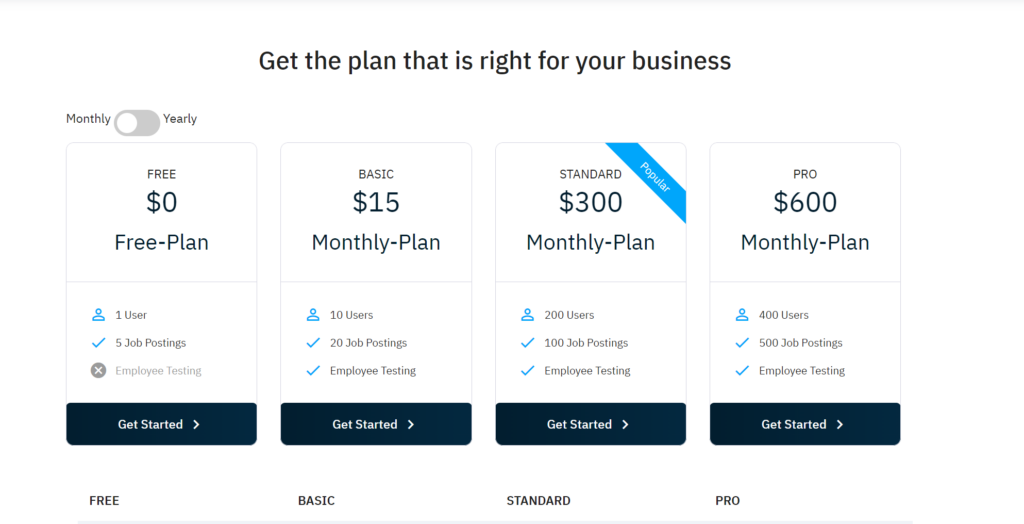
The older version of this page quoted TeamGlide plans at $15, $300 and $600 a month. None of those figures reconciles with a source that is reachable today, so they have been removed rather than restated. If SE Technology publishes a current price list, this table gets updated.
Which platform should you actually buy?
TeamGlide is the better buy in a few real cases. If you have no applicant tracking system and want posting, tracking and light screening in a single subscription, a bundle beats stitching two tools together. If you hire a handful of people a year into common roles, 69 tests may cover you. And if annual cost is the binding constraint, a listing that starts at $162 a year is a different order of spend.
Testlify is the better buy when the assessment itself is the constraint. That means volume screening, role-specific depth, technical hiring, or any process where you will later have to explain why one candidate advanced and another did not. The evidence base moved here too. A reassessment of decades of selection research put structured interviews at .42 and cognitive ability at .31 for predicting job performance, which reorders a hierarchy the field treated as settled. The design implications for selection systems follow from that: structure and job relevance carry the weight, not the raw test type.
The wider hiring shift points the same way. The World Economic Forum's Future of Jobs Report 2025 puts skills disruption at the centre of workforce planning, which is a hard problem to solve with 69 tests. If you are working out where assessment fits in your process, our take on hiring on skills rather than resumes covers the operating model.
How do you vet an assessment vendor?
Five checks, in the order that saves the most time. Each one takes minutes and any one of them can end the evaluation early.
- Load the vendor's own domain. Not the directory listing, not the sales deck. A parked domain, an expired certificate or a docs site that 404s tells you more about renewal risk than any feature grid.
- Ask for validity evidence on the specific tests you will run. Not the platform in general. The EEOC guidance on employment tests is blunt that the employer stays responsible for job-relatedness and validation, even when relying on the vendor's documentation. A vendor that cannot produce a technical manual is handing you the risk.
- Check the audit rules for every place you hire. New York City requires an annual bias audit of automated employment decision tools, a published summary of the results, and 10 business days of notice to candidates, under Local Law 144. In the EU, the AI Act treats systems used for recruitment and candidate evaluation as high risk, with obligations that fall on the deployer as well as the provider.
- Ask where candidate data lives and what happens when the contract ends. Retention window, deletion process, sub-processors, and export format. Get the answer in writing.
- Test the exit before you sign. Run a real export. If scores only come out as a PDF, you have no way to move a hiring history to another tool, and no way to check later whether your cutoffs were doing anything useful. Our guide to running pre-employment testing properly goes through the process end to end, and there is a separate walkthrough of keeping testing EEOC-defensible.
What evidence should a shortlist rest on?
The Testlify Multi-Signal Talent Evaluation Model combines several role-relevant signals, including assessments, interviews, simulations, references and reviewer feedback, so a decision rests on more than one thing. One signal is fragile. A candidate should move forward when several independent signals point the same way, not because one test score or one good conversation stood out.
Here is what that looks like in practice, as an illustrative case rather than a customer story. A 400-person logistics company hiring 30 warehouse supervisors a quarter could run a role-specific skills test and a situational judgement set before the first call, then add structured reviewer scoring at the interview stage. The screening step does not replace the interview. It changes what the interview is for, because the panel walks in already knowing which competencies need probing. Where remote testing is involved, proctoring controls decide whether those scores mean anything at all.
The caveat matters as much as the model. More signals cost candidates time, and a five-stage process for a role with 40 applicants is over-engineering. Match the number of signals to the stakes of the role, not to the capability of the tool.
Try Testlify on your next role
Pick one role you are hiring for this quarter and run the assessment step on it. Build from the library of 3,500 expert-validated tests, or book a demo and have someone walk through the setup for that specific role. The 7-day trial needs no credit card, and one role is enough to see whether scored shortlists change what your interviews feel like.
FAQs
Related resources
View all
Competitor Comparisons
Testlify vs Humantelligence: A detailed comparison
Competitor Comparisons
Testlify vs Meta Hire: A detailed comparison
Competitor Comparisons
Testlify vs Interviewer.AI: A detailed comparison
Competitor Comparisons
Testlify vs Hogan: A detailed comparison
Competitor Comparisons
Testlify vs Ensize: A detailed comparison
Competitor Comparisons
Testlify vs CallidusCloud: A detailed comparison
Get started.
Hire on proof, not resumes.
Run your first skills-based assessment free — no credit card required.