
Testlify vs FurstPerson: A detailed comparison
Discover the perfect solution for evaluating your candidates’ skills with Testlify. Dive into our comprehensive Testlify vs FurstPerson…
Short answer: this comparison changed shape in 2020. FurstPerson, the contact-center hiring system most buyers mean when they search for it, stopped selling as a standalone product after it was acquired in October 2020. So the useful question is no longer which of two products wins a feature checklist. It is what you evaluate instead, and on what evidence.
 ChatGPT
 Gemini
 Claude
 Grok
Grok Perplexity
TL;DR
- FurstPerson was a contact-center hiring system built around job simulations. It was acquired in October 2020 and is no longer marketed as an independent product.
- Its pricing was never published, and it still is not, so any cost comparison you find online is guesswork.
- Testlify covers a wider slice: role-based skills tests, cognitive and personality tests, coding tests, proctoring, and multi-reviewer scoring across technical and non-technical roles.
- Contact-center hiring is still a volume problem. The US employs about 2.7 million customer service representatives, with roughly 289,500 openings projected each year through 2035.
- Judge any assessment platform on evidence quality, not feature counts. Simulations and work samples earn their reputation because performance on them tracks performance on the job.

What happened to FurstPerson?
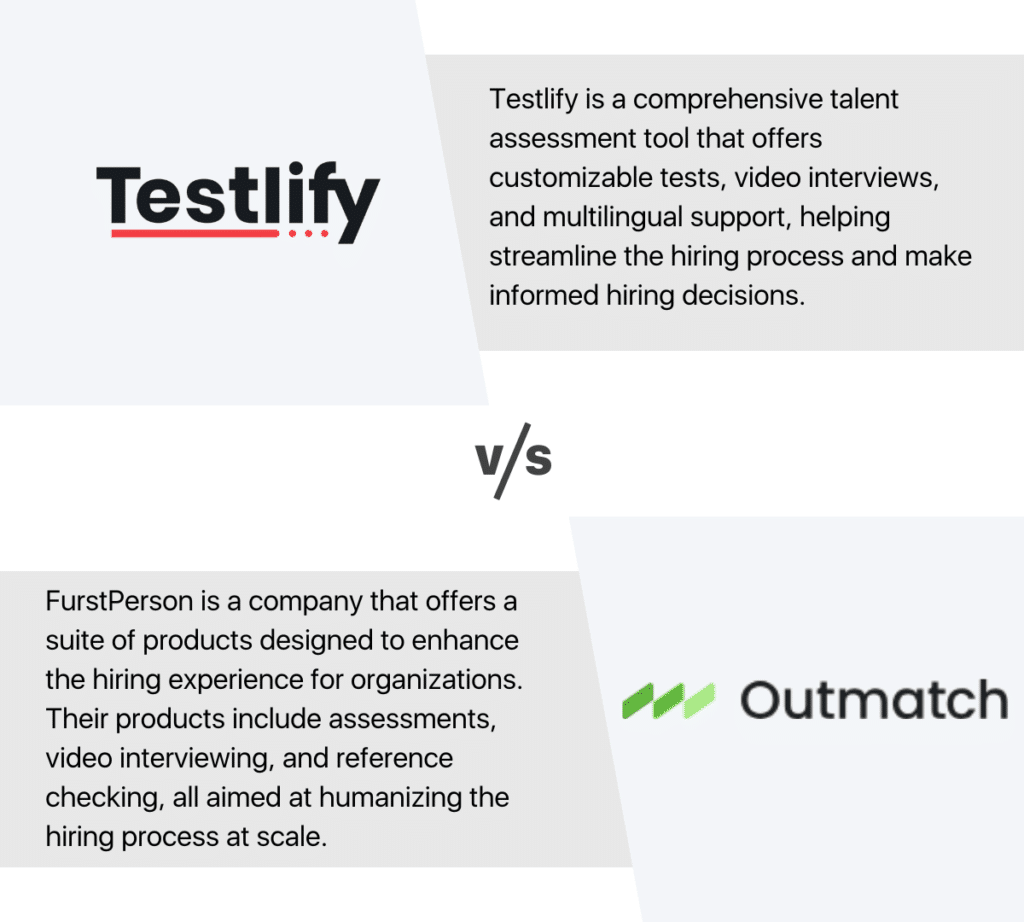
FurstPerson was acquired on October 26, 2020, and folded into a larger hiring platform. It has not been sold or marketed as a separate product since. The acquisition announcement described it as a contact-center hiring system running in more than 600 locations across North America, Europe, Latin America, and Asia.
That matters more than any feature row. If you are building a shortlist in 2026, you cannot buy FurstPerson the way the comparison articles still describe it. You would be buying a component of somebody else's platform, on that platform's terms and pricing. Most comparison pages on the web, including the earlier version of this one, still write about it in the present tense as though nothing happened.
The practical read: treat FurstPerson as a reference point for what good contact-center screening looked like, not as a live option to price out.
What does FurstPerson do?
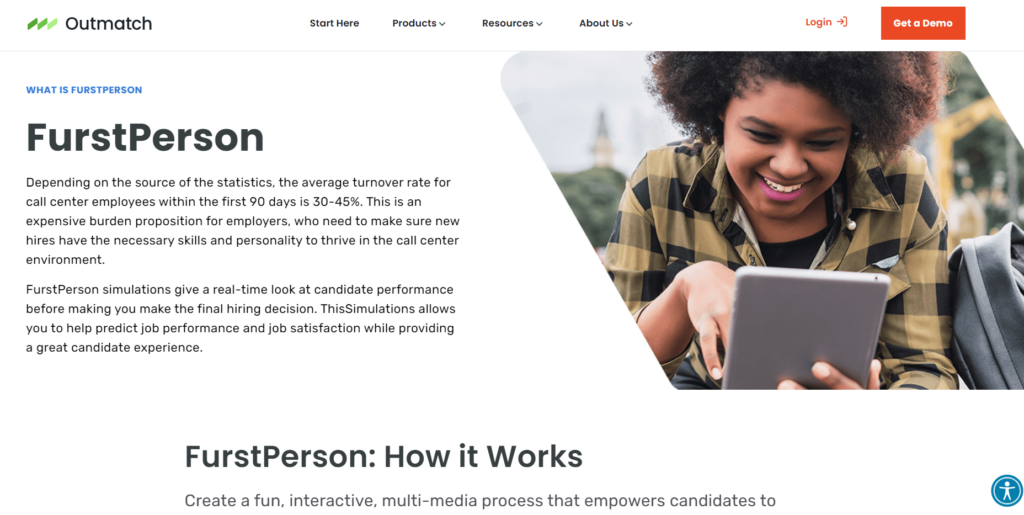
FurstPerson built pre-hire assessments for contact centers. The product combined contact-center simulations, problem-solving tests, personality tests, and hiring analytics, and it connected to applicant tracking systems so scores landed where recruiters already worked.
The simulation piece was the interesting part. Instead of asking a candidate whether they handle angry customers well, a simulation puts them in a scripted call or chat and scores what they actually do. That design choice is why the product held on in a crowded category for as long as it did.
Its limits were real too. The library was built for one family of roles. If you hired contact-center agents and nothing else, that focus was a strength. If you also hired developers, analysts, or field staff, you needed a second tool, and you paid for two.
How we compared these two platforms
Feature tables are easy to fake, so here are the criteria this comparison uses, drawn from the Testlify Multi-Signal Talent Evaluation Model. That model says one signal is fragile and several are not: a candidate should move forward when assessments, interviews, simulations, references, and reviewer feedback all point the same way, rather than on one strong test score or one good conversation.
Four questions, applied to both:
- Signal breadth. How many independent, role-relevant signals can the platform produce?
- Evidence quality. Does the assessment resemble the work, or only ask about it?
- Role coverage. Does it serve the roles you hire now and the ones you will hire next year?
- Transparency. Can you see pricing, scoring, and method before you sign?
Where a claim could not be verified against a public source, the table below says so instead of scoring a point either way. The previous version of this page marked dozens of capabilities absent for FurstPerson with no source behind any of them. That is not a comparison, it is an assertion.
How do Testlify and FurstPerson compare?
What you are evaluating | Testlify | FurstPerson (last publicly documented) |
|---|---|---|
Availability in 2026 | Sold directly | Not sold as a standalone product since 2020 |
Primary design | Skills and behavioral assessment across roles | Contact-center hiring system built on job simulations |
Role coverage | Technical and non-technical roles, plus role-based test libraries | Contact-center and customer-facing roles |
Job simulations | Yes, including work-style and situational formats | Yes, its core strength |
Coding and technical tests | Yes | Not publicly documented |
Cognitive and problem-solving tests | Yes | Yes |
Personality tests | Yes | Yes |
Proctoring and assessment integrity | Yes, layered identity, environment, and browser controls | Not publicly documented |
Multi-reviewer scoring | Yes | Not publicly documented |
ATS integration | Yes | Yes |
Public pricing | Published plans | Never published, quote only |
Read the third column as history, not as a live product spec. Anything marked "not publicly documented" means exactly that: no public source states it either way, so scoring it would be invention.
Which tool fits high-volume hiring?
For contact-center and other high-volume roles, the deciding factor is whether the platform can screen at volume without turning every hire into a coin flip. Volume is not going away, even where headcount is. Customer service representatives held about 2.7 million US jobs in 2025 and employment is projected to fall 5 percent through 2035, yet roughly 289,500 openings are still expected every year over that decade.
Read those two numbers together, because separately they mislead. The occupation is shrinking and still hiring hundreds of thousands of people a year, which means most of that hiring is replacement hiring. Churn, not growth, is what keeps the requisition open. A screening process that lets weak fits through is not just a quality problem, it feeds the churn that created the opening.
A narrow simulation tool handles that well for one role family. A broader platform handles it for the contact center and for the supervisor, analyst, and support-engineer roles those agents get promoted into. If you only ever hire agents, narrow wins on depth. Most teams do not.
Pro tip: before you compare vendors, count the distinct role families you hired for in the last 12 months. If the answer is more than two, a single-role tool will cost you a second contract within a year, and the integration work usually costs more than the license.
Testlify vs FurstPerson: pricing
FurstPerson never published pricing. Quotes were negotiated, which is normal for enterprise contact-center software and unhelpful when you are trying to budget. Every "FurstPerson pricing" figure circulating on comparison sites is inferred, not sourced.
Testlify publishes its plans, which is the difference worth caring about at this stage. You can see the tiers before a sales conversation rather than after. That transparency is not a small thing when procurement asks for three quotes and one vendor will not name a number without a discovery call.
The cost that actually moves is the cost of hiring badly. SHRM benchmarking put the average cost per hire at nearly $4,700 in its 2022 figures. Multiply that by the replacement hiring a contact center runs through in a year and the assessment license stops being the expensive line item.
Which is the best FurstPerson alternative?
If you want the closest match to what FurstPerson did, look for job simulations first and a broad test library second. If you want the platform you will not replace in two years, invert that.
Testlify is built for the second case: role-based skills tests, cognitive and personality assessment, coding tests, proctoring, and multi-reviewer scoring in one place, across technical and non-technical hiring. It is a pre-hire assessment platform, not an applicant tracking system and not a sourcing tool, and it works alongside those rather than replacing them. Being clear about that boundary is more useful to a buyer than claiming the whole stack.
The evidence argument is the one worth weighing. The US Office of Personnel Management notes that work samples carry a high degree of criterion-related validity, because performance on the test relates closely to performance on the job, and that candidates tend to see them as fair. That is the case for simulations, and it holds whichever vendor you pick. The question is whether you can get that evidence for every role you hire, or only one.
Skills also keep moving. The World Economic Forum's Future of Jobs Report 2025 found employers expect 39% of workers' core skills to change by 2030. A test library that is easy to re-map to new competencies ages better than one built around a fixed role profile. Worth checking on the Testlify test library before you commit, and worth checking on any vendor you shortlist.
For a wider set of options, the FurstPerson alternatives roundup covers more ground, and you can compare assessment tools across the category.
Ready to assess candidates on real skills?
Pick two roles you are hiring for right now, one technical and one not, and build an assessment for each. You will learn more from that in an afternoon than from any feature table, this one included. Book a demo and bring those two roles with you.
Key takeaways
- FurstPerson is a historical comparison, not a live one. It was acquired in October 2020 and no longer sells independently. Anyone still comparing it head to head is comparing against a product they cannot buy, so the shortlist needs rebuilding around what is actually purchasable today.
- Simulations were the right idea and they still are. Watching a candidate do a scripted version of the work predicts on-the-job performance better than asking them to describe it, which is why work samples hold their reputation. Whatever you shortlist, insist on assessments that resemble the job.
- Single-role depth has a hidden cost. A tool built for one role family works beautifully until you hire outside it, then you are paying for two systems and stitching results together by hand. Count your role families before you decide.
- Volume in contact centers is replacement volume. The occupation is shrinking while still opening roughly 289,500 roles a year, so screening quality directly feeds or slows the churn that keeps those roles open. Treat screening as a retention lever, not just a filter.
- Opaque pricing is a real cost. A vendor that will not name a number before discovery slows procurement and makes budgeting guesswork. Published pricing lets you compare in an afternoon rather than a quarter.
- Skills drift faster than role profiles. With employers expecting 39% of core skills to change by 2030, a library you can re-map beats one locked to a fixed profile. Check how easily a platform lets you change what you measure.
FAQs
Related resources
View all
Competitor Comparisons
Testlify vs Caliper Essentials: A detailed comparison
Competitor Comparisons
Testlify vs TeamGlide: A detailed comparison
Competitor Comparisons
Testlify vs Humantelligence: A detailed comparison
Competitor Comparisons
Testlify vs Meta Hire: A detailed comparison
Competitor Comparisons
Testlify vs Interviewer.AI: A detailed comparison
Competitor Comparisons
Testlify vs Hogan: A detailed comparison
Get started.
Hire on proof, not resumes.
Run your first skills-based assessment free — no credit card required.