
Testlify vs Verensics: A detailed comparison
Discover the perfect solution for evaluating your candidates’ skills with Testlify. Dive into our comprehensive Testlify vs Verensics…
Testlify and Verensics both run early in the hiring process, and that is roughly where the similarity ends. Testlify measures whether a candidate can do the job. Verensics measures whether a candidate is likely to behave honestly once they have it. Those are different questions, and no feature grid turns one tool into the other.
This page was rebuilt in August 2026 after a check of both vendors' published material. The version before it scored Verensics against 79 skills-testing features and marked it absent on most of them. That told you very little, because Verensics never set out to be a skills-testing platform in the first place.
TL;DR
- Testlify is a pre-hire skills assessment platform. Verensics is an integrity and risk screening platform. They are not substitutes.
- Choose Testlify when the open question is capability: can this person do the work, and how do they compare with the rest of the shortlist.
- Choose Verensics when the open question is risk: theft, misconduct, or an internal investigation that needs everyone asked the same things in the same order.
- Testlify publishes its pricing and starts at $139 a month. Verensics does not publish pricing and asks buyers to book a discovery session.
- Some teams genuinely need both signals. Running one does not cover the other.
 ChatGPT
 Gemini
 Claude
 Grok
Grok Perplexity
What does Verensics actually do?
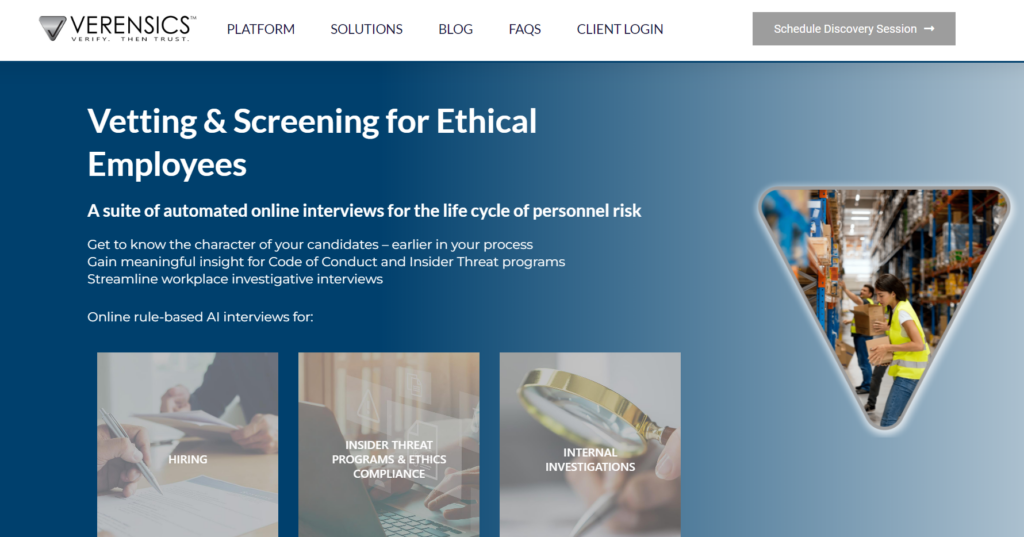
Verensics sells automated integrity interviews. The platform runs a rule-based, AI-guided questionnaire that asks a candidate or an employee a structured series of yes or no questions about workplace behavior, then returns a risk summary the company calls a Visible Risk Index. Its three stated uses are pre-employment due diligence, insider-threat monitoring, and internal workplace investigations.
The vendor's published material, checked on 29 August 2026, says an interview usually takes 15 to 20 minutes and covers more than 35 topics, among them employee theft, harassment, workplace violence and willingness to report misconduct. Verensics describes the design as following American Psychological Association guidance and built with industrial-organizational psychologists. Testlify has not independently verified those design claims. Neither should you: ask for the technical documentation before you sign anything.

Why do companies screen for integrity?
Because the losses are large, and a lot of them start inside the building. The Association of Certified Fraud Examiners estimates organizations lose 5% of revenue to fraud every year, a figure drawn from 1,921 real cases across 138 countries that cost $3.1 billion between them.
Retail shows the same shape at national scale. The National Retail Federation put shrink at $112.1 billion in 2022, up from $93.9 billion the year before, with the average shrink rate rising from 1.4% to 1.6%.
Pro tip: read that survey carefully before anyone quotes it at you. It attributes about 65% of shrink to internal and external theft combined, and does not split the two. A vendor citing that 65% as an employee-theft number is stretching the source further than it goes.
What does Testlify actually do?
Testlify measures job skills before the interview stage. The library holds more than 3,500 tests and 180,000 validated questions, plus over 150 interview templates, spanning role-specific skills, coding, cognitive ability and personality. Candidates take an assessment, and the hiring team gets scored reports they can line up side by side.
The point is to replace a resume skim and a gut call with evidence. That matters most when the shortlist is long and the candidates look similar on paper, which is precisely when interviewers fall back on impressions.
The Testlify Multi-Signal Talent Evaluation Model is the reasoning underneath it. One signal is fragile. Several role-relevant signals together are not, so assessments, interviews, simulations, references and reviewer feedback each add context, and a candidate should advance when those signals agree rather than because one score looked strong.
Testlify vs Verensics: feature comparison
The table lists only dimensions where at least one vendor publishes something concrete. Where a vendor publishes nothing, it says so. A cross mark would imply a feature is missing, and that is a claim neither company's material supports.
Dimension | Testlify | Verensics |
|---|---|---|
What it measures | Job skills, coding, cognitive ability, personality | Integrity risk and counterproductive workplace behavior |
Primary use | Pre-hire skills screening and shortlisting | Pre-employment due diligence, insider threat, investigations |
Method | Assessments and AI-assisted interviews | Automated structured interview, yes or no questions |
Stated length | Varies by assessment | 15 to 20 minutes |
Headline output | Scored candidate reports and skill breakdowns | Visible Risk Index |
Content library | 3,500+ tests, 180,000+ validated questions | 35+ integrity topics |
Published entry price | $139 per month, or $1,668 per year | Not published |
Free trial | 7 days, no credit card | Not published |
Design basis stated by vendor | Validated question bank, role-based assessments | APA guidance, industrial-organizational psychologists |
Which tool should you choose?
Pick on the question you actually have. If you cannot tell which of six shortlisted people can do the work, that is a skills problem, and an integrity interview will not answer it. If you have a shrink problem in a warehouse, or an investigation where every employee needs the same questions in the same order, that is a risk problem, and a coding test will not answer it.
Here is the caveat that applies either way. Anything used to make an employment decision carries legal weight, integrity screening included. The EEOC treats any test or selection procedure used in hiring as something that has to be job-related and consistent with business necessity, and the Uniform Guidelines on Employee Selection Procedures supply the four-fifths rule regulators use as a rough screen for adverse impact. Keep the documentation for whichever tool you buy.
How much do Testlify and Verensics cost?
Testlify publishes its pricing. The Starter plan is $139 a month, or $1,668 a year, and includes 100 candidate credits (about $16.68 per candidate), 3 user seats and unlimited assessments. Extra seats cost $15 each per month and extra credits $21. There is a 7 day free trial with no credit card, plus a 30 day money-back guarantee. A custom plan covers teams assessing more than 25,000 candidates a year.
Verensics does not publish pricing, and points buyers to a discovery session instead. That is normal for risk and investigation tooling, where scope varies a lot between deployments, but it does mean you cannot compare cost until you have been through a sales conversation. Nothing has been invented here to fill that gap, and any Verensics price you see quoted on a comparison page is worth tracing back to a source.
Can you use both together?
Yes, and for some roles that is the sensible answer. A logistics company hiring warehouse staff at volume could assess the hands-on competencies the job needs, then run an integrity interview only for the roles with inventory access. The two signals do not overlap, so neither one covers for the other.
The trade-off is candidate patience. Every extra stage costs completion rate, and a 20 minute integrity interview stacked on top of a 40 minute skills assessment is a lot to ask before any human has spoken to the candidate. If you run both, put the cheaper filter first and save the second for the shortlist. For a wider view of the category, the roundup of tools that replace Verensics covers vendors this page does not, and the Peoplogica Skills breakdown, the Perspect AI comparison and the Maki People write-up apply the same test to three other platforms.
Ready to see what candidates can do?
Testlify gives you scored, comparable evidence before the first interview, so the shortlist arrives already ranked on the skills the role needs. Start a 7 day free trial with no credit card, or book a demo and see the reports for a role you are hiring right now.
Key takeaways
- These tools answer different questions. Testlify measures capability, Verensics measures integrity risk. Treating either as a replacement for the other leaves a real gap in the process, because a candidate can be highly skilled and a poor risk, or trustworthy and unable to do the job.
- Absence marks on a comparison grid are usually unevidenced. The earlier version of this page marked Verensics missing on dozens of skills-testing features it never claimed. When you read any vendor comparison, check whether a cross means "we verified this is absent" or simply "we did not look".
- Integrity screening has real numbers behind it. Fraud costs organizations about 5% of revenue a year, and retail shrink reached $112.1 billion in 2022. If your roles carry cash, stock or system access, that exposure is worth screening for.
- Published pricing is itself a signal. Testlify lists $139 a month and a 7 day trial, so you can budget before a sales call. Verensics does not publish rates, which pushes the evaluation into a longer cycle you should plan for.
- Both types of screening are legally live. Any procedure feeding a hiring decision must be job-related and defensible, so keep validation documents and adverse-impact records from whichever vendor you pick.
- Sequence matters more than stacking. Running both is reasonable for high-risk roles, but candidate completion drops with every added stage, so filter on skills first and reserve integrity screening for the shortlist.
FAQs
Related resources
View all
Competitor Comparisons
Testlify vs Journeyfront: A detailed comparison
Competitor Comparisons
Testlify vs FurstPerson: A detailed comparison
Competitor Comparisons
Testlify vs Caliper Essentials: A detailed comparison
Competitor Comparisons
Testlify vs TeamGlide: A detailed comparison
Competitor Comparisons
Testlify vs Humantelligence: A detailed comparison
Competitor Comparisons
Testlify vs Meta Hire: A detailed comparison
Get started.
Hire on proof, not resumes.
Run your first skills-based assessment free — no credit card required.