
Testlify vs Caliper Essentials: A detailed comparison
Discover the perfect solution for evaluating your candidates’ skills with Testlify. Dive into our comprehensive Testlify vs Caliper…
 ChatGPT
 Gemini
 Claude
 Grok
Grok Perplexity
Testlify vs Caliper Essentials: which one fits?
Caliper Essentials is a personality and cognitive instrument. Testlify is a full assessment and interviewing platform. If you need a validated read on how someone is wired for a sales or management role, Caliper does that one thing deeply. If you need to test what a candidate can actually do, and interview them, pick Testlify.
That is the honest version of this comparison, and it is worth stating up front because the two products are not really substitutes. They answer different questions about the same candidate.

TL;DR
- Caliper Essentials is built around the Caliper Profile: 98 questions, 21 personality traits and one measure of cognitive ability, taken untimed in about 60 to 75 minutes.
- Testlify covers the same behavioral ground and adds skills tests, coding assessments, AI interviews and proctoring in one place, so you are not buying a second tool six months later.
- Talogy does not publish Caliper pricing. Testlify does: $139 a month on annual billing for 100 candidate credits a year.
- Personality is a real signal, but it is not the strongest one. Structured interviews and job-knowledge tests predict performance better, which argues for combining signals rather than leaning on one profile.
- Pick Caliper if you want a single deep behavioral instrument with consultant support. Pick Testlify if one team owns hiring end to end and needs evidence across skills, behavior and interviews.
How do Testlify and Caliper Essentials differ?
The difference is breadth of signal, not quality. Caliper Essentials measures personality traits and one type of cognitive ability, then maps the result against a library of about 70 research-based job models. It is a psychometric instrument with a reporting layer around it, sold with debrief consultations and certification programs.
Testlify starts from the job instead of the profile. You assemble an assessment from role-specific skills tests, cognitive tests, personality and culture tests, situational judgement questions, coding work and interview questions, then score all of it in one candidate report. Personality is one section of that report rather than the whole thing.
A pattern we keep seeing with teams under 200 people: they buy a behavioral instrument, get a genuinely useful profile, and then still have no idea whether the candidate can build the spreadsheet model or write the SQL query the job needs every day. That gap is the reason this page exists.
What do Testlify and Caliper Essentials each cover?
The table below compares the two on what they measure and how they run. Rows marked with a dash are capabilities the vendor does not describe on its own product pages, which is not the same as a confirmed absence.
Capability | Testlify | Caliper Essentials |
|---|---|---|
Personality and behavioral assessment | Yes, plus DISC, enneagram and 16-trait reports | Yes, 21 traits, the core of the product |
Cognitive ability | Yes, a full cognitive test category | Yes, one abstract reasoning measure |
Role-specific skills tests | Yes, across blue collar, software, language and engineering | Not described |
Coding assessment | Yes, 45+ coding languages, browser VS Code editor, multi-file projects, up to 20 test cases | Not described |
Office application tests | Yes, Google Docs, Sheets and Slides, Microsoft Word, Excel and PowerPoint | Not described |
Typing test | Yes, scored 60% accuracy and 40% speed, weighting configurable | Not described |
One-way video interviews | Yes | Not described |
Two-way conversational AI interviews | Yes, video, voice and outbound phone at $0.18 per minute | Not described |
Live human interview panel scheduling | No | Not described |
Remote proctoring | Yes, three presets and dual-device monitoring | Not described |
AI-written answer detection | Yes, classifies answers as human, AI generated or mixed | Not described |
Item-level psychometrics for recruiters | Yes, difficulty index, discrimination index, quality risk | Held by the test publisher |
Job models or role templates | 3,500+ tests to build role-specific assessments from | About 70 off-the-shelf job models |
Interview question templates | 150+ | Not applicable |
Consultant debrief and certification | Not offered | Yes, a named add-on |
Published pricing | Yes | No, quote only |
Free trial | 7 days, no card required | Not published |
Pro tip: before you compare feature lists, write down the three decisions you actually make about a candidate this quarter. If two of the three are "can they do the work", a personality-only instrument will not settle them, however good the report reads.
Testlify: what it is and who it suits
Testlify is a pre-hire assessment and interviewing platform. One assessment can carry a skills test, a cognitive test, a personality section, a coding task and an AI interview, and every part lands in the same scored report.
Key features
- More than 25 question types, including coding with a browser-based VS Code editor, practical file-upload tasks, and live Office documents the candidate edits in Google or Microsoft.
- AI interviews in three formats: one-way async video, two-way conversational video or voice, and outbound phone calls billed at $0.18 a minute. You choose the avatar, the voice, the persona and the prompt, and set attempt and recording limits.
- Automatic multilingual transcripts on any recording over 30 seconds, with AI scoring you can switch off, hide from reviewers, or exclude from the final average.
- Proctoring with three presets and a dual-device mode that turns the candidate's phone into a second camera pointed at their screen. The session will not start until that phone is connected.
- Item-level psychometrics surfaced to recruiters, not just to a psychometrician: difficulty index, discrimination index and a quality-risk flag on every question.
Pros
- One tool answers both questions, what the person is like and what they can do.
- Pricing is public, and the trial needs no card.
- The human-in-the-loop controls are real. The product ships the line "AI scores and insights are for guidance only. Use human judgment for final decisions", and AI scoring can be advisory only.
- SOC 2 Type II, ISO 27001, GDPR and NYC Local Law 144 coverage for teams that need a defensible paper trail.
Cons
- No scheduling for live human interview panels. If you want calendars coordinated across five interviewers, that stays in another tool.
- Assessments run on Chromium desktop browsers. The mobile app is a recording fallback, not a way to sit a full test on a phone.
- If you already run Greenhouse or Workday, Testlify integrates as the screening layer and leaves your system of record alone. The built-in hiring pipeline is deliberately simple, aimed at teams that have no tracking system at all.
- Personality and cultural tests are qualitative and carry no total score, by design. Do not expect a single number to rank candidates on fit.
Best for
Teams of roughly 10 to 200 people where one person owns hiring and does not do it full time. Often a founder, an operations lead or a single HR generalist who needs evidence fast and cannot run a consultant-led assessment program.
Pricing
On annual billing, Starter is $139 a month for 100 candidate credits a year, billed $1,668 up front, with 3 seats. Basic is $279 a month for 300 credits and 5 seats. Business is $699 a month for 1,000 credits and 10 seats. One credit is consumed when a qualified candidate starts an assessment, and credits do not roll over. White labeling and the 100+ ATS integrations are $2,388 a year each on the self-serve plans, so budget for them separately rather than assuming they are included. Full tiers are on the Testlify pricing page.
Caliper Essentials: what it is and who it suits
Caliper Essentials is Talogy's cloud assessment and reporting product, built around the Caliper Profile. Caliper was an independent firm for decades, was acquired by PSI Services, and now sits inside Talogy, which is why the same product is described under three names across the web.
Key features
- The Caliper Profile itself: 98 scored questions covering 21 personality traits and one cognitive ability measure, mixing forced-choice, Likert and abstract-reasoning items.
- A library of about 70 off-the-shelf job models, with custom models built by Talogy's psychologists when nothing fits.
- Three report families: selection reports for hiring, coaching reports for development areas, and individual development guides.
- A talent audit view for reading strengths and gaps across a whole team rather than one candidate.
- Add-ons that a psychometric buyer will recognize: extended reporting, talent analytics, debrief consultations, 360 feedback and certification programs.
Pros
- Deep, well-established personality science with decades of norming behind it.
- Forced-choice items are harder to game than agree-or-disagree scales, which matters when candidates have read the practice guides.
- Job models and debrief support mean a non-specialist can interpret the output without a psychology background.
- Strong fit for sales and management selection, which is where the instrument has the most role evidence.
Cons
- Pricing is not published. Every evaluation starts with a sales conversation, which is slow if you are trying to screen candidates this month.
- Talogy's own product pages for Caliper do not describe coding assessments, skills tests, remote proctoring or AI interviewing, so a technical or high-volume screen needs a second product.
- 60 to 75 minutes is a long ask for a first-stage screen, and completion drops as the ask grows.
- Item-level statistics stay with the publisher. You get the interpretation, not the underlying question data.
Best for
Organizations hiring or promoting into sales and leadership roles, with budget for a consultant-supported program and a real need for depth on one candidate rather than throughput across many.
Pricing
Not published. Talogy asks buyers to contact an account team, and quotes vary by volume, report package and whether debrief consulting is included. Treat any per-test figure you find on a practice-test site as unrelated to what an employer pays.
How does Caliper Essentials work?
A candidate receives a link and works through the Caliper Profile untimed, typically finishing in 60 to 75 minutes. Most items are forced choice: given four behavioral statements, pick the one most like you and the one least like you. That format exists because it is harder to fake than a scale where every candidate can guess which end looks employable.
Scores come back as trait levels rather than pass or fail, then get compared against the job model you selected. A sales model weights persuasiveness and resilience differently from a service model. The output is a selection report with recommended interview probes, and Talogy will run a debrief call to walk a hiring manager through it.
The workflow assumes a candidate who is already shortlisted. It is an instrument for deciding between three finalists, not for cutting 200 applicants down to 20.
Do personality tests predict job performance?
Less than most buyers assume, and that is the finding that should shape this decision. The 2022 Sackett meta-analysis rebuilt the validity estimates the field had used for years and found earlier numbers had been substantially overcorrected. On the corrected figures reported by the Society for Industrial and Organizational Psychology, structured interviews lead at .42, job-knowledge tests reach .40, work-sample tests .33, and general cognitive ability .31.
Read that ordering carefully. The two strongest predictors on the list are things a personality instrument does not do: a structured interview and a test of whether the candidate knows the job. Work samples, the closest thing to "show me you can do this", beat raw cognitive ability.
None of that makes personality assessment useless. It makes it a component. Trait data explains why a strong performer stalls in a role that needs constant cold outreach, and no skills test surfaces that. The mistake is treating one profile as the decision.
The stakes are the reason to combine signals rather than economize on them. Gallup puts the cost of replacing a single employee at one-half to two times their annual salary, and calls that a conservative estimate. Against a number like that, running a skills test alongside a behavioral one is cheap.
Job-relatedness is also a legal position, not only a quality one. The EEOC guidance on employment tests and selection procedures expects an employer to be able to show that what it measures relates to the job. Evidence drawn from several role-relevant sources is easier to defend than a single trait score, whichever vendor produced it.
How much do Testlify and Caliper Essentials cost?
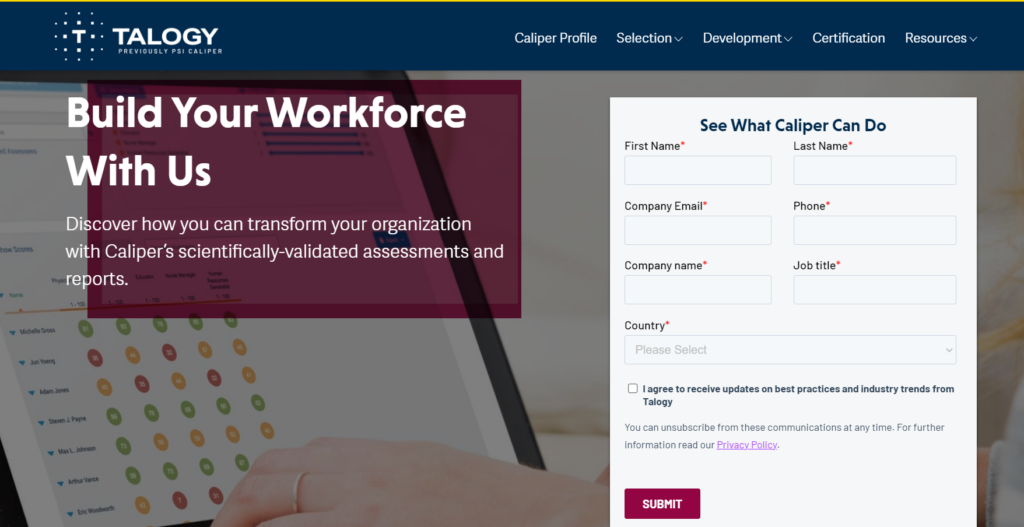
Testlify publishes its prices. On annual billing the entry plan is $139 a month for 100 credits a year, with a 7-day free trial that needs no card, a 30-day money-back guarantee and the price locked for 24 months. Monthly billing costs more per credit, and extra credits are sold on top of every tier.
Caliper Essentials does not publish prices. That is normal for consultant-supported psychometrics, and it is not a trick, but it does change your timeline: a quote, a scoping call and a debrief package take weeks that a card-free trial does not.
The comparison that matters is cost per decision, not cost per test. A 60-minute behavioral profile on a shortlist of three is a different purchase from a 25-minute skills screen on 200 applicants, and a team that needs both usually finds that buying two systems costs more than the licence gap suggests once admin time is counted.
How do you choose between them?
Start with the failure you are trying to prevent. Teams that keep hiring people who can do the work but do not last need behavioral depth. Teams that keep hiring people who interview beautifully and then cannot perform need work samples.
The Testlify Multi-Signal Talent Evaluation Model is how we frame this: combine several role-relevant signals, assessments, interviews, simulations, references and reviewer feedback, instead of relying on a resume, one test or one interviewer's read. One signal is fragile. Several pointing the same way is a decision you can defend six months later when someone asks why you hired this person.
Applied here, that means a personality profile is a signal worth having and a poor place to stop. Not every role needs every signal, and weighting them equally is its own error, but a shortlist decided on one instrument is a shortlist decided on one opinion.
Skills are also moving under you. The World Economic Forum's Future of Jobs Report 2025 found employers expect 39% of the skills a job needs to change by 2030, with 63% naming the skills gap as their main barrier to transformation. Trait profiles age slowly. Skill requirements do not, which is an argument for a platform where you can change what you test next quarter without a new contract.
If you want the same comparison against the wider Talogy portfolio rather than the Caliper product specifically, the Talogy platform comparison covers it. For the behavioral side on its own, our guide to hiring with a Big Five personality test explains what trait models can and cannot tell you, and using personality tests in selection covers where they belong in a process.
Hire on evidence, not one personality score
Run a real assessment on a real role and see what a multi-signal report looks like next to a trait profile. Start the 7-day free trial with no card, or book a demo and bring a job description; the fastest way to settle this comparison is to score one live shortlist both ways.
Key takeaways
- These are different instruments, not rivals. Caliper Essentials measures 21 personality traits and one cognitive ability. Testlify measures those plus skills, coding and interview performance. Deciding between them starts with which question you cannot currently answer about your candidates, not which feature list is longer.
- Personality is a weaker predictor than the market assumes. On the corrected 2022 validity figures, structured interviews sit at .42 and job-knowledge tests at .40, ahead of cognitive ability at .31. Any process that rests on one trait profile is resting on a middling signal, so budget for a second one.
- Published pricing changes your timeline. Testlify lists $139 a month annually for 100 credits and runs a card-free trial; Caliper quotes are sales-led. If you need candidates screened this month rather than this quarter, that difference outweighs most feature rows.
- Assessment length is a conversion cost. A 60 to 75 minute profile is reasonable for three finalists and punishing for 200 applicants. Match the instrument to the stage, and keep the long one late in the process.
- Proctoring and AI detection now matter at the screening stage. Candidates use AI assistants on take-home tasks. A platform that flags AI-written answers and can watch the desk through a second device protects the validity of everything it measures; a mailed-link questionnaire cannot.
- Bad hires are expensive enough to justify redundancy in your signals. Gallup's estimate of one-half to two times salary to replace someone makes a second assessment look cheap. Run the behavioral test and the work sample, then compare where they disagree.
- Buy for the next two years of roles, not this one. With 39% of required skills expected to shift by 2030, the ability to change what you test without renegotiating a contract is worth more than any single test in today's library.
FAQs
Related resources
View all
Competitor Comparisons
Testlify vs TeamGlide: A detailed comparison
Competitor Comparisons
Testlify vs Humantelligence: A detailed comparison
Competitor Comparisons
Testlify vs Meta Hire: A detailed comparison
Competitor Comparisons
Testlify vs Interviewer.AI: A detailed comparison
Competitor Comparisons
Testlify vs Hogan: A detailed comparison
Competitor Comparisons
Testlify vs Ensize: A detailed comparison
Get started.
Hire on proof, not resumes.
Run your first skills-based assessment free — no credit card required.