
How to evaluate digital marketing skills before you hire
A six-step way to evaluate digital marketers on real work: skills to test by role, data tasks, work samples, a scoring rubric and red flags.

A marketing resume can list every tool and a big growth number, and still tell you nothing about the person. Tool names, channel lists and campaign results look the same on a strong application and a weak one.
Hiring teams then fall back on gut feel and the best interview, which rewards confident talkers over capable marketers. A resume is easy to polish and hard to check.
Knowing how to evaluate digital marketing skills fixes this, because you watch the candidate do the work. This guide shows what to test for each marketing role, in what order, and how to score it on one rubric.
TL;DR:
- Evaluate digital marketing skills by testing the work, not the resume: a skills test, a data task, a capped work sample, a structured interview and a reference check, scored on one rubric.
- Pick 4 to 5 skills that matter for the role before you post the job. A paid media specialist, a content marketer and a marketing manager need different tests.
- Put cheap, objective checks first. A 30 to 40 minute skills test before any interview saves the most recruiter and hiring manager time.
- Cap take-home work at 2 to 3 hours, use your own data or realistic sample data, and score it against anchored levels from 1 to 4.
- Check results claims in the interview: ask for the baseline, the candidate's own part and how the result was measured.
- Allow AI tools in take-home tasks, but ask candidates to explain and defend their choices live.
- SHRM's 2025 research found 34% of organizations often or always hire on skills first, so most teams still have room to gain here.
 ChatGPT
 Gemini
 Claude
 Grok
 Perplexity
How do you evaluate digital marketing skills?
Digital marketing skills are evaluated by testing what the candidate can do on real tasks, in a fixed order, against criteria agreed before the first application arrives. Define the skills the role needs, run a short skills test, give a task with real data, ask for a scored work sample, then use a structured interview and references to check past results.
Resumes are a weak filter for this role. In LinkedIn's January 2025 survey of HR professionals, 73% said fewer than half of the applications they receive meet all the listed criteria, and 64% said qualified talent had become harder to find in the past year.
Marketing makes the problem worse, because results are shared across teams, agencies and budgets. A line like "grew organic traffic 200%" says little about the person.
Testing skills also widens the pool. LinkedIn Economic Graph's Skills-Based Hiring 2025 Report (March 2025) found that a skills-based approach would grow the talent pool for a typical job 6.1 times globally and 15.9 times in the United States, because people with the right skills but a different job title come into view. For the background on the approach, see this guide to skills-based hiring.

Which digital marketing skills should you evaluate?
The digital marketing skills worth evaluating fall into three groups: channel skills (search, paid media, social, email, content), analytics skills (measurement, attribution, testing) and working skills (strategy, communication, collaboration). Most roles need depth in one or two channels, working knowledge of the rest and solid analytics.
Skill area | What good looks like | How to evaluate it |
|---|---|---|
SEO | Matches content to search intent, fixes technical issues in priority order | Audit of one real page, keyword brief |
Paid search and paid social | Structures campaigns, sets bids and budgets by goal, reads ROAS and CPA | Mock account review, budget split task |
Social media | Plans content by platform and audience, knows organic vs paid roles | Two-week content plan with goals |
Email and lifecycle | Segments lists, writes for one action, tests subject lines and timing | Rewrite a weak email, build a three-step flow |
Content and copy | Clear writing, brand voice, writes for a reader and a keyword | Short brief plus a 300-word draft |
Analytics | Reads GA4 and ad platform reports, spots the leak, picks a fix | Report with three questions |
Strategy | Starts from the business goal, picks channels second, sets KPIs | 90-day plan for a real problem |
Communication and collaboration | Explains results to sales, product and leadership in plain words | Present the work sample, situational questions |
The US Bureau of Labor Statistics lists analytical skills, communication, creativity, decision-making, interpersonal skills and organization as the key qualities for marketing managers, and projects 6% job growth for the occupation from 2025 to 2035 in its Occupational Outlook Handbook. That list is a useful check: if a test only covers tools, it misses half of what makes a marketer good.
How do the skills change by role and seniority?
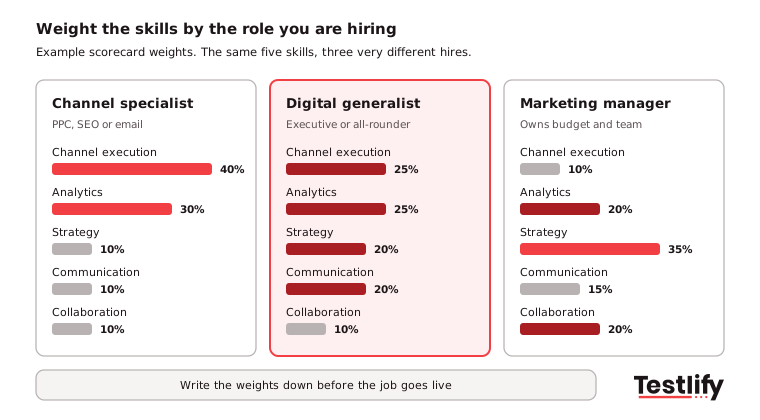
Digital marketing skills to test change with the role type and the level. A specialist needs depth in one channel, a generalist needs breadth plus analytics, and a manager needs strategy, budget judgment and the ability to lead others. Weight the scorecard to match, instead of using one generic list for every opening.
Level | Specialist (for example PPC or SEO) | Generalist (digital marketing executive) | Manager or head of digital |
|---|---|---|---|
Junior (0 to 2 years) | Platform basics, clean setup, follows a plan | Basics across 3 or more channels, good writing | Rarely hired at this level |
Mid (3 to 5 years) | Optimizes on data, runs tests, owns a budget line | Plans multichannel campaigns, reads reports alone | Leads one or two people, owns a channel mix |
Senior (5+ years) | Sets channel strategy, explains trade-offs to leadership | Builds the plan from the business goal, picks KPIs | Sets budget and targets, hires and coaches, reports to the C-suite |
For a full hiring plan by role, the digital marketing manager hiring guide covers the job description, interview stages and onboarding.
Pro tip: Write the scorecard before you post the job: pick 4 to 5 skills, give each a weight and share it with every interviewer. Teams that skip this step end up hiring whoever interviewed best.
How to evaluate digital marketing skills step by step
The best way to evaluate digital marketing skills is to run six steps, from the cheapest, most objective check to the most expensive one. Each step removes a different kind of weak candidate, so interviewers only spend time on people who have already shown they can do the basics.
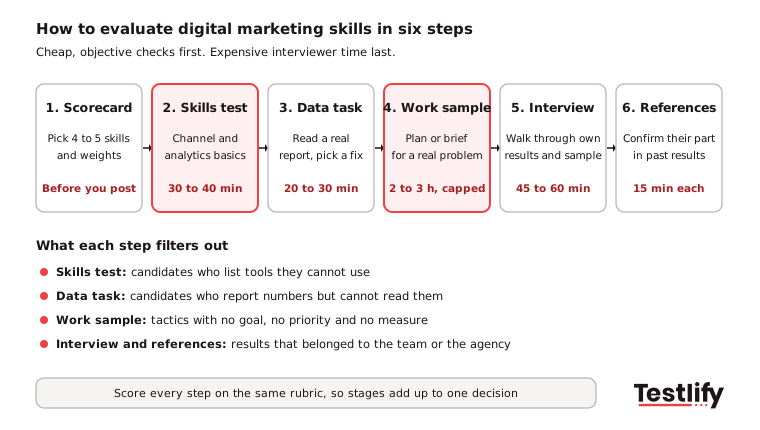
- Build the scorecard: Agree on 4 to 5 skills and their weights with the hiring manager before the job goes live.
- Run a short skills test: Send a 30 to 40 minute online test on the channels and analytics the role needs, right after the application.
- Give a data task: Share a report and ask three questions. This takes 20 to 30 minutes and shows who can read numbers, not just quote them.
- Ask for a work sample: Give the shortlist a real problem and a 2 to 3 hour cap. Pay for longer tasks.
- Hold a structured interview: Ask every candidate the same questions about the work sample and their own past results. A structured interview keeps scores comparable.
- Check references: Ask former managers what the candidate personally owned in the results they claim.
Few teams test this early. In the Testlify and SHRM Labs Skills-first talent report 2026, 32.8% of HR and talent leaders said they use no skills assessment at any stage, and only 6.9% assess before the first interview.
SHRM's 2025 skills-first research found that 53% of HR professionals have not used project-based assessments, even though 46% of organizations that use them report low turnover, against 34% of those that do not.
How do you test hands-on channel skills?
Hands-on channel skills are tested with short, role-specific questions and tasks that mirror the platforms the person will use in the job. Test the one or two channels the role owns in depth, and the rest at a basic level, so a strong specialist is not rejected for a weak score in a channel they will never touch.
- Paid search and shopping: Keyword match types, bidding by goal, budget pacing, conversion tracking. Use the Google Ads specialist test.
- SEO: Search intent, on-page fixes, crawl and index issues, internal links. Use the SEO test.
- Analytics: GA4 events, funnels, attribution, reading a drop in traffic. Use the Google Analytics test.
- Email and lifecycle: Segmentation, deliverability, testing. Use the email marketing test.
- Social media: Platform choice, content planning, community and paid social basics. Use the social media management test.
For a quick, broad first screen, a 10-minute digital marketing assessment checks content marketing, SEO, channel knowledge and website basics, and pairs well with one or two of the channel tests above. This post explains how to use a digital marketing test to screen candidates and set a fair pass mark.
What makes a good digital marketing work sample?
A good digital marketing work sample is a short, paid or time-capped task built on a real business problem, with the data the candidate needs and a clear question to answer. The task should take 2 to 3 hours at most, look like the first month of the job, and be scored on the same rubric for every candidate.
Three work samples that work well for most roles:
- The data read: Share a GA4 export or a campaign report and ask: which channel drove the best return last quarter, which page loses the most conversions, and what would you fix first and why?
- The 90-day plan: Describe a real problem, for example a SaaS product with a low free-to-paid conversion rate, and ask for the likely causes, the channels and tests to try, the KPIs and a rough budget split.
- The rewrite: Give one weak asset (an ad, a landing page section or an email) and ask for a better version plus a note on what changed and how to test it.
Key takeaway: Strong answers start from the goal, rank the fixes and say how success will be measured. Weak answers list best practices that could apply to any company.
To test creative problem solving on its own, add the creative thinking test.
How should you score candidates?
Candidates should be scored on a weighted rubric with 4 to 5 criteria and anchored levels from 1 to 4, where each level describes what the candidate actually did. Anchors stop one interviewer's "good" from meaning another interviewer's "great", and weights make sure the skills that matter most for the role count most.
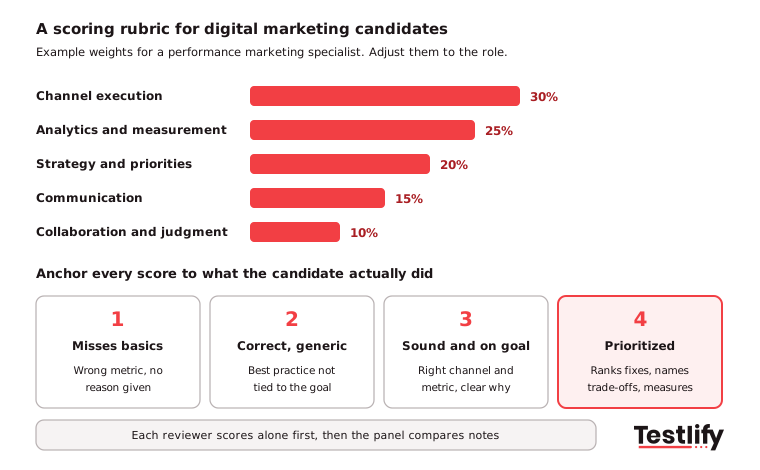
The US Office of Personnel Management's structured interview guidance makes the same point for interviews: every candidate gets the same questions in the same order, and every answer is rated on the same scale and standards.
Ask every reviewer to score alone before the debrief, then compare. A large gap between two reviewers on the same answer usually means the anchor needs a clearer example.
How do you check a portfolio and results claims?
A portfolio and results claims are checked by asking the candidate to rebuild the story behind each number: where it started, what they personally did, what else changed at the same time and how it was measured.
Real results hold up under these questions. Borrowed results do not.
Use these questions in the structured interview:
- Baseline: What was the number before you started, and over what period did it change?
- Ownership: Which parts did you do yourself, and which did the team, agency or another channel do?
- Measurement: Which tool and which attribution model produced the number?
- Cause: What else changed at the same time, such as price, season, product or budget?
- Lesson: What did not work, and what did you change because of it?
Candidates with confidential work can talk through the method on anonymized numbers. A missing portfolio is not a reason to reject a junior candidate; the work sample gives you the evidence instead.
For more questions by topic, see these digital marketing interview questions.
How should you handle AI tools in take-home tasks?
AI tools in take-home tasks are best handled with a clear, written rule: allow AI in take-home tasks, ask candidates to say where they used it, and test their judgment live. Marketers use AI for drafts, ideas and analysis at work, so banning it in a take-home task tests a skill the job does not need.
- Take-home tasks: Allow AI and ask for a short note on how it was used. Score the thinking, the choices and the fit with the brief, not the polish.
- Live follow-up: In the interview, ask the candidate to change one part of their plan on the spot, for example a 30% budget cut. People who did the thinking adapt quickly.
- Timed skills tests: Keep these closed-book with proctoring, so the score shows what the candidate knows. See how anti-cheating and proctoring works for online tests.
What are the red flags when evaluating digital marketers?
The red flags when evaluating digital marketers are claims that cannot be explained, answers that never mention the business goal and work that looks the same for every company. One red flag is a question to ask, not a reason to reject; a pattern of them is.
- Big results with no baseline, period or measurement method.
- "We" in every answer and no clear "I" when asked what they did.
- Vanity metrics only: followers, impressions or open rates with no link to leads or revenue.
- A plan that starts with channels and tactics instead of the problem.
- Tool lists with no example of a decision made with the tool.
- No mention of tests, failures or what they would change.
Soft skills show up here too. A communication test and a situational judgment test add evidence on how the candidate handles stakeholders, pressure and shifting priorities.
How does Testlify help you evaluate digital marketing skills?
Testlify helps hiring teams evaluate digital marketing skills with ready-made marketing tests, custom tasks and AI interviews in one assessment, scored automatically. Recruiters can build an assessment from a job description, mix tests with their own questions, and compare candidates on the same scorecard before anyone schedules an interview.
- Test library: 3,500+ tests, including tests for digital marketing, Google Ads, Google Analytics, SEO, email marketing, social media, creative thinking and communication.
- Custom questions: 25+ question types, including file upload for work samples, video and audio answers, and Chat AI, Voice AI and Video AI interviews.
- Fair scoring: Weighted scoring, a per-skill breakdown and AI candidate insights, so every candidate is judged on the same criteria.
- Integrity: 20+ proctoring checks, including AI assistance detection and copy and paste tracking, for the timed parts.
- Fits your stack: 100+ ATS and HRIS integrations, including Greenhouse, Lever, Workday and BambooHR, and tests in 15+ languages.
For a deeper look at test-based screening, read this guide to assessing candidate digital marketing skills.
Ready to evaluate digital marketers on real work?
Pick the marketing tests that match your scorecard, add one work sample, and send the same assessment to every applicant. Start a 7-day free trial with no credit card, or book a demo to see a marketing assessment built from your own job description.
Frequently asked questions (FAQs)

Director of Marketing
Akash Patange is the Director of Marketing at Testlify, where he works closely with HR leaders and recruiters to help organizations improve hiring outcomes. He writes about talent assessment, recruitment technology, and data-driven hiring practices.
LinkedInRelated resources
View all
Skill assessment
Data visualization skills: what they are and how to evaluate them

Skill assessment
5 tips to evaluate project management skills

Skill assessment
Financial analyst skills: what to look for and how to test them

Skill assessment
5 tips to evaluate Python programming skills

Skill assessment
Trustworthiness in the workplace: How to assess it in hiring

Skill assessment
5 tips to evaluate UX design skills
Get started.
Hire on proof, not resumes.
Run your first skills-based assessment free — no credit card required.