
Testlify vs. Vervoe: Which Platform is Best for HR Teams?
Testlify vs. Vervoe: Discover which talent assessment platform best suits your hiring needs
Testlify and Vervoe both replace resume screening with a scored assessment, but they make different bets. Vervoe bets on job simulations graded by machine learning, sold through a sales conversation. Testlify bets on breadth: a library of 3,500+ tests, conversational AI interviews across chat, voice and video, 20+ proctoring controls, and a published price. If your team runs high-stakes or high-volume hiring and wants to see the bill before the demo, Testlify is the stronger fit. If you hire a handful of roles a year and want a polished simulation for each, Vervoe still earns a look.
TL;DR
- Vervoe is a job-simulation platform: 300+ ready-made assessments, AI grading that ranks candidates automatically, and pricing you have to request.
- Testlify covers more ground: 3,500+ tests across 4,500+ roles, custom questions, and AI interviews that talk back to the candidate in chat, voice or video.
- Proctoring is the clearest gap. Vervoe lists six anti-cheating layers; Testlify runs 20+ measures including dual-camera proctoring and AI-assistance detection.
- Pricing transparency favors Testlify: $139 a month for the Standard plan with a 7-day free trial and a 30-day money-back guarantee, versus a quote-only model at Vervoe.
- Work samples predict performance well (operational validity of .33 in Sackett et al. 2022), but structured interviews and job-knowledge tests score higher, so the winning setup combines signals rather than picking one.
- Pick Vervoe when you hire few roles and want one deep simulation per role. Pick Testlify when you need breadth, integrity controls, ATS reach or a predictable cost per candidate.
 ChatGPT
 Gemini
 Claude
 Grok
Grok Perplexity
What is Testlify?
Testlify is a skills-based hiring platform that screens candidates with role-specific tests, cognitive and personality assessments, coding challenges and conversational AI interviews, then scores everything into one report a hiring team can act on. It is built for recruiters who screen at volume and need the results to hold up when a hiring manager, a candidate or a regulator asks how the decision was made.
How does Testlify work?
The workflow is the same whether you hire three people or three hundred. Set up a role, invite candidates, let the platform score and flag, then decide with your team.
1. Create tailored assessments
Recruiters pick from 3,500+ pre-built tests or generate custom questions with AI. Formats include multiple choice, open text, file upload, spreadsheet tasks, live coding in 45+ programming languages, and AI-led interviews that simulate on-the-job conversations in chat, voice or video.
2. Send candidate invitations
Candidates get a link by email or through a public invite. No account creation, no app download. That matters for hourly and frontline roles, where every extra step costs you completions.
3. Anti-cheating and proctoring
Every assessment can run with layered proctoring: webcam snapshots, screen recording, full-screen enforcement, tab and copy-paste tracking, dual-camera monitoring, IP and location checks, and AI-assistance detection. You choose how strict to be per role.
4. AI scoring and analytics
Scores land automatically, broken down by skill and question. AI insights on candidate reports summarize strengths and gaps so a recruiter reading 80 reports on a Friday afternoon doesn't have to reconstruct each one from raw numbers.
5. Integration with applicant tracking systems (ATS)
Testlify connects to 100+ ATS and HR tools, including Greenhouse, Lever, Workday and SAP SuccessFactors, so invitations go out from the ATS and scores flow back to the candidate record.
6. Data compliance
Testlify is GDPR compliant and holds SOC 2 Type II and ISO 27001 certifications, with CCPA coverage, role-based admin controls and audit logs for enterprise security reviews.

What is Vervoe?
Vervoe is an Australian skills-assessment platform built around job simulations. Instead of a knowledge quiz, a candidate does a slice of the actual job (answers a customer email, builds a spreadsheet, records a video pitch) and Vervoe's machine-learning models grade and rank the responses automatically. Its library lists more than 300 skills-based assessments, each one editable for your role.
How does Vervoe work?
Vervoe keeps the recruiter's job to four moves: pick or build an assessment, invite, let the AI grade, review the ranked list.
1. Create the assessment
Choose from the 300+ library templates, organized by function (sales, customer service, software development, accounting and finance, admin, HR, marketing, product), or start from a job description and let the AI builder suggest questions.
2. Customize the process
Adjust time limits, question order and branding. Vervoe supports text, multiple choice, video, audio, file upload, code, number, spreadsheet and presentation tasks, plus Google Docs, Sheets and Slides questions.
3. Invite candidates
Invitations go out from Vervoe or through an integrated ATS. Candidates complete the assessment in their own time, in a browser.
4. Review and shortlist
Vervoe's AI grades every answer and ranks the field, so candidates surface by skill rather than by who applied first. Recruiters open report cards, adjust weights, and shortlist.
5. Data compliance
Vervoe states ISO/IEC 27001 certification and GDPR compliance. It does not list a SOC 2 report on its security pages, which enterprise procurement teams in North America often ask for first.
Testlify vs. Vervoe feature comparison
Every row below comes from each vendor's own published pages as of September 2026. Where Vervoe does not publish a figure, the table says so rather than guessing.
Feature | Testlify | Vervoe |
|---|---|---|
Pre-built assessment library | 3,500+ tests across 4,500+ roles | 300+ skills-based assessments |
Programming languages for coding tests | 45+ | Coding tasks supported; language count not published |
Conversational AI interviews (candidate talks with an AI) | Yes: chat, voice and video | No: one-way video and audio responses |
Question types | MCQ, open text, coding, live coding, file upload, spreadsheet, Google Workspace, Microsoft Office, rating, number, date, qualifier, AI chat, voice and video | Text, MCQ, video, audio, file upload, code, number, spreadsheet, presentation, Google Docs, Sheets and Slides |
AI grading and ranking | Yes, with AI candidate summaries | Yes; summaries not a listed feature |
Weighted scoring | Yes | Yes |
Anti-cheating measures | 20+: webcam snapshots, dual camera, screen recording, full-screen enforcement, tab and copy-paste tracking, IP and location, AI-assistance detection, question-level activity logs | Six listed: question randomization, geolocation detection, plagiarism detection, candidate imagery, immersive questions, AI-assisted (ChatGPT and web) detection |
ATS and HR integrations | 100+ native | 16 named ATS integrations plus Zapier |
White-label and custom branding | Yes, including custom domain and emails | Logo, colors and tone on assessments |
Published pricing | Yes: Standard from $139 a month | No: request a quote |
Free trial | 7 days, no credit card | Not listed on the pricing page |
Money-back guarantee | 30 days | Not listed |
Security certifications | SOC 2 Type II, ISO 27001, GDPR, CCPA | ISO/IEC 27001, GDPR |
Reporting | Skill-level breakdowns, benchmarking, PDF, Excel and CSV export, shareable links | Completions, score distribution, question-by-question analytics, report cards |
Testlify vs. Vervoe: Test library and test types
Testlify pairs its conversational AI interviews with over 3,500 tests covering 4,500+ job roles across 50+ industries. The library breaks down into:
- Cognitive ability tests (problem-solving, logical reasoning, attention to detail)
- Role-specific tests (tailored assessments for named job roles)
- Blue-collar hiring tests (practical checks for skilled-trade and frontline roles)
- Programming tests (coding, algorithms, framework knowledge)
- Software skills tests (Microsoft Office, CRM systems, other business tools)
- Psychometric tests (personality traits, emotional intelligence, behavioral tendencies)
- Situational judgment tests (decision-making, conflict resolution, judgment under pressure)
- Live coding tests (real-time coding in a shared environment)
- Typing tests (speed, accuracy, data entry)
- Language tests (speaking and writing proficiency)
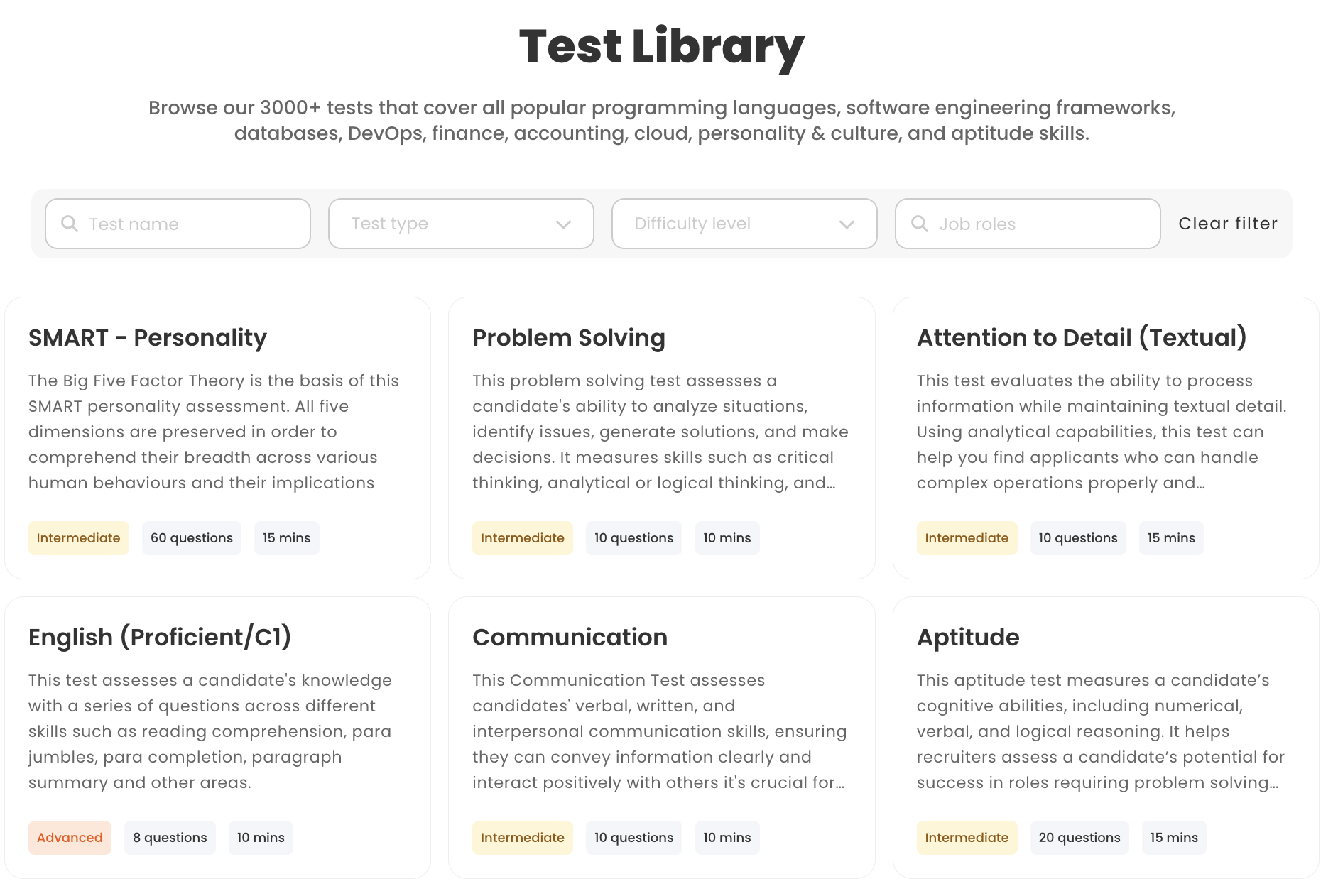
Vervoe lists more than 300 assessments, grouped by function rather than by test type. The main groups are:
- Software development (front-end, back-end, QA, DevOps simulations)
- Customer service (email, chat and phone scenarios)
- Sales (discovery calls, objection handling, pitch videos)
- Marketing (copywriting, PPC, content briefs)
- Accounting and finance (bookkeeping, statements, budgeting)
- Admin and office (scheduling, document handling, executive support)
- Human resources and product (screening, product ownership tasks)
- General skills (communication, numerical reasoning, typing)
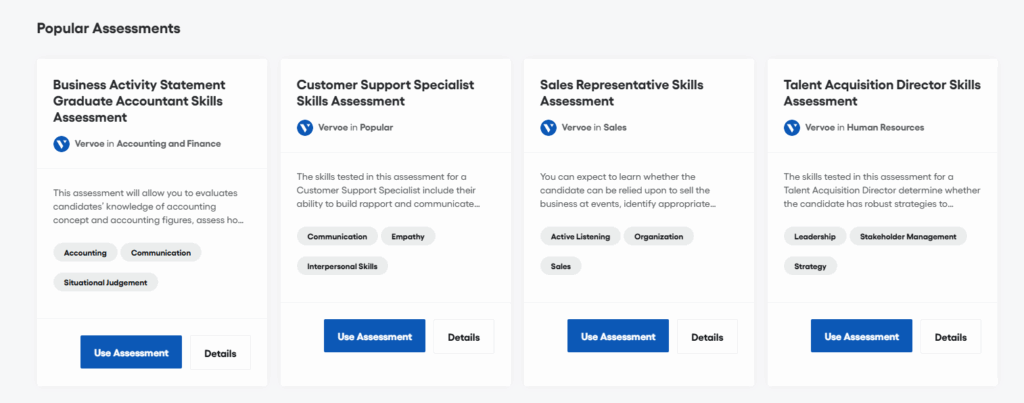
Verdict: Vervoe's templates are well built, but 300 assessments cannot cover 4,500 roles. Hiring a warehouse supervisor, a Kotlin developer and a French-speaking support agent in the same quarter means custom builds on Vervoe and library picks on Testlify. Testlify's conversational AI interviews add a layer Vervoe does not have at all.
Testlify vs. Vervoe: Custom question types
Testlify lets you build assessments from 15+ question types, so one assessment can mix a scenario MCQ, a spreadsheet task, a coding exercise and an AI video interview:
- Multiple choice and scenario-based MCQs
- Open-ended and descriptive questions
- AI-powered chat simulation
- AI-powered video interview
- AI-powered audio interview
- Custom coding questions and live coding
- Fill in the blanks
- File upload
- Google Docs, Sheets and Slides tasks
- Microsoft Office tasks
- Rating, number and date questions
- Qualifier questions
Vervoe also lets you build from scratch, with a smaller but simulation-heavy set:
- Text
- Multiple choice
- Video and audio responses
- File upload
- Code
- Number
- Spreadsheet and presentation simulations
- Google Docs, Sheets and Slides questions
Verdict: Both platforms cover the core formats. Testlify's edge is the interactive AI interview, where a candidate handles a live back-and-forth with an AI interviewer instead of recording a monologue. For roles judged on how someone thinks on their feet, that difference shows up in the shortlist.
Testlify vs. Vervoe: Weighted scoring
Testlify supports weighted scoring at the test and question level. Recruiters can also override an AI score or hand-mark an open answer, so the final number reflects what the role actually needs.
Vervoe offers weighting too. You can push a skill group up or down and re-rank the field without re-running the assessment.
Verdict: A draw. Both let you say "communication counts double for this role" and have the ranking follow.
Testlify vs Vervoe: White-labeling capabilities
Testlify offers full white-labeling: your logo, your colors, your domain, and invitation and rejection emails written in your voice. Candidates never see a third-party brand unless you want them to. Staffing agencies and resellers run client-branded assessments on the same account.
Vervoe lets you add your logo, colors and tone to each assessment. The assessment feels like yours; the platform behind it is still visibly Vervoe.
Verdict: Both brand the candidate experience. Testlify goes further with custom domains and a reseller plan, which matters if you assess on behalf of clients.
Testlify vs. Vervoe: Conversational interviews
Testlify uses conversational AI to put candidates in a two-way exchange that mirrors the job:
- Chat AI: the candidate handles a realistic text scenario, such as a billing dispute or an angry customer, and the AI responds to what they say.
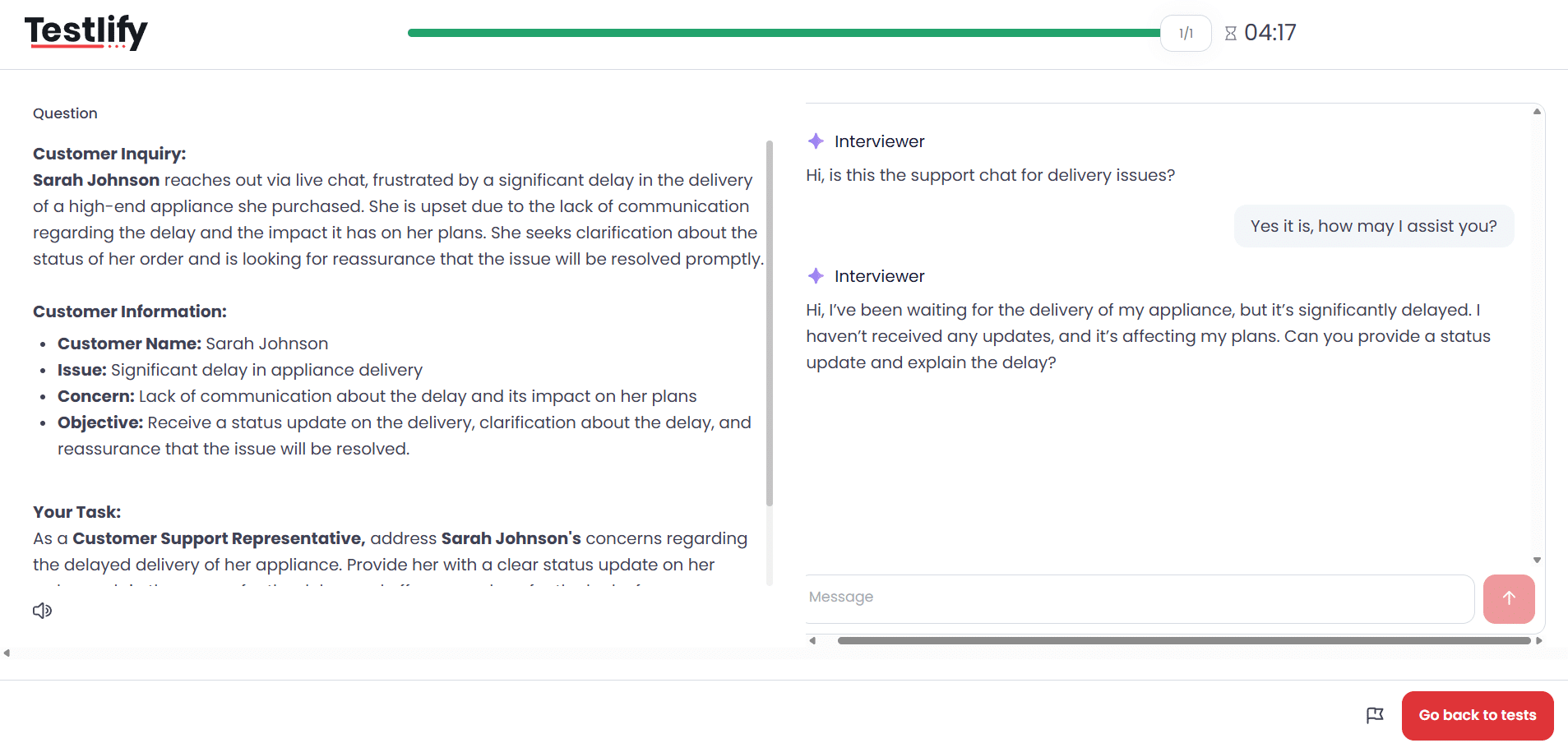
- Voice AI: candidates answer role-specific prompts out loud, useful for sales, support and any role where tone carries the message.
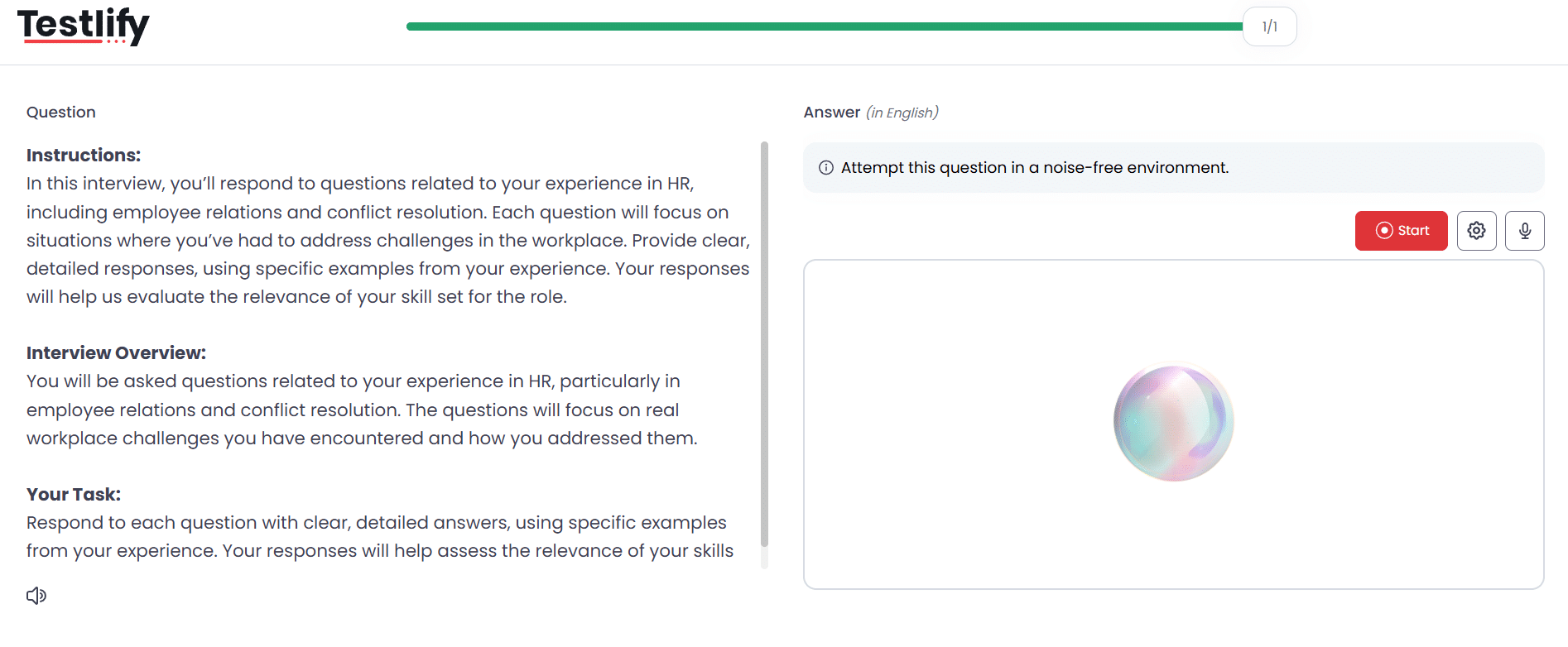
- Video AI: an AI interviewer walks the candidate through a scenario on video, so reviewers can assess presence and clarity alongside the answer itself.
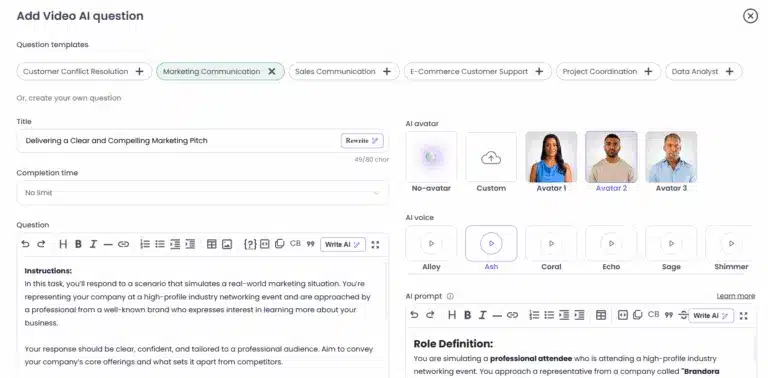
Vervoe focuses on job simulations. Candidates can record video or audio answers to a prompt (say, a message to a client about a delayed order), which gives you one side of a conversation.
Verdict: Testlify wins this section. A recorded monologue tells you how someone presents. A live exchange tells you how they listen, adapt and recover, which is the skill you are hiring for in customer-facing and leadership roles.
Testlify vs. Vervoe: Anti-cheating and proctoring features
Integrity is where the two platforms diverge most, and it matters more each year. Gartner surveyed 3,000 job candidates in 2025: 6% admitted to interview fraud, four in ten said they used AI during the application, and Gartner predicts one in four candidate profiles worldwide will be fake by 2028. An assessment you cannot trust is worse than no assessment, because it hands you false confidence.
Testlify runs 20+ anti-cheating and remote proctoring measures, configurable per assessment:
- Face detection and photo ID verification
- Webcam snapshots and live video monitoring
- Dual-camera proctoring
- Screen recording and screen sharing
- Full-screen mode and forced full-screen mode
- Tab, copy-paste and mouse-out tracking
- IP and location proctoring
- Multiple-monitor restriction
- Question randomization and question-level activity logs
- AI-assistance detection
- Talking prohibition and environment checks
- Honesty agreements
Vervoe lists six anti-cheating layers on its features page:
- Question randomization, so each candidate sees a slightly different set
- Geolocation detection, flagging assessments completed from several locations
- Machine-learning plagiarism detection across candidate answers
- Candidate imagery, using video and audio questions to confirm who is answering
- Immersive questions that are hard to outsource
- AI-assisted detection that checks answers against ChatGPT and web sources
Verdict: Vervoe's approach is smart and low-friction, and for a small hiring team it is often enough. But it has no dual camera, no screen recording, no forced full screen and no activity logs. If a candidate's assessment score decides a compliance-sensitive hire, you want reviewable evidence, not only a flag. Testlify gives you the evidence trail.
Pro Tip: Match strictness to stakes. Turn on full proctoring for regulated, technical and senior roles, and run a lighter set (randomization, tab tracking, AI detection) for high-volume entry roles where completion rate matters more than a perfect audit trail. Both platforms let you configure this; only Testlify gives you the full range to configure.
Testlify vs. Vervoe: Benchmarking analytics
Testlify benchmarks each candidate against the wider pool for that test and role, so a 72% on a data-analysis test reads as "top quartile" or "below the median" rather than a bare number.
Vervoe report cards show raw scores and how they compare with other candidates in your own assessment, plus a score-distribution view across the field.
Verdict: Close to a draw. Testlify's cross-customer benchmarks help most when you are hiring a role for the first time and have no internal baseline yet.
Testlify vs. Vervoe: Integrations and workflows
Testlify integrates with 100+ ATS and HRMS platforms, so recruiters trigger assessments from the ATS and see scores on the candidate card without switching tabs.
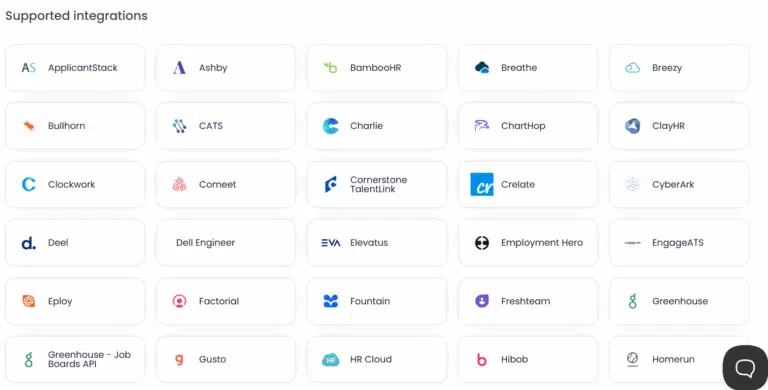
Vervoe names 16 ATS integrations on its integrations page (Greenhouse, Lever, Workday, SAP SuccessFactors, SmartRecruiters, iCIMS, Jobvite, Teamtailor, Recruitee, Breezy HR, Comeet, JobAdder, Pinpoint, Oracle, Zoho Recruit and ShopHire), plus Slack and SMS tools, and reaches other apps through Zapier.
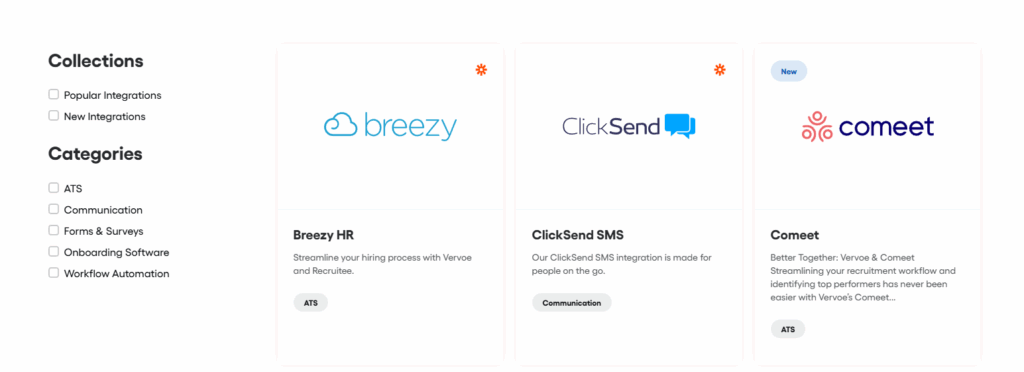
Verdict: If your ATS is on Vervoe's list of 16, you are fine. If it isn't, you are building Zapier workflows and owning their maintenance. Testlify's 100+ native connections make that problem rare.
Testlify vs. Vervoe: AI overviews
Testlify generates an AI overview of each candidate: a short summary of how they performed, where they were strong and where they fell short, drawn from the full report.
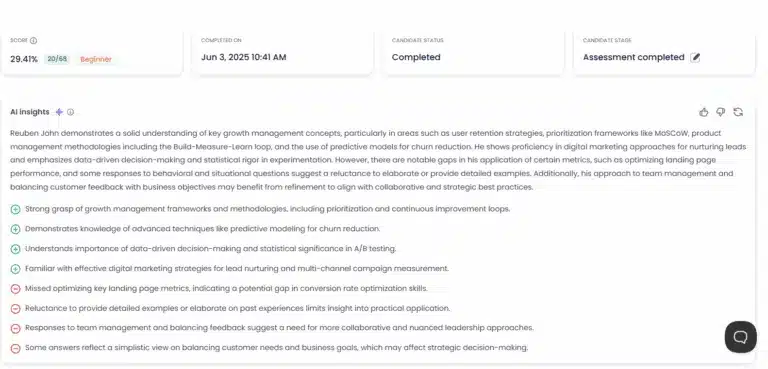
Vervoe uses AI to grade and rank, and its report cards are detailed, but a written performance summary is not a feature it lists. Recruiters read the card and draw their own conclusion.
Verdict: Small feature, big time saving. When you are comparing 60 candidates for one role, a two-paragraph summary per candidate is the difference between a same-day shortlist and a next-week one.
Testlify vs. Vervoe: Reporting and insights
Testlify provides detailed analytics on question-level performance, candidate behavior during the test, and benchmarks. Reports export to PDF, Excel or CSV and share by link with hiring managers who never log in.
Vervoe reports on completions, score distribution and question-by-question results. Candidates are graded and ranked automatically, and you can sort by removing a question or skill group from the view.
Verdict: Both turn raw answers into a ranked, shareable report. Testlify's behavior analytics and integrity evidence give reviewers more to stand on when a decision is questioned.
Testlify vs. Vervoe: Customer support
Testlify offers human support across chat and email, onboarding for new accounts, a help center with documentation and best-practice guides, and dedicated account management on Custom plans.
Vervoe offers a help center and support portal, with SSO, regional data storage and uptime SLAs on enterprise contracts.
Verdict: Comparable on paper. Ask each vendor for their median first-response time in your region and hold them to it in the contract.
Testlify vs. Vervoe: Pricing plans
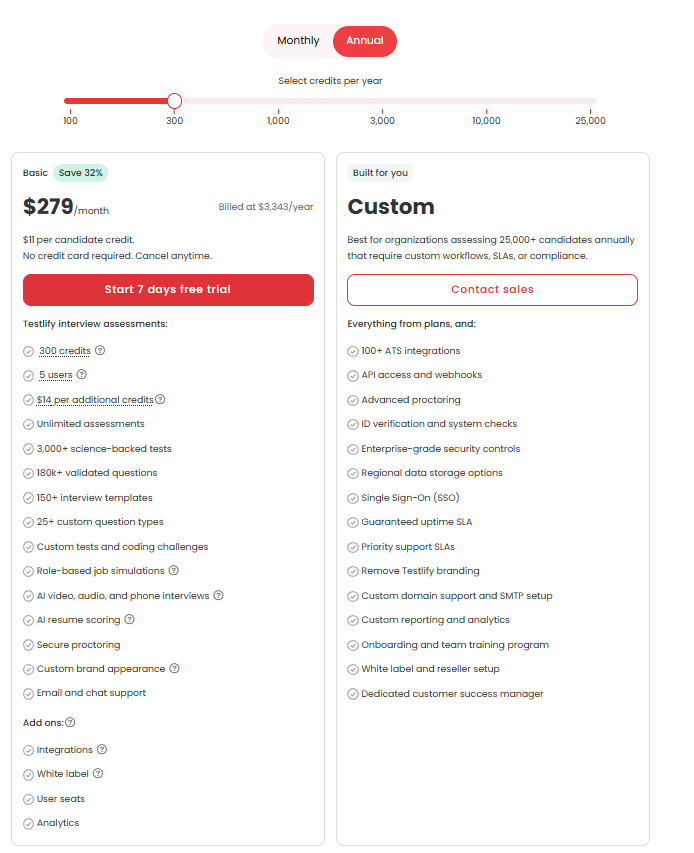
Testlify publishes its pricing, and the numbers are current as of September 2026:
- Standard plan: $139 a month, billed as $1,668 a year, with 100 candidate credits (about $16.68 per credit), 3 user seats, additional seats at $15 a month, and extra credits at $21 each. Includes a 7-day free trial with no credit card and a 30-day money-back guarantee. Base pricing is locked for 24 months.
- Custom plan: for organizations assessing 25,000+ candidates a year, with custom workflows, compliance requirements and a dedicated account manager. Priced on request.
- Enterprise and reseller plans: custom pricing with dedicated support; the reseller plan adds white-label delivery for agencies.
- Non-profits: 25% off with the code TESTLIFYCARES25.
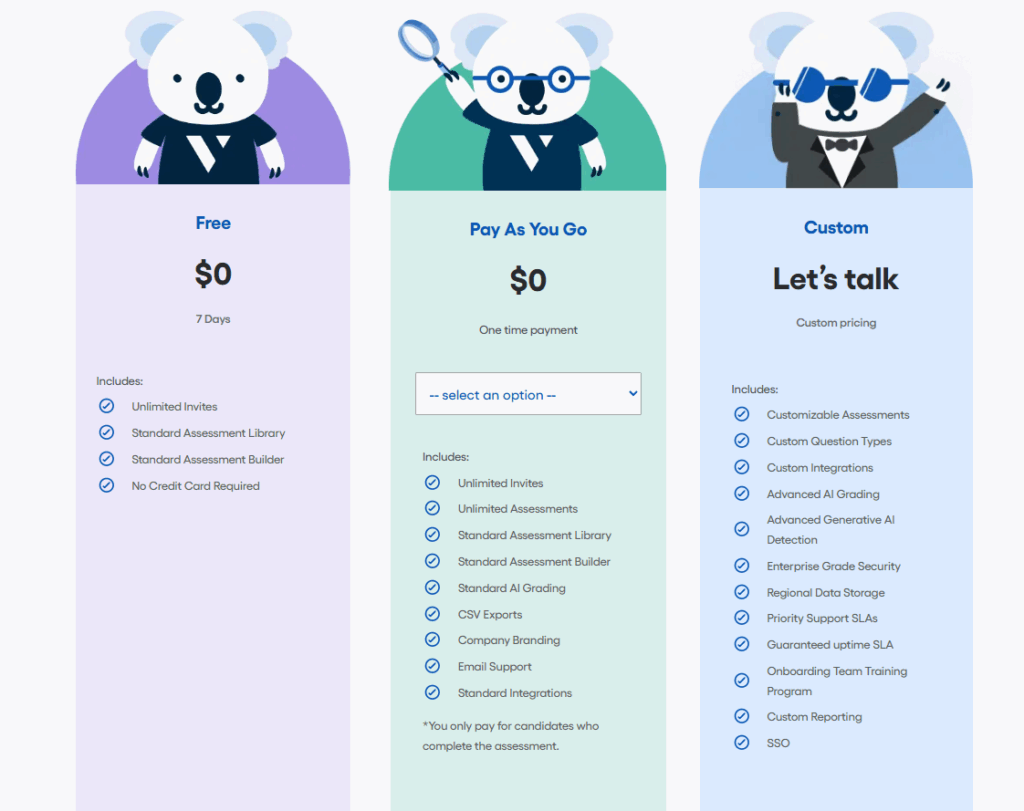
Vervoe does not publish prices. Its pricing page describes "pricing built for skills-first hiring at scale" and offers a request-pricing form and a demo. Enterprise contracts include SSO, regional data storage and uptime SLAs. Third-party listings quote a range of entry prices, and they disagree with each other, so the only reliable number is the one Vervoe's sales team gives you.
Here is what that means in practice. Take a 300-person software company that screens about 250 candidates a year for support and sales roles. On Testlify's Standard plan, that is $1,668 for the plan plus 150 extra credits at $21, or $3,150, for a total near $4,818 a year, roughly $19 per assessed candidate, known before the first call. On Vervoe, the same team cannot compute that figure until a quote arrives, and cannot compare quotes across renewals without asking again.
Verdict: Testlify wins on transparency and on the ability to trial before you buy. Vervoe may come in cheaper at a specific volume, but you will not know until you have spent an hour with sales.
Which platform has the best work samples?
Vervoe is built around work samples and does them well. Testlify offers work samples too, alongside cognitive, psychometric, coding and interview signals. Neither is the right answer alone: the research says work samples are a strong predictor, not the strongest, so the platform that lets you combine signals wins over the platform that perfects one.
Vervoe vs other skill assessment tools: which one has the best work samples?
Vervoe's simulations are the most job-like on the market at its price point. A candidate for a support role answers real-looking tickets; a candidate for an analyst role builds a real spreadsheet. If a hiring manager's only complaint about screening is "the test doesn't look like the job," Vervoe fixes that complaint directly.
The catch is what a work sample cannot tell you. Sackett, Zhang, Berry and Lievens re-estimated the validity of selection methods in the Journal of Applied Psychology in 2022, correcting earlier estimates they found had been inflated. Their operational validities put structured interviews first at .42, job-knowledge tests at .40, biodata at .38, work samples at .33 and cognitive ability at .31, figures the Society for Industrial and Organizational Psychology summarized for practitioners. Those exact coefficients are still debated in print, but the ranking holds: a work sample is a good signal and a structured interview is a slightly better one.
That is the case for the Testlify Multi-Signal Talent Evaluation Model: combine several role-relevant signals (a work sample, a structured AI interview, a cognitive test, reviewer feedback) instead of leaning on one. Testlify supports every one of those signals in a single assessment. Vervoe supports the work sample superbly and the rest partially. So for the narrow question "who has the best work samples," Vervoe is at least Testlify's equal. For the question that predicts your hire, "who lets me combine work samples with the other signals," Testlify is ahead.
How do you evaluate Vervoe as a vendor?
Buyers keep asking three specific questions about Vervoe as a recruitment technology company: how it handles white-label delivery, whether it supports evidence-based recruitment, and whether it works as recruitment agency software. Here is an honest read on each, with the same yardstick applied to Testlify.
How to evaluate the recruitment technology company Vervoe on white label hiring technology
Vervoe supports custom branding: your logo, colors and tone on every assessment, plus a welcome video. It does not advertise a custom domain or a reseller tier. Testlify offers full white-label delivery, custom domains, branded invitation and rejection emails, and a reseller plan built for agencies running assessments under a client's name. If white-label means "the client never sees the vendor," Testlify meets that bar and Vervoe partially does.
How to evaluate the recruitment technology company Vervoe on evidence based recruitment
Evidence-based recruitment has a legal yardstick in the United States: the Uniform Guidelines on Employee Selection Procedures, 29 CFR Part 1607, which asks employers to hold validity evidence for any selection procedure that produces adverse impact, using the four-fifths rule as the trigger. Vervoe's job-relevant simulations and I/O-psychologist-designed templates are a sound basis for that evidence. Where Testlify adds to it is the audit trail: benchmark data, question-level analytics and proctoring evidence that show how a score was produced, not just what it was. Whichever platform you choose, ask for the validation documentation on the specific assessment you plan to use, not the platform overall.
How to evaluate the recruitment technology company Vervoe on recruitment agency software
Neither Vervoe nor Testlify is an ATS or an agency CRM, and you should not buy either as one. For an agency, the questions that matter are: can you run client-branded assessments, can you share a report with a client who has no login, can you invite in bulk, and is the cost per candidate predictable enough to quote to clients? Vervoe covers branded assessments and shareable report cards; pricing is on request. Testlify covers all four, with a reseller plan, public report links, bulk invites and a published per-credit price. On this use case, Testlify is the more agency-ready of the two.
Is Testlify a good Vervoe alternative?
Yes, and for most teams that hire more than a few roles a year it is the better option. The reasons are specific:
- Breadth of coverage: 3,500+ tests for 4,500+ roles versus 300+ simulations. Fewer custom builds, faster time to first invite.
- Two-way AI interviews: chat, voice and video interviews where the AI responds to the candidate, versus recorded one-way answers.
- Integrity controls: 20+ proctoring measures with reviewable evidence versus six flag-based layers.
- Integration reach: 100+ native ATS and HR connections versus 16 plus Zapier.
- Transparent cost: $139 a month published, a 7-day trial and a 30-day guarantee, versus a quote.
- Decision support: AI candidate summaries and cross-customer benchmarks that shorten the path from report to shortlist.
If you are weighing more than these two vendors, the Vervoe alternatives comparison covers 15 platforms side by side.
When is Vervoe the better pick?
A comparison that only flatters one side isn't worth reading, so here are the cases where Vervoe wins.
- You hire a few roles, repeatedly, and want one deep simulation for each. A 40-person agency filling the same three sales and support roles all year gets more from a polished Vervoe simulation than from a 3,500-test library it will never explore.
- Your hiring managers reject anything that doesn't look like the job. Vervoe's immersive tasks are the easiest sell to a skeptical manager who has been burned by abstract tests.
- You are already on an ATS Vervoe integrates with natively and your proctoring needs are light. Randomization plus plagiarism detection is a reasonable floor for entry-level, low-risk roles.
Outside those cases, especially once integrity, breadth or predictable cost enters the conversation, Testlify is the safer bet.
See the difference on your own roles. Book a demo and bring one job description; the Testlify team will build the assessment with you live, proctoring included.
FAQs

Director of Marketing
Akash Patange is the Director of Marketing at Testlify, where he works closely with HR leaders and recruiters to help organizations improve hiring outcomes. He writes about talent assessment, recruitment technology, and data-driven hiring practices.
LinkedInRelated resources
View all
Competitor Comparisons
Testlify vs. Adaface: Which Skills Assessment Platform Wins in 2026?
Competitor Comparisons
Testlify vs TestGorilla: Which Talent Assessment Platform is Best for You?
Competitor Comparisons
Testlify vs Mercer Talent Enterprise: A detailed comparison
Competitor Comparisons
Testlify vs Skillsarena: A detailed comparison
Competitor Comparisons
Testlify vs Cappfinity: A detailed comparison
Competitor Comparisons
Testlify vs CredoHire: A detailed comparison
Get started.
Hire on proof, not resumes.
Run your first skills-based assessment free — no credit card required.