
Testlify vs CredoHire: A detailed comparison
Discover the perfect solution for evaluating your candidates’ skills with Testlify. Dive into our comprehensive Testlify vs CredoHire 2023…
Testlify and CredoHire both cut the candidate pile down before a recruiter spends time on interviews, but they answer different questions. CredoHire is an AI recruitment platform built around a scored, verified CV: it parses candidate data, runs an AI-led interview, and hands back a rating. Testlify is a pre-hire assessment platform: candidates take role-relevant tests, and the score reflects work they actually did.

TL;DR
- CredoHire scores the candidate's profile and interview answers. Testlify scores their performance on role-relevant tasks. That difference decides which one fits your process.
- Anything that scores candidates and decides who moves forward is a selection procedure, and the employer stays responsible for proving it is job related, even when the tool came from a vendor.
- Testlify publishes its pricing: $139 a month, or $1,668 a year for 100 candidate credits, which works out to $16.68 per candidate.
- CredoHire's own site could not be reached to confirm any current pricing or feature detail, so none is repeated here. Ask the vendor directly before you sign anything.
- Vendor viability now belongs on the evaluation checklist next to features and price. A screening tool that disappears takes your assessment history with it.
 ChatGPT
 Gemini
 Claude
 Grok
Grok Perplexity
What is CredoHire?
CredoHire is an AI recruitment platform that generates what it calls a Credo verified CV. Its stated approach is to replace early-round screening interviews with an AI-conducted video interview, convert the candidate's spoken answers to text, and apply natural language processing to produce a profile carrying technical and soft-skill scores, an interview summary, and a hiring recommendation.
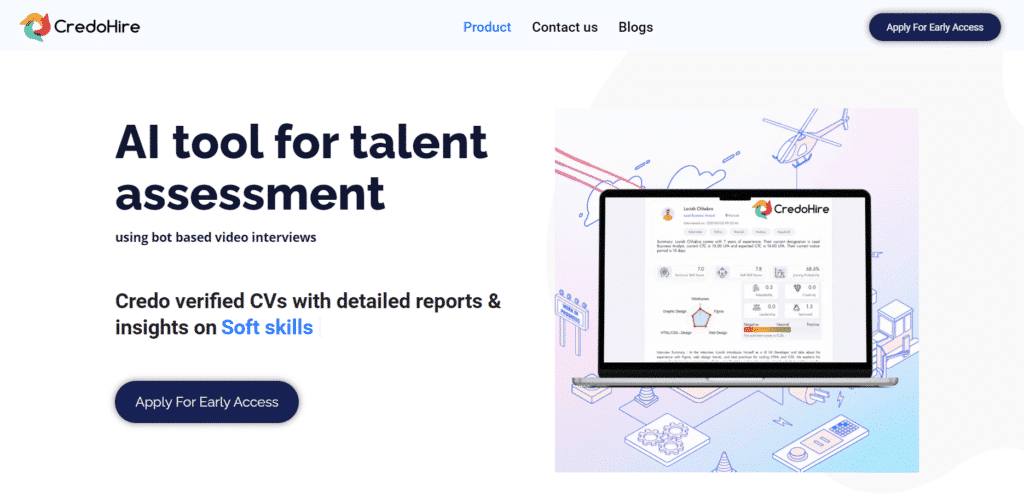
Two things are worth saying plainly. First, the product category is AI screening and candidate profiling, not skills testing. It reads and rates what a candidate says and what their history shows. Second, CredoHire's own website could not be reached while this page was being written, so no product or pricing detail beyond that description is repeated here rather than pulled from third-party directories that may be years stale. Directory listings for small vendors are copied forward for a long time after the underlying facts change.
That is not a knock on the company. It is a warning about how you should treat any specification you read on a comparison page, including this one: confirm it with the vendor before it influences a purchase.

What is Testlify?
Testlify is a pre-hire talent assessment platform. Candidates complete role-relevant tests, and hiring teams get scored, comparable evidence before the first interview. The library of validated skills tests holds 3,500 or more tests across 12 test categories, covering coding, cognitive ability, software skills, language, and personality.

The approach follows the Testlify Multi-Signal Talent Evaluation Model: combine several role-relevant signals, including assessments, interviews, simulations, references, and reviewer feedback, rather than advancing someone on one strong resume or one polished conversation. One signal is fragile. Several pointing the same direction is a decision you can defend.
Testlify is not an applicant tracking system, a sourcing tool, or a background-check provider. It connects to the rest of the hiring stack rather than replacing it. If you need one system to run requisitions, sourcing, and screening, neither tool on this page is the whole answer.
How do Testlify and CredoHire differ?
The honest comparison is not a feature count. It is a difference in what the score is made of. The table below covers only dimensions that could be confirmed from a live, first-party source. Where a vendor's own site could not be reached, the cell says so instead of showing a cross, because an unverified absence is not the same as a missing feature.
Dimension | Testlify | CredoHire |
|---|---|---|
What the score measures | Performance on role-relevant tests and simulations | Profile data plus AI-interview responses |
Primary category | Pre-hire skills assessment | AI screening and candidate profiling |
Test library | 3,500 or more validated tests, 12 categories | Not published on a reachable source |
Custom assessments | Assessment builder with custom questions | Not published on a reachable source |
Assessment integrity | Identity checks, environment controls, browser lockdown, AI-assistance detection, session evidence | Not published on a reachable source |
Published pricing | $139 a month, $1,668 a year for 100 credits | Not published on a reachable source |
Free trial | 7 days, no card required | Not published on a reachable source |
Read that table as a statement about evidence, not about quality. Five rows of "not published on a reachable source" tell you something real: at the time of writing, a buyer could not do basic diligence on this vendor from public sources. That belongs in your decision.
How do you check an AI hiring tool before you buy?
Most comparison pages stop at features and price. The parts that actually cause trouble later are the ones nobody demos. Three checks are worth doing before a contract, and they take about an afternoon.
Confirm the tool is defensible as a selection procedure
The moment a score decides who advances, the tool is a selection procedure, and the legal weight sits with the employer. The EEOC guidance on employment tests is blunt about where responsibility lands: "While a test vendor's documentation supporting the validity of a test may be helpful, the employer is still responsible for ensuring that its tests are valid under UGESP." The underlying standard is the Uniform Guidelines on Employee Selection Procedures at 29 CFR Part 1607. Ask any vendor for validation evidence tied to the roles you hire, not a generic one-pager.
Check which rules apply where you hire
Rules are local and they already bite. New York City requires employers using an automated employment decision tool to commission an independent annual bias audit, publish a summary of the results, and give candidates at least 10 business days of notice before the tool is used on them. In the EU, the AI Act classifies AI systems used for recruitment and candidate selection as high risk, with obligations that follow the deployer as well as the provider. A tool that cannot produce an audit trail is a tool you will have to explain without one.
Ask what happens if the vendor goes away
This check has moved from paranoid to routine, and CredoHire is a live example of why: neither of its obvious web addresses returned a working product site during this research. Before you commit, ask where assessment records live, how you export them, and what notice you get. Screening history is hiring evidence. If a discrimination claim arrives two years after a rejection, "the vendor shut down" is not an answer.
Pro Tip: Run the same five candidates through any tool you are evaluating and read the outputs next to what those people actually did in the role. If the scores do not separate your strong performers from your weak ones, the tool is measuring something, but not the thing you are hiring for.
Why skills evidence beats profile scoring
Profile-based scoring has a structural problem: it rates the record, and the record is a proxy. Skills evidence rates the work. That gap is widening. The World Economic Forum Future of Jobs Report 2025 puts the share of workers' core skills expected to change by 2030 at 39 percent, down from 44 percent two years earlier but still a large share of any job description. A CV describes what someone did in a role that may no longer look the same.
Tenure data points the same way. U.S. Bureau of Labor Statistics figures put median employee tenure at 3.9 years as of January 2024, the lowest since January 2002, and 2.7 years for workers aged 25 to 34. Shorter stints mean thinner, noisier histories to score, and more candidates whose best evidence is what they can do now rather than where they have been.
None of this makes AI screening useless. It makes it a first filter rather than a verdict. The strongest processes use AI to organize and summarize evidence, then put a scored work sample in front of a human who decides.
What does Testlify cost?
Testlify publishes its pricing, which is worth saying because much of this category does not. The Standard plan is $139 a month, or $1,668 a year, and includes 100 candidate credits. One credit is consumed when a candidate starts an assessment, which works out to $16.68 per candidate. Extra credits beyond the plan are $21 each. Three user seats are included and additional seats are $15 a month.
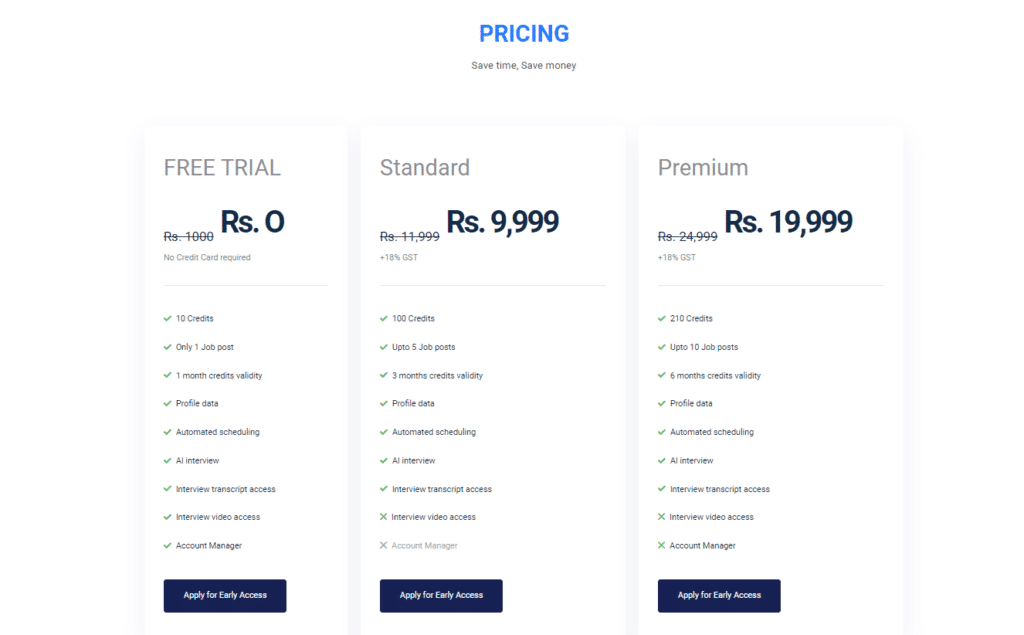
There is a 7-day free trial with no card required, a 30-day money-back guarantee, and base plan pricing locks for 24 months after purchase. Organizations assessing more than 25,000 candidates a year move to a custom plan.
Do the arithmetic against your own volume before comparing headline prices. At 100 candidates a year the cost per assessed candidate is $16.68. Against the cost of one mis-hire, that is a rounding error. Against 40 candidates a year, a credit pack you do not use is waste, and credits expire at the end of the cycle.
When is a different tool the better choice?
Testlify is not the right buy for everyone, and pretending otherwise wastes your time and ours.
- You need sourcing, not screening. If the problem is that not enough qualified people apply, an assessment platform does not fix it. Fix the pipeline first.
- You hire fewer than a handful of people a year. A structured interview scorecard and a short work sample, run by hand, will serve you better than any subscription.
- Your bottleneck is scheduling. If interviews are the jam, an interview-scheduling or AI-interview product targets that directly. Testlify sits earlier in the funnel.
- You need one system of record for the whole funnel. Testlify integrates with the ATS rather than replacing it, so a single-vendor mandate points elsewhere.
Where Testlify earns its place is the specific case of too many plausible candidates and no reliable way to rank them. Skills-based screening gives every applicant the same task and produces a score you can compare, defend, and improve. Personality and behavioral instruments have a narrower job, and the limits of workplace personality testing are worth understanding before you weight one heavily.
Hire on evidence, not on a resume
If early screening currently runs on gut feel and CV keywords, the fastest improvement is to put one role-relevant assessment in front of the first interview and compare the shortlist you get to the one you would have picked. Start a 7-day free trial, or book a demo and bring a live role to it, so the conversation is about your shortlist rather than a feature list.
FAQs
Related resources
View all
Competitor Comparisons
Testlify vs RecruitPack: A detailed comparison
Competitor Comparisons
Testlify vs Remote Interview: A detailed comparison
Competitor Comparisons
Testlify vs Safety Quotient Assessment: A detailed comparison
Competitor Comparisons
Testlify vs SoftSkillLab: A detailed comparison
Competitor Comparisons
Testlify vs TalentChaser: A detailed comparison
Competitor Comparisons
Testlify vs Sales Candidate Assessment: A detailed comparison
Get started.
Hire on proof, not resumes.
Run your first skills-based assessment free — no credit card required.