
Testlify vs Meta Hire: A detailed comparison
Discover the perfect solution for evaluating your candidates’ skills with Testlify. Dive into our comprehensive Testlify vs Metahire…
 ChatGPT
 Gemini
 Claude
 Grok
Grok Perplexity
Testlify vs Metahire: which should you choose?
Testlify and Metahire solve different halves of the same problem. Metahire automates the front of the funnel, posting jobs, ranking resumes, scheduling and running recorded interviews. Testlify measures whether a candidate can actually do the work, using role-specific tests scored the same way for everyone. Choose on the evidence your hiring decision is missing.
TL;DR
- Metahire is a recruitment automation platform. Its strength is speed at volume: resume ranking, one-click job posting, recorded interviews, scheduling and reference checks in one place.
- Testlify is a talent assessment platform. Its strength is evidence: role-specific tests across 45+ programming languages, cognitive and personality assessments, situational judgment tests and proctoring controls.
- If the bottleneck is too many applicants and too few recruiter hours, automation breadth wins. If the bottleneck is weak shortlists reaching hiring managers, measured skills win.
- Published Metahire pricing disagrees across software directories, so treat any single listed figure as a starting point and confirm it with the vendor.
- The feature table below is the fastest way to see where each platform goes deep and where it stops.
No credit card required. GDPR compliant. 128 G2 reviews.
Trusted by 1,500+ hiring teams from fast-scaling startups to enterprise TA functions

What does Metahire do?
Metahire is an end-to-end recruitment automation platform built in India. It handles job creation and one-click posting, reads and ranks incoming resumes, runs skill screening, schedules and conducts recorded audio and video interviews, chases candidates with automated follow-ups, and runs reference checks. The company says it has processed more than 10 million applications, and it lists customers including Cosmos Bank and Concentrix.
The product is aimed squarely at hiring teams drowning in applicant volume. The vendor's headline promise is closing the gap between "apply" and "offer" in about 72 hours. Business intelligence dashboards track time to hire, cost per hire and applicant source, so recruiting operations leads get funnel metrics without exporting to a spreadsheet.
That breadth is real, and it is the honest reason a team would pick Metahire. One vendor, one login, most of the recruiting workflow. The tradeoff shows up in what the platform can tell you about a candidate's actual ability, which is a narrower story.
What makes Testlify different from Metahire?
Testlify does one job and goes deep on it: producing defensible evidence about whether someone can do the role. That means a large library of role-specific tests, coding assessments spanning 45+ programming languages, cognitive ability tests, personality and psychometric assessments, situational judgment tests, typing and software-skills tests, and proctoring controls built to keep scores trustworthy.
The practical difference is what lands on a hiring manager's desk. Resume ranking tells you a candidate's history looks like the job description. A scored assessment tells you they solved the problem the job actually involves. Those are not the same claim, and only one of them survives a hiring manager asking "how do you know?"
Testlify is not an applicant tracking system, a sourcing tool or an HRIS, and it does not pretend to be. It integrates with the stack rather than replacing it. If you need one platform to run the whole funnel end to end, that is a genuine point in Metahire's favor. If you need the screening decision to be evidence-based, depth beats breadth.
How we compared these two platforms
Software directories rank both tools on star ratings and pricing. Neither tells a buyer how to judge an assessment platform, so here are the five criteria this comparison uses:
- Evidence quality. What does the platform actually measure, and is the measurement consistent across candidates?
- Test library depth. How many roles and skills are covered out of the box, before anyone has to build a custom test?
- Result integrity. What stops a strong score from being someone else's work?
- Workflow fit. How much of the surrounding hiring process does the tool own, and how well does it hand off to the parts it does not?
- Cost clarity. Can a buyer work out what they will pay before a sales call?
Those five are ordered deliberately. A platform that scores well on workflow fit and badly on evidence quality will make a hiring team faster at making the same mistakes.
Feature-wise comparison for Testlify vs Metahire
The table below runs the two platforms side by side across test library, assessments, video interviews, candidate experience, anti-cheating, reporting, enterprise readiness and support. Rows marked "Not stated" mean the vendor does not publish that detail, which is different from a confirmed gap.
Features | Testlify | Metahire |
|---|---|---|
Test Library | ||
Role-specific tests | ✓ | ✓ |
Cognitive ability tests | ✓ | ✗ |
Programming Tests | ✓ | ✓ |
No. of programming languages supported | 45+ | Not stated |
Situational judgment tests | ✓ | ✗ |
Typing test | ✓ | ✗ |
Software skills tests | ✓ | ✗ |
Non-technical tests | ✓ | ✓ |
Psychometric tests | ✓ | ✗ |
Personality tests | ✓ | ✓ |
Motivation test | ✓ | ✗ |
Assessment templates | ✓ | ✓ |
Custom assessments creation | ✓ | ✗ |
Test recommendations for different job roles | ✓ | ✓ |
Coding tests | ✓ | ✓ |
Assessments | ||
Custom assessment builder | ✓ | ✗ |
Custom coding questions | ✓ | ✗ |
Multiple-choice questions | ✓ | ✓ |
Descriptive questions | ✓ | ✗ |
Video interview questions | ✓ | ✓ |
Assessments curated by I/O psychologists | ✓ | Not stated |
Google doc | ✓ | ✗ |
Google sheets | ✓ | ✗ |
Google slides | ✓ | ✗ |
Audio questions | ✓ | ✗ |
Qualifier questions | ✓ | ✓ |
File upload questions | ✓ | ✗ |
Quality check | Extensive process incl. peer reviews, sample testing, review by psychometrician & more | Not stated |
Video interview questions | ||
One-way video interview | ✓ | ✓ |
Custom video questions creation | ✓ | ✓ |
Candidate's recording attempts per question | ✓ | Not stated |
Live video interview | ✗ | ✓ |
Candidate experience | ||
Fully customizable email templates | ✓ | ✗ |
Custom invitation and rejection email | ✓ | ✗ |
Mobile-friendly | ✓ | ✓ |
Candidate support | ✓ | ✓ |
Instructions before assessment | ✓ | Not stated |
Average assessment length | 40-60 minutes | 5-10 minutes |
Anti-cheating features | ||
Session recording | ✓ | ✓ |
Snapshot capturing | ✓ | ✗ |
Mouse tracking | ✓ | ✗ |
Copy-paste disabled | ✓ | ✗ |
Microphone and camera access | ✓ | ✓ |
Location access | ✓ | ✗ |
IP address tracking | ✓ | ✗ |
Randomization of question sequence | ✓ | ✓ |
Time limit on tests | Yes, typically 10 minutes | ✗ |
Reporting and analytics | ||
Detailed reports | ✓ | ✓ |
Easy to share reports and scorecards | ✓ | ✓ |
Exportable/downloadable reports | ✓ | ✓ |
Recruiting analytics | ✓ | ✗ |
Candidate benchmarking | ✓ | ✓ |
Completion rate and response insights | ✓ | ✗ |
Enterprise friendly | ||
White label feature | ✓ | ✗ |
Custom branding | ✓ | ✗ |
ATS integration | ✓ | ✓ |
User, role, and access management | ✓ | ✓ |
Bulk candidate invite | ✓ | ✓ |
Share public link invite to candidates | ✓ | ✓ |
Candidate pipeline management | ✓ | ✓ |
Internationalization | ✓ | ✗ |
Campus hiring support | ✓ | ✗ |
Dedicated account manager | ✓ | ✗ |
GDPR compliant | ✓ | ✓ |
Multilingual abilities | ✓ | ✗ |
Customer support | ||
24/7 support | ✓ | ✗ |
On-call support | ✓ | ✓ |
Email support | ✓ | ✓ |
Product demo | ✓ | ✓ |
Training & onboarding tour | ✓ | Not stated |
How Metahire works?
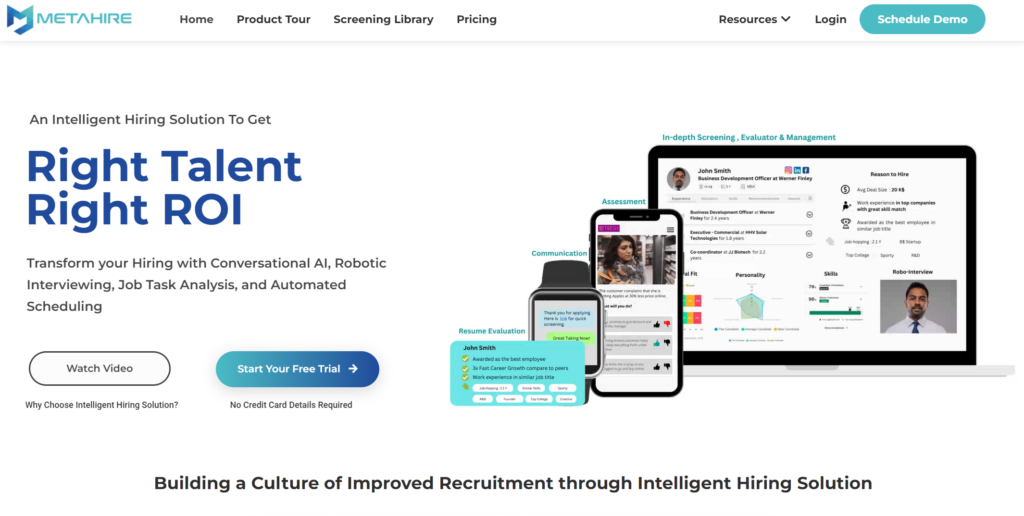
Metahire's candidate experience is built around an application flow that keeps people moving: a short application, automated messaging, and remote-friendly steps that do not need a recruiter on a call. The platform creates the job, posts it to multiple boards and portals in one click, then reads every incoming resume and ranks applicants against the requirement.
From there it runs screening and assessment steps, sends follow-ups and reminders, and can conduct a recorded interview with transcript and ranking attached. Detailed reports close the loop. The whole design assumes the hard part of hiring is throughput, and it is built to compress the "apply" to "offer" window to roughly 72 hours.
Where that model strains is depth of evidence. Ranking a resume against a job description is pattern matching on claims a candidate made about themselves. A recorded interview adds signal, but it is still self-report under better lighting. Neither produces a score you can defend to a hiring manager who wants to know why candidate four beat candidate eleven. For teams whose shortlists keep falling apart at the technical stage, that gap is the whole problem, and it is worth reading up on pre-hire assessment basics before choosing either tool.
Testlify vs Metahire: Pricing
Pricing is where this comparison gets genuinely messy, and pretending otherwise would not help a buyer. Metahire's published numbers disagree across software directories, so the honest answer is a range plus a warning.
Metahire pricing
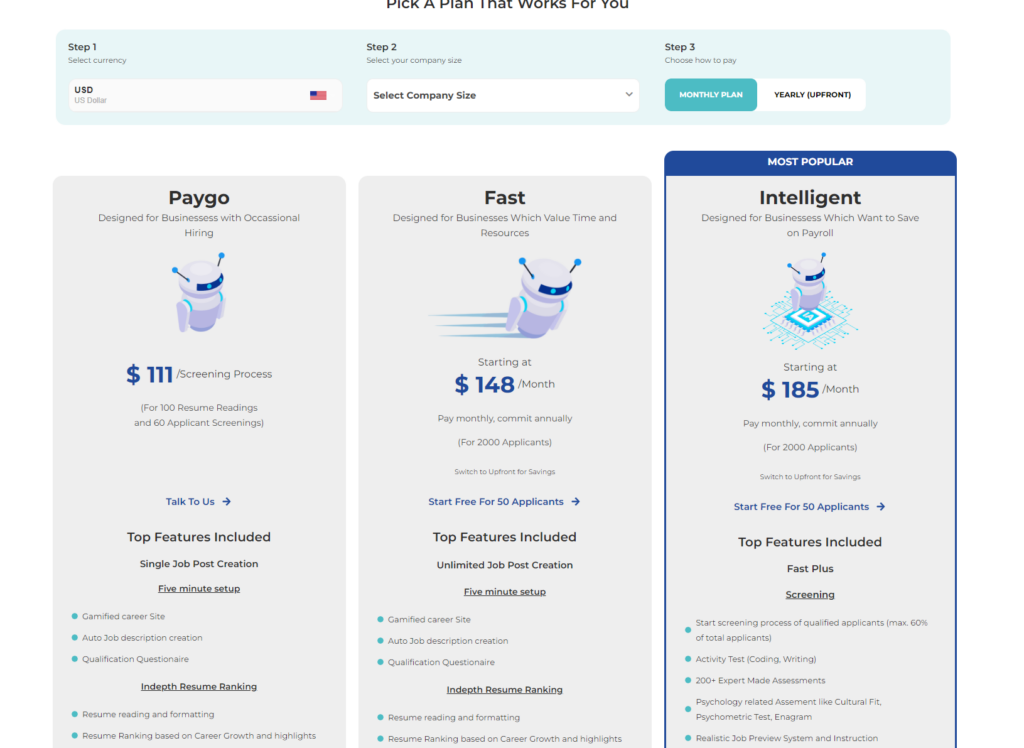
Metahire has historically listed three tiers, billed monthly or annually:
- Paygo: a $111 one-time fee covering 100 resume readings and 60 applicant screenings, aimed at occasional hiring.
- Fast: from $148 per month for 2000 applicants, including job post creation, resume ranking, screening, assessments, and candidate and internal messaging.
- Intelligent: from $185 per month for 2000 applicants, adding deeper screening, activity tests, psychology assessments, realistic job previews, and a robotic interview system with transcript and ranking.
Other directories list Metahire entry pricing from $70 per month, and the India premium plan at around Rs 29,500. Those figures cannot all be current at once. Vendors reprice, directories go stale, and regional plans differ, so confirm the live number with Metahire directly rather than trusting any listing, this page included.
What this means for budgeting
Applicant-count pricing and assessment-count pricing behave differently as you scale. A plan priced per applicant rewards a narrow funnel; a plan priced per assessment rewards testing only the people who clear an initial screen. Model both against your real monthly volume before comparing headline prices, because the sticker rarely survives contact with an actual hiring quarter.
Which platform fits which hiring team?
Metahire is the better pick when applicant volume is the problem. High-volume roles, campus and bulk hiring, small recruiting teams handling thousands of applications, or any team that wants scheduling, messaging and reference checks in the same tool as screening. If a recruiter is spending their week on coordination rather than judgment, automation breadth is worth more than test depth.
Testlify is the better pick when shortlist quality is the problem. Technical and specialist roles, teams whose hiring managers keep rejecting recruiter shortlists, regulated or audit-sensitive hiring where a scored, consistent process matters, and any org that wants remote assessment results it can actually trust. Depth of measurement is the point.
Plenty of teams run both, which is the answer nobody selling software likes to give. Automation handles the top of the funnel, assessment decides who reaches a human. If neither fits, there are other Metahire alternatives worth a look before committing.
What evidence should a hiring platform give you?
This is the question the directory listings skip, and it is the one that decides whether a tool pays for itself.
Testlify frames it through the Testlify Multi-Signal Talent Evaluation Model: combine several independent, role-relevant signals rather than leaning on a resume, one test, or one interviewer's opinion. Assessments, interviews, simulations, references and structured reviewer feedback each add context and cover a different blind spot. AI assists the process; people make the call.
The research backs the shape of that argument. A major reanalysis of selection-method validity research places structured interviews among the strongest predictors of job performance, and puts years of education and general years of experience among the weakest. That is a direct challenge to resume-led screening, because years of education and experience are most of what a resume ranker can see.
Combining that evidence consistently matters as much as collecting it. A meta-analysis of mechanical versus clinical data combination found that combining assessment information by a fixed rule predicts outcomes as well as or better than experts recombining the same information by their own judgment. Put plainly: the scorecard beats the gut re-read, even when the gut belongs to an expert.
The skills side is moving too. World Economic Forum survey data covering more than 1,000 employers and over 14 million workers puts 39% of workers' core skills on track to change by 2030, down from 44% in 2023 and 57% in 2020, with 63% of employers naming the skills gap as the biggest barrier to transforming their business. Skill instability is easing, but it has not gone away, and a resume describes skills someone needed in a previous job.
There is a cost argument underneath all of this. SHRM benchmarking data puts the average cost per hire at $4,129. A mis-hire costs that twice, once on the person who did not work out and once on the replacement, before counting the months of output nobody got.
Pro Tip: before you compare vendors, write down the last three hires that did not work out and name the signal that would have caught each one. If the answer is "we would have known in twenty minutes of watching them work," you need assessment depth. If it is "we never got to them, the resume screen buried them," you need funnel automation. Buy for the failure you actually have.
A caveat worth stating: assessments are not free. They add a step candidates can drop out of, they need someone to configure them properly, and a badly chosen test measures nothing useful while costing you good applicants. Depth is only an advantage when the test genuinely maps to the role, which is why the Testlify test library matters more than the raw test count.
Ready to see what scored, role-specific evidence looks like on your own shortlist? Book a demo and walk through a real assessment for a role you are hiring right now.
Key takeaways
- Buy for your actual bottleneck, not the longer feature list. Metahire wins on funnel automation and Testlify wins on measured evidence, so the right choice depends on whether recruiter hours or shortlist quality is what keeps failing. Teams that pick on feature count usually buy breadth they never switch on.
- Resume ranking and skills measurement answer different questions. One says a background resembles the job description, the other says a candidate solved the problem the job involves. That distinction decides whether a hiring manager trusts your shortlist, so make sure at least one tool in your stack produces the second kind of answer.
- Structured, consistently scored evidence outperforms expert re-reading. The selection-validity research puts structured methods among the strongest predictors and fixed-rule scoring ahead of case-by-case reinterpretation, which means the value comes from applying the same rule to every candidate, not from having a smarter reviewer at the end.
- Treat every published Metahire price as unconfirmed. Directory listings currently disagree by a wide margin, from $70 per month up to $185 per month depending on the source, so model your real applicant volume and get a live quote before comparing totals. A sticker price you cannot verify is not a budget.
- Assessment depth has a real cost. Tests add a step candidates can abandon and need proper configuration to be worth anything, so the win comes from choosing tests that map tightly to the role rather than from testing more people more often.
- Running both tools is a legitimate answer. Automation can own the top of the funnel while assessment decides who reaches a human, and for high-volume technical hiring that split usually beats forcing one platform to do a job it was not built for.
FAQs
Related resources
View all
Competitor Comparisons
Testlify vs Interviewer.AI: A detailed comparison
Competitor Comparisons
Testlify vs Hogan: A detailed comparison
Competitor Comparisons
Testlify vs Ensize: A detailed comparison
Competitor Comparisons
Testlify vs CallidusCloud: A detailed comparison
Competitor Comparisons
Testlify vs Brillium: A detailed comparison
Competitor Comparisons
Testlify vs Priority Bridge: A detailed comparison
Get started.
Hire on proof, not resumes.
Run your first skills-based assessment free — no credit card required.