
Testlify vs Humantelligence: A detailed comparison
Discover the perfect solution for evaluating your candidates’ skills with Testlify. Dive into our comprehensive Testlify vs Humantelligence…
Testlify and Humantelligence are not really rivals. Testlify is a pre-hire assessment platform that scores what a candidate can do before you hire them. Humantelligence is a culture and communication tool that reads how people already at work prefer to collaborate, and surfaces that inside Outlook, Teams, Slack and Zoom. If you are choosing between them, you are usually answering two different questions.
So the useful comparison is not a feature war. It is a question of which decision you are trying to make, and what evidence that decision deserves.
 ChatGPT
 Gemini
 Claude
 Grok
Grok Perplexity
TL;DR
- Testlify measures job-relevant skills before an offer. Humantelligence measures behavioral style and surfaces it during everyday work.
- Humantelligence lists its pricing openly: $10 per person per month for teams under 300, sliding down to $1 per person per month above 200,000 people, billed annually.
- Humantelligence assesses Behaviors, Motivators and Work Energizers. It does not list skills tests, coding tests or cognitive ability tests.
- The current selection research puts structured, work-relevant evidence ahead of personality style as a predictor of job performance, so behavioral data belongs alongside skills evidence, not instead of it.
- If a behavioral tool helps screen or rank candidates in New York City or the EU, it picks up bias-audit and notice duties that a post-hire collaboration tool does not.

Testlify vs Humantelligence: what is the difference?
Testlify assesses candidates before you hire, using role skills, coding, cognitive ability, language and situational judgment tests. Humantelligence assesses working style, then feeds those insights into the tools employees already use every day. One shortens your shortlist. The other improves how the team works once the shortlist becomes a hire.
That distinction matters more than any checkbox. A hiring team that buys a behavioral platform expecting a skills screen ends up with rich personality data and no evidence that anyone can do the job. A team that buys a skills platform expecting culture analytics gets defensible hiring decisions and no help with how the new hire communicates on a Tuesday afternoon.
What does Humantelligence do?
Humantelligence is a plug-in that measures three things it calls Behaviors, Motivators and Work Energizers (BMW), then shows a colleague's style at the moment you are writing to them or meeting them. It runs inside Outlook, Teams, Google, Slack, Zoom and WebEx, and connects to HRIS data and applicant tracking systems including Greenhouse and iCIMS.
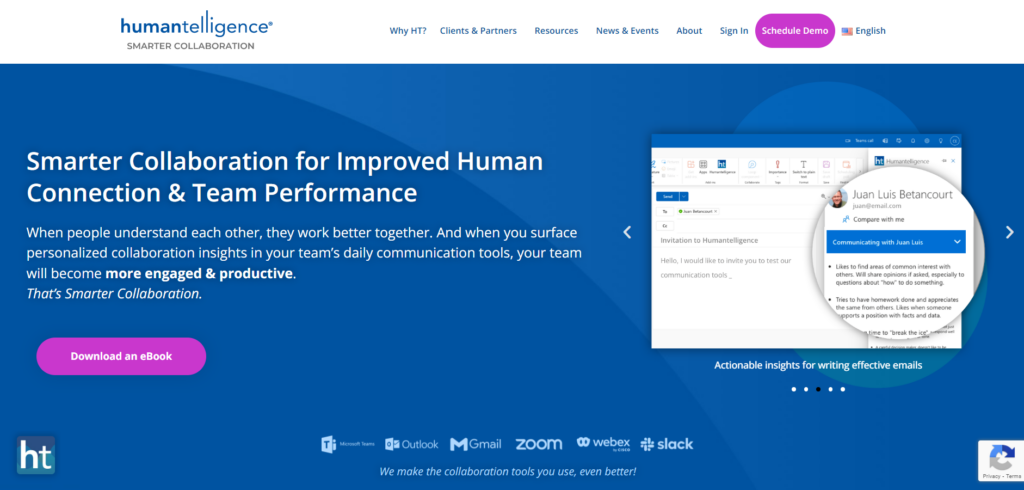
The product is built for the work that happens after the hire. It rewrites an email so it lands better with a specific reader. It offers a meeting a nudge about who in the room needs detail and who needs the headline. Used that way, it is a genuine collaboration aid and it is priced like one.
What it does not claim, on its own site, is any form of skills or cognitive testing. That absence is not a flaw. It is the product boundary, and pretending otherwise is how buyers end up disappointed.
What does Testlify do?
Testlify sits earlier in the process. It runs role-based skills assessments, coding assessments, cognitive assessments, language and typing tests, situational judgment questions, AI interviews with video, audio or chat responses, and reference checks. Results land as candidate reports and scorecards that several reviewers can score independently, and they sync into the ATS you already run.
Testlify also includes personality and behavioral assessment, which is where the two products genuinely overlap. The difference is placement. Testlify uses behavioral signal as one input into a hiring decision, next to a work sample and a structured interview. Humantelligence uses it as the product.
This is the Testlify Multi-Signal Talent Evaluation Model: combine several role-relevant signals, including assessments, interviews, simulations, references and reviewer feedback, so no single score carries a decision on its own. One signal is fragile. Several pointing the same way are worth acting on.
Feature comparison: Testlify vs Humantelligence
The table below only includes dimensions that can be checked against each vendor's own published material. Where a vendor does not state a capability, it reads "Not published" rather than a cross, because absence of a published claim is not proof of absence.
Dimension | Testlify | Humantelligence |
|---|---|---|
Primary job to be done | Pre-hire skills and role-fit assessment | Culture and communication insight inside daily work tools |
What it measures | Role skills, coding, cognitive ability, language, situational judgment, personality and behavior | Behaviors, Motivators and Work Energizers |
Skills and coding tests | Yes | Not published |
Cognitive ability tests | Yes | Not published |
Personality and behavioral assessment | Yes, as one hiring signal | Yes, as the core product |
AI interviews (video, audio, chat) | Yes | Not published |
Assessment integrity and proctoring | Yes | Not applicable, no testing product |
Where the output appears | Candidate reports, scorecards, ATS | Outlook, Teams, Google, Slack, Zoom, WebEx |
Stated integrations | ATS and HR systems, APIs, webhooks | HRIS, Greenhouse, iCIMS, collaboration tools |
Public list pricing | Listed by plan on the Testlify pricing page | $1 to $10 per person per month by org size |
Best fit stage | Screening and selection, before the offer | Collaboration and team communication, after the hire |
How much do Testlify and Humantelligence cost?
Humantelligence states per-person pricing openly, which is unusual in this category. Its bands run $10 per person per month for organizations of 300 people and under, $5 for 300 to 1,000, $4 for 1,000 to 20,000, $3 for 20,000 to 50,000, $2 for 50,000 to 200,000 and $1 above 200,000, billed annually.
Testlify plan pricing is listed on its plan and pricing page. The two are hard to compare per unit anyway, and the reason is worth saying plainly: Humantelligence charges per employee for an always-on tool, while an assessment platform is bought against a hiring plan. A 2,000-person company assessing 400 candidates a year is buying two very different volumes.
Pro tip: price these against the decision, not the seat. If a behavioral platform costs $4 per employee per month across 5,000 staff, that is a $240,000 annual line for collaboration insight. Worth it if adoption is real. Poor value if it is a dashboard nobody opens.
Does behavioral data predict job performance?
Not as well as work-relevant evidence does, and that is the single most important thing to understand before choosing. The 2022 re-analysis of selection validity by Sackett and colleagues corrected a long-standing statistical overcorrection and re-ranked what actually predicts performance at work.
On the corrected numbers, structured interviews came out top at 0.42, followed by job knowledge tests at 0.40, empirically keyed biodata at 0.38, work sample tests at 0.33 and cognitive ability tests at 0.31. General personality inventories did not make that top five. Contextualized behavioral measures, the kind that ask how someone acts at work rather than in general, do better than the generic sort, but they still sit below structured, job-relevant evidence.
Read that carefully, because it cuts both ways. It is not an argument that behavioral data is useless. It is an argument about order. Establish that someone can do the job, then use style data to work out how to onboard them, who to pair them with, and how to run their first review. Reverse the order and you have optimised for how a person feels to work with before checking whether they can do the work.
Here is the practical version. A team hiring a support lead can run a written scenario and a structured interview to see whether the candidate can de-escalate an angry enterprise customer. Behavioral style then tells the manager whether that person will want written prep before a hard call or would rather talk it through. The first decides the hire. The second decides the first ninety days.
What do NYC and EU hiring AI rules require?
The moment a behavioral tool helps decide who advances, it changes regulatory category. Under New York City's Local Law 144 of 2021, a bias audit must be conducted on an automated employment decision tool before that tool is used, and candidates must be told the tool is being used along with the job qualifications and characteristics it will assess. The law took effect on January 1, 2023, and the Department of Consumer and Worker Protection began enforcing it on July 5, 2023.
The EU draws the line in a similar place. Annex III of the EU AI Act classes AI systems intended for the "recruitment or selection of natural persons, in particular to place targeted job advertisements, to analyse and filter job applications, and to evaluate candidates" as high risk.
Neither rule cares what the vendor calls the product. A culture tool used purely for post-hire collaboration sits outside this. The same tool used to rank or filter applicants does not. If you plan to use behavioral data anywhere near a screening decision, get that use in front of your employment counsel before it ships, and ask the vendor for the audit documentation in writing.
Which tool should you choose?
Choose Humantelligence if the problem you are solving is that teams communicate badly, meetings go sideways, and managers do not know what motivates their own people. It is built for that, it is priced for that, and it lives where the work happens.
Choose Testlify if the problem is that your shortlist is guesswork. If interviews are unstructured, resumes are doing the filtering, and nobody can explain afterwards why one candidate advanced over another, a skills assessment fixes the input rather than the vibe.
And if you have budget for both, run them in that order. Skills evidence decides who joins. Behavioral insight decides how well they land. Buying the second without the first is the more common mistake, mostly because culture data is more fun to look at than a test score.
Worth naming the caveat: an assessment platform will not fix a broken team dynamic, and no amount of pre-hire rigor rescues a manager who never runs a one-to-one. If your attrition problem starts at month nine rather than at the offer stage, a screening tool is the wrong purchase.
Hire on evidence, not on impressions
Pick one open role this quarter and put a role-relevant assessment in front of the first interview, then compare the shortlist you get against the one your old process produced. Browse the Testlify assessment library to find the tests that match the role, look at how cognitive ability assessments fit alongside a structured interview, or book a demo and we will map the assessments to your competencies with you.
Key takeaways
- These products answer different questions. Testlify evaluates whether a candidate can do the job before the offer. Humantelligence explains how colleagues prefer to work once they are in the building. Treating either as a substitute for the other is how a tool ends up unused six months after purchase, so decide which question you are funding before you compare features.
- Order the evidence correctly. Corrected validity research ranks structured interviews at 0.42 and job knowledge tests at 0.40 ahead of general personality measures. Establish capability first, then use style data to onboard well. Running it the other way round optimises for likeability before competence, which is exactly the bias structured hiring exists to remove.
- Behavioral data near a hiring decision is regulated. New York City requires a bias audit before an automated employment decision tool is used and requires candidate notice, and the EU AI Act classes candidate evaluation systems as high risk. A tool marketed for collaboration does not escape those duties if you use it to filter applicants, so confirm the intended use with counsel.
- Compare cost against the decision, not the seat. Humantelligence charges $1 to $10 per person per month for every employee, always on. Assessment spend scales with hiring volume instead. A 5,000-person company with 200 hires a year should model both against the outcome each one changes, not against a per-user headline.
- Ask for what is published, not what is implied. Humantelligence documents Behaviors, Motivators and Work Energizers, plug-ins for six collaboration tools, and integrations with Greenhouse and iCIMS. It documents no skills or cognitive testing. Any comparison that marks a vendor down on a capability it never claimed is telling you more about the author than the product.
- One signal is fragile. The Testlify Multi-Signal Talent Evaluation Model exists because a single test score, a single interview or a single personality profile is a thin basis for a decision that costs a salary to get wrong. Combine assessment results, structured interview feedback and reviewer scoring, and keep the final call with a human.
FAQs
Related resources
View all
Competitor Comparisons
Testlify vs Meta Hire: A detailed comparison
Competitor Comparisons
Testlify vs Interviewer.AI: A detailed comparison
Competitor Comparisons
Testlify vs Hogan: A detailed comparison
Competitor Comparisons
Testlify vs Ensize: A detailed comparison
Competitor Comparisons
Testlify vs CallidusCloud: A detailed comparison
Competitor Comparisons
Testlify vs Brillium: A detailed comparison
Get started.
Hire on proof, not resumes.
Run your first skills-based assessment free — no credit card required.