
Testlify vs Recruiter: A detailed comparison
Discover the perfect solution for evaluating your candidates’ skills with Testlify. Dive into our comprehensive Testlify vs Recruiter.hr…
 ChatGPT
 Gemini
 Claude
 Grok
Grok Perplexity
Searching for a Recruiter.hr alternative?
Short answer: choose Recruiter.hr if the gap in your process is tracking and onboarding applicants, and choose Testlify if the gap is proving a candidate can actually do the work. Recruiter.hr wraps a built-in applicant tracking system (ATS) around basic screening tests. Testlify is a dedicated skills assessment platform, with 3,500+ tests, coding tasks, role simulations, AI interviews, and proctoring built for the screening stage.
TL;DR
- Recruiter.hr is an HR suite: job posting, an ATS, onboarding, and psychology, personality, and cognitive screening tests.
- Testlify is an assessment platform: role-specific skills tests, coding challenges, simulations, AI interviews, and proctoring controls.
- The two overlap only at the screening step, so most teams end up asking which tool owns evidence of skill, not which tool is bigger.
- Testlify publishes plan prices; Recruiter.hr quotes on request, which makes budget comparison slower.
- If you already run an ATS you like, adding an assessment layer beats replacing the ATS.
Trusted by 1,500+ hiring teams, from fast-scaling startups to enterprise talent acquisition functions.

What is the real difference between these tools?
Recruiter.hr is built to move applicants through a pipeline. Testlify is built to measure what those applicants can do. One answers "where is this candidate in our process", the other answers "can this person do the job". Teams that confuse the two buy an ATS and then wonder why shortlist quality never improves.
That distinction matters more than any feature count. A pipeline tool records decisions. An assessment tool changes them, because the shortlist is scored before the first call instead of after four interviews.
Feature comparison: Testlify vs Recruiter.hr
Compare the two side by side before you shortlist either. The table below is organized the way buyers evaluate: test library first, then assessment building, candidate experience, integrity controls, reporting, and support.
Features | Testlify | Recruiter.hr |
|---|---|---|
Test Library | ||
Role-specific tests | Yes | No |
Cognitive ability tests | Yes | Yes |
Programming tests | Yes | No |
Programming languages supported | 45+ | No |
Situational judgment tests | Yes | No |
Typing test | Yes | No |
Software skills tests | Yes | No |
Non-technical tests | Yes | No |
Psychometric tests | Yes | Yes |
Personality tests | Yes | Yes |
Motivation test | Yes | Yes |
Assessment templates | Yes | No |
Custom assessment creation | Yes | No |
Test recommendations by job role | Yes | No |
Coding tests | Yes | No |
Assessments | ||
Custom assessment builder | Yes | Yes |
Custom coding questions | Yes | Yes |
Multiple-choice questions | Yes | Yes |
Descriptive questions | Yes | Yes |
Video interview questions | Yes | Yes |
Assessments curated by I/O psychologists | Yes | Not stated |
Google Docs, Sheets, and Slides simulations | Yes | No |
Audio questions | Yes | No |
Qualifier questions | Yes | Yes |
File upload questions | Yes | No |
Quality check | Peer reviews, sample testing, and psychometrician review | Not stated |
Interviews | ||
One-way video interview | Yes | Yes |
Custom video question creation | Yes | No |
Candidate recording attempts per question | Yes | No |
Two-way video, audio, and chat AI interviews | Yes | Live video interview only |
Candidate experience | ||
Customizable email templates | Yes | Yes |
Custom invitation and rejection email | Yes | Yes |
Mobile-friendly | Yes | Yes |
Candidate support | Yes | Yes |
Instructions before assessment | Yes | Yes |
Average assessment length | 40 to 60 minutes | Not stated |
Anti-cheating controls | ||
Session recording | Yes | No |
Snapshot capturing | Yes | Yes |
Mouse tracking | Yes | Yes |
Copy-paste disabled | Yes | No |
Microphone and camera access | Yes | Yes |
Location access | Yes | No |
IP address tracking | Yes | No |
Randomized question sequence | Yes | Yes |
Reporting and analytics | ||
Detailed reports | Yes | Yes |
Shareable reports and scorecards | Yes | Yes |
Exportable reports | Yes | Yes |
Recruiting analytics | Yes | No |
Candidate benchmarking | Yes | No |
Completion rate and response insights | Yes | No |
Enterprise readiness | ||
White label | Yes | No |
Custom branding | Yes | No |
ATS integration | 100+ integrations | Built-in ATS |
User, role, and access management | Yes | Yes |
Bulk candidate invite | Yes | No |
Public link invite | Yes | Yes |
Candidate pipeline management | Yes | Yes |
Multilingual platform | 11 languages, tests in 7 | Not stated |
Campus hiring support | Yes | Not stated |
Dedicated account manager | Yes | Not stated |
GDPR compliant | Yes | Yes |
Support | ||
24/7 support | Yes | No |
Email and chat support | Yes | Yes |
Product demo | Yes | Yes |
Onboarding and training program | Yes | No |
Two rows deserve a second look. Testlify now runs two-way video, audio, and chat AI interviews, not just one-way recordings, so the interview row is no longer a straight loss. And the ATS row is not a scoreboard: Recruiter.hr has its own ATS, while Testlify plugs into 100+ of them, including the one you probably already own.
How does Recruiter.hr work?
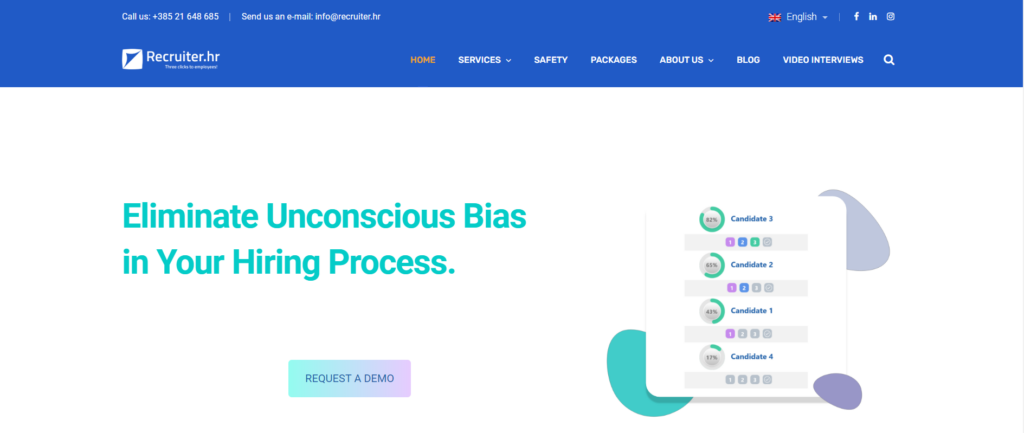
Recruiter.hr is a human resources platform with pre-employment screening, onboarding tools, and employee surveys in one place. Its screening tests cover psychology, personality, and cognitive ability, and you can combine several tests into one sitting.
Custom questions are not part of that flow, so the tests you send are the tests the vendor wrote. For a generalist role that is often fine. For a role where the work is specific, a fixed question bank is the constraint you feel first.
The platform adds anti-cheating measures such as candidate recording and supervised proctoring, plus a built-in ATS for posting jobs to multiple boards and managing applicants through the pipeline.
How do the two platforms price their plans?
Testlify prices in public and charges per candidate assessed. Recruiter.hr does not publish rates. That single difference decides a lot of shortlists, because a buyer who cannot model cost cannot get budget approved without a sales call first.
Testlify pricing
The Standard plan starts at $139 per month, billed at $1,668 per year, and includes 100 candidate credits, which works out to $16.68 per candidate assessed. Three user seats are included and extra seats cost $15 each per month. A credit is consumed when a candidate starts an assessment, not when you send an invite. There is a 7-day free trial, a 30-day money-back guarantee, and a custom plan for teams assessing 25,000+ candidates a year. Full plan details sit on the Testlify pricing page.
Recruiter.hr pricing
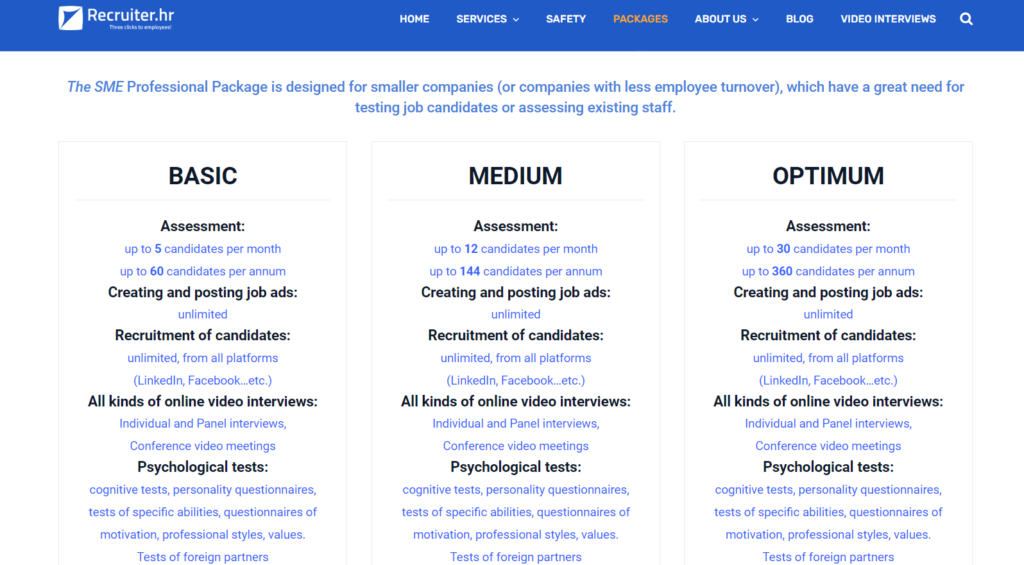
Recruiter.hr offers three plans: basic, medium, and optimum. Prices are not published, so you request a quote. Ask for cost per hire rather than cost per seat when you do, since an ATS priced per recruiter behaves very differently at 20 hires a year than at 2,000.
How should you choose between the two?
Start with the decision you are trying to improve, not the feature list. If your last three bad hires interviewed well and then underperformed, the problem is evidence, not tracking. If good candidates went dark between stages, the problem is workflow.
The Testlify Multi-Signal Talent Evaluation Model is the way to structure that call. It says one signal is fragile and several independent signals create confidence: a skills assessment, a coding task or simulation, an interview, reference feedback, and reviewer scores that are recorded rather than remembered. A candidate should advance when several role-relevant signals agree, not because one interview went well.
There is research behind that stance. A major reanalysis of selection-method validity by Sackett and colleagues revised many long-quoted validity estimates downward and still put structured, job-relevant methods among the stronger predictors of performance, well ahead of years of experience. A separate meta-analysis on combining candidate data found that adding scores up mechanically predicts outcomes at least as well as experts recombining the same information by judgment. Translation for a hiring team: score first, discuss second. The debrief where everyone talks first and looks at the evidence afterward is the step that quietly undoes the assessment.
A worked example. A 900-person logistics company hiring 40 warehouse supervisors a year runs a resume screen, three interviews, and a reference check. Swap the resume screen for a 45-minute assessment built from a situational judgment test and a spreadsheet simulation, and the first interview starts with a scored shortlist instead of a stack of claims. The interview loop does not get longer. It gets pointed at the two things the assessment could not measure.
Pro Tip: run both tools against one open role before you sign anything. Send 20 real candidates through the assessment, then check how many the hiring manager would have rejected on the resume alone. That number is your business case, and it takes a week to produce.
Is your screening process defensible?
Anything that scores candidates has to survive scrutiny later. Under the US Uniform Guidelines on Employee Selection Procedures, a selection rate for any group that is less than 80% of the rate for the highest-scoring group is generally treated as evidence of adverse impact, which is the four-fifths rule employers are measured against. In the European Union, the AI Act classifies AI systems used for recruitment and candidate evaluation as high risk, with documentation, human oversight, and record-keeping obligations attached.
Neither rule cares which vendor you picked. Both care whether you can show what was measured, how it was scored, and who made the call. That is easier when assessment results, proctoring evidence, and reviewer notes live in one auditable record instead of three inboxes.
The skills themselves keep moving too. Employers surveyed for the World Economic Forum Future of Jobs Report 2025 expect 39% of workers' core skills to change by 2030, down from 44% in the 2023 edition but still a large share of every job description you are hiring against. A test library you cannot edit ages faster than the roles it screens for.
Which tool fits which hiring team?
Best fit for Testlify
Teams that already run an ATS and need better evidence at the screening stage. High-volume hiring, technical roles, blue-collar and skilled trades where a hands-on simulation beats an interview, and any team facing an adverse-impact review. Also the better fit if you want candidate data that ties back to a role rather than a resume.
Where it is not the answer: Testlify is not an ATS, an HRIS, a payroll system, or a background-check provider. If you have no pipeline tool at all, an assessment platform alone will not fix that.
Best fit for Recruiter.hr
Smaller HR teams that want posting, tracking, onboarding, and light screening from one vendor and one invoice. If nobody owns an ATS today and the screening bar is basic personality and cognitive testing, one system is simpler to run than two.
Where it gets tight: no coding tests, no custom questions, and quote-only pricing. Technical hiring and specialized roles are where teams usually add an assessment layer on top.
Hire on evidence, not resumes
Pick one open role this quarter and put a scored assessment in front of the first interview. You can start on the 7-day free trial and build the assessment from a role template, or book a demo and have the team map it to the role with you. If you want the shortlist version first, the talent assessment tools guide covers what to look for, and the recruiter test shows what a role-specific assessment actually contains.
Key takeaways
- These tools solve different problems. Recruiter.hr tracks applicants and onboards them; Testlify measures whether they can do the work. Buying the wrong one means shortlist quality stays flat while the reporting gets prettier, so name the broken step before you compare features.
- Evidence beats intuition, and the order matters. Mechanical scoring predicts outcomes at least as well as expert judgment applied to the same data, which means the scores should be recorded before the debrief, not adjusted during it.
- Custom questions decide how long a test library stays useful. Recruiter.hr uses fixed vendor tests. With 39% of core skills expected to change by 2030, a library you can edit is what keeps the screen matched to the role.
- Published pricing shortens the buying cycle. Testlify lists plan rates and charges per candidate assessed at $16.68 per credit on the Standard plan; a quote-only vendor adds a sales call before you can model cost.
- Integration beats replacement. If your ATS works, adding assessments through one of 100+ integrations costs less and breaks less than migrating your pipeline to a new suite.
- Defensibility is a process property, not a feature. The four-fifths rule and the EU AI Act both ask for records of what was measured and who decided, so keep scores, proctoring evidence, and reviewer notes in one place from day one.
FAQs
Related resources
View all
Competitor Comparisons
Testlify vs Otomeyt: A detailed comparison
Competitor Comparisons
Testlify vs Plum: A detailed comparison
Competitor Comparisons
Testlify vs Evalart: A detailed comparison
Competitor Comparisons
Testlify vs HiPeople: A detailed comparison
Competitor Comparisons
Testlify vs REALCODERZ: A detailed comparison
Competitor Comparisons
Testlify vs HighMatch: A detailed comparison
Get started.
Hire on proof, not resumes.
Run your first skills-based assessment free — no credit card required.