
Testlify vs letsremotify: A detailed comparison
Discover the perfect solution for evaluating your candidates’ skills with Testlify. Dive into our comprehensive Testlify vs Letsremotify…
LetsRemotify and Testlify get compared constantly, and the comparison confuses people, because the two companies sell different things. LetsRemotify is a remote talent service: you describe the engineer you need and it supplies pre-vetted people. Testlify is an assessment and interviewing platform: you keep your own hiring process and use it to measure whoever applies. One rents you a shortlist. The other gives you a way to build one.
So "which is better" depends on whether your real problem is finding candidates or judging them. That question is worth answering before you look at a single feature row.
TL;DR
- LetsRemotify is a staffing and outsourcing service for remote tech roles. Testlify is software your team runs to test, interview and score candidates from any source.
- Public reviews of LetsRemotify sit on Trustpilot, G2, TrustRadius, Glassdoor and Indeed and lean positive, but many of them are employee reviews rather than buyer reviews. Check which kind you are reading before you trust the score.
- LetsRemotify does not publish pricing. Testlify does: Starter is $139 a month billed annually, which covers 100 candidate credits a year.
- Testlify covers the part a staffing partner never sells you, which is an evaluation system you keep: 3,500+ tests, AI video and phone interviews, and 20+ proctoring measures.
- No pipeline at all? A staffing partner solves the harder problem first. Plenty of applicants and no reliable way to rank them? An assessment platform is the cheaper fix.
 ChatGPT
 Gemini
 Claude
 Grok
Grok Perplexity
What is LetsRemotify?
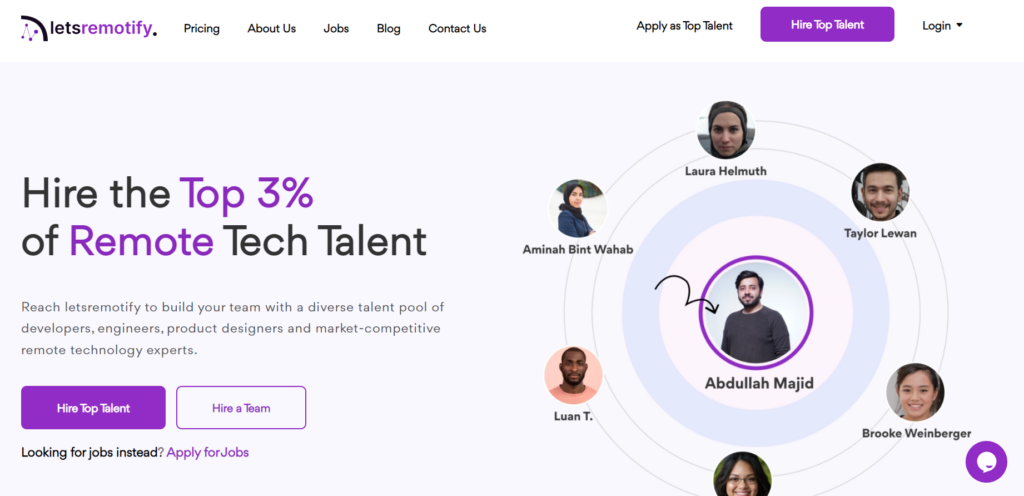
LetsRemotify is a remote talent outsourcing platform. Companies tell it which engineering roles they need filled, and it supplies remote developers, engineers and product designers from a pool it says it has already screened, keeping only the top 3% of applicants. It handles the payment rails and offers a two-week risk-free trial on a placement. The service is aimed squarely at teams that want working engineers quickly and do not want to run the search themselves.
That model has real pull right now. US software developer employment is projected to grow 10 percent between 2025 and 2035, against 3 percent for all occupations, so competition for good engineers is not easing. Buying access to a screened bench is a legitimate answer to that.

What do LetsRemotify reviews actually say?
LetsRemotify reviews are mostly positive, and they are spread across two very different kinds of site. Trustpilot, G2, TrustRadius, Capterra and SoftwareWorld carry buyer-side feedback about hiring outcomes and support. Glassdoor and Indeed carry employee reviews from people who work at LetsRemotify. Both count, but they answer different questions, and the ratings get quoted interchangeably.
The buyer-side themes are consistent: smooth onboarding, a wide talent pool, responsive support. The recurring gripe is about managing a large pool and assigning work once people are placed. The employee-side reviews mostly praise culture and flexibility, which tells you about LetsRemotify as an employer and nothing about whether a placed engineer will pass your code review.
The gap worth noticing is that almost none of these reviews describe an evaluation method. They describe a service experience. If you want to know how a candidate was judged, or to apply the same bar to someone who came through your careers page instead, the review sites cannot tell you, because that is not what the product does.
How do Testlify and LetsRemotify differ?
The short answer: LetsRemotify supplies people, Testlify supplies evidence. LetsRemotify does the vetting for you and hands you a shortlist. Testlify gives your team the tests, interviews and proctoring to do the vetting itself, on any candidate, from any channel, using the same standard every time.
That difference decides almost everything downstream. With a staffing partner, the quality bar lives inside somebody else's process and you inherit their judgement. With an assessment platform, the bar is yours, it is written down, and it applies to an agency candidate, a referral and an inbound applicant equally. The tradeoff is real: you keep control, and you also keep the work.
This is the thinking behind the Testlify Multi-Signal Talent Evaluation Model, which combines several role-relevant signals rather than trusting one. A candidate should not advance because of one strong resume, one polished call, or one vendor's say-so. They should advance when assessment scores, interview responses, work samples and reviewer feedback all point the same direction. A staffing partner is one signal. It is a useful one. It is not the whole picture.
Testlify vs LetsRemotify at a glance
Dimension | Testlify | LetsRemotify |
|---|---|---|
What you buy | Software your team operates | A service that supplies people |
Category | Pre-hire assessment and interviewing | Remote talent sourcing and outsourcing |
Who it evaluates | Any candidate, from any source | Candidates inside its own talent pool |
Test library | 3,500+ tests, 4,500+ roles, 45+ programming languages | Not published as a customer-facing library |
Interviewing | One-way video, two-way conversational AI video, voice and AI phone interviews | Interview coordination as part of the service |
Proctoring | 20+ measures including dual-device monitoring and AI-assistance detection | Not published |
Reporting | Per-question difficulty and discrimination indexes, benchmarking, PDF and CSV exports | Service reporting on placements |
Pricing transparency | Published per-plan pricing | Quote only, not public |
Live human interview panels | Not scheduled in Testlify | Coordinated by the service |
Sourcing candidates | Not a sourcing tool | Core of the offering |
Note the last two rows, because they are the honest limits on both sides. Testlify will not find you a candidate, and it does not schedule live interview panels between humans. LetsRemotify will not give you a measurement system you can point at your own applicants.
LetsRemotify: features, pros and pricing
Key features
A pre-screened remote talent pool covering developers, engineers and product designers, with LetsRemotify stating it onboards only the top 3% of applicants. Placement support, secure payment handling, a two-week risk-free trial, and account support through the engagement. The pitch is speed to a working engineer without running a search.
Pros
- Solves sourcing, which is the expensive half of remote technical hiring.
- The risk-free trial window lowers the cost of a bad first match.
- Buyer reviews consistently mention fast onboarding and responsive support.
- Useful when a role must be filled faster than an internal pipeline can produce candidates.
Cons
- Pricing is not public, so budgeting means a sales conversation before you can compare anything.
- The vetting standard is the vendor's, not yours, and it is not documented in a way you can audit or reuse.
- It evaluates its own pool. Applicants from your careers page, referrals and agencies stay unmeasured.
- Ratings blend buyer reviews with employee reviews, which makes a headline score hard to read.
Best for
Teams with an urgent remote engineering role, no bench, and no internal capacity to run a search. It works best as a supply channel, not as a hiring standard.
Pricing
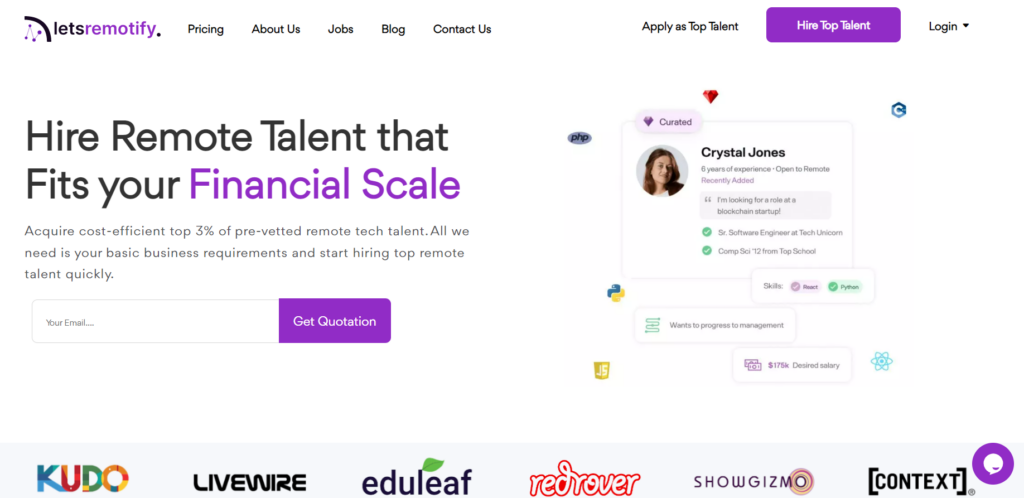
LetsRemotify does not publish rates. You request a quote. Expect staffing-style economics, where the cost tracks the engineer's rate and the engagement length rather than a per-candidate software fee.
Testlify: features, pros and pricing
Key features
A library of 3,500+ tests spanning 4,500+ roles and 45+ programming languages, with 25+ question types: coding in an embedded VS Code editor with up to 20 test cases, typing tests scored on 60% accuracy and 40% speed, Google Docs, Sheets and Slides tasks, Microsoft Word, Excel and PowerPoint tasks, situational judgement, cognitive and personality tests.
Interviewing runs one-way async video, two-way conversational AI video with selectable avatars and voices, and outbound AI phone interviews billed at $0.18 per minute, with 150+ interview templates, automatic multilingual transcripts and AI scoring a human can override. Proctoring adds 20+ measures, including dual-device monitoring where the candidate's phone acts as a second camera, plus AI-assistance detection and photo ID face matching. Reporting goes down to per-question difficulty and discrimination indexes, which is unusual outside test-publisher tooling. Teams without an applicant tracking system also get a simple built-in pipeline, and teams that already run one connect through 100+ ATS integrations.
Pros
- Applies one documented standard to every candidate, wherever they came from.
- AI scores and insights ship with a stated disclaimer that they are guidance only, and human override is a toggle, which matters for NYC Local Law 144 and similar rules.
- Certified against SOC 2 Type II, ISO 27001, GDPR and CCPA.
- Pricing is public, so you can model cost before you talk to anyone.
Cons
- It does not source candidates. If your pipeline is empty, this is not the tool that fills it.
- It does not schedule live human interview panels, so calendar coordination stays wherever it lives today.
- Assessments need a Chromium browser on desktop. The mobile app is a recording fallback, not a way to sit a full test on a phone.
- White labeling, the 100+ ATS integrations and SAML SSO are $2,388 a year add-ons on the self-serve plans rather than included features.
Best for
Teams that already get applicants and cannot rank them consistently, and any team that needs its hiring decisions to be defensible after the fact.
Pricing
Testlify sells candidate credits, where one credit covers one started assessment. Annual billing, from the published Testlify plans:
Plan | Credits per year | Price | Per credit | Seats |
|---|---|---|---|---|
Starter | 100 | $139/mo, billed $1,668/year | $16.68 | 3 |
Basic | 300 | $279/mo, billed $3,348/year | $11.16 | 5 |
Business | 1,000 | $699/mo, billed $8,388/year | $8.39 | 10 |
Premium and above | 3,000+ | Contact sales | Volume-based | 20+ |
There is a 7-day free trial with no card, a 30-day money-back guarantee, and base pricing locked for 24 months. Extra seats run $15 per seat per month. Credits do not roll over, which is the detail most people miss when they size a plan.
Which one fits your hiring problem?
Start with the bottleneck, not the feature list. If you cannot get qualified remote engineers into the top of your funnel, a staffing partner removes that constraint and an assessment platform will not. If candidates arrive and your team argues about who is actually good, the constraint is measurement, and buying more candidates makes the argument louder.
Seniority is what makes this bite in 2026. Senior roles took 69.3% of software development postings in the first quarter of 2026, with entry-level down at 4.5%. And 37% of the growth in those postings between May 2025 and May 2026 came from titles that mention AI. Senior AI-adjacent engineers are exactly the group where a resume tells you the least and a work sample tells you the most.
Remote makes the measurement gap wider again. Gallup found 51% of remote-capable US employees working hybrid as of the second quarter of 2025, with fully remote holding steady. When you never share a room with a candidate, structured evidence is most of what you have.
Can you use both together?
Yes, and for a lot of teams that is the sensible answer rather than a compromise. Use a staffing partner as one supply channel. Run every candidate, from that channel and every other one, through the same assessment before anyone commits. You get the speed of a screened bench and a bar you can actually defend, and you find out fast whether the partner's shortlist is better than your inbound.
Pro tip: run your own assessment on the next three candidates a staffing partner sends, before you sign anything longer than a trial. If they clear your bar comfortably, you have proof the partnership is worth the premium. If they land in the same band as your inbound applicants, you have just learned that you were paying for sourcing, not for quality, and you can renegotiate on that basis.
Ready to put a real standard behind remote technical hiring? Start a 7-day free trial or book a demo to see coding assessments, AI interviews and proctoring on your own roles. If you are still shortlisting vendors, the LetsRemotify alternatives roundup and the wider assessment platform comparisons cover the rest of the field.
Key takeaways
- These are two different purchases. LetsRemotify sells access to pre-vetted remote engineers, Testlify sells the system you use to judge candidates. Deciding between them on a feature grid produces nonsense, because most rows describe things only one of them was ever built to do.
- Diagnose the bottleneck before you buy. An empty pipeline and an unrankable pipeline are opposite problems with opposite solutions. Buying supply when your issue is measurement just gives your team more candidates to disagree about.
- Read LetsRemotify reviews by source. Glassdoor and Indeed ratings come from employees, while G2, Trustpilot, TrustRadius and Capterra come from buyers. A blended headline score hides which group liked what, so open the reviews rather than the average.
- Published pricing is a real advantage during evaluation. Testlify lists $139 to $699 a month on annual billing, so you can model cost in an afternoon. A quote-only vendor puts a sales cycle between you and a budget number, which slows every comparison you try to run.
- Vendor vetting is not portable. A staffing partner's bar applies to its own pool and disappears the moment you assess a referral or an inbound applicant. A standard you own applies to everyone and survives a change of supplier.
- Both can be right at once. Use the partner for supply, use assessments as the gate, and let the scores tell you over a couple of quarters whether the partner's shortlist actually beats what you source yourself.
FAQs
Related resources
View all
Competitor Comparisons
Testlify vs Topgrading: A detailed comparison
Competitor Comparisons
Testlify vs Recruiter: A detailed comparison
Competitor Comparisons
Testlify vs Otomeyt: A detailed comparison
Competitor Comparisons
Testlify vs Plum: A detailed comparison
Competitor Comparisons
Testlify vs Evalart: A detailed comparison
Competitor Comparisons
Testlify vs HiPeople: A detailed comparison
Get started.
Hire on proof, not resumes.
Run your first skills-based assessment free — no credit card required.