
Testlify vs Otomeyt: A detailed comparison
Discover the perfect solution for evaluating your candidates’ skills with Testlify. Dive into our comprehensive Testlify vs Otomeyt…
Testlify and Otomeyt both screen candidates on demonstrated skills instead of resumes, but they are no longer the same kind of purchase. Testlify is a pre-hire assessment platform your own team runs. Otomeyt is an AI hiring platform that also sells sourcing, contract hiring and recruitment process outsourcing alongside the software. That one difference decides most of this comparison.
The rest of it comes down to what you want to own. Buy assessment depth and your team keeps the evidence, the scoring and the decision. Buy a services layer and somebody else does part of the work, which is genuinely useful when the hiring team is three people and the req list is forty. Neither is the wrong answer. They are answers to different questions.
 ChatGPT
 Gemini
 Claude
 Grok
Grok Perplexity
TL;DR
- Testlify is assessment software. Otomeyt is assessment software plus a staffing and RPO business, so you are comparing a product against a product-and-service model.
- Otomeyt rebuilt its lineup. The Oto_Code, Oto_Video, Oto_Qualify and Oto_Catalyst tools that most comparison pages still describe have been replaced by four modules it calls RecruitEdge, MeritEdge, DataEdge and TalentEdge.
- Testlify publishes its rates. Otomeyt does not publish any pricing on its own site today, so budget planning means a sales call first.
- Testlify covers 3,500 or more tests across 12 test categories and 4,500+ job roles. Otomeyt states 500 or more real-world skills and puts its weight on technical and code-authenticity depth.
- Pick on the evidence you need, not the checkmark count. Structured, job-relevant evidence predicts performance better than anything a resume can tell you, and that is the part worth paying for.

What is the difference between Testlify and Otomeyt?
Testlify is a pre-hire talent assessment platform: skills tests, role-based tests, cognitive and personality tests, coding tests, AI interviews, proctoring and multi-reviewer scoring. Otomeyt is an AI-native hiring platform whose assessment engine sits beside sourcing, candidate engagement and a recruitment services arm. Testlify sells you the measurement. Otomeyt will also sell you the hiring.
That framing matters more than any feature row, because it changes who does the work. A talent team that already has recruiters and an applicant tracking system usually needs better signal at the screening stage, not another sourcing pipeline. A team that is short-staffed and hiring in bursts, campus drives especially, may want the services attached.
Both platforms are betting on the same shift. In the World Economic Forum's Future of Jobs Report 2025, employers expect 39% of workers' core skills to change by 2030. When the skill set under a job title keeps moving, a resume describes a person's past and an assessment describes what they can do now.
Testlify vs Otomeyt feature comparison
The table below is built only on dimensions that can be checked against each vendor's own published material. Where a vendor does not document something, the cell says "Not published" rather than marking it absent. A blank in a vendor's marketing is not proof a capability is missing, and treating it that way is how comparison tables end up wrong.
Dimension | Testlify | Otomeyt |
|---|---|---|
What you are buying | Assessment platform | Assessment platform plus staffing and RPO services |
Named assessment engine | Testlify test library | MeritEdge |
Library size | 3,500+ tests, 5,000+ job roles | 500+ real-world skills (vendor stated) |
Test categories published | 12 | Not published |
Coding and technical tests | Yes | Yes |
Cognitive ability tests | Yes | Yes |
Personality and psychometric tests | Yes | Not published |
Video interview questions | Yes | Yes, asynchronous |
AI question generation from a job description | Yes | Yes |
Code-authenticity and plagiarism checks | Yes | Yes, via its Global Code Verification System |
Proctoring and impersonation checks | Yes | Yes (vendor stated) |
ATS integration | Yes | Yes (vendor stated) |
Candidate sourcing and engagement | No, Testlify is not a sourcing tool | Yes |
Recruitment services and RPO | No | Yes |
Public pricing | Yes | Not published |
Two rows there deserve a second look. Testlify says no to sourcing on purpose: it is an assessment platform, not an applicant tracking system, and pretending otherwise would be the kind of over-claim that shows up on day three of an implementation. And "Not published" against Otomeyt's psychometric row is a genuine unknown, not a jab. Its own site details coding, cognitive and behavioural evaluation without ever naming a psychometric instrument.
How does Otomeyt work in 2026?
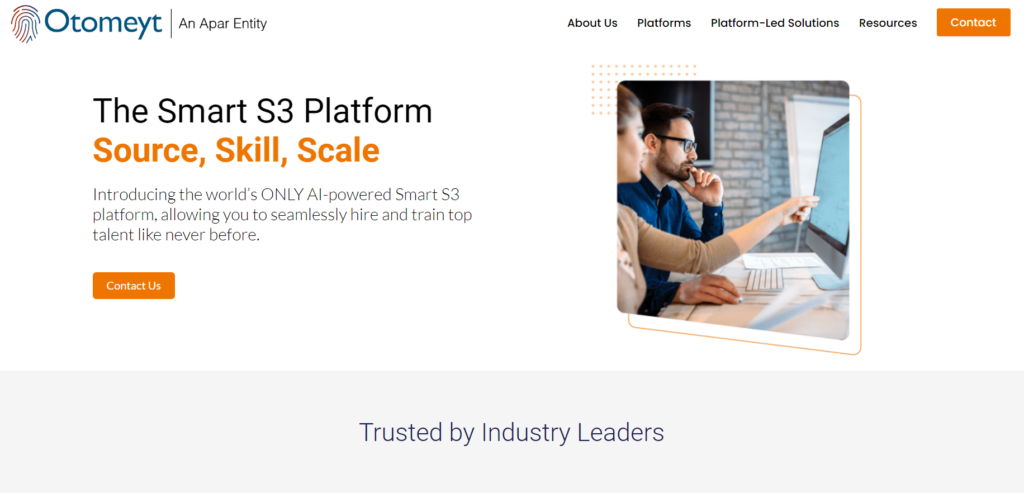
Otomeyt runs four modules. RecruitEdge handles sourcing, MeritEdge runs the skill assessments and interviews, DataEdge does data enrichment, and TalentEdge automates engagement, screening, scheduling and job-description building. MeritEdge is the piece that competes with an assessment platform: it auto-generates technical questions from a job description, runs real-time coding environments, and returns AI-evaluated reports and structured interview scorecards.
The proctoring story is built around code authenticity. Otomeyt describes plagiarism detection, impersonation detection and a Global Code Verification System aimed at tech interviews specifically. For engineering hiring at volume, that is a sharp focus, and campus drives are clearly a target use case.
Worth knowing before you compare notes with a colleague: almost every comparison page still on the first page of Google describes Otomeyt as four tools called Oto_Code, Oto_Video, Oto_Qualify and Oto_Catalyst. Those names are gone from otomeyt.ai. OtoVideo survives as the interview tool. If a directory listing is a lineup behind, treat its pricing table with the same suspicion.
The services half is the part checklists miss entirely. Otomeyt also sells contract hiring, contingent workforce, full-time hiring, executive search, payroll and compliance support, and RPO. It states 12 or more years of experience, 15,000 or more candidates hired, 1 million or more assessments taken and 100,000 or more interviews conducted. Those are vendor figures, not audited ones, and they describe a hiring company as much as a software company.
What makes Testlify different from Otomeyt?
Depth and breadth of measurement, and the fact that your team keeps the decision. Testlify's library runs to 3,500 or more tests across 12 categories, covering role-specific skills, cognitive ability, software skills, programming, engineering, personality and culture, language, situational judgment, typing, blue collar work and simulations. Coverage that wide matters when you hire outside engineering.
The reason to care is not the catalogue size. It is what multiple independent signals do to your hit rate. The Testlify Multi-Signal Talent Evaluation Model is the house version of this: a candidate should not move forward on one strong resume, one polished interview or one test score, but when several role-relevant signals point the same way. Assessment results, coding evidence, behavioural evidence, interview responses, reviewer ratings and reference checks each cover a blind spot the others leave open.
Selection research backs the shape of that argument. In the revised validity estimates published by Sackett and colleagues in 2022 and summarized by the Society for Industrial and Organizational Psychology, structured interviews came out highest at .42, job knowledge tests at .40, work sample tests at .33 and cognitive ability at .31. No single method is close to a sure thing on its own. Combining them is the whole point.
Pro tip: Before you compare vendors, write down the three competencies that actually decide success in the role you hire most. Then ask each vendor which specific test produces evidence for each one. Vendors answer that question very differently, and the answer is more useful than any feature grid.
The other difference is scope honesty. Testlify does not source candidates, run your payroll or replace your ATS. It integrates and hands the evidence back. That is a narrower promise than Otomeyt's, and for a team that already owns its pipeline it is usually the more useful one.
How much do Testlify and Otomeyt cost?
Testlify publishes its rates. The Standard plan is $139 per month, or $1,668 per year, which works out at $16.68 per candidate assessed across 100 annual credits. Extra credits run $21 each, additional user seats $15 per month beyond the three included, and white labelling or ATS integrations are $2,388 per year each. A Custom plan covers organizations assessing 25,000 or more candidates a year. There is a 7-day free trial and a 30-day money-back guarantee.
Otomeyt publishes nothing. Not on its home page, not on its employer page, not on its assessments page. Older directory listings still carry Indian rupee plans and a four-tier free, professional, business and enterprise structure, and this post used to repeat them. Those figures no longer appear anywhere on the vendor's own site, so they have been removed rather than restated. Budget for a sales conversation.
Price per seat is the wrong number to optimize anyway. Gallup puts the cost of replacing one employee at one-half to two times that employee's annual salary. Against one wrong hire who leaves a $90,000 role inside a year, the gap between two assessment subscriptions is a rounding error. Buy the tool that improves the decision, then argue about the invoice.
Which platform fits your hiring model?
Testlify fits a team that owns its hiring and wants better evidence at the screening stage. Otomeyt fits a team that wants software and hands attached to it. Read those as two different budgets, because they are.
A worked example. A 900-person financial services firm is hiring 40 people a quarter: roughly a dozen engineers, the rest in operations, compliance and customer teams. In-house recruiters own the pipeline and the ATS is already in place. Their problem is the 300 applicants per non-technical req that nobody can screen properly, so interviews start on gut feel. That team needs breadth of assessment across non-engineering roles and scoring their own hiring managers can defend. Assessment depth wins, and the services layer would be paying for capacity they already have.
Change one variable. The same firm opens a campus drive, 2,000 students in three weeks, mostly engineering, with two recruiters. Now the constraint is capacity and code authenticity at volume, and an outsourced sourcing and screening arm starts to earn its money.
The caveat nobody puts in a comparison table: services models create a dependency. When an outside team runs sourcing and first-round screening, the evidence about why a candidate advanced lives partly outside your organization. That is fine while the relationship is good. It is painful when you switch providers, or when a rejected candidate asks how the decision was made. Assessment-only tooling keeps that record on your side of the line.
How should you evaluate an AI hiring platform?
Ask what evidence the system produces, who reviews it, and whether you could explain the decision to a candidate or a regulator. Feature counts age badly. The evaluation questions below do not.
- Which competencies does each test actually measure? Map the role to competencies first, then to evidence. A test library is only as useful as its fit to the jobs you hire.
- Can a human override the machine? AI should structure and summarize evidence. People should decide. Any vendor implying otherwise is selling you a problem.
- What happens to assessment integrity at volume? Identity checks, environment controls, browser behaviour and plagiarism detection all matter more as candidate numbers climb.
- Is the scoring defensible? If a candidate challenges a rejection, you need the record: which competency, which evidence, which reviewer.
- Who owns the data and the audit trail? Especially relevant under a services model.
Point four is becoming a compliance question rather than a preference. Annex III of the EU AI Act classifies as high-risk any AI system intended for the recruitment or selection of people, naming the filtering of job applications and the evaluation of candidates specifically. Any organization hiring into the EU with an AI-native platform is going to need documentation, human oversight and an explainable trail, whoever runs the screening.
The pressure to solve this is not going away. The World Economic Forum reported 63% of employers citing skills gaps as the key barrier they face. Every one of those employers has to find out what candidates can do, and a resume will not tell them.
Hire on evidence, not on a feature grid
Start with one role. Build an assessment for the job you hire most, score the next 20 candidates on it before the first interview, and compare that shortlist against what your old process would have produced. That single comparison settles more vendor debates than a month of demos. Browse the full Testlify test library to see what fits your roles, or book a demo and walk through the assessment for your hardest req. If you are still scoping the market, other Otomeyt alternatives are covered separately.
FAQs
Related resources
View all
Competitor Comparisons
Testlify vs Plum: A detailed comparison
Competitor Comparisons
Testlify vs Evalart: A detailed comparison
Competitor Comparisons
Testlify vs HiPeople: A detailed comparison
Competitor Comparisons
Testlify vs REALCODERZ: A detailed comparison
Competitor Comparisons
Testlify vs HighMatch: A detailed comparison
Competitor Comparisons
Testlify vs BryQ: A detailed comparison
Get started.
Hire on proof, not resumes.
Run your first skills-based assessment free — no credit card required.