
Testlify vs Ducknowl: A detailed comparison
Discover the perfect solution for evaluating your candidates’ skills with Testlify. Dive into our comprehensive Testlify vs Ducknowl…
Testlify and Ducknowl both shorten the gap between "we have 400 applicants" and "we know which six to interview", but they do it from opposite ends. Ducknowl is a video-first screening platform built around resumes and recorded interviews. Testlify is an assessment platform built around measuring skills before anyone joins a call. Picking between them is less about feature counts and more about which part of your funnel is actually broken.
TL;DR
- Ducknowl is strongest at the top of the funnel: resume screening, one-way and live video interviews, and video messaging in one dashboard.
- Testlify is strongest at proving ability: 3,500+ tests, coding and cognitive assessments, and proctoring built for remote hiring.
- Testlify publishes its pricing (Standard is $139 per month, or $1,668 billed annually). Ducknowl quotes privately, which makes budgeting slower.
- Ducknowl does offer cognitive and personality assessments and ATS integrations, correcting a claim repeated across several comparison pages, including an earlier version of this one.
- Ducknowl runs live two-way interviews. Testlify does not, so teams that interview inside one tool should weigh that honestly.
- Choose on the bottleneck: video coordination points to Ducknowl, unreliable shortlists point to Testlify.
 ChatGPT
 Gemini
 Claude
 Grok
Grok Perplexity
What is the difference between Testlify and Ducknowl?
Testlify measures what a candidate can do through skills, coding, cognitive and personality assessments, then ranks the shortlist on those scores. Ducknowl screens who a candidate appears to be by ranking resumes and collecting recorded or live video answers. Testlify answers "can this person do the job," Ducknowl answers "who is worth a conversation."
That distinction matters more than any checklist. A team drowning in scheduling calls has a coordination problem, and video screening fixes it. A team that keeps advancing candidates who fail in week three has an evidence problem, and no amount of video fixes that.

What is Ducknowl?
Ducknowl is a talent screening and assessment platform that puts resume screening, video screening and skill testing in a single dashboard. Its published product set covers resume screening with ranked candidate lists, one-way interviewing, live video interviewing, essay questions, video texting, video job descriptions, skill assessments drawn from a test bank or built custom, cognitive assessments and personality assessments.
Ducknowl lists integrations with Greenhouse, JazzHR, Crelate, Zoho, SmartRecruiters, Joynd, Dynamicats, LinkedIn, Dice and Indeed. The product is aimed at professional, campus, tech and contract hiring, and it leans on video as the primary way to compress early screening.
Testlify vs Ducknowl: feature comparison
The table below reflects each platform's own published product and pricing pages as of August 2026. Where a capability is not documented publicly, it is marked as not listed rather than guessed at. That is a deliberate change: an earlier version of this comparison marked several Ducknowl capabilities as absent when Ducknowl's own site documents them.
Capability | Testlify | Ducknowl |
|---|---|---|
Test library size | 3,500+ tests, 180,000+ questions | Test bank plus custom tests |
Role-specific skills tests | Yes | Yes |
Coding assessments | Yes | Not listed publicly |
Cognitive assessments | Yes | Yes |
Personality assessments | Yes | Yes |
Resume screening and ranking | Yes | Yes, a core module |
One-way video interviews | Yes | Yes |
Live two-way video interviews | No | Yes |
AI video, audio and phone interviews | Yes | Not listed publicly |
Video messaging to candidates | Not listed publicly | Yes, video texting |
Video job descriptions | Not listed publicly | Yes |
Role-based job simulations | Yes | Not listed publicly |
Proctoring and integrity controls | Yes, secure proctoring on all plans | AI proctoring referenced |
Advanced proctoring and ID verification | Yes, on the Custom plan | Not listed publicly |
ATS integrations | 100+ integrations | Yes, 10 named platforms |
Custom branding | Yes | Not listed publicly |
White label | Yes, as a paid add-on | Not listed publicly |
Single sign-on | Yes, on the Custom plan | Not listed publicly |
Interview templates | 150+ | Not listed publicly |
Published pricing | Yes | No, quote only |
Free trial | 7-day, no card required | Not listed publicly |
Money-back guarantee | 30-day | Not listed publicly |
Pro tip: Before comparing any two screening tools, write down the single number you want to move, such as interviews per hire or 90-day attrition. A tool that improves neither is a tool you are buying out of habit.
Which platform tests skills more deeply?
Testlify, by a wide margin, and it is the clearest split between the two products. Testlify ships 3,500+ tests and 180,000+ validated questions covering role skills, coding, cognitive ability, personality and language, plus role-based job simulations. Ducknowl offers a test bank and custom tests, but its documented depth sits well below that.
Depth matters because skill requirements keep moving. The World Economic Forum's Future of Jobs Report 2025 found employers expect 39% of workers' core skills to change by 2030. A test library that covers last year's stack ages badly, and a small bank ages fastest.
The caveat cuts the other way too. If you hire high volumes into roles where the real screen is communication and reliability rather than technical skill, a 3,500-test library is mostly shelf space. Retail, hospitality and field-service teams often get more from a fast video screen than a deep assessment battery.
How do the two compare on assessment integrity?
Testlify treats integrity as a product layer. Secure proctoring is included on the Standard plan, and the Custom plan adds advanced proctoring and identity verification. Ducknowl references AI proctoring as part of its screening flow but does not publish an equivalent breakdown of controls.
This is where the Testlify Multi-Signal Talent Evaluation Model earns its keep. The model combines several role-relevant signals, including assessments, interviews, simulations, references and reviewer feedback, rather than trusting any one of them. One signal is fragile. A recorded video answer can be coached. A single test score can be an outlier. Read together, and reviewed by a human, they are far harder to fake.
Worth being blunt about the limits: a proctoring flag is a prompt to look closer, not proof of cheating, and nobody should reject a candidate on a flag alone. Testlify's controls are built to give reviewers context, not verdicts.
Testlify vs Ducknowl: pricing compared
Testlify publishes its pricing. The Standard plan is $139 per month, or $1,668 billed annually, and includes 100 candidate credits per year, which works out to roughly $16.68 per candidate assessed. It comes with 3 user seats (extra seats are $15 per month), unlimited assessments, secure proctoring and email and chat support. ATS integrations and white label are add-ons at $2,388 per year each. Base pricing is locked for 24 months, and there is a 7-day free trial with no card required plus a 30-day money-back guarantee.
The Custom plan targets large-scale hiring above 25,000 candidates a year and adds advanced proctoring, identity verification, single sign-on, an uptime commitment and a dedicated customer success manager.
Ducknowl pricing
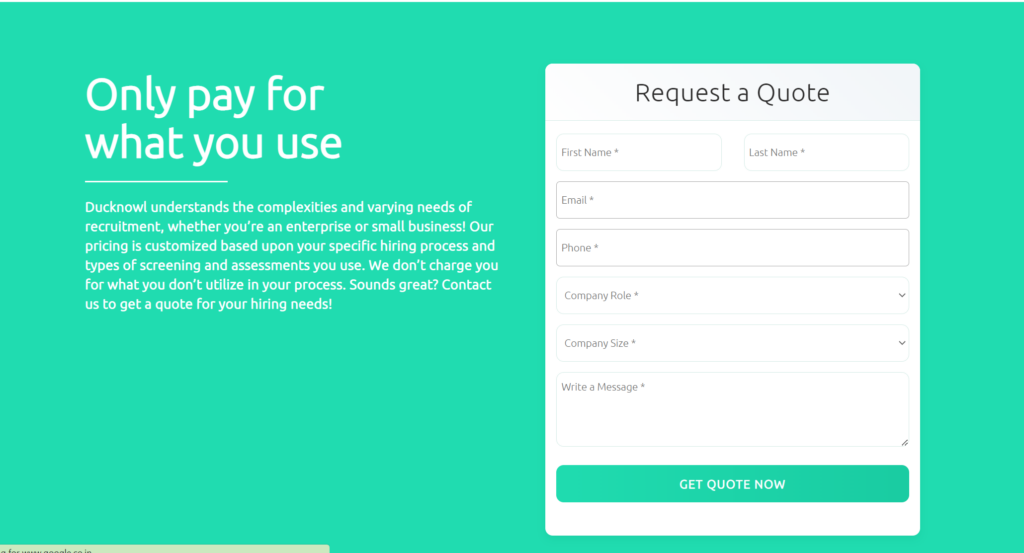
Ducknowl does not publish prices. Its pricing page states that costs are customized to each hiring process and the types of screening and assessment used, and buyers request a quote or email sales directly. That model can suit a narrow, well-defined process, but it slows down budget approval and makes side-by-side comparison harder before a sales call.
Cost per candidate is the wrong lens on its own. SHRM's benchmarking puts the average cost per hire at $4,129. Against that, the difference between two screening tools is rounding. What moves the number is how many wrong people reach a final interview.
Which tool should you choose?
Choose Ducknowl if the bottleneck is early-funnel throughput: too many resumes, too much scheduling, too many first calls that could have been a five-minute recording. Its video texting and video job descriptions are genuinely differentiated, and live two-way interviewing inside the same tool is something Testlify does not offer.
Choose Testlify if the bottleneck is shortlist quality: interviews that go well followed by hires that do not work out, or hiring managers who do not trust the shortlist. Published pricing, a 7-day trial and 100+ ATS integrations also make it easier to pilot without a procurement cycle.
Consider both if you hire at volume into skilled roles. They overlap less than the category label suggests. A practical split many teams land on: video screen first to cut the field, then assess the survivors, so the expensive signal is spent on a smaller group.
Scale is the reason this ordering matters. The US Bureau of Labor Statistics reported 7.4 million job openings and 5.3 million hires in June 2026. In a market where openings outnumber hires, the cost of a slow, low-signal screen is measured in candidates who accept somewhere else first.
Hire on evidence, not guesswork
Testlify gives hiring teams the assessment layer that makes a shortlist defensible: 3,500+ tests, role-based simulations, secure proctoring, and reports a hiring manager can actually read. Start the 7-day free trial, or book a demo and walk through a real role with the team. If you are still mapping the market, the full Ducknowl alternatives roundup and the wider assessment platform comparison cover the rest of the field. You can also browse the 3,500-test library or check current plan pricing before you talk to anyone.
FAQs
Related resources
View all
Competitor Comparisons
Testlify vs letsremotify: A detailed comparison
Competitor Comparisons
Testlify vs Topgrading: A detailed comparison
Competitor Comparisons
Testlify vs Recruiter: A detailed comparison
Competitor Comparisons
Testlify vs Otomeyt: A detailed comparison
Competitor Comparisons
Testlify vs Plum: A detailed comparison
Competitor Comparisons
Testlify vs Evalart: A detailed comparison
Get started.
Hire on proof, not resumes.
Run your first skills-based assessment free — no credit card required.