
Top 15 The TalentMetrix Alternatives and Competitors
Discover 15 powerful TalentMetrix alternatives to streamline your hiring process and assess candidates with confidence.
TalentMetrix is a psychometric testing tool. It scores personality, behaviour, cognitive ability and emotional intelligence, then hands back a diagnostic report that mixes numbers with written interpretation. If that is the job you need done, it does it. Teams usually start looking elsewhere when they need to test whether someone can actually do the work, not just describe how they might approach it, and when they want published pricing instead of a sales call.
This page reviews 15 alternatives, what each one is genuinely good at, and where the real differences sit. Prices and ratings are carried from each vendor's public material and change often, so treat them as a starting point rather than a quote.
TL;DR
- TalentMetrix is strongest on psychometrics and written interpretation, and weakest if you want work-sample testing, coding tasks or AI interviewing in the same tool.
- Its pricing is not published, so every evaluation starts with a sales conversation. Several alternatives publish theirs.
- Personality and culture tests are qualitative. They do not produce a total score, and treating them like a pass or fail gate is the most common mistake teams make with a tool like this.
- If you are replacing one narrow test type, pick on test library depth. If you are replacing a whole screening stage, pick on what happens after the test: scoring controls, integrity evidence and how results reach your hiring team.
- Testlify is the closest single-tool replacement, because assessments, AI interviews and proctoring sit in one product rather than three.
 ChatGPT
 Gemini
 Claude
 Grok
Grok Perplexity
What is TalentMetrix?
TalentMetrix is a cloud-based pre-employment testing service built around psychometrics. It offers ready-made tests in competencies like teamwork, time management, communication, decision making, conflict management, problem solving, emotional intelligence, situational leadership and critical thinking. Reports combine a score with qualitative interpretation, which is the part psychologists tend to value and hiring managers tend to skim.
Pricing is not published. Buyers contact the sales team for a quote that varies by test type, hiring volume and services.

Why look for a TalentMetrix alternative?
Three reasons come up repeatedly, and only one of them is about the tests themselves.
The first is scope. A personality profile tells you how someone prefers to work. It does not tell you whether they can write the SQL query, handle the angry customer or build the spreadsheet. Selection research has been clear on this for a long time: the strongest predictors of job performance are the ones closest to the work itself. In the most recent major reanalysis of selection validity, Sackett and colleagues (2022) revised many long-quoted validity figures downward, and still placed structured interviews among the strongest predictors while ranking years of education and general years of experience among the weakest.
The second is what happens to the result. A rich narrative report is only useful if a human reads it consistently. When teams instead let one experienced person re-interpret every score by feel, accuracy usually drops. A meta-analysis by Kuncel and colleagues (2013) found that mechanically combining assessment information predicts outcomes as well as, or better than, experts recombining the same information holistically. So the tool that helps most is the one that makes consistent combination easy, not the one with the longest write-up.
The third is speed of change. The World Economic Forum's Future of Jobs Report 2025 found employers expect 39% of the key skills a job needs to change by 2030, down from 44% in 2023. A fixed battery of nine competencies ages faster than a library you can add role-specific tests to.
There is a fourth reason that is not about capability at all. If you hire in New York City and use an automated tool to screen or rank candidates, the city's Local Law 144 requires an annual independent bias audit and candidate notice for automated employment decision tools. More broadly, the EEOC's guidance on employment tests and selection procedures expects any test that screens people out to be job related and consistent with business necessity. Whichever tool you pick, you need the evidence trail, not just the score.
How we picked these alternatives
Each tool below had to clear four bars.
- It replaces something TalentMetrix does. Behavioural, cognitive or role-specific testing, at minimum.
- It is buyable by a team under 200 people. Either published pricing or a self-serve trial. Tools that only sell through an enterprise motion are noted as such.
- It produces evidence a reviewer can defend. Score breakdowns, not a single number with no working shown.
- It covers more than one signal, or is unusually strong on one. Narrow tools are here when they are the best in their lane.
Pro tip: before you shortlist any of these, write down the two decisions the assessment has to improve. Most teams say "better hires", which no tool can be measured against. "Cut the 40-candidate screening pile to a defensible top 8 before the first call" can be.
Quick comparison of the top alternatives
Tool | Best for | Entry pricing signal |
|---|---|---|
Testlify | Replacing a whole screening stage in one tool | $139/month annual, 100 credits |
TestGorilla | General skills-first screening | Free plan, paid from $83/month annual |
Adaface | Candidate experience, conversational tests | From $180/year |
Vervoe | Job simulations with AI grading | From $300/year, 10 candidates |
Codility | Large-scale engineering hiring | From $1,200/year |
Mercer Mettl | Psychometrics with heavy proctoring | Custom quote |
iMocha | Skills inventory across a workforce | From $999/year |
Hirevue | High-volume video interviewing | Not published |
TestDome | Short work-sample tests | Published by vendor |
Coderbyte | Unlimited-use developer testing | About $199/month |
TalentClick | Safety and risk behaviour | Custom quote, unlimited-use model |
HackerEarth | Enterprise tech hiring at volume | From $99/month |
HackerRank | Developer screening and interviews | Published by vendor |
TestInvite | Granular exam control | From $37/month |
eSkill | Clerical and software proficiency | Custom quote |
1. Testlify
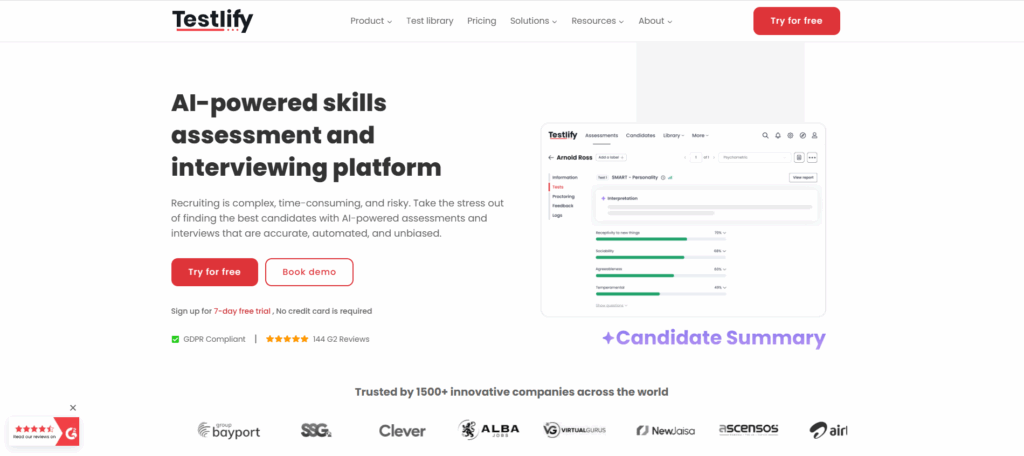
Testlify is an AI-assisted skills assessment and interviewing platform. Where TalentMetrix answers "what is this person like", Testlify is built to answer "can this person do the work, and can you show why you decided that". It is the only tool on this list that carries assessments, AI interviews and proctoring in a single product rather than three that have to be stitched together.
The approach has a name internally: the Testlify Multi-Signal Talent Evaluation Model. It combines several role-relevant signals, including assessments, interviews, simulations, references and reviewer feedback, so a candidate advances when multiple signals agree rather than on one strong test score. One signal is fragile. Several pointing the same way is a decision you can defend.
Features
- Test library: 3,500+ tests across 4,500+ roles and 50+ industries, spanning cognitive ability, personality and culture, psychometric, situational judgement, coding, software skills, language and blue collar categories.
- 25+ question types, including the unusual ones: live tasks in Google Docs, Sheets and Slides and in Microsoft Word, Excel and PowerPoint, plus multi-file coding projects in a browser-based VS Code editor with up to 20 test cases. There is also vibe coding, which asks candidates to direct AI tools to a working solution instead of writing syntax by hand.
- AI interviewing in three formats: one-way async video, two-way conversational AI video, and outbound AI phone interviews billed at $0.18 per minute. You choose the avatar, the voice, the prompts, the number of attempts and the recording time. Transcripts are automatic and multilingual for recordings over 30 seconds.
- Item-level psychometrics recruiters can actually see: difficulty index, discrimination index and a quality-risk flag for questions with very low accuracy or high skip rates. That is test-publisher instrumentation, and almost nothing else in this price bracket exposes it.
- Dual-device proctoring: the candidate's phone becomes a second camera showing both them and their screen. The session will not start until mobile monitoring is active. Alongside it sits an AI checker that classifies an answer as human, AI generated or mixed.
Scoring is where the earlier research point lands. Weights run from x0 to x5 per test, negative marking has two explicit modes, and any question can be marked non-scorable. AI scores and insights ship with a disclaimer in the product that they are guidance only and human judgment makes the final call, and "include AI score in the final average" is a toggle you can switch off.
Two honest limits. Testlify does not schedule live human interview panels, so calendar coordination stays wherever it lives today. And assessments run on Chromium desktop browsers, with the mobile app acting as a capture fallback rather than a way to sit a full test on a phone.
Testlify pricing
Published on the pricing page and priced by candidate credits, with one credit per started assessment. Annual billing:
- Starter: $139/month, billed $1,668/year, 100 credits at $16.68 each, 3 seats.
- Basic: $279/month, billed $3,348/year, 300 credits at $11.16 each, 5 seats.
- Business: $699/month, billed $8,388/year, 1,000 credits at $8.39 each, 10 seats.
- Premium, Enterprise and Custom: 3,000, 10,000 and 25,000+ credits, priced on contact with sales.
Extra seats are $15 per seat per month. There is a 7-day free trial with no card, a 30-day money-back guarantee, and pricing locked for 24 months. Worth knowing before you budget: white labeling and the 100+ ATS integrations are $2,388/year add-ons on the self-serve tiers and included on Custom, so do not assume they come bundled. If you already run Greenhouse, Lever or Workday, Testlify plugs in as the screening layer and your ATS stays the system of record. If you have no ATS at all, Testlify ships a simple built-in pipeline: post the job, take applications, move people through stages. It is deliberately basic, and it is not a replacement for an enterprise system of record.
2. TestGorilla
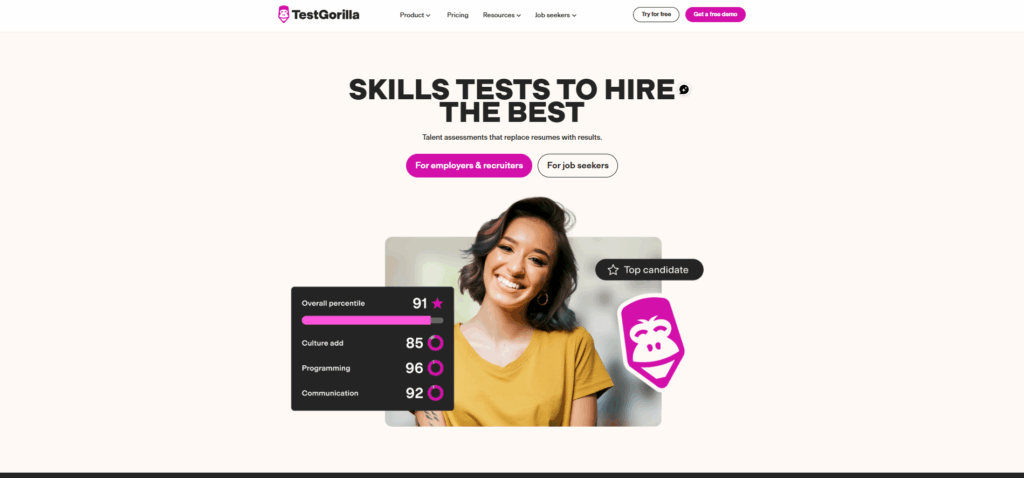
TestGorilla is a skills-first hiring platform with a science-backed library of 300+ tests. It is the most direct like-for-like swap if what you want is a broader test catalogue than TalentMetrix offers, with the same low setup cost.
Features
- Pre-built assessments: 300+ validated tests covering coding, cognitive ability, numerical reasoning, personality and culture fit.
- Asynchronous video interviews: open-ended video prompts for communication and persuasion, answered in the candidate's own time.
- Bias reduction: anonymised results, standardised scoring and DEI-aligned formats.
- Customisation: your branding, logos and intro videos, plus control over test order, difficulty and timing.
G2 Rating: 4.5/5
Pricing: a free plan with essential tests and unlimited candidate invites. Starter and Pro plans start at $83/month and $127/month billed annually, varying by company size.
3. Adaface
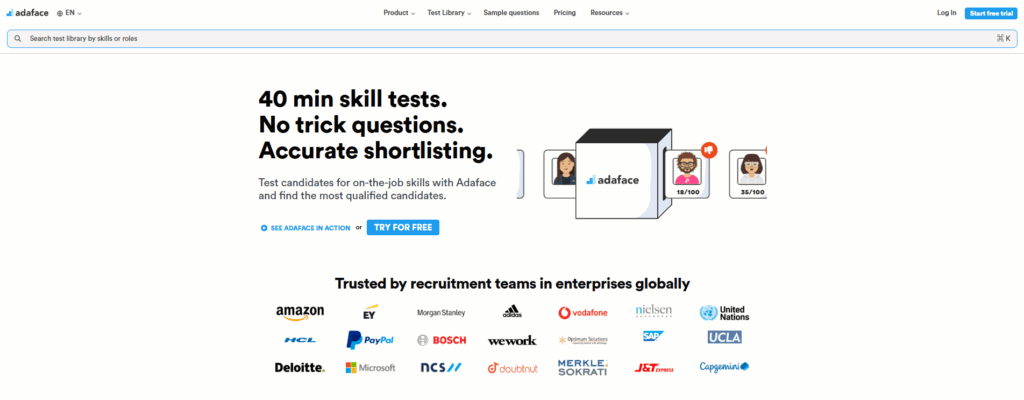
Adaface replaces the standard test-taking format with a chatbot conversation. Candidates answer questions from "Ada" rather than working through a form, which cuts drop-off on longer assessments. If your complaint about psychometric testing is that candidates abandon it halfway, this is the one to look at.
Features
- Conversational assessments: recruiter-style questioning with contextual, role-relevant follow-ups.
- Assessment library: 150+ pre-built templates across engineering, finance, customer support and operations.
- Real-time scoring: automatic pass, borderline or fail classification to speed up filtering.
- Anti-cheating: questions are written in-house and kept private, and are re-tested against public AI tools.
G2 Rating: 4.6/5
Pricing: free trial available. Plans start at $180/year for the Individual plan and scale for larger teams.
4. Vervoe
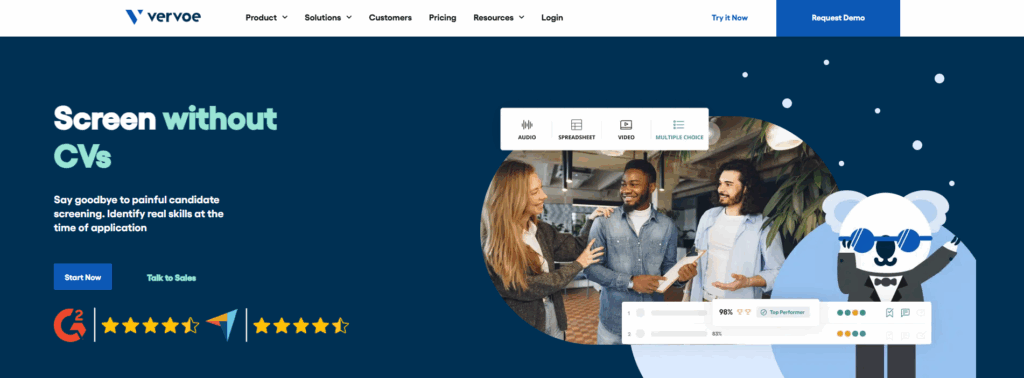
Vervoe puts candidates into job-related tasks and lets AI grade and rank the responses. It sits at the opposite end of the spectrum from TalentMetrix: less about traits, more about output. The tradeoff is build time, since a good simulation takes longer to set up than a ready-made personality test.
Features
- Job simulations: 300+ pre-built tests covering on-the-job tasks in customer support, sales, marketing, technology and operations.
- Multi-format testing: text, video, file uploads and spreadsheets in the same assessment.
- AI grading: responses scored and ranked on accuracy, effort and relevance.
- Team review: several reviewers can score and comment in one dashboard.
G2 Rating: 4.6/5
Pricing: a pay-as-you-go model suited to teams with uneven hiring cycles. The entry plan starts at $300 per year for 10 candidates and rises as you add candidates.
5. Codility
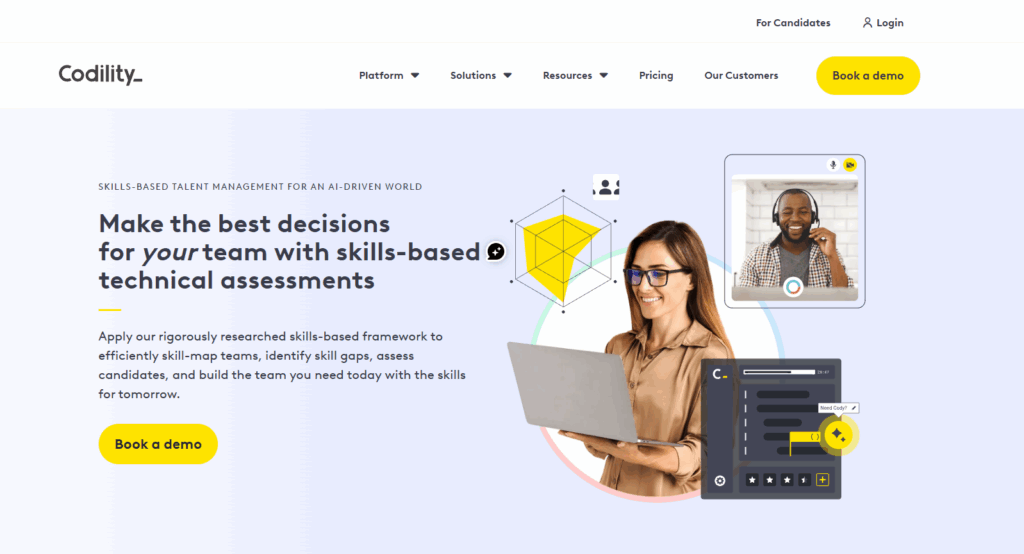
Codility is built for engineering recruitment at scale. It is not a TalentMetrix replacement for non-technical roles, and it is not trying to be. For a team hiring developers in volume, it is one of the two or three serious options.
Features
- Coding test bank: 1,100+ tasks across 45+ programming languages, from basic algorithms to system design.
- Live technical interviews: a shared IDE with syntax highlighting, compiler support and a test runner.
- Automated scoring: submissions assessed for logic, correctness, efficiency and readability without manual code review.
- Reporting: task-by-task breakdowns, test-case pass rates and code-quality metrics.
G2 Rating: 4.6/5
Pricing: three tiers, with a Starter plan at $1,200 per year, a Scale plan at $6,000 per year and a custom enterprise option.
6. Mercer Mettl
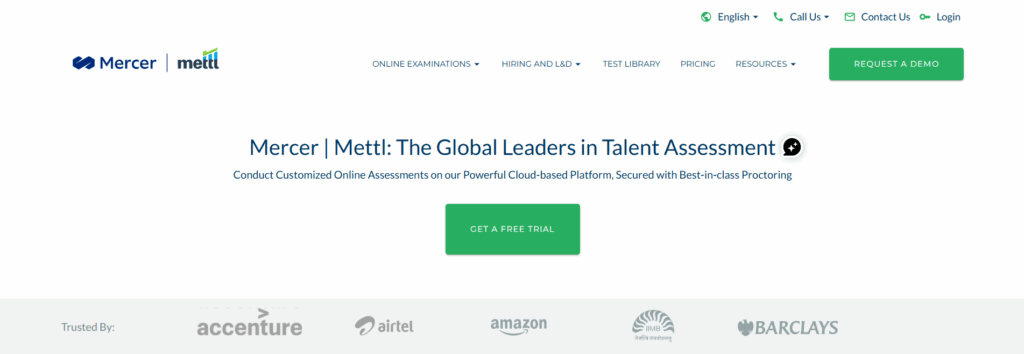
Mercer Mettl is the closest match to TalentMetrix on research pedigree, with behavioural and psychometric depth backed by Mercer, plus proctoring built for campus and certification volumes. It is also the most likely to involve a procurement process rather than a card payment.
Features
- Test coverage: 200+ job-specific assessments across technical, cognitive, behavioural and psychometric domains, all customisable.
- Enterprise proctoring: AI face recognition, browser lockdown and live human invigilation.
- Brand personalisation: your branding, logos and a dedicated test domain.
- Reporting: competency-based scoring, percentile comparisons and hiring recommendations.
G2 Rating: 4.4/5
Pricing: customised. Cost depends on the number of tests, candidates and features, so you contact Mettl for a quote.
7. iMocha
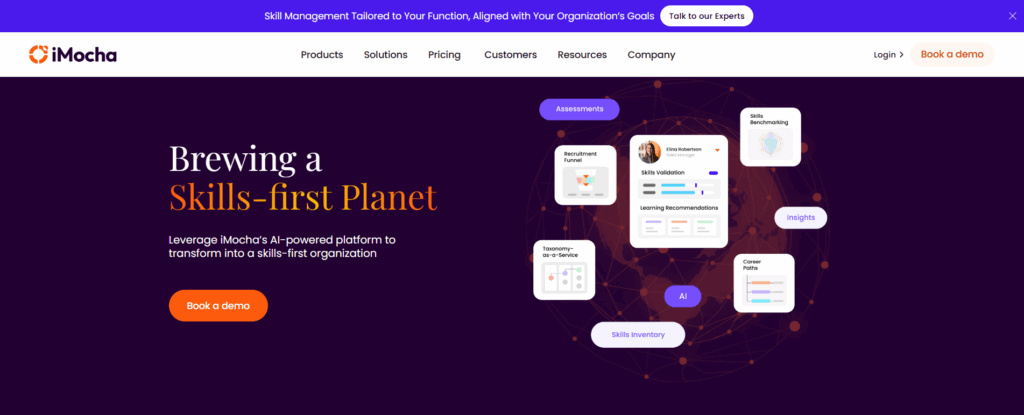
iMocha started in pre-employment testing and now sells skills intelligence across an existing workforce as much as at the hiring gate. If your problem is "we do not know what skills we already have", it answers a different and larger question than TalentMetrix does.
Features
- Test library: over 3,000 ready-to-use tests and 30,000+ skills mapped to job roles, including SAP, cybersecurity and financial services.
- Custom test builder: pick from existing questions or write new ones, with control over scoring logic, difficulty and structure.
- AI interviewer: a conversational virtual interviewer that runs video interviews for high-volume hiring.
- Reporting: performance by domain, skill group and question category.
G2 Rating: 4.4/5
Pricing: 14-day free trial. Plans start at $999/year for Starter and scale for larger teams.
8. Hirevue
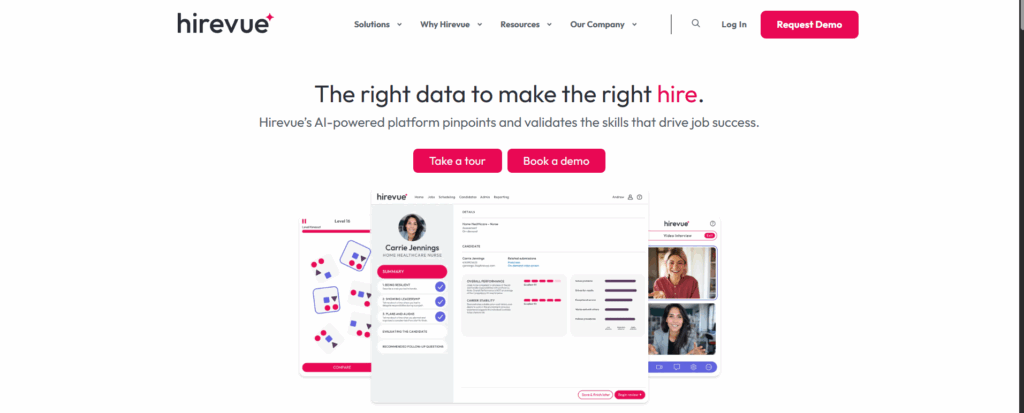
HireVue is built for hiring at very high volume through on-demand video interviews, coding challenges and game-based assessments. It overlaps with TalentMetrix on cognitive and personality measurement, and diverges sharply on price point and buying process.
Features
- Validated question library: role-specific interview questions developed using industrial-organisational psychology.
- Video interviews: structured one-way or live interviews scored against rubrics, with AI analysis of responses.
- Game-based assessments: cognitive games covering problem solving and related skills.
- Scheduling and automation: automated interview scheduling, chatbot candidate engagement and ATS integrations.
G2 Rating: 4.1/5
Pricing: three plan tiers, none publicly disclosed. Details require booking a demo.
9. TestDome
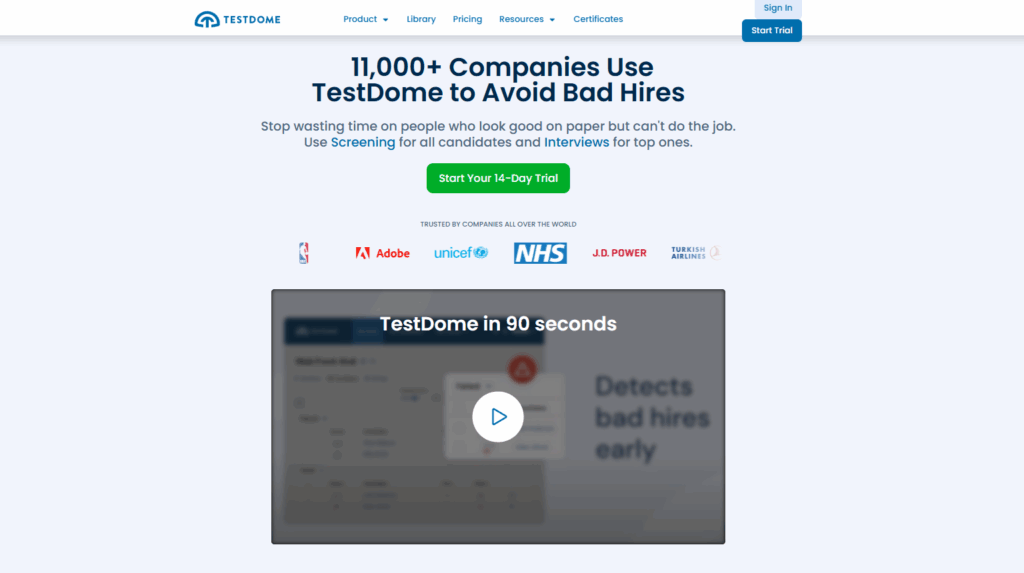
TestDome is built around short work-sample tests rather than trivia. Its 150+ pre-built assessments simulate real job tasks across programming, IT, accounting and customer service, which makes it a practical option when you want proof of skill without a two-hour battery.
Features
- Work-sample testing: job-relevant tasks that mirror day-to-day responsibilities.
- 150+ pre-built tests: short assessments across software development, accounting, customer service and data entry.
- Custom questions: build your own tasks or mix them with the library.
- Benchmarking: visual scorecards, percentile rankings and clear pass or fail thresholds.
G2 Rating: 4.5/5
Pricing: subscription plans published by the vendor. The figure previously shown here described a different product and has been removed rather than restated without verification.
10. Coderbyte
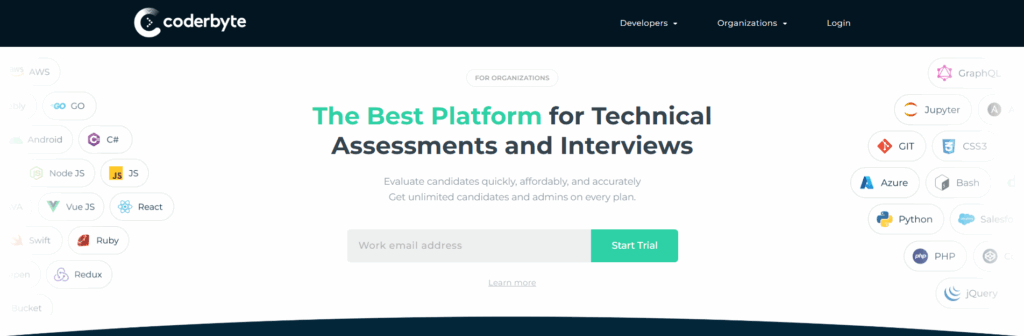
Coderbyte targets startups and mid-sized teams hiring developers and data scientists, with an unlimited-use subscription instead of per-candidate pricing. For a small engineering team hiring steadily, the cost model is the main draw.
Features
- Coding challenges: 1,000+ challenges across 30+ programming languages and 100+ technical skills, plus project-based exercises.
- Multiple question types: coding tasks, multiple choice, open-ended written answers and SQL queries.
- Interview tools: live technical interviews with video, a collaborative code editor, Jupyter notebook and spreadsheet support, and a whiteboard.
- Reporting: code submissions, replayable sessions, automated scorecards and benchmarking charts.
G2 Rating: 4.4/5
Pricing: subscription-based, at roughly $199/month for unlimited candidates and tests, with discounted annual billing available.
11. TalentClick
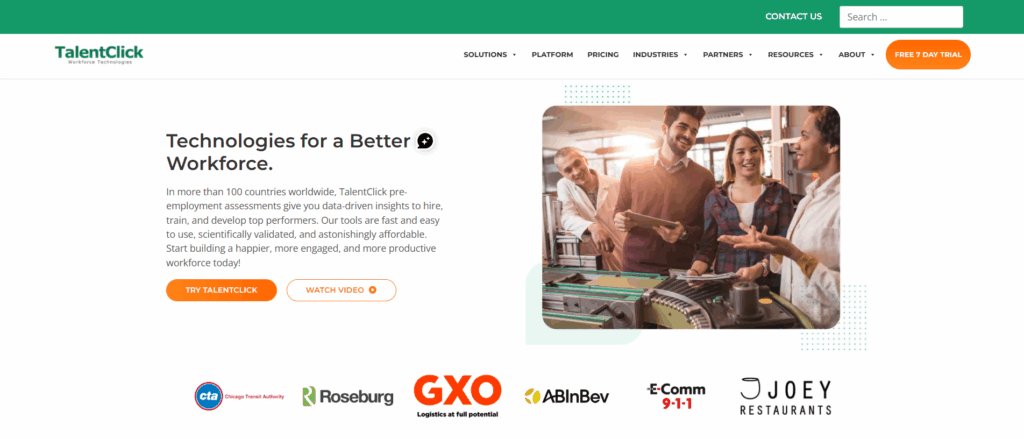
TalentClick is the safety specialist on this list. Its behavioural assessments predict risk-taking and unsafe work behaviour, which matters in construction, manufacturing, transport and field services. If your hiring risk is measured in incidents rather than in ramp time, it is worth a look.
Features
- Unlimited-use subscriptions: a flat-rate plan with no per-assessment fee, suited to high applicant volumes.
- Validated behavioural tests: Attitude-Values-Personality, Safety Quotient, Driver Safety Quotient, Cognitive Quotient, English Proficiency and Leadership Profile.
- Fit scores: predefined performance profiles that rank candidates against job fit.
- Analytics portal: report building, team analytics, usage tracking and custom templates.
G2 Rating: 5/5
Pricing: not publicly disclosed. Companies contact the sales team for a quote based on size, hiring volume and features.
12. HackerEarth
HackerEarth is an enterprise tech hiring platform built for large-scale screening and structured developer interviews, with unusually deep coverage of technical roles and proctoring.
Features
- Content library: 25,000+ questions across software development, data science, AI and machine learning, DevOps and cloud.
- FaceCode interviews: collaborative coding interviews with a shared editor, question banks and a whiteboard.
- Advanced proctoring: webcam monitoring, tab tracking, audio detection and behavioural analysis, with live human proctoring available.
- Custom tests: templates or from-scratch builds with flexible scoring logic, difficulty levels and time limits.
G2 Rating: 4.5/5
Pricing: plans start at $99 per month, with higher tiers for larger teams.
13. HackerRank
HackerRank is a technical hiring platform for engineering, data science and DevOps roles, used by large enterprises. Candidate familiarity is a real advantage here: many developers have already taken one of its tests, which reduces friction at the top of the funnel.
Features
- Test library: 7,500 curated questions across 45+ programming languages, covering frontend, backend, data, security and QA roles.
- Interview workflows: screening, take-home tests and live interviews in one place, with pair programming and system design boards.
- Anti-cheating: webcam recording, copy detection and time analysis.
- Structured scoring: custom rubrics covering coding ability, collaboration and problem solving.
G2 Rating: 4.5/5
Pricing: published by the vendor. The starting figure previously shown here was corrupted and has been removed rather than restated without verification.
14. TestInvite
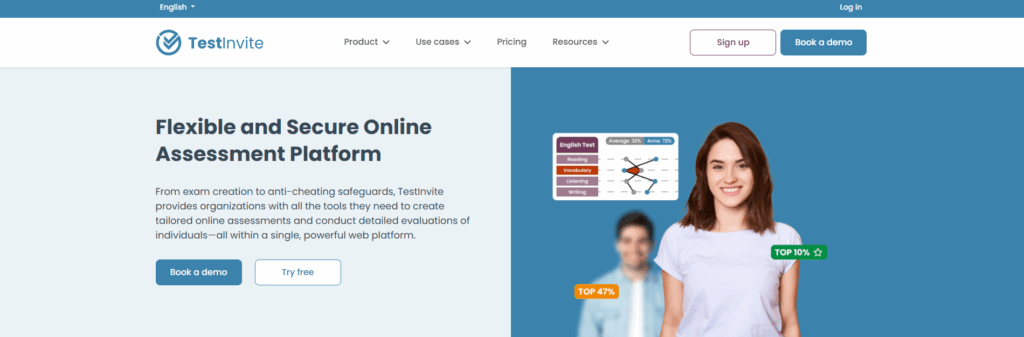
TestInvite gives you more control over the mechanics of a test than almost anything else here: question types, scoring logic, timing and proctoring are all configurable. That control is the point, and it is also the learning curve.
Features
- Custom test creation: multiple choice, essays, coding challenges and video responses, with custom scoring logic and time limits.
- Assessment library: pre-built tests for problem solving, communication and role-specific skills.
- Detailed reports: custom scoring metrics, benchmarks, categorisation and narrative feedback.
- Proctoring: lockdown browser mode, AI cheat detection, randomised question banks and video or audio monitoring.
G2 Rating: 4.7/5
Pricing: starts at $37/month for the Starter plan, with a limited number of test attempts. Higher tiers add features and usage, and add-ons raise the price.
15. eSkill
eSkill covers the clerical and software-proficiency ground that psychometric tools skip: data entry, spreadsheets, call-centre handling, literacy and numeracy. For high-volume administrative hiring it is one of the most practical options on this list.
Features
- Test library: over 600 ready-to-use assessments, plus custom tests built from thousands of questions covering specific subjects, skills and software tools.
- Job simulations: interactive scenarios replicating customer service interactions, data entry and IT troubleshooting.
- Proctoring: monitoring for copy-paste attempts, window switching and irregular response behaviour, with automatic flagging.
- Analytics: overall scores plus skill-specific breakdowns against job benchmarks.
G2 Rating: 4.5/5
Pricing: not disclosed publicly. Recruiters contact the sales team for a custom quote.
Which is the best TalentMetrix alternative?
For most teams replacing TalentMetrix, Testlify is the strongest single choice, because it covers the widest span of the decision in one product: role-specific and psychometric testing, AI interviews in chat, voice and video, and proctoring evidence that stands up when someone asks how you reached a shortlist.
The honest exceptions are worth naming. If you hire developers almost exclusively, a specialist technical platform will go deeper on code review workflows. If your hiring risk is workplace safety, a dedicated behavioural-risk tool is the better fit. And if you need a psychologist-authored narrative report for succession planning rather than hiring, the research-led psychometric vendors remain the right call.
Testlify carries an extensive test library of 3,500+ tests, item-level psychometrics most competitors keep internal, and dual-device proctoring where the candidate's phone acts as a second camera. Pricing is published rather than quoted.
The fastest way to judge it is to run one real role through it. Book a demo and bring a job description you are actively hiring for, or start a free trial and build the assessment yourself. For a side-by-side on features and pricing, read the detailed Testlify vs TalentMetrix comparison, or browse the wider set of assessment platform alternatives.
Key takeaways
- Match the test to the decision, not to the category. Personality data answers "how will this person work with us". Work samples answer "can they do the job". Buying the first when you needed the second is the most expensive mistake in this category, because you only find out after the hire.
- Published pricing changes who can buy. TalentMetrix, Mercer Mettl, TalentClick, eSkill and HireVue all quote rather than publish. If you are a team of 30 without a procurement function, that alone rules several of them out, regardless of test quality.
- Consistency beats interpretation. Kuncel and colleagues found mechanical combination of assessment data predicts as well as or better than experts reworking the same information by judgment. Pick the tool that makes consistent scoring easy, and keep the human decision at the end rather than in the middle.
- Qualitative tests do not have a total score. Personality and culture assessments produce a profile, not a rank. Using one as a cutoff gate is both bad practice and hard to defend if the result is ever challenged.
- Compliance is now part of the buying decision. Bias-audit and notice rules for automated hiring tools already apply in New York City, and selection procedures that screen people out have to be job related. Ask each vendor what evidence they produce, not just what they measure.
- Skills churn faster than test batteries. With 39% of key job skills expected to change by 2030, a library you can extend beats a fixed set of competencies, however well validated it was when it was built.
FAQs

Director of Marketing
Akash Patange is the Director of Marketing at Testlify, where he works closely with HR leaders and recruiters to help organizations improve hiring outcomes. He writes about talent assessment, recruitment technology, and data-driven hiring practices.
LinkedInRelated resources
View all
Alternatives
Top 15 Equip Alternatives and Competitors
Alternatives
Top 15 Harver Alternatives and Competitors
Alternatives
Top 15 Talview Alternatives and Competitors
Alternatives
Top 15 Cangrade Alternatives and Competitors
Alternatives
Top 15 Test Partnership Alternatives and Competitors
Alternatives
Top 15 Alva Labs Alternatives and Competitors
Get started.
Hire on proof, not resumes.
Run your first skills-based assessment free — no credit card required.