
Top 15 Cangrade Alternatives and Competitors
Discover 15 powerful Cangrade alternatives to streamline your hiring process and assess candidates with confidence.
No screening platform owns "the science." The method does. Structured, scored, job-relevant evidence predicts performance well; a resume skim and a friendly chat do not, and that gap holds no matter whose logo sits in the corner of the report. So the honest way to compare Cangrade with its competitors is to ask what each tool actually measures, how it scores, and whether it will show you the workings.
Cangrade is a predictive hiring platform built on custom Success Models. It is good at what it does. Teams still leave it, usually for three reasons: it quotes rather than publishes prices, its focus is behavioral prediction rather than hands-on skill testing, and a small team often wants to buy on a card today instead of booking a call. This page compares 15 alternatives on those terms, and it starts with the evidence rather than the feature grid.
 ChatGPT
 Gemini
 Claude
 Grok
Grok Perplexity
TL;DR
- Validity belongs to the method, not the vendor. Structured, scored assessment beats resume screening and unstructured interviews, and the research that ranks predictors is public.
- Cangrade publishes no plan pricing. Every tier is quote-only, so a small business cannot work out its cost without talking to sales.
- Four of the 15 alternatives below also price by quote only. Published pricing is a real buying criterion, not a nicety.
- Behavioral prediction and work-sample testing answer different questions. Most teams that switch want more of the second.
- Any AI scoring you buy in 2026 needs a bias audit trail and a human override, because New York, Colorado and the EU now all ask for one.
- Testlify starts at $139 a month billed annually, with a 7-day free trial and no card required, which is the fastest way to test the difference yourself.

What is Cangrade and how does it work?
Cangrade is an AI-driven talent intelligence and assessment platform that predicts how well a candidate will do in a specific role at a specific company. Its pre-hire assessment measures more than 50 psychometric traits in a candidate sitting of roughly 14 minutes, then scores each person against a custom Success Model built for that role.
The Success Model is the whole product, really. It is a profile of the traits and soft skills that predict success in one role at one organization, and Cangrade builds it three ways: from your own performance and retention data, from input by your internal experts, or by running a job description through generative AI. Its Jules AI copilot wraps resume screening, assessments, structured interviews, video interviews and reference checks around that score.
Cangrade says its models predict candidate success up to 10 times more accurately than traditional methods such as resume review and unstructured interviews, and that every trait has been tested for reliability, predictive validity and freedom from adverse impact. Read that claim the way you would read any vendor claim: the comparison is against a very low baseline. Unstructured interviews are a weak predictor, so beating them is the floor, not the ceiling.
Why do teams look for a Cangrade alternative?
Three patterns come up again and again in switching conversations, and none of them is "the product is bad."
You cannot see the price. Cangrade publishes no plan pricing at all. For a 30-person agency deciding between two tools on a Thursday afternoon, a quote request is a week of delay for a number that may not fit the budget anyway.
You want to watch people work, not just profile them. Trait-based prediction tells you who tends to succeed. A work sample tells you whether this person can actually build the thing, write the email, or fix the spreadsheet. Both are useful. Teams hiring for hands-on roles usually want more of the second than a psychometric platform is built to give.
You need the audit trail. If AI scoring touches a hiring decision, someone will eventually ask you to explain it. That is a compliance question now, not a philosophical one, and the answer has to be a document.
How do you judge the science behind a screening tool?
Marketing copy about "validated" assessments is cheap. The underlying research is public, and it is more useful than any vendor page.
Which candidate screening software has the strongest science behind it, Cangrade or its competitors?
None of them, and that is the useful answer. Predictive validity is a property of the selection method, not of the brand that sells it. The strongest published evidence ranks structured interviews, work samples and job-knowledge tests among the better predictors of job performance, and it ranks years of education and general years of experience among the weakest. Pick the tool that runs the strong methods well.
The reference point most people cite is a 1998 summary of 85 years of selection research. It has since been substantially revised. A 2022 reanalysis by Sackett and colleagues found that earlier estimates had been systematically overcorrected for range restriction and revised many of them downward, while keeping structured interviews near the top of the list (Journal of Applied Psychology, 2022). The exact coefficients are still argued over in print. The ranking is not: structure beats no structure, evidence beats impressions.
There is a second finding worth knowing before you buy anything with an AI score in it. When you have already gathered assessment data, combining it by a fixed rule predicts outcomes at least as well as letting an expert reweigh the same information by judgment at the end (Kuncel and colleagues, 2013). That is an argument for scoring consistently. It is not an argument for letting the machine decide, which is a different thing and a legally risky one.
So the questions that actually separate these tools are boring and answerable:
- Does the tool measure something the job needs, or something that merely correlates with it?
- Is every candidate scored the same way, on the same scale?
- Can you see the score break down into parts, and change the weights?
- Can a human override the score, and is that override recorded?
- Will the vendor hand you a bias-audit summary without a fight?
What the regulators now expect
Three rules changed the buying checklist. The EEOC's guidance on employment tests is the baseline: a selection procedure that screens out a protected group has to be shown "job-related and consistent with business necessity," and employers "should ensure that employment tests and other selection procedures are properly validated for the positions and purposes for which they are used" (EEOC guidance). That obligation sits with you, the employer, not with the vendor.
New York City's Local Law 144 is more specific. An automated employment decision tool must have had a bias audit within one year of use, a summary of the results has to be public, and candidates need notice 10 business days before the tool is used (NYC Department of Consumer and Worker Protection). Colorado's SB24-205 takes effect on 1 February 2026 and asks deployers of high-risk AI to use reasonable care against algorithmic discrimination and to give people a route to appeal an adverse decision "via human review if technically feasible" (Colorado General Assembly). In the EU, AI used "for the recruitment or selection of natural persons, in particular to place targeted job advertisements, to analyse and filter job applications, and to evaluate candidates" is classed as high-risk under Annex III of the AI Act (EU AI Act, Annex III).
Practical translation: ask every vendor on your shortlist for the bias-audit summary, the override log, and a sentence describing what the model uses. If a vendor treats that as an unusual request, that tells you something.
What does Cangrade cost?
Cangrade does not publish pricing. There are no plan tiers on the site, no per-candidate rate, and no self-serve checkout. Cost is quoted per customer and depends on hiring volume and how complex the Success Models are. Third-party software directories that profile Cangrade report the same thing: custom pricing, contact sales. A free trial of the Jules copilot is offered.
For a small business that is a genuine problem, and it is the reason this page exists in its current form. If you have 8 hires to make this year, you are not going to build a business case around a number you have to ask for. The Testlify entry tier is $139 a month billed annually. You can compare that to a quote. You cannot compare a quote to another quote you do not have yet.
Four of the 15 alternatives below do the same (Mercer Mettl, Hirevue, Hiremojo and eSkill), so treat pricing transparency as a shortlist filter rather than a tiebreaker.
How did we evaluate these tools?
Five criteria, applied the same way to every tool on the list. They are weighted toward what a team under 200 people can verify without a procurement process.
Criterion | Why it matters | How to check it in 20 minutes |
|---|---|---|
Method fit | Trait profiling, work samples and coding tests answer different questions. Buying the wrong one is the most common expensive mistake. | Write down the one thing the hire must be able to do on day 30. Ask the vendor to show you that being measured. |
Scoring transparency | A single composite score you cannot decompose is impossible to defend and impossible to improve. | Ask to see one finished candidate report, not a slide about reports. |
Human override | Regulators in three jurisdictions now expect a person to be able to change an AI-influenced outcome. | Ask whether an override is possible, who can do it, and whether it is logged. |
Published pricing | Quote-only pricing costs a small team a week and removes your ability to benchmark. | Look for a price on the pricing page. That is the whole test. |
Time to first assessment | A tool you cannot pilot before you buy is a tool you are buying on faith. | Start a trial and try to send a real test to a real candidate the same day. |
Best alternatives to Cangrade software
The shortlist below keeps the 15 tools this page has always covered, in the same order. Coverage of rival assessment vendors on Testlify pages is a deliberate editorial decision rather than an automated one, so the sections for other vendors have been corrected and tidied rather than expanded. The Testlify entry, the evaluation criteria, the pricing analysis and the FAQ are new.
Before the list, the head-to-head most readers of this page actually want:
What you are comparing | Cangrade | Testlify |
|---|---|---|
Core method | Psychometric trait prediction against a custom Success Model | Skills, cognitive, personality, coding and work-sample testing, plus AI interviewing |
Assessment length | About 14 minutes, 50+ traits | Configurable per test, with per-question time limits and section breaks |
Work samples | Job simulations offered | Coding in an embedded VS Code editor, typing tests, Google Docs, Sheets, Slides, Word, Excel and PowerPoint tasks, file and URL submissions |
Interviewing | Structured and video interviews | One-way video, two-way conversational AI video, voice, and outbound AI phone interviews billed at $0.18 a minute |
Item-level psychometrics shown to you | Not published | Difficulty index, discrimination index and quality risk per question |
Human override of AI scores | Human judgment expected | Toggles for showing AI scores and for including them in the final average, plus routed manual review |
Proctoring | Standard integrity controls | 20+ measures including dual-device monitoring, where the candidate's phone acts as a second camera |
Published pricing | No, quote only | Yes, from $139 a month billed annually |
Free trial | Free trial of the Jules copilot | 7 days, no card required |
One caution before the list. Vendor pricing and third-party ratings move quickly, and the figures in the sections below are indicative rather than freshly audited. Check each vendor's own pricing page before you build a business case on a number.
1. Testlify
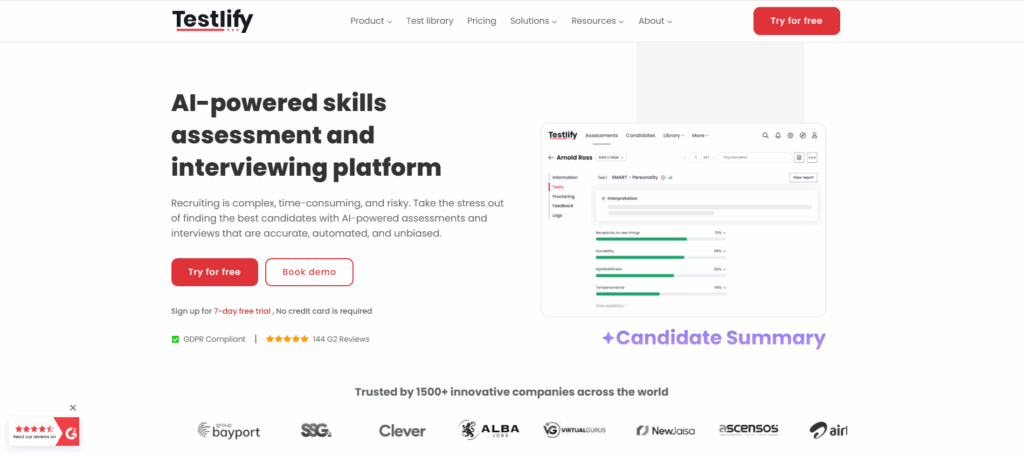
Testlify is a conversational AI-powered skills assessment and interviewing platform. Where Cangrade predicts fit from traits, Testlify is built to watch people do the work: coding in a real editor, a spreadsheet task, a timed typing test, a recorded answer scored against a rubric. Both signals are legitimate. This one is easier to defend to a hiring manager who wants to know why the shortlist looks the way it does.
The idea behind it is the Testlify Multi-Signal Talent Evaluation Model: combine several role-relevant signals, including assessments, interviews, simulations, references and reviewer feedback, rather than advancing someone on one strong resume or one polished interview. One signal is fragile. Several pointing the same way is a decision you can stand behind.
Key features
- Test library and question depth: 3,500+ tests and 180,000+ validated questions mapped to 4,500+ roles across 50+ industries, with more than 25 question types. Browse the full test library before you commit to anything.
- Work samples, not just quizzes: coding questions run in an embedded VS Code editor with up to 20 test cases (visible or hidden, individually scored, including SQLite database cases). There are also live Google Docs, Sheets and Slides tasks, Microsoft Word, Excel and PowerPoint tasks, file uploads and URL submissions. Vibe coding questions let candidates direct AI tools to a working solution instead of writing syntax by hand, which is closer to how most engineers now work.
- Interviewing in the same tool: one-way async video, two-way conversational AI video, voice and audio questions, and outbound AI phone interviews at $0.18 a minute. You pick the AI avatar, the voice, the persona and the prompt, set attempt limits and recording time, and get automatic multilingual transcripts. There is no separate video vendor to buy.
- Item-level psychometrics you can actually see: difficulty index, discrimination index and a quality-risk flag per question, plus answer, score and time distributions. This is test-publisher instrumentation, and it is how you find out that question 7 is not measuring anything.
- AI with the brakes on: AI scores open-ended answers, documents, spreadsheets, presentations, source code and design files, and an AI checker classifies an answer as human, AI-generated or mixed. The product ships the line "AI scores and insights are for guidance only. Use human judgment for final decisions," and both "display AI scores to the reviewer" and "include AI score in the final average" are toggles you control.
- Proctoring, including dual-device: 20+ integrity measures across three presets. The standout is dual-device monitoring, where the candidate's phone becomes a second camera positioned to show both the person and the laptop screen. Flags are evidence for a human to review, and auto-termination is a separate opt-in setting rather than something the flags do by themselves.
- Fits the stack you already run: 100+ ATS integrations, plus Zapier, webhooks, SAML SSO, SCIM provisioning and real-time SIEM streaming for teams that need them. Testlify also ships a simple built-in hiring pipeline (job requisitions, an application form, job-board publishing, and applied to reviewed to shortlisted to rejected stages) for teams that do not run an ATS at all.
Pros
- Published prices, a 7-day free trial with no card, and a 30-day money-back guarantee, so a small team can evaluate it without a sales call.
- Assessment, work samples, proctoring and interviewing sit in one product, which removes an integration and a second contract.
- Scoring is decomposable and overridable, which is the property that makes an AI-assisted decision explainable later.
- Accommodation requests are a structured, human-reviewed flow, and DEI data collection is anonymous and optional.
Cons
- Assessments need a Chromium desktop browser (Chrome or Edge). The mobile app is a fallback for recording audio and video, not a way to sit a full test on a phone.
- ATS integrations, white labeling and SSO are paid add-ons on the self-serve tiers at $2,388 a year each, included only on Custom. Budget for them if you need them.
- AI resume scoring currently works with Greenhouse; other ATS integrations for that specific feature are available on request.
- Testlify does not schedule live human interview panels. If calendar coordination for a four-person panel is the job to be done, that stays with your ATS or scheduling tool.
Best for
Teams under about 200 people who want to see candidates work, need the pricing up front, and would rather run one tool than stitch an assessment platform to a video vendor. It scales past that, but that is where the fit is sharpest.
Testlify pricing
Pricing is a credit selector crossed with a monthly or annual toggle, and one credit covers one started assessment. Full detail sits on the Testlify pricing page.
- Starter: $139/month billed annually ($1,668/year), 100 credits at $16.68 each, 3 seats.
- Basic: $279/month billed annually ($3,348/year), 300 credits at $11.16 each, 5 seats.
- Business: $699/month billed annually ($8,388/year), 1,000 credits at $8.39 each, 10 seats.
- Premium, Enterprise and Custom: 3,000, 10,000 and 25,000+ credits with 20, 30 and 40 seats, priced by volume on contact with sales.
- Month-to-month: the same tier names at different credit counts, from $198/month for 10 credits.
- Everything else: extra seats $15 a month, 7-day free trial with no card, 30-day money-back guarantee, price locked for 24 months, and a 25% non-profit discount.
2. TestGorilla
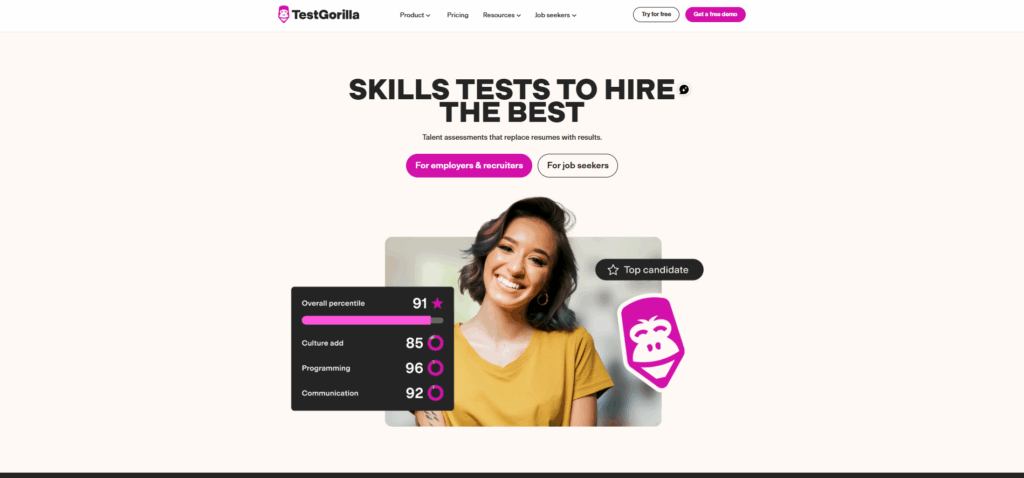
TestGorilla is a pre-employment testing platform offering a range of assessments designed to evaluate both technical and soft skills.
Widely adopted across industries, it helps improve quality-of-hire by enabling companies to screen candidates with role-specific tests that reflect actual job requirements.
Features
- Test coverage: Choose from 300+ scientifically validated tests including cognitive ability, software skills, language proficiency, and personality traits. Tests are regularly updated and aligned to real job requirements.
- Video questions: Use video questions to capture non-verbal cues and evaluate soft skills such as communication, confidence, and situational thinking.
- Bias mitigation: Reports are anonymized and scored objectively to reduce bias in shortlisting. Cultural fit and personality tests help identify alignment beyond hard skills.
- Custom branding: Employers can brand tests with logos, themes, and custom intro videos. Additional control over question order and timing is also available.
Pricing: TestGorilla offers a Free plan with essential tests and unlimited candidate invites. The Starter and Pro plans start at $83/month and $127/month respectively (billed annually), with pricing varying based on company size.
3. Adaface
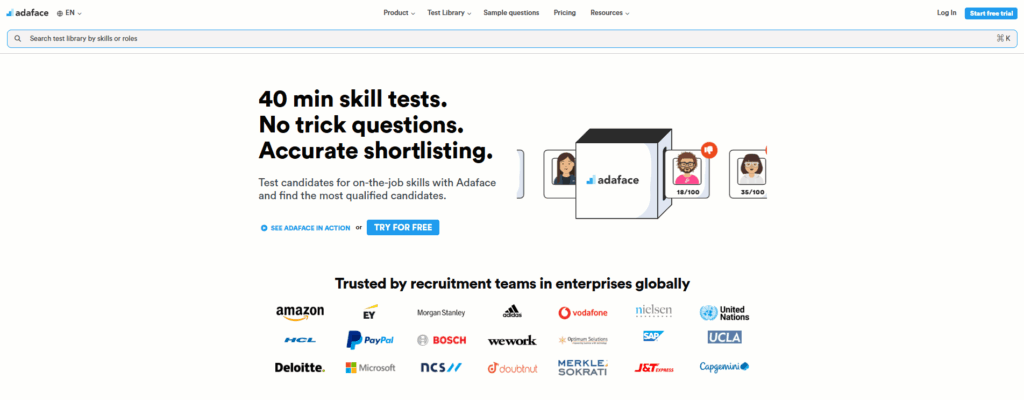
Adaface builds candidate assessments around an AI chatbot called Ada. It positions itself as a candidate-friendly assessment tool, replacing static pre-employment testing with a conversational approach.
The chatbot aims to simulate real-world conversational experiences, reducing test anxiety and improving the candidate experience.
Features
- Conversational assessments: Instead of static tests, candidates interact with Ada, a chatbot that presents questions in a natural, chat-based flow. This helps reduce candidate drop-off and improves test completion rates.
- Job-specific tests: Questions are mapped to the actual responsibilities of the role. A front-end developer is asked about debugging real UI components instead of solving generic puzzles.
- Real-time scoring and status: Candidates are automatically assigned a pass, borderline pass, or fail status. Recruiters can instantly filter candidates and reduce time spent on manual review.
- Customization and templates: Access a library of 150+ role-specific assessments, or build your own by modifying question types, time limits, and complexity to match your hiring needs.
Pricing: Free trial available. Plans start at $180/year (Individual plan for basic needs) and scale up for larger teams.
4. Vervoe
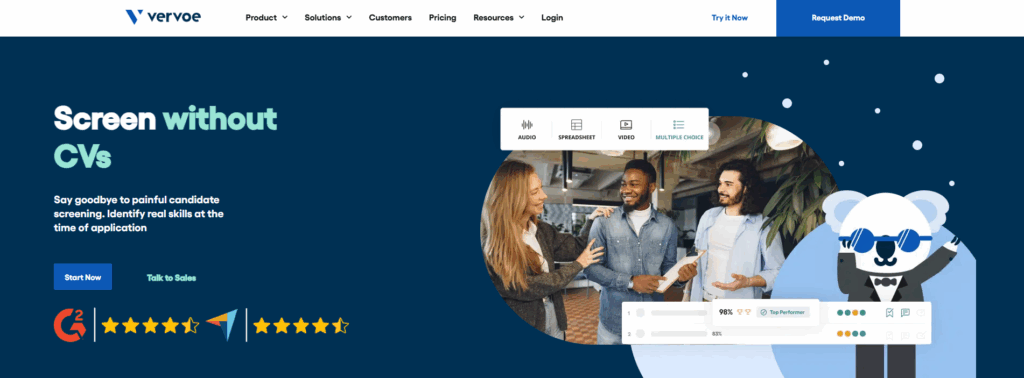
Vervoe is a platform whose mission is to make hiring about merit rather than resumes. It enables employers to see candidates perform job-related tasks and uses AI to automatically grade and rank their responses.
Vervoe's assessments cover technical, soft, and creative skills, with an emphasis on real-world exercises that let every candidate show what they can do in practical scenarios.
Features
- Job simulation tests: Choose from 300+ customizable templates for roles in sales, support, engineering, design, and more. Simulations include writing emails, debugging code, and solving customer issues.
- Flexible question formats: Use multiple-choice, video response, free text, file uploads, and audio for assessing a wide variety of competencies.
- AI grading: Built-in AI evaluates candidate responses and automatically ranks them based on skill proficiency. Recruiters can override AI scores or review raw answers.
- Anti-cheating measures: Includes plagiarism detection, time-limited questions, and other proctoring tools to protect assessment integrity.
Pricing: Follows a pay-as-you-go model, which can suit organizations with even hiring cycles or tight cost control. The entry plan starts at $300 per year for 10 candidates, with pricing increasing as more candidates are added.
5. Codility
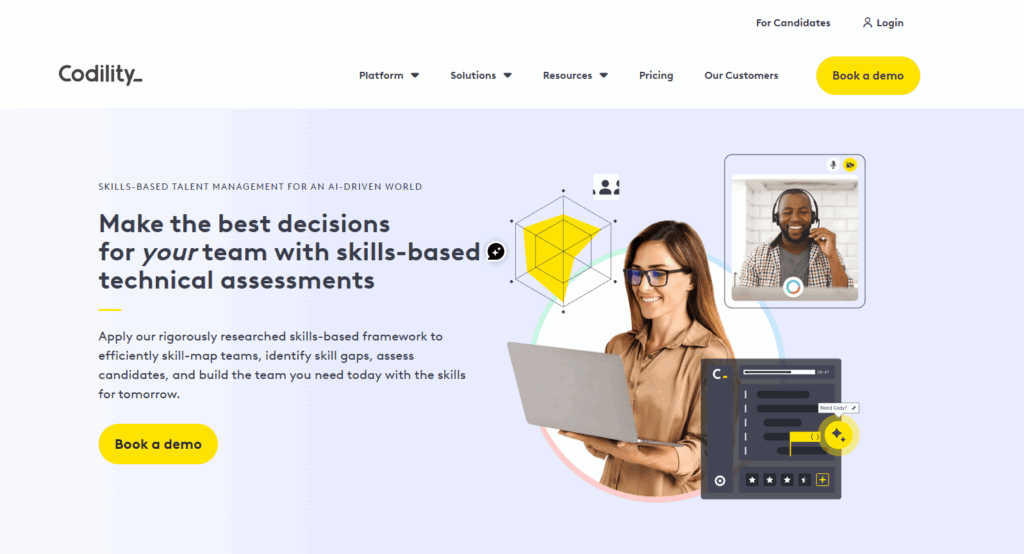
Codility is an online coding test and interview platform used by enterprises to assess and validate the skills of tech talent. It covers coding tests, live technical interviews, and training modules.
By focusing on objective, skill-based evaluations, Codility helps teams make evidence-based hiring decisions while reducing bias and saving engineering time.
Features
- Extensive test library: 1,100+ coding and technical tests in dozens of programming languages.
- Live technical interviews: Real-time coding interviews with a pair programming interface and code evaluation.
- Enterprise-grade features: Full anti-plagiarism suite, ATS integrations, and detailed performance reports.
- Bias mitigation and analytics: By focusing on skill-based tasks and standardized scoring, Codility helps reduce unconscious bias in hiring. It provides analytics to compare candidates objectively.
Pricing: Codility is sold in tiered packages. The Starter plan is priced at around $1,200/year, the Scale plan at $6,000/year, and enterprise customers can obtain custom pricing for broader usage and additional features.
6. Mercer Mettl
Mercer Mettl is an assessment suite backed by Mercer. It is strong in behavioral and psychometric evaluation, which suits organizations that need rigor and compliance in their hiring.
It is known for research-based assessments and secure proctoring, and is widely used in corporate hiring, campus recruitment, and certification testing.
Features
- Broad test coverage: Supports 200+ job roles with domain-specific tests in IT, finance, sales, and more. Psychometric and cognitive tests are grounded in occupational psychology research.
- Advanced proctoring: Combines AI proctoring with human monitoring. Includes image-based tracking, facial recognition, and browser lockdown tools to prevent cheating.
- Custom branding: Organizations can use their logos, colors, and custom subdomains to deliver assessments under their own brand.
- Benchmarking and scoring: Provides percentile-based reports, trait breakdowns, and hiring recommendations to support data-driven decisions.
Pricing: Customized. Organizations need to contact Mercer Mettl for a quote, as costs depend on the number of tests, candidates, and features.
7. iMocha
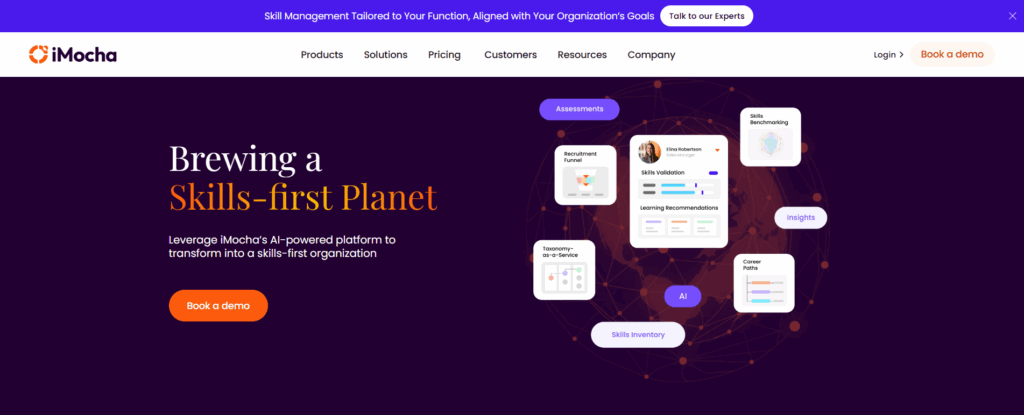
iMocha is an AI-powered skills assessment platform that supports both pre-employment testing and workforce upskilling. It has built a large skills database and is known for its skills-intelligence features. Companies use iMocha to test candidates on skills ranging from coding and IT to finance and language.
Features
- Extensive test library: Over 3,000 ready-to-use tests and 30,000+ skills mapped to industry job roles, including niche domains like SAP, cybersecurity, and financial services.
- Custom test builder: Allows HR teams to build tests by mixing existing questions or creating new ones with custom scoring logic.
- AI interviewer Tara: A virtual assistant that engages candidates through conversational interviews, generating qualitative reports.
- Reporting and analytics: Track candidate performance by domain, skill group, and question category.
Pricing: 14-day free trial available. Plans start at $999/year (Starter) and scale up for larger teams.
8. Hirevue
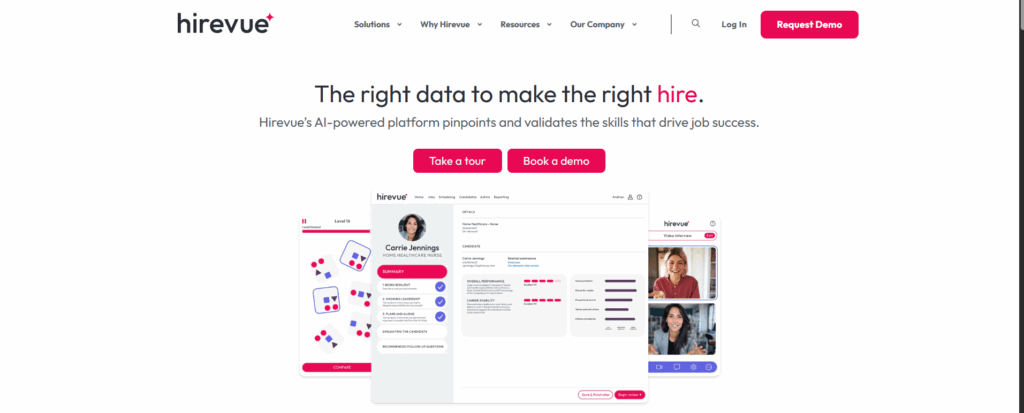
Hirevue is a pioneer in digital interviewing that has expanded into assessments. It offers a video interviewing platform combined with game-based and AI-driven assessments.
Enterprises use it for high-volume hiring with on-demand video interviews, coding challenges, and AI-scored games that measure cognitive ability and personality.
Features
- IO science content library: Access to validated role-specific interview content.
- Video interviews (on-demand and live): One-way and live video interviews with scoring rubrics. AI captures non-verbal cues and evaluates the verbal response content and tone.
- Game-based assessments: AI-driven cognitive games that measure problem-solving, communication, and coding skills.
- Scheduling and automation: Auto-schedules interviews, engages candidates via chatbots, and integrates with your ATS.
Pricing: Three plan tiers, but pricing is not publicly disclosed and requires booking a demo for details.
9. TestDome
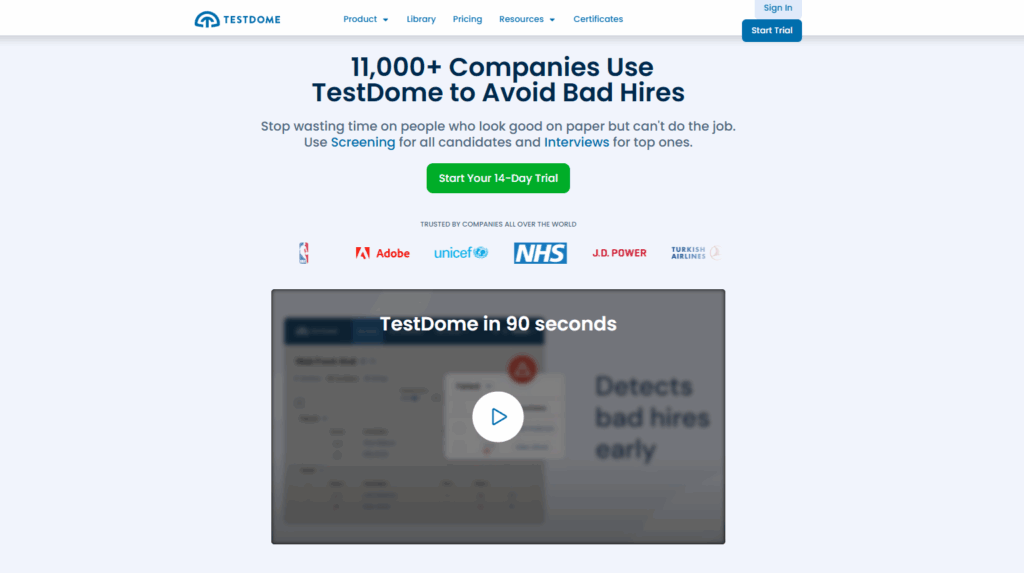
TestDome is a skills assessment platform focused on helping recruiters identify candidates with work-sample tests rather than theoretical quizzes or timed challenges.
Features
- Work-sample testing: Candidates are evaluated using realistic tasks that mirror what they would actually do on the job.
- Library of 150+ pre-built tests: Covers roles across software development, accounting, customer service, data entry, and more. Tests are short and designed to filter out unqualified applicants quickly.
- Custom question creation: Build your own tasks or mix them with TestDome's library. You can test specific coding languages, logic, writing, or numerical reasoning.
- Benchmarking and analytics: Compare candidate performance side-by-side with visual scorecards, percentile rankings, and pass/fail indicators.
Pricing: TestDome pricing is subscription-based, with plans starting at around $199/month for unlimited candidates and tests. Discounted annual plans are available for organizations that prefer yearly billing.
10. Hiremojo
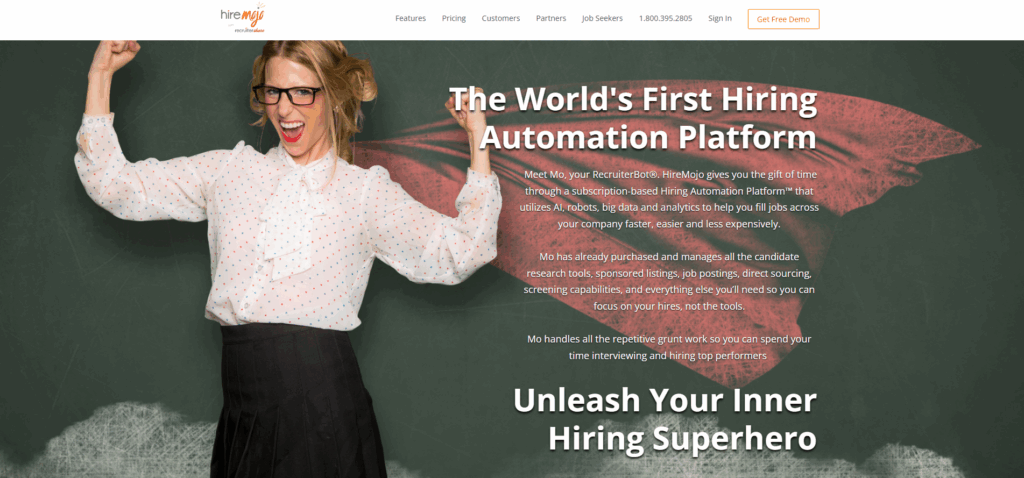
Hiremojo positions itself as a hiring automation platform. It handles job descriptions, job posting, applicant pre-screening, interview scheduling, and candidate communications, which reduces manual work for small HR teams.
Features
- Automated job posting: Creates and distributes job openings across multiple job boards to attract a broad pool of candidates without manual effort.
- Candidate pre-screen and scoring: Uses a patented online interview and screening process to pre-screen applicants. It scores and ranks candidates based on their responses to custom interview questions.
- Job and interview content library: Ready-to-use templates for job descriptions and interview questions, which can be customized.
- Candidate management: A built-in applicant tracking interface to view resumes, track pipeline stages, add notes, schedule interviews, and send automated thank-you or rejection emails.
Pricing: HireMojo does not publicly disclose pricing. Companies need to contact their sales team for a custom quote based on size, hiring volume, and features needed.
11. HackerEarth
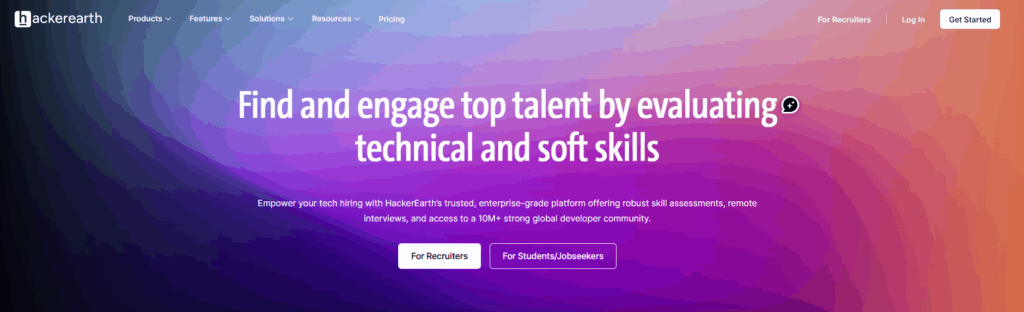
HackerEarth is an AI-powered tech hiring platform built for developer assessments, covering entry-level coding tests through advanced technical interviews.
Features
- Technical test library: A library of 25,000+ questions across 25+ skill areas, including multiple choice, project-based, and data science questions.
- Advanced proctoring: AI-powered webcam monitoring and plagiarism detection protect the integrity of assessments.
- FaceCode interviews: Live coding interviews with a built-in IDE, whiteboard, and video chat to mimic an in-person technical screen.
- Analytics and skill reports: Detailed skill-based performance reports and AI-generated summaries covering technical performance and behavioral insights.
Pricing: Plans start at $99 per month, with higher tiers available for larger teams and more advanced hiring needs.
12. HackerRank
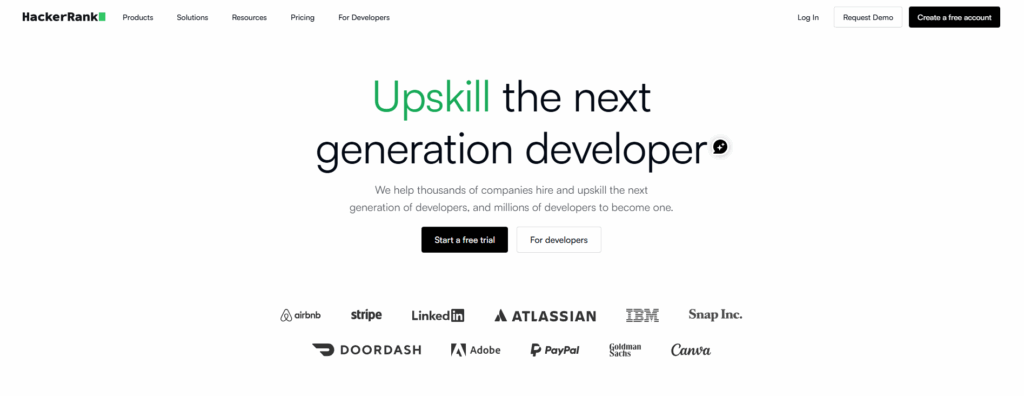
HackerRank is a developer assessment platform and competitive coding hub that has been on the market for over a decade. Organizations use it to create and administer skill-based coding tests and conduct technical interviews at scale.
Features
- Vast coding library: Over 7,500 coding and technical questions across 45+ programming languages, including algorithmic challenges, debugging exercises, and domain-specific problems.
- End-to-end hiring tools: Supports the full developer hiring workflow, from automated coding assessments to a live pair-programming interview platform and take-home projects.
- Fair and secure assessments: Plagiarism detection, IP tracking, and time violation alerts support a fair testing environment.
- Enterprise integrations: Integrates with major applicant tracking systems and other HR tools.
Pricing: Usage-based. The Starter plan begins at roughly $198/month, with higher tiers and enterprise licensing available.
13. TestInvite
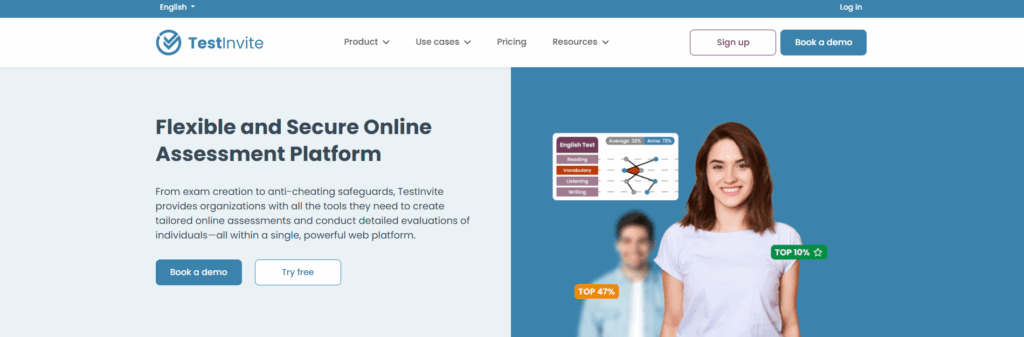
TestInvite is online exam and assessment software built for secure, highly customizable testing across corporate hiring, educational exams, and professional certification.
Features
- Custom test creation: A flexible test builder with a wide variety of custom question types, suited to organizations that want granular control over test design.
- Assessment library: A library of pre-built tests covering common skills like problem-solving, communication, and role-specific competencies.
- Advanced reporting: Modify scoring logic, derive new metrics, compare results against benchmarks or norms, categorize scores, and add textual interpretations for score ranges.
- Anti-cheating and proctoring measures: Lockdown browsers, AI-driven cheating detection, and question randomization.
Pricing: Starts at around $37 per month for the Starter tier. Higher tiers with more features and capacity are available.
14. eSkill
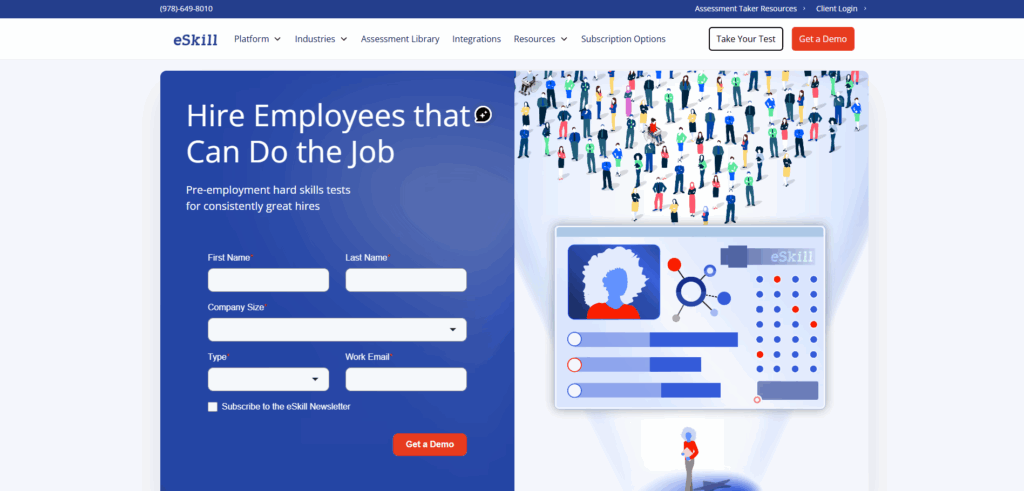
eSkill is a long-established pre-employment testing platform known for the variety of its skills tests. It offers a library of ready-made assessments and tools for creating custom ones.
Features
- Extensive test library: Over 600 ready-to-use tests. Users can also build custom assessments from thousands of questions covering specific subjects, topics, or software tools.
- Job simulations: Interactive simulations that evaluate how candidates perform in real-world job scenarios.
- Anti-cheating and advanced proctoring: Monitors behaviors such as copy-pasting and tab switching, flagging suspicious activity in real time.
- Reporting and analytics: Detailed candidate reports, including overall scores and performance breakdowns by subject or question.
Pricing: eSkill does not disclose pricing publicly. Recruiters need to contact the sales team for a custom quote.
15. Canditech
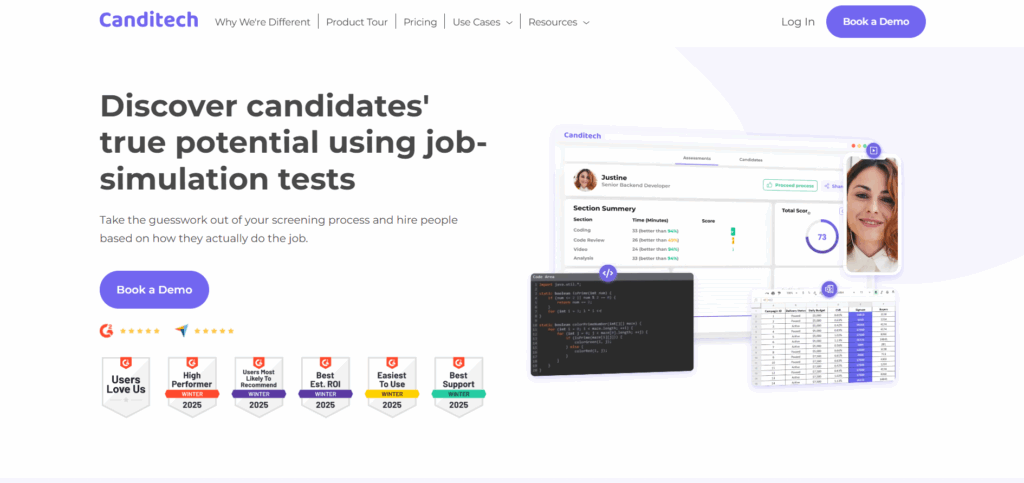
Canditech is a newer entrant in the skills assessment space. The platform specializes in job simulation assessments, letting employers evaluate candidates through realistic work scenarios rather than standard quizzes.
Features
- Custom and expert-built tests: Build your own assessments or use Canditech's library of 500+ expert-designed tests.
- Realistic job simulations: Work-sample tasks such as writing code, analyzing data in a spreadsheet, drafting an email response, or handling a mock situation relevant to the job.
- Automated scoring: Grades and ranks candidates on simulation performance, so every candidate is measured by the same criteria.
- Benchmarking analytics: Score benchmarks that compare candidate results against industry standards or predefined job-specific benchmarks.
Pricing: Team plan starts at $150/month for 100 candidates.
Which is the best Cangrade alternative?
It depends on what you are replacing. If the gap is behavioral prediction at high volume, the psychometric specialists on this list are the closer match. If the gap is technical depth, the coding platforms will beat a general tool on developer hiring alone.
For most teams leaving Cangrade, though, the gap is narrower than that: they want to see evidence of the work, they want the interviewing in the same tool, and they want to know the price before they book a call. On those three, Testlify is the strongest fit on this list. It runs coding, spreadsheet and typing work samples alongside cognitive and psychometric tests, it does one-way and conversational AI video interviews natively, and it prices in public from $139 a month.
Two honest caveats. Testlify is not the deepest pure-play coding platform on this page, so a company hiring only senior engineers should look hard at the specialists. And if your entire case for assessment rests on predicting tenure from personality data against your own performance history, that is the thing Cangrade was built to do, and switching for its own sake will not help you.
If you want to see how the wider category compares, the assessment tool comparison hub covers the same criteria across other platforms, and the coding assessment tests and ATS integration pages go deeper on the two areas most switching teams ask about first.
Pro tip: run a two-week bake-off before you sign anything
Pick one role you are actually hiring for. Send the same five candidates through two tools in the same week. Then compare three things: how many finished, how long scoring took you, and whether the two shortlists agree. Disagreement is the interesting part, because it shows you what each tool is really measuring. Most teams learn more from those two weeks than from six vendor demos, and it costs one trial each.
Try it on a real role this week
The fastest way to settle a screening-tool argument is to run one. Testlify's free trial lasts 7 days and needs no card, which is long enough to build an assessment, send it to live candidates and read the reports. If you would rather be walked through it against your own hiring process first, book a demo with the Testlify team, or read how skills-based hiring changes the shape of a screening funnel before you start.
Key takeaways
- Validity is a property of the method, not the vendor. Structured, scored, job-relevant assessment predicts performance far better than resume review or an unstructured chat, and that holds across every reanalysis of the literature. It matters because it changes the question you ask on a sales call: not "is your tool validated" but "which method does your tool run, and how consistently."
- Quote-only pricing has a real cost. Cangrade publishes nothing, and four of the 15 alternatives below do the same. For a team under 200 people that means a week of delay and no way to benchmark. Treat a published price as a feature, and shortlist accordingly.
- Trait prediction and work samples answer different questions. One tells you who tends to succeed in a role; the other tells you whether this person can do the task. Decide which one your next hire actually turns on, then buy for that, because a tool built for the other will feel disappointing for reasons nobody can name.
- AI scoring now carries paperwork. New York City wants a bias audit within the past year and 10 business days of candidate notice, Colorado wants reasonable care and a human appeal route from February 2026, and the EU classes recruitment AI as high-risk. Ask for the audit summary during evaluation, not after your first complaint.
- A human override is the control that matters. Consistent scoring is good; automatic rejection is a liability. Check that a person can change an outcome and that the change is recorded, because that log is what you will be asked for.
- Pilot before you commit. Two tools, one real role, five real candidates, two weeks. Nothing in a demo tells you what completion rate and shortlist disagreement will tell you, and both are free to measure.
FAQs

Director of Marketing
Akash Patange is the Director of Marketing at Testlify, where he works closely with HR leaders and recruiters to help organizations improve hiring outcomes. He writes about talent assessment, recruitment technology, and data-driven hiring practices.
LinkedInRelated resources
View all
Alternatives
Top 15 Test Partnership Alternatives and Competitors
Alternatives
Top 15 Alva Labs Alternatives and Competitors
Alternatives
Top 15 Pixonality Alternatives and Competitors
Alternatives
Top 15 Perspect AI Alternatives and Competitors
Alternatives
Top 15 Evalgator Alternatives and Competitors
Alternatives
Top 15 Peoplogica Skills Alternatives and Competitors
Get started.
Hire on proof, not resumes.
Run your first skills-based assessment free — no credit card required.