
Top 15 Harver Alternatives and Competitors
Discover 15 powerful Harver Alternatives to streamline your hiring process and assess candidates with confidence.
Pre-employment testing platforms have become essential in modern recruitment, helping organizations efficiently evaluate candidates’ skills and reduce hiring biases.
Harver is a predictive hiring platform built for high-volume recruitment. It combines validated assessments with intelligent matching to help organizations quickly identify top-fit candidates. Harver emphasizes a science-backed approach: for instance, it offers a library of 900+ ready-made job profiles covering common roles in industries like BPO, retail, tech, and more.
However, it is not a one-size-fits-all solution. Depending on specific needs such as a more diverse test library, AI-driven candidate engagement, or different pricing models other platforms can be equally effective or even superior in certain respects.
In this article, we’ll explore the top 15 Harver alternatives, comparing their features, G2 ratings, and pricing to help you make an informed decision.
 ChatGPT
 Gemini
 Claude
 Grok
Grok Perplexity
Testlify
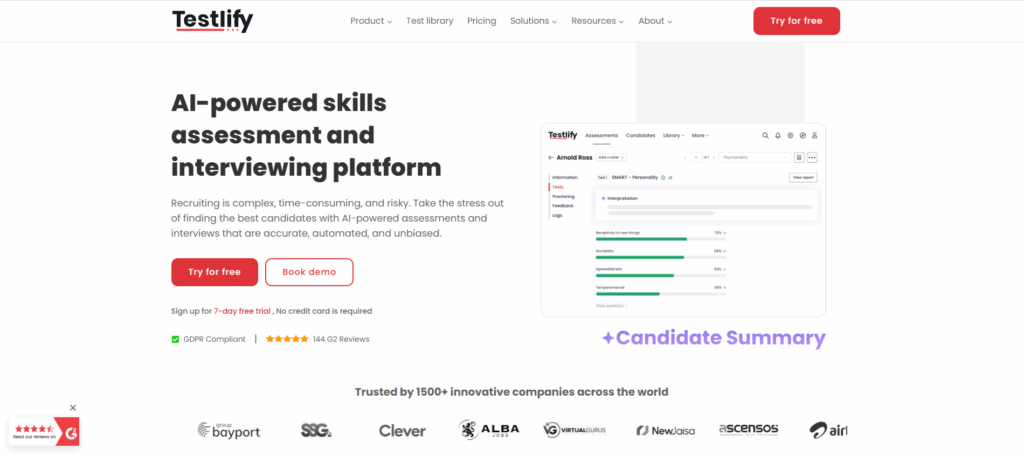
Testlify is an AI-native skills assessment and interviewing platform that helps organizations evaluate candidates against job-relevant skills rather than rely solely on resumes and interviews. With 3,500+ role-specific tests across 50+ industries, 15+ question types, AI-powered interviews, and advanced proctoring, Testlify enables hiring teams to screen candidates faster and identify top talent at scale.
Features
- Extensive test library: Offers 3,500+ ready-to-use tests that cover all popular programming languages, software engineering frameworks, databases, DevOps, finance, accounting, cloud, personality & culture, and aptitude skills.
- Conversational AI interviews: Uses conversational AI interviewers to simulate on-the-job scenarios across chat, voice, and video formats to provide a realistic, engaging candidate experience.
- AI-driven insights: Automatically generate concise summaries of each candidate’s performance, highlighting strengths and areas for improvement.
- ATS integrations: Supports 100+ applicant tracking system integrations to streamline recruitment workflows.
- Anti-cheating & proctoring: Features like dual webcam monitoring, randomized questions, and browser lockdown ensure test integrity and prevent cheating.
G2 Rating: 4.7
Testlify pricing
Testlify offers flexible pricing plans that scale with your business, providing everything from basic assessments for startups to advanced features for enterprise-level hiring.
- Starter plan: Ideal for small teams and startups, this plan starts at $139/month (billed at $1,663/year) and includes 100 candidate credits at $17 per credit with support for 3 users.
- Starter: Designed for growing businesses, the Starter starts at $279/month (billed at $3,343/year) and includes 300 credits at $11 per credit with support for 5 users.
- Starter: Built for scaling teams, this plan costs $699/month (billed at $4,192/year) and includes 1,000 credits at $8 per credit with 10 users.
- Premium plan: Suited for high-growth organizations, the Premium plan includes 3,000 credits and supports 20 users, with pricing available upon contacting the sales team.
- Enterprise plan: Designed for large enterprises, this plan includes 10,000 credits and supports 30 users, with pricing available upon contacting the sales team.
- Enterprise plus plan: Designed for large-scale hiring programs, this plan includes 25,000 credits and supports up to 40 users, with pricing details available upon contacting the sales team.
- Unlimited plan: For companies seeking unrestricted access, Testlify offers an unlimited plan that includes unlimited candidate credits and full platform functionality, with pricing available on request from the sales team.
2. Test Partnership
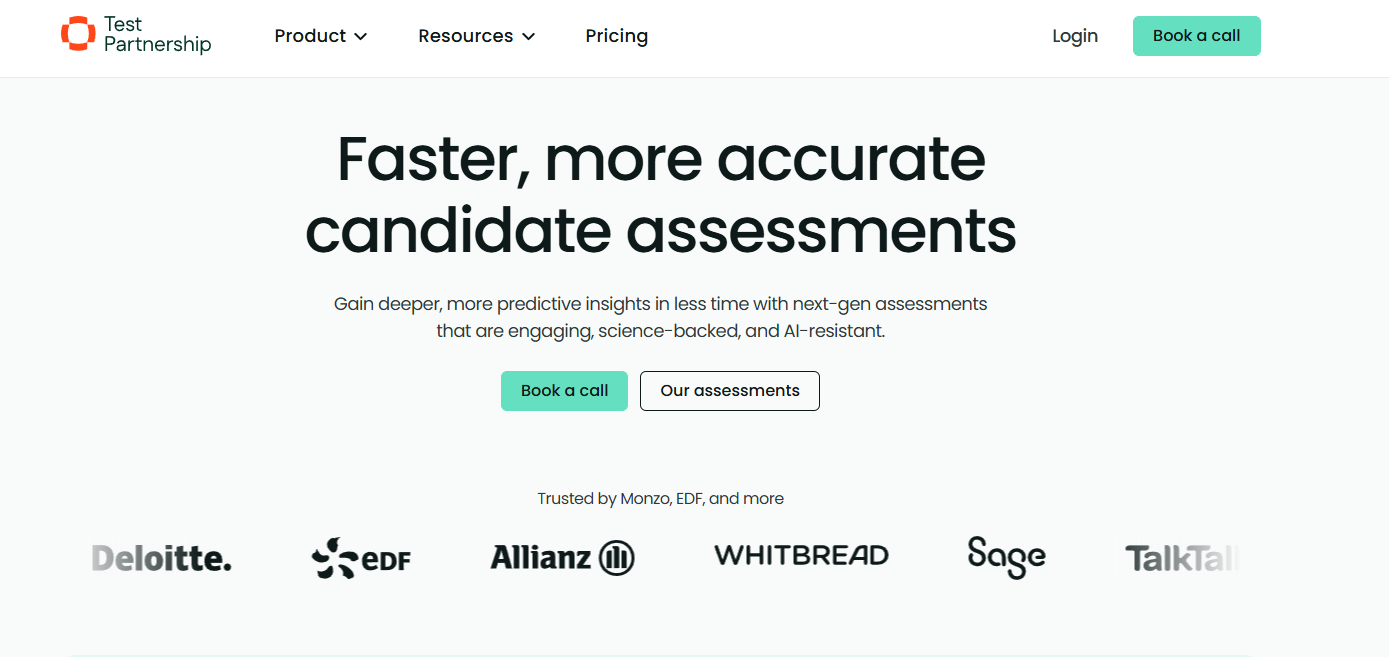
Test Partnership is a psychometric assessment provider focused on aptitude, personality and situational judgment testing. It sells to SMEs, graduate programs, and volume hiring teams, and it backs the tests with business psychologists who help set cut scores and run validity studies.
Key features
- Aptitude tests: numerical, verbal, and inductive reasoning, critical thinking, data analysis and mechanical reasoning, plus the MindmetriQ game series, built to resist AI assistance.
- Behavioral assessments: situational judgment tests, personality questionnaires, emotional intelligence, learning agility, strengths and soft skills assessments.
- Office skills tests: MS Excel and Word tests for admin and operations roles.
- Volume tooling: bulk CSV invites, a public link candidates use to register themselves, automatic reminders and automatic pass or fail emails based on your score criteria.
- Cheat detection: flags assistive tools, window switching, and unusual timestamps, and logs device activity. Short in-person verification tests are available as an add-on.
- Accessibility: screen reader support, up to 100% extra time, color blind safe design, and options for neurodiverse candidates.
- Custom psychometrics: bespoke tests, custom norm groups and validity studies built by business psychologists, all sold as paid add-ons.
G2 rating: 4.6/5
Pricing
Custom quote only. The pricing page routes to a short call that covers three things: your annual assessment volume, whether pay-as-you-go or an unlimited licence fits, and which add-ons you need.
Alva Labs
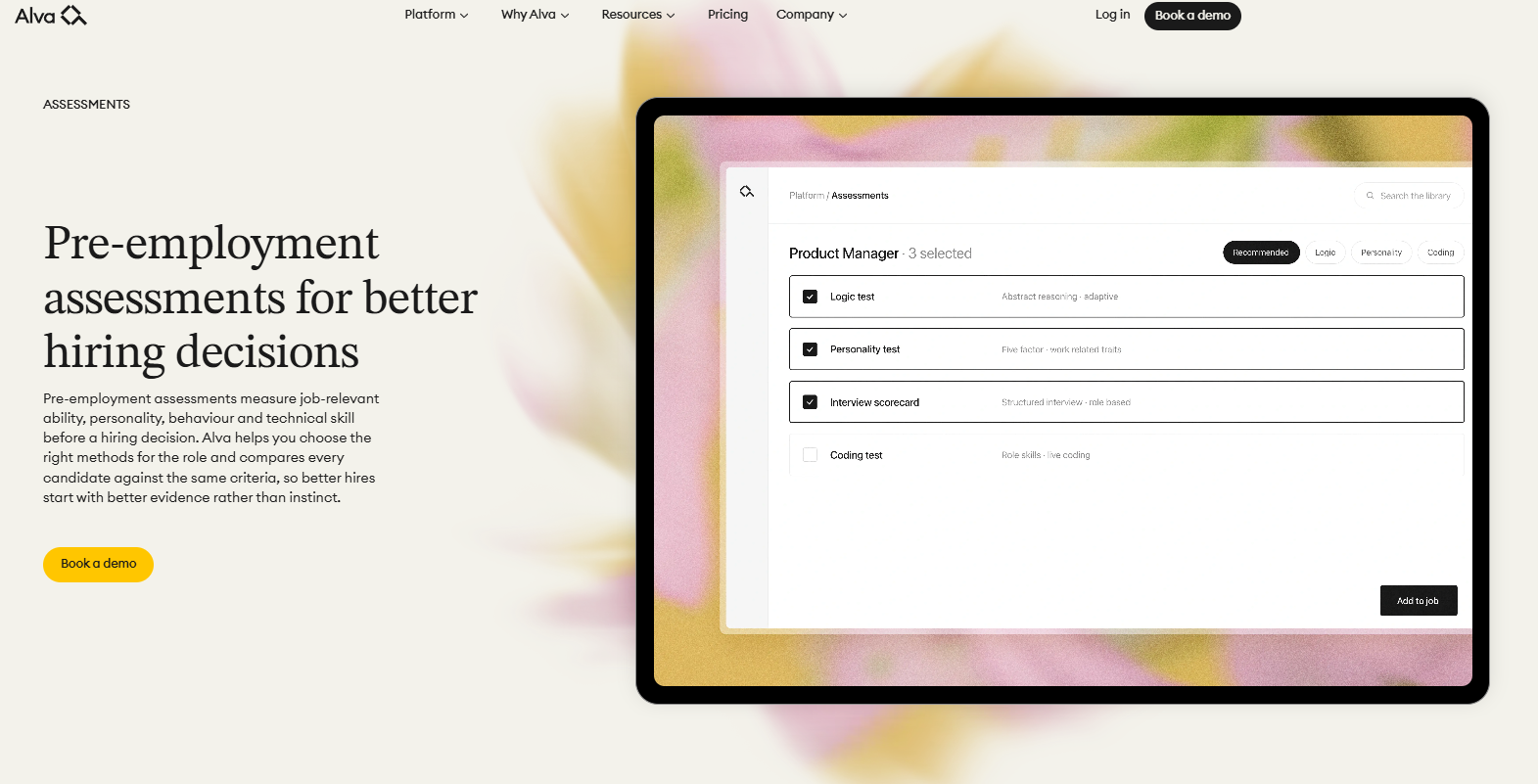
Alva Labs is a psychometric assessment and hiring platform built around a logic test and a personality test, calibrated on 1.5 million candidates. You can run its assessments inside your existing ATS or move the whole process into its own hiring system. It charges per hire rather than per candidate, so testing every applicant costs nothing extra.
Key features
- Core psychometrics: logic and personality tests, a coding test, a leadership report, and deep insights reports on the base psychometrics level.
- Role fit scoring: role fit scores and structured interview kits built from each candidate's results, on the agentic psychometrics level.
- AI agent: interprets results, answers questions about specific traits, and drafts interview material. Everything it produces can be reviewed and edited before anyone relies on it.
- Hiring system option: an optional agentic hiring system that replaces your ATS. It covers the career page, job boards, sourcing and CV screening, interview scheduling and transcription, transcripts scored against the role criteria, and candidate communication.
- Integrations: ATS integrations on every level, plus HRIS integrations on the full hiring system.
G2 rating: 4.7/5
Pricing
Per hire, billed in arrears, at a rate set by your annual hiring volume tier (grow, scale, or enterprise).

Vervoe
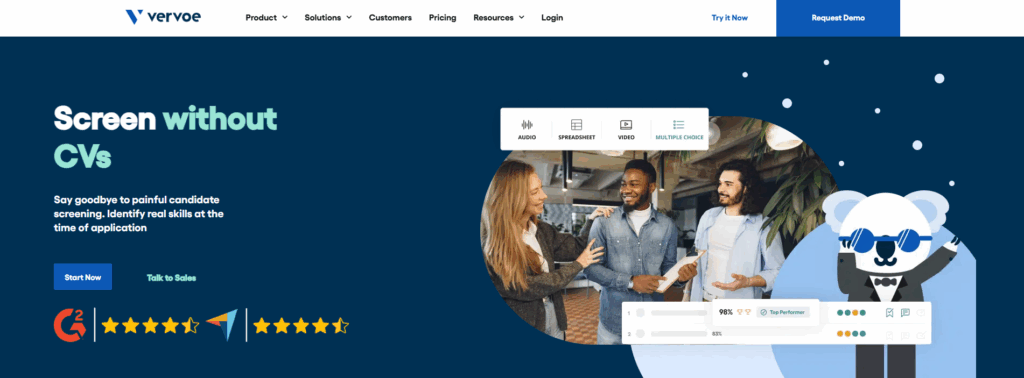
Vervoe is a platform whose mission is to make hiring about merit rather than resumes. It allows employers to see candidates perform job-related tasks and uses AI to automatically grade and rank their responses.
Vervoe’s assessments cover technical, soft, and even creative skills, with an emphasis on real-world exercises that let every candidate showcase their talent in practical scenarios.
Features
- Job simulation tests: Over 300 ready-made assessments across various roles and industries, emphasizing real job tasks to evaluate merit.
- Custom questions & formats: Ability to add your own questions in multiple formats (multiple-choice, free text, video responses, spreadsheets, etc.) for tailored assessments.
- AI grading: Automatically evaluates and ranks candidate responses using machine learning, helping recruiters efficiently identify top performers.
- Anti-cheating measures: Incorporates features like plagiarism detection, time-limited questions, and other proctoring tools to ensure assessment integrity.
G2 Rating: 4.6/5
Pricing: Vervoe uses a pay-as-you-go model, which is ideal for organizations with seasonal or flexible hiring needs. The entry plan starts at $300 per year for 10 candidates, with the option to purchase additional candidate credits as needed.
Codility
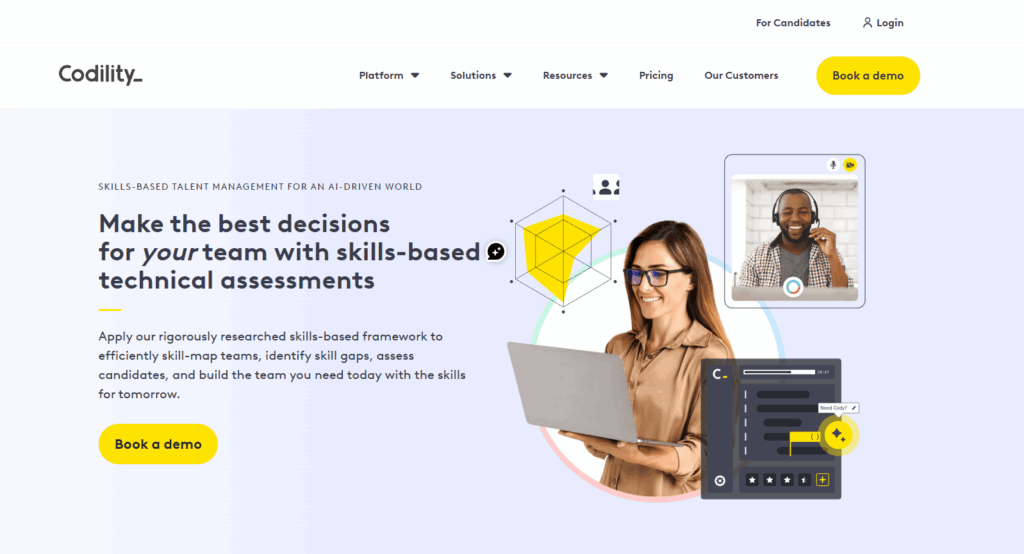
Codility is an online coding test and interview platform widely used by enterprises to assess and validate the skills of tech talent. It offers a comprehensive suite for coding tests, live technical interviews, and even training modules.
By focusing on objective, skill-based evaluations, Codility helps teams make evidence-based hiring decisions while reducing bias and saving engineering time.
Features
- Extensive test library: A library of 1,100+ coding and technical challenges spanning dozens of programming languages, covering a broad range of technical skills.
- Live technical interviews: Tools for real-time coding interviews, including a collaborative pair-programming interface and automated code evaluation to facilitate interactive candidate assessments.
- Enterprise-grade platform: Robust anti-plagiarism features, ATS integrations, and detailed performance reporting, suitable for large organizations with high standards for security and analytics.
- Bias mitigation & analytics: Standardized scoring and analytics to compare candidates objectively, helping reduce unconscious bias in technical hiring.
G2 Rating: 4.6/5
Pricing: Codility is sold in tiered packages. The Starter plan is priced at around $1,200/year, the Scale plan at $6,000/year, and enterprise customers can obtain custom pricing for broader usage and additional features.
Mercer Mettl
Mercer | Mettl (often referred to simply as Mettl) is a comprehensive online assessment platform providing a suite of tests for technical, cognitive, behavioral, and psychometric evaluation. Backed by the global consulting firm Mercer, Mettl is known for its research-based assessments and secure proctoring capabilities.
Features
- Wide range of tests: Supports assessments for over 200 job roles and experience levels, including domain-specific exams, IT and coding tests, as well as aptitude and language tests.
- Advanced proctoring measures: Offers AI-powered proctoring tools (webcam monitoring, browser lockdown) and options for human proctoring to ensure assessment integrity and prevent cheating.
- Customization and branding: Allows organizations to brand the test environment with their logo, custom themes, or even conduct assessments on a custom subdomain. This creates a seamless and professional candidate experience.
- Detailed reporting analytics: Delivers in-depth competency reports, percentile benchmarks, and even hiring recommendations to help interpret candidate results.
G2 Rating: 4.4/5
Pricing: Mercer Mettl’s pricing is customized. Organizations need to contact Mettl for a quote, as costs depend on the number of tests, candidates, and features.
Hirevue
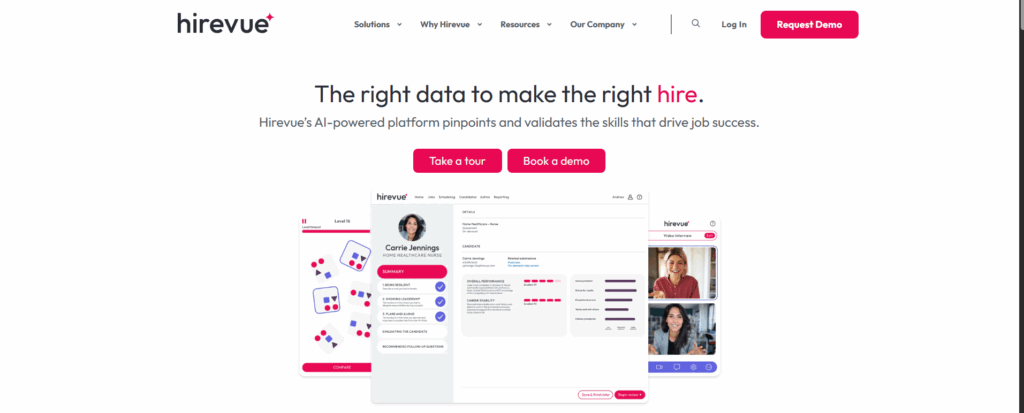
HireVue is a pioneer in digital interviewing that has expanded into the assessment arena. It offers a platform combining on-demand video interviewing with AI-driven and game-based assessments.
Enterprises worldwide use HireVue to streamline high-volume hiring through one-way video interviews, coding challenges, and even gamified tests that measure cognitive abilities and personality traits.
Features
- I/O science-based content: Provides a library of validated, role-specific interview questions and assessment content developed by industrial-organizational psychologists to ensure reliability and fairness.
- Video interviews (on-demand & live): Supports one-way recorded video interviews as well as live video interview sessions. The platform can use AI to analyze candidates’ verbal responses and non-verbal cues (such as tone and facial expression) and apply structured scoring rubrics.
- Gamified assessments: Includes AI-scored game-based assessments that evaluate skills like problem-solving, communication, and even coding through engaging, game-like challenges.
- Automation & scheduling: Automates many recruiting tasks – it can auto-schedule interviews, engage candidates with chatbots for FAQs or next steps, and integrates with ATS platforms to synchronize candidate data and status.
G2 Rating: 4.1/5
Pricing: The company offers three tiered plans. However interested customers need to contact HireVue’s sales team or book a demo to get specific pricing details for their organization.
TestDome
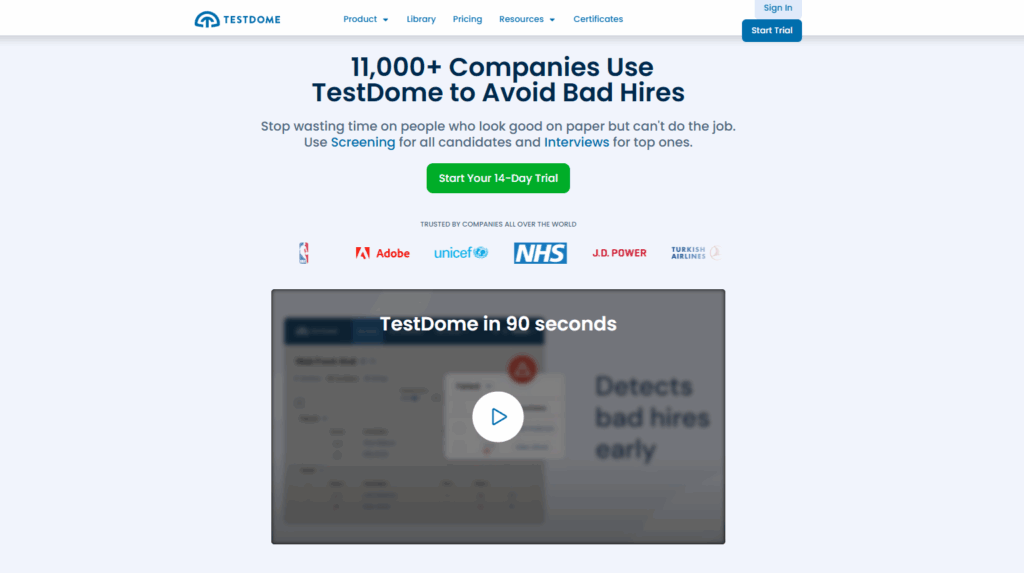
TestDome is a skills testing platform focused on work-sample assessments. Unlike trivia or theoretical quizzes, TestDome provides over 150 pre-made tests that require applicants to perform tasks closely mirroring real job work.
These tests span domains from programming and IT to accounting, customer service, and more, allowing employers to see how candidates might actually perform in the role.
Features
- Work-sample tests: Real-world tasks and scenarios are at the core of TestDome’s assessments. For example, coding challenges, data entry exercises, or customer support simulations that reflect on-the-job duties.
- 150+ pre-built tests: Cover roles across software development, accounting, customer service, data entry, and more. Tests are short, effective, and designed to filter out unqualified applicants quickly.
- Anti-cheating measures: Includes basic proctoring options such as webcam monitoring and screen recording to deter and detect cheating during tests.
- Benchmarking analytics: Provides side-by-side comparisons of candidates’ test scores and performance, helping recruiters easily identify top performers based on objective data.
G2 Rating: 4.5/5
Pricing: Operates on a pay-per-candidate model. Larger packages or enterprise arrangements are also available for high-volume hiring needs.
Coderbyte
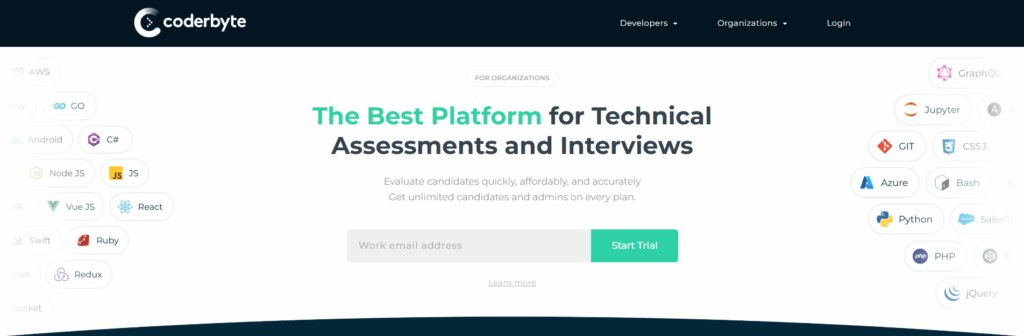
Coderbyte is a technical assessment platform primarily geared towards startups and mid-sized companies for hiring developers and data scientists. It enables unlimited coding tests, technical screening challenges, and even take-home project evaluations on a subscription basis, making it a cost-effective choice for growing teams.
Features
- Extensive coding challenges: Offers a library of 1,000+ coding challenges across 30+ programming languages and over 100 different technical skills. You can also include full project-based exercises to thoroughly vet candidates.
- Multiple question types: Supports various question formats including not only coding tasks but also multiple-choice questions, open-ended written responses, and SQL/database queries for comprehensive technical screening.
- Integrated interview tools: Provides a built-in platform for live technical interviews with features like video conferencing, a collaborative real-time code editor, support for Jupyter notebooks and spreadsheets, and a virtual whiteboard for system design or diagramming.
- Detailed reporting: Generates in-depth reports for each assessment and interview, including the candidate’s code submissions, replayable coding session recordings, automated scorecards, skill ratings, and internal benchmarking charts to compare candidates.
G2 Rating: 4.4/5
Pricing: Coderbyte pricing is subscription-based. Plans start at around $199/month, which allows unlimited candidates and tests. (Discounted annual plans are available for organizations that prefer yearly billing.)
Hiremojo
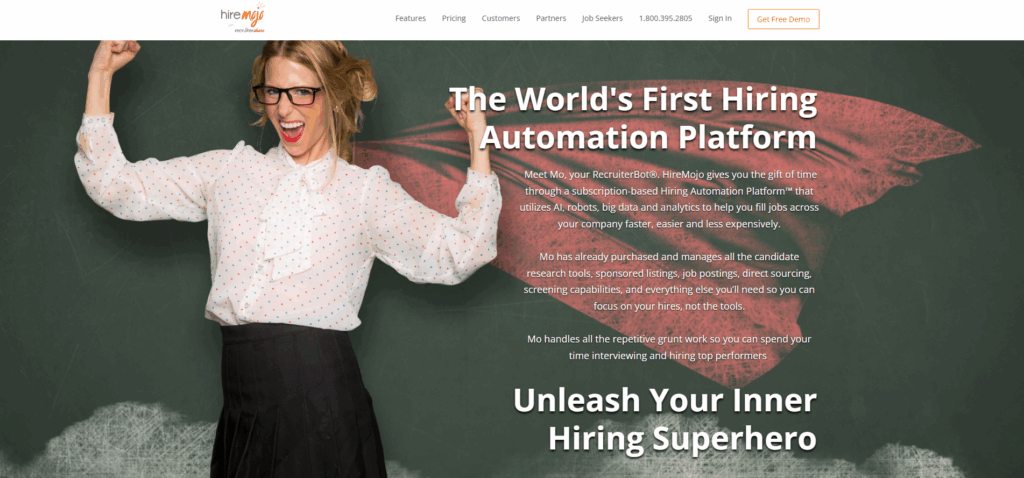
HireMojo positions itself as the industry’s first hiring automation platform, aiming to automate the entire recruitment process. It handles everything from writing job descriptions and posting jobs to pre-screening applicants, scheduling interviews, and managing communications, thereby reducing the manual workload on HR teams.
Features
- Automated job posting: Helps create and distribute job openings across multiple job boards and platforms to attract a broad pool of candidates without manual effort.
- Candidate pre-screen & scoring: Uses a patented online interview and screening process to automatically pre-screen applicants. It scores and ranks candidates based on their responses to custom interview questions, so you can quickly focus on the most qualified individuals.
- Job & interview content library: Provides ready-to-use templates for job descriptions and interview questions. This content is designed by experts and can be customized, enabling organizations to quickly set up effective job postings and consistent interview processes.
- Candidate management: A built-in applicant tracking interface to easily view resumes, track candidate pipeline stages, add notes, schedule interviews, and even send automated “Thank you” or rejection emails to close the loop with applicants.
G2 Rating: 4.5/5
Pricing: HireMojo does not publicly disclose pricing. Interested companies need to contact their sales team for a custom quote. Pricing is likely tailored to the organization’s size, hiring volume, and specific features needed.
HackerEarth
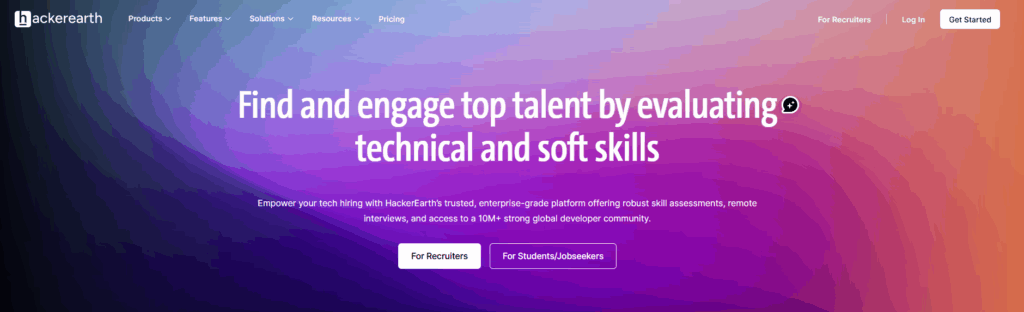
HackerEarth is an AI-powered tech hiring platform that provides a suite of tools for screening and hiring software developers. It supports everything from standardized coding assessments and competitive hackathons to remote pair-programming interviews.
Features
- Comprehensive question library: Over 25,000 questions across 25+ categories (including multiple-choice, coding challenges, project-based exercises, data science problems, etc.), enabling creation of highly tailored tests for any tech role.
- Advanced proctoring: Utilizes AI-driven proctoring measures such as webcam monitoring, live candidate authentication, plagiarism detection, and environment checks to ensure the integrity of each assessment.
- Live coding interviews (FaceCode): An interactive live coding interview tool with a collaborative code editor, built-in question library, HD video chat, and a virtual whiteboard for on-the-spot problem-solving.
- Analytics & skill reports: Provides detailed skill-based performance reports and even AI-generated summaries that highlight each candidate’s coding proficiency and behavioral insights from the interview.
G2 Rating: 4.5/5
Pricing: HackerEarth offers scalable plans designed to grow with your business. Pricing starts at $99 per month for the Starter. Higher-tier plans with expanded features are available for larger teams
HackerRank
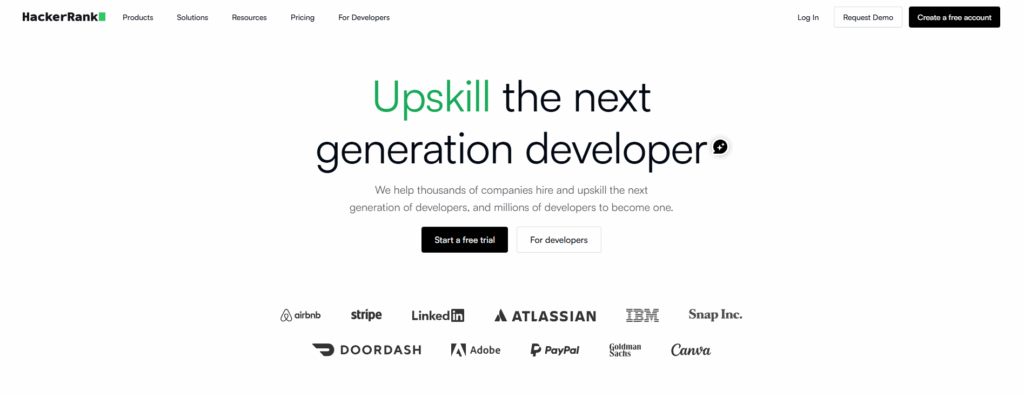
HackerRank is a veteran developer assessment platform and competitive coding hub that has been on the market for over a decade. It enables organizations to create and administer skill-based coding tests and conduct technical interviews, helping them efficiently screen and hire qualified developers at scale.
Features
- Vast coding library: Offers over 7,500 coding and technical questions across 45+ programming languages. These include algorithmic challenges, debugging exercises, and domain-specific problems, providing ample content for evaluating candidates’ coding skills.
- End-to-end hiring tools: Supports the full developer hiring workflow, from automated coding assessments for initial screening to a live pair-programming interview platform and even take-home projects, all within one ecosystem.
- Fair and secure assessments: Leverages robust proctoring and candidate monitoring features (such as plagiarism detection, IP tracking, and time violation alerts) to ensure a fair testing environment where each candidate has an equal opportunity to perform.
- Enterprise integrations: Seamlessly integrates with major Applicant Tracking Systems and other HR tools, allowing companies to incorporate HackerRank into their existing recruiting tech stack without disruption.
G2 Rating: 4.5/5
Pricing: HackerRank uses a flexible, usage-based pricing model. The Starter plan begins at roughly $198/monthnth, with higher-tier plans and enterprise licensing available to accommodate larger hiring needs and additional features.
TestInvite
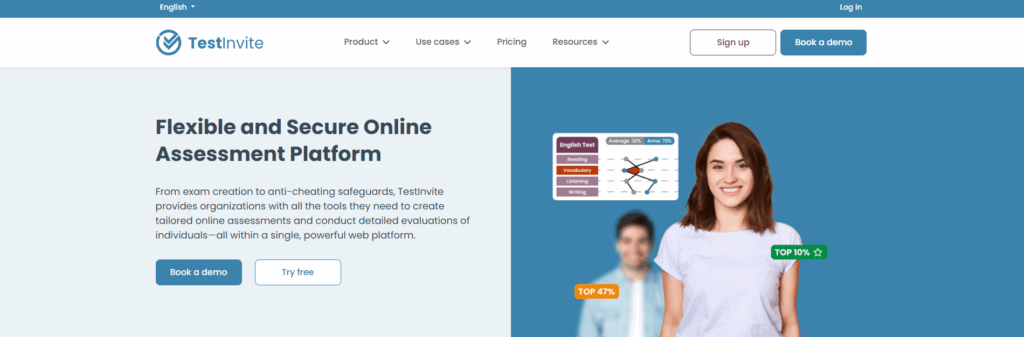
TestInvite is a comprehensive online exam and assessment software built to facilitate secure, highly customizable testing for a variety of purposes, including corporate hiring, educational exams, and professional certification.
Features
- Custom test creation: Offers a highly flexible test builder supporting a wide variety of question types, giving organizations granular control over the content and structure of their assessments.
- Assessment library: In addition to custom tests, users can leverage a library of pre-built tests to evaluate candidates on common skills like problem-solving, communication, and other role-specific competencies.
- Advanced reporting: Allows administrators to modify scoring logic and derive custom metrics in candidate reports. Users can compare results against established benchmarks or norms, categorize scores into defined ranges, and add narrative interpretations for those ranges, yielding richer insights.
- Secure proctoring: Incorporates a comprehensive set of anti-cheating measures, including a lockdown browser mode, AI-driven cheating detection (e.g. for suspicious behavior or multiple people), and randomization of questions, all designed to ensure the integrity of each assessment.
G2 Rating: 4.7/5
Pricing: Starts at around $37 per month for the Starter. Higher-tier plans with more features and greater capacity are available at increased price points.
eSkill
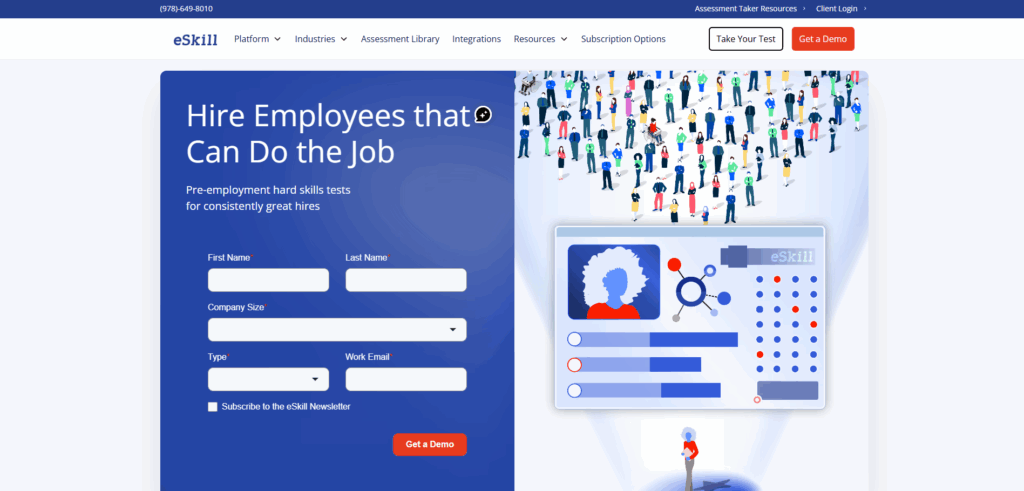
eSkill is a long-established pre-employment testing platform known for its vast variety of skills tests. It offers both an extensive library of ready-made assessments and tools for creating custom tests.
Features
- Extensive test library: Provides over 600 ready-to-use tests. Users can also create custom assessments by choosing from thousands of questions covering specific subjects, topics, or software tools to match the exact requirements of a job role.
- Job simulations: Goes beyond standard Q&A formats by offering interactive simulations that evaluate how candidates perform in real-world job scenarios (for example, simulating a customer service call, data entry task, or IT troubleshooting exercise).
- Advanced proctoring: Implements strong anti-cheating measures to maintain test integrity. This includes monitoring for behaviors like copy-pasting, excessive window switching, or irregular response patterns, and automatically flagging suspicious activities in real time.
- Detailed analytics: Delivers comprehensive candidate reports that include overall scores and performance breakdowns by subject area or question type. These analytics help hiring managers quickly identify each applicant’s strengths and weaknesses relative to the job’s requirements.
G2 Rating: 4.5/5
Pricing: eSkill does not publicly list pricing. Interested organizations need to contact eSkill’s sales team to obtain a custom pricing quote based on their testing volume and feature needs.
Canditech
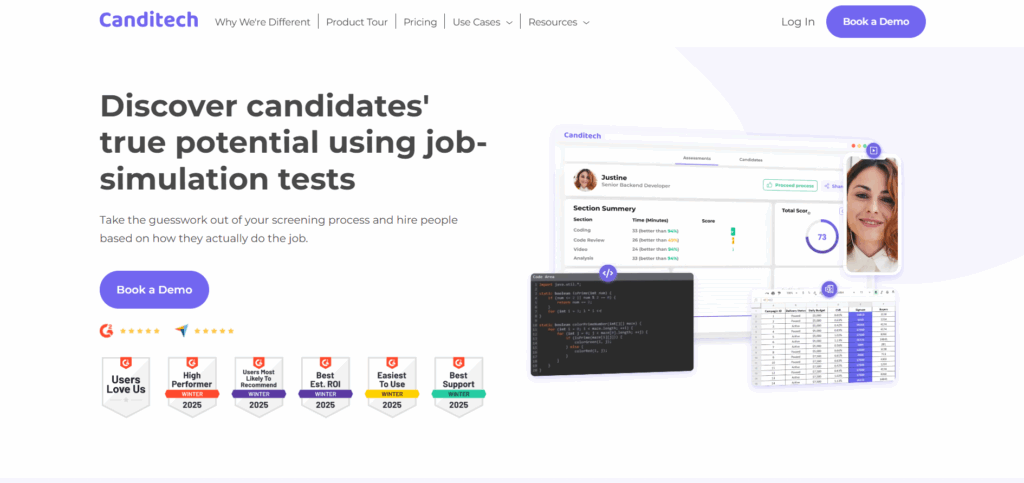
Canditech is a newer entrant in the skills assessment space that has quickly gained acclaim, boasting a perfect 5.0 rating on G2.
The platform specializes in job simulation assessments, enabling employers to evaluate candidates through realistic work scenarios rather than standard quizzes. This approach provides a highly predictive measure of how candidates will perform in actual job tasks.
Features
- Custom & expert-built tests: Build your own customized assessments or leverage Canditech’s library of 500+ expert-designed tests to create the perfect evaluation for your hiring needs.
- Realistic job simulations: Focuses on work-sample tasks and scenarios. Candidates might be asked to write code, analyze data in an Excel spreadsheet, draft an email response, or handle a mock situation relevant to the job.
- Automated scoring: Automatically grades and ranks candidates based on their performance on the simulations. This lets you immediately identify top performers and reduces human bias, since all candidates are measured by the same objective criteria.
- Benchmarking analytics: Offers robust analytics including score benchmarks, allowing your team to compare candidates’ results against industry standards or predefined job-specific benchmarks for additional context.
G2 Rating: 5.0/5
Pricing: Team plan starts at $150/month for 100 candidates
Which is the best Harver alternative?
When considering all these options, Testlify stands out as the top alternative to Harver for both mid-sized companies and large enterprises.
Explore the full comparison in the Testlify vs Harver comparison article
Testlify features an extensive test library (over 3,500 tests), AI-powered candidate evaluations, and conversational AI interviews for creating realistic job simulations at scale. It also supports 100+ ATS integrations out of the box.
Whether you’re looking for pre-employment testing tools or a conversational AI-powered interview platform for high-volume hiring, Testlify excels at delivering everything you need without overwhelming your budget.

Director of Marketing
Akash Patange is the Director of Marketing at Testlify, where he works closely with HR leaders and recruiters to help organizations improve hiring outcomes. He writes about talent assessment, recruitment technology, and data-driven hiring practices.
LinkedInRelated resources
View all
Alternatives
Top 15 Talview Alternatives and Competitors
Alternatives
Top 15 Cangrade Alternatives and Competitors
Alternatives
Top 15 Test Partnership Alternatives and Competitors
Alternatives
Top 15 Alva Labs Alternatives and Competitors
Alternatives
Top 15 Pixonality Alternatives and Competitors
Alternatives
Top 15 Perspect AI Alternatives and Competitors
Get started.
Hire on proof, not resumes.
Run your first skills-based assessment free — no credit card required.