
Testlify vs SHL: A detailed comparison
Discover the perfect solution for evaluating your candidates’ skills with Testlify. Dive into our comprehensive Testlify vs SHL comparison…
SHL competitors fall into three groups: skills-first platforms with published pricing (Testlify is one), volume-hiring engines built around behavioral science (Harver), and psychometric publishers with a consulting layer (Talogy, Hogan, Criteria). Which one beats SHL for you depends on one question: do you need to prove a candidate can do the job, or profile how they are likely to behave?
This comparison starts with Testlify vs SHL head to head, then widens out to the rest of the SHL competitor set, because "shl competitors" and "shl alternatives" are the searches that bring most readers here. You'll get a feature table, a pricing comparison with a real number you can check, two head-to-heads (Harver vs SHL, SHL vs Talogy), and a buying checklist rooted in the selection research rather than vendor claims.
TL;DR
- SHL is the psychometric benchmark for large enterprises: decades of norm data, deep personality and reasoning instruments, and a consulting model priced by quote.
- Testlify is the skills-first alternative: 3,500+ role tests, coding and software simulations, proctoring, and a published Standard plan at $139 a month, so you know the cost before a sales call.
- The best-validated selection tools measure job-relevant skill and structure. Structured interviews (.42) and job knowledge tests (.40) outrank cognitive ability (.31) in the 2022 Sackett reanalysis, which changes how you should weigh a personality-heavy suite.
- Harver wins on high-volume automation; Talogy on consulting-led assessment programs; Testlify on breadth of job-skill evidence per dollar. None of the three is a drop-in SHL clone.
- Cheaper than SHL is easy to find. Cheaper and still defensible under the EEOC four-fifths rule takes a validation plan, whichever vendor you pick.
 ChatGPT
 Gemini
 Claude
 Grok
Grok Perplexity
Who are the top SHL competitors?
The top SHL competitors are Testlify, Harver, Talogy, Criteria, Hogan Assessments, and Test Partnership. Testlify competes on job-skills breadth and transparent pricing, Harver on volume-hiring automation, Talogy and Hogan on consulting-led psychometrics, and Criteria and Test Partnership on lighter cognitive and personality batteries for mid-market teams. Each covers a different slice of what SHL sells as one enterprise bundle.
That last point matters more than any feature grid. SHL sells an integrated suite: reasoning tests, the OPQ personality questionnaire, situational judgment, video interviewing, assessment centers, and the consultants who design a program around them. Almost nobody else sells all of that. So "SHL competitor" really means "the vendor that does the part of SHL you actually use, better or cheaper." Start by naming that part.
Vendor | Where it competes with SHL | Pricing model | Best fit |
|---|---|---|---|
Testlify | Role-specific skills tests, coding and software simulations, cognitive and personality tests, proctoring, AI interviews | Published plans plus custom enterprise quotes | Teams that need proof of job skill across many roles |
Harver | Volume screening, behavioral and game-based assessment (added pymetrics in 2022), scheduling automation | Quote on request | Hourly and frontline hiring at scale |
Talogy | Psychometric batteries, leadership assessment, consulting-designed programs (formerly PSI and Cubiks) | Quote on request | Enterprises that want a consulting partner |
Criteria | Cognitive aptitude and personality batteries for general roles | Quote on request | Mid-market general hiring |
Hogan Assessments | Personality-based leadership and derailer profiling | Quote on request, certification-based | Executive and leadership selection |
Test Partnership | Cognitive and personality tests aimed at cost-conscious buyers | Published tiers | Smaller teams that mainly want reasoning tests |
Notice what the table does not say: that any of these vendors "replaces SHL." A 1,000-person retailer running SHL for store managers and Harver for seasonal staff is not confused; it has matched tools to jobs. The mistake is buying one enterprise suite for every role and paying consulting rates to screen a data-entry clerk.

What is SHL?
SHL is a UK-founded assessment publisher that started in 1977 as Saville and Holdsworth Limited. It is best known for the Occupational Personality Questionnaire (OPQ), its Verify range of numerical, verbal, and inductive reasoning tests, and a consulting practice that builds selection and leadership programs for large employers.
Three things define the SHL experience for a buyer. First, the science is deep. SHL has norm groups and validation studies going back decades, which is why regulated industries and Fortune-scale employers keep renewing. Second, it is sold as a program, not a product. You buy a package, often with implementation and consulting hours attached, and the platform reflects that: strong reporting, slower self-serve changes. Third, pricing is by quote only. SHL does not publish a price list, so a mid-market team cannot budget for it without a sales cycle.
None of that is a criticism. It is the shape of the product. It just means SHL fits a specific buyer: a large organization with a defined competency model, a procurement team, and a preference for personality and reasoning data over hands-on skill evidence.
What is Testlify?
Testlify is a pre-hire talent assessment platform that evaluates what candidates can do, not only how they are likely to behave. It combines role-specific skills tests, coding and software simulations, cognitive and personality assessments, situational judgment questions, conversational AI interviews, anti-cheat proctoring, and multi-reviewer scoring in one workflow that plugs into more than 100 ATS integrations.
The library is the visible difference. Testlify's skills test library covers 3,500+ tests built from 180,000+ validated questions, spanning coding in 40+ languages, Google Workspace and Microsoft Office tasks, typing, language, and thousands of role-specific job knowledge tests. You can stack several tests into a single assessment, add custom questions, and set the weight of each section yourself.
The invisible difference is the operating model. Testlify runs on the Testlify Multi-Signal Talent Evaluation Model: instead of one personality profile or one interview, the platform collects several independent signals per candidate (a skills score, a cognitive score, a work sample, a video response, reviewer ratings) and lets the hiring team weigh them. One signal is fragile. Several signals pointing the same way are what make a shortlist defensible.
Feature-wise comparison for Testlify vs SHL
Here is the capability comparison hiring teams ask about most. Rows describe what each platform emphasizes and sells publicly; SHL's exact modules vary by contract, so confirm the ones you need in your quote.
Capability | Testlify | SHL |
|---|---|---|
Primary approach | Multi-signal: job skills plus cognitive and behavioral evidence | Psychometric: reasoning and personality (OPQ) plus consulting |
Role-specific job skills tests | Yes, 3,500+ tests built from 180,000+ validated questions | Limited; focus is on general ability and behavior |
Coding and technical assessments | Yes, 40+ programming languages, live and take-home | Available through its technical-hiring products; confirm language coverage in your quote |
Software and typing simulations | Yes (Google Workspace, Microsoft Office, typing) | Not a core strength |
Cognitive ability tests | Yes | Yes (Verify range, a market benchmark) |
Personality and behavioral | Yes | Yes (OPQ, a market benchmark) |
Situational judgment | Yes | Yes |
Custom assessment builder | Yes, self-serve with custom questions and weights | Custom programs, typically consultant-configured |
Video and AI interviews | One-way video, audio, and conversational AI interviews | Video interviewing available |
Proctoring and anti-cheating | Webcam snapshots, ID checks, tab-switch and copy-paste tracking, AI-assistance detection, session recording | Proctoring options available on selected products |
Reporting | Skill-level breakdowns, benchmarks, shareable candidate reports, CSV and PDF exports | Detailed psychometric reports and profile narratives |
ATS integrations | 100+ integrations (Workday, Greenhouse, Lever, SAP SuccessFactors and more) | Enterprise ATS integrations |
Free trial | 7 days, no credit card | No public trial |
Published pricing | Yes, Standard plan listed publicly | No, quote only |
Data protection | GDPR compliant | GDPR compliant |
Read the table with one filter: what evidence does your role actually need? A financial analyst role needs numerical reasoning, and SHL's Verify tests are excellent there. A support engineer role needs a debugging task, a customer-reply simulation, and a typing test, and that is where a skills library beats a personality suite. Most companies hire both kinds of roles, which is why the "everything in one platform" argument favors the vendor with the wider library.
How do Testlify and SHL compare on pricing?
Testlify publishes its prices; SHL does not. Testlify's Standard plan is $139 a month, billed annually at $1,668, and includes 100 candidate credits a year, 3 user seats, access to the full test library, and a 7-day free trial without a credit card. SHL quotes each contract individually, usually as an annual enterprise agreement that bundles assessments with implementation and consulting.
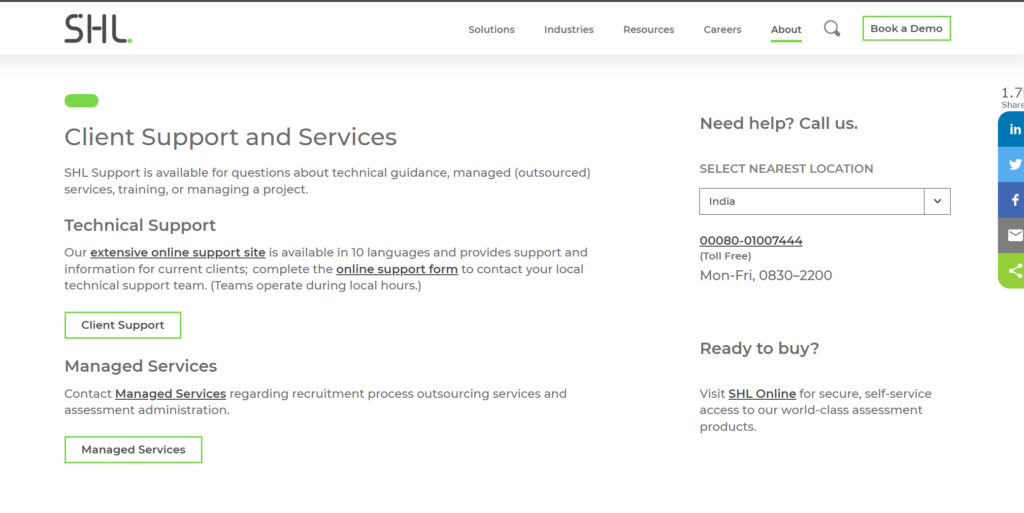
The credit model is worth understanding before you compare quotes. On Testlify a credit is used when a candidate starts an assessment, extra credits cost $21 each, unused credits expire at the end of the cycle, and paid plans carry a 30-day money-back guarantee. Full details are on the Testlify pricing page. Enterprise buyers assessing 25,000+ candidates a year move to a custom plan, which is the tier that competes most directly with an SHL contract.
Why does this matter so much? Because recruiting is already expensive. SHRM put the average cost per hire at nearly $4,700 in its 2022 benchmarking cost of recruitment analysis, and the same piece notes that 60 percent of that is soft cost: manager and recruiter time. An assessment platform earns its fee by cutting that time, not by adding another line item. A tool you can budget in a spreadsheet, test in a week, and cancel if it fails is a very different purchase from a multi-year program.
Which tools are cheaper than SHL?
Testlify, Test Partnership, and Criteria are commonly evaluated as cheaper than SHL, and Testlify is the only one of the three whose entry price you can read without a call ($139 a month on the Standard plan). Whether any of them is cheaper for your company depends on your SHL quote, your candidate volume, and how much consulting you were paying for.
A quick way to compare like for like: divide each quote by the number of candidates you will actually assess. On Testlify's Standard plan that is about $16.68 per candidate at full use of the 100 annual credits. Ask SHL for the same per-candidate figure, including implementation, and the conversation gets honest fast. Then ask both vendors which tests in the price are validated for the roles you hire, because a cheap suite you cannot defend is the most expensive option of all.
What are the best SHL alternatives in 2026?
The best SHL alternative is the one that measures the thing your roles depend on. For skills-heavy hiring across many job families, Testlify is the strongest fit. For hourly volume hiring, Harver. For consulting-led leadership and psychometric programs, Talogy or Hogan. For a lighter reasoning-and-personality battery at mid-market prices, Criteria or Test Partnership.
That answer frustrates people who want a single "winner," so here is the reasoning behind it. The largest reanalysis of selection validity in a generation, published in the Journal of Applied Psychology in 2022 by Sackett, Zhang, Berry, and Lievens (study record), revised the classic rankings after correcting for over-generous range-restriction adjustments. In the updated figures, structured interviews (.42), job knowledge tests (.40), empirically keyed biodata (.38), and work samples (.33) all predict performance better than general cognitive ability (.31), as summarized in SIOP's review of the findings. The exact coefficients are still argued about in print. The ranking is not: job-specific evidence and structure keep winning.
So a platform built mainly around reasoning tests and a personality inventory is not wrong, it is incomplete. The SHL alternatives worth shortlisting are the ones that add job knowledge, work samples, and structured interview support on top, and let you weight them per role.
How to compare SHL alternatives
Use the same five questions for every vendor on the shortlist, SHL included. Score each 1 to 5 and you will have a defensible decision in an afternoon.
- Evidence type: Does the tool measure job knowledge, work samples, and structured interview responses, or only reasoning and personality? Weight this by the roles you hire most.
- Adverse-impact control: The EEOC's Uniform Guidelines apply a rule of thumb: a selection rate for any group below four-fifths (80 percent) of the highest group's rate is treated as substantially different, per the EEOC's Q&A on the guidelines. Ask how the vendor helps you monitor that per test, and whether you can see pass rates by group.
- Integrity controls: Remote testing without ID checks, tab-switch detection, and AI-assistance flags is unproctored testing with extra steps. Ask what evidence a reviewer sees when a flag fires.
- Time to first shortlist: Can a recruiter build an assessment, invite 50 candidates, and read ranked results in a day without a consultant? If the answer involves an implementation phase, price that phase in.
- Total cost per candidate: Contract value divided by assessed candidates, including seats, implementation, and consulting. The only pricing number that survives a CFO review.
Pro Tip: Run your top two vendors on the same live requisition for two weeks. Same job, same candidate pool, same interviewers. Compare how many of each tool's top-10 scorers your hiring manager actually wanted to interview. That one experiment tells you more than any demo, and it costs a free trial.
Harver vs SHL: which fits volume hiring?
Harver fits high-volume hourly hiring better; SHL fits professional and leadership selection better. Harver is a volume-hiring platform that added behavioral, game-based assessment when it acquired pymetrics in August 2022, and its strength is automating screening, scheduling, and decisioning for thousands of frontline applicants. SHL brings deeper psychometrics and consulting, at a pace and price built for corporate roles.
The clearest way to see the difference is the workflow each vendor optimizes. Harver's 2022 pymetrics acquisition announcement describes a "hiring optimization platform" spanning recruitment through employee development: the pitch is throughput and predictive matching for hourly and professional funnels. SHL's pitch is precision: the right reasoning battery and personality profile for a defined competency model, with people who will build the program for you.
Where does Testlify sit between them? Closer to Harver on speed and self-serve, closer to SHL on assessment depth for professional roles, and ahead of both on job-skill breadth. A retail chain hiring 5,000 store associates a year should look hard at Harver. The same chain hiring 40 regional analysts, 25 developers, and 300 customer-support agents needs role-specific skill tests for each, and that is the Testlify use case. Plenty of enterprises end up with two of the three.
SHL vs Talogy for talent assessment solutions
SHL and Talogy are the two most alike vendors on this page: both are psychometric publishers with a consulting arm, both sell by quote, and both serve large enterprises with validated batteries and leadership assessment. Talogy is the newer brand. It was created in March 2022 when PSI Talent Management unified 17 acquired businesses, including Cubiks and Caliper, under one name, according to the Talogy launch announcement, which says the group delivers more than 30 million assessments a year in over 50 languages.
Choosing between them is mostly a question of portfolio and relationship. SHL has the more famous single instruments (OPQ, Verify) and the longer track record with global norm groups. Talogy inherits a broad catalog from its acquisitions (Logiks reasoning tests, the PAPI personality inventory, Caliper profiles) and tends to sell as a consulting-designed program. If your incumbent psychologist trained on one, you will probably stay with that one.
The trade-off both share is the same one that sends buyers looking for SHL competitors in the first place: neither publishes pricing, neither offers a self-serve free trial, and neither leads with hands-on job-skill tests. If your assessment strategy is "profile the person," they are the benchmark. If it is "prove the skill," a skills-first platform with the psychometrics bolted on will get you there faster and for a known price.
Which should you choose: Testlify or SHL?
Choose SHL if you run a consulting-led selection program for corporate and leadership roles, you already have a competency model and an I-O psychologist, and personality and reasoning data are the evidence you trust most. Choose Testlify if you hire across many job families, need proof of hands-on skill (coding, software, typing, role knowledge) alongside cognitive and behavioral data, want proctoring and AI interviews in the same flow, and prefer to see the price before the sales call.
Honestly, the decision is rarely about which tool is "better." It is about which evidence your hiring managers will act on. Our bet, watching how enterprise teams actually use assessment data, is that a manager will trust a ranked coding score or a work sample faster than a long personality narrative, and that trust is what shortens time-to-hire. The talent assessment tools roundup and the enterprise pre-hire platform comparison cover the wider field if SHL and Testlify are not your only two contenders, and the Testlify alternatives hub lists every head-to-head comparison in one place.
One caveat in Testlify's own direction: if your only need is a globally normed personality instrument for senior leaders, SHL or Hogan will serve you better than a skills library, and pretending otherwise would be the kind of one-sided comparison this page is trying not to be.
Test the difference on a real role
Pick one open requisition, build an assessment from the test library in about 20 minutes, invite your current shortlist, and compare the ranked results with your interviewers' gut calls. Start a free trial on the Testlify plans page (7 days, no credit card), or book a demo to walk through an SHL migration plan with the team, including how to run structured AI interviews alongside the tests.
FAQs
Related resources
View all
Competitor Comparisons
Testlify vs PXT Select: A detailed comparison
Competitor Comparisons
Testlify vs McQuaig: A detailed comparison
Competitor Comparisons
Testlify vs Kolbe: A detailed comparison
Competitor Comparisons
Testlify vs HireSharp: A detailed comparison
Competitor Comparisons
Testlify vs HiringBranch: A detailed comparison
Competitor Comparisons
Testlify vs Emmersion: A detailed comparison
Get started.
Hire on proof, not resumes.
Run your first skills-based assessment free — no credit card required.