
Testlify vs HiringBranch: A detailed comparison
Discover the perfect solution for evaluating your candidates’ skills with Testlify. Dive into our comprehensive Testlify vs HiringBranch…
HiringBranch is a soft-skills and language assessment built for customer-facing hiring. Testlify is a full pre-hire skills assessment platform with AI interviews, coding and cognitive tests, and layered proctoring. If you only hire contact-center and retail agents and want a conversation simulator that scores fluency and empathy, HiringBranch is a fair fit. If you hire across roles and want one platform for skills, interviews and integrity checks at a published price, Testlify covers more ground.
This comparison uses only what each vendor publishes plus primary research: HiringBranch's own product pages, Testlify's live pricing page, the U.S. Bureau of Labor Statistics, the World Economic Forum, Gartner and a 2022 meta-analysis of selection validity. Every number below is one you can check yourself.
 ChatGPT
 Gemini
 Claude
 Grok
Grok Perplexity
TL;DR
- HiringBranch measures soft skills, spoken fluency and language proficiency through a mock customer conversation. It does not offer coding tests, a standalone cognitive ability test or video interviews.
- Testlify pairs 3,500+ tests and 180k+ validated questions with two-way conversational AI interviews, so one platform screens agents, analysts and engineers on the same workflow.
- Testlify publishes its prices: the Standard plan is $139 a month ($1,668 a year for 100 candidate credits). HiringBranch does not publish pricing and asks you to request a quote.
- Fraud is now a buying criterion. Gartner found 6% of 3,000 surveyed candidates admitted to interview fraud, and Testlify's 20+ proctoring measures go well beyond HiringBranch's three stated checks.
- HiringBranch wins when you screen thousands of frontline agents in 14 languages over WhatsApp and never want to run an interview. Testlify wins everywhere else.

What is HiringBranch?
HiringBranch is an AI-powered soft-skills and language assessment for customer-facing roles. Candidates handle a simulated customer conversation by chat, voice or email, and the vendor's Soft Skills AI and Intelligibility AI score empathy, negotiation, active listening, critical thinking and spoken fluency. The company was formed in 2022 out of LearningBranch, a language-training business founded in 2014.
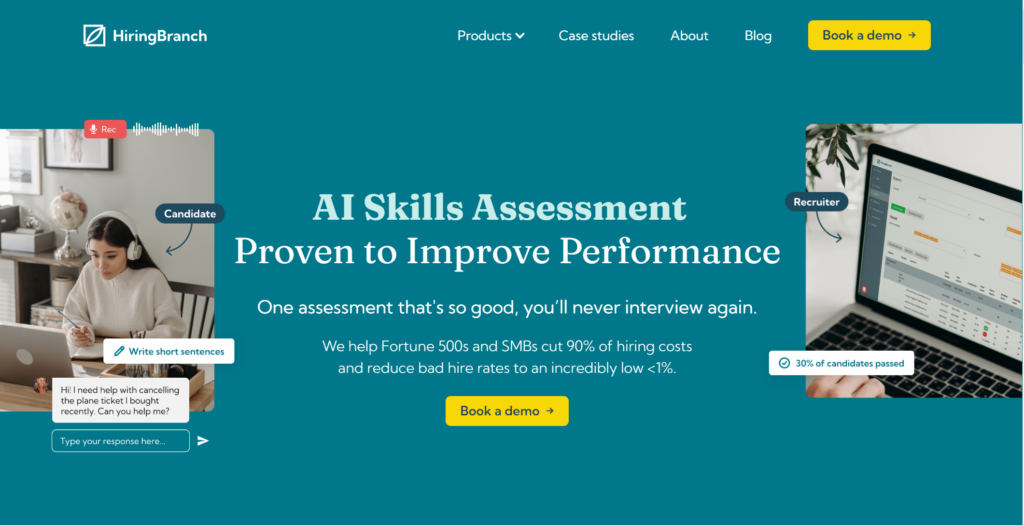
The product is built for high-volume frontline hiring: retail associates, customer support, sales, help desk and back office, across retail, hospitality, telecom, banking, healthcare and contact centers. HiringBranch's site claims 98% accuracy in skills scoring, 80% faster hiring, 1% bad hires and 2x hiring quality. Those are vendor claims, not audited results, and HiringBranch does not publish the sample sizes or method behind them.
In October 2025 HiringBranch added a conversational skills screener that runs over WhatsApp or a web app and is pitched as a replacement for resume scanning. The company says 70% of candidates prefer WhatsApp for employer contact, which is why the screener lives there.
Is the Hiring Branch assessment the same as HiringBranch?
Yes. "Hiring Branch", "hiring branch assessment" and "HiringBranch assessment" all refer to the same product from the same Canadian company. The two-word spelling is a leftover from the LearningBranch era and from listing sites that split the name. There is no separate Hiring Branch product, and the assessment, the screener and the training module all sit under one HiringBranch account.
How does the HiringBranch assessment work?
A candidate receives a link, watches a short setup video (HiringBranch discourages any other preparation) and then works through a scripted customer scenario by live chat, voice or email. Two AI models grade the exchange at once: Soft Skills AI scores quality, customer, sales and teamwork focus, while Intelligibility AI scores fluency and correctness across 20+ acoustic dimensions for voice prompts.
The assessment is offered in 14 languages (English, French, German, Italian, Spanish, Portuguese, Dutch, Mandarin, Turkish, Polish, Japanese, Swedish, Hindi and Arabic), but automated AI scoring covers only five of them: English, French, Spanish, Portuguese and Hindi. Recruiters see scores, recordings and skill-category averages in a dashboard. Candidates never see their scores. HiringBranch says 90% or more of invited candidates complete the assessment.
What is Testlify?
Testlify is a pre-hire talent assessment platform. It combines role-based skills tests, cognitive ability tests, coding assessments, personality and language tests, and conversational AI interviews across chat, voice and video, with proctoring and multi-reviewer scoring on top. The live pricing page lists 3,500+ science-backed tests, 180k+ validated questions, 150+ interview templates and 25+ custom question types on every plan.
The design philosophy is different from HiringBranch's. Instead of one conversation that produces one score, Testlify lets you stack signals for a role: a 10-minute Customer Service test built on situational judgment questions, a language proficiency test, a two-way AI interview and a typing test can sit in one battery. That is the Testlify Multi-Signal Talent Evaluation Model in practice: combine multiple role-relevant signals (assessments, interviews, simulations, references and reviewer feedback) so no candidate is advanced on one strong conversation alone.
Testlify vs HiringBranch: feature comparison
Every row below comes from the two vendors' own published pages as of September 2026. Rows that could not be verified were left out on purpose.
Area | Testlify | HiringBranch |
|---|---|---|
Primary focus | Pre-hire skills assessment across technical, cognitive, language, personality and role-specific tests, plus AI interviews | Soft-skills and language assessment for customer-facing roles via a mock customer conversation |
Test library | 3,500+ tests, 180k+ validated questions, 25+ question types, custom tests | One conversational assessment (Soft Skills AI + Intelligibility AI), customizable within the vendor's framework |
Coding and cognitive tests | Yes, including coding assessments and cognitive ability tests | No coding tests; cognitive ability is inferred inside the conversation, not tested separately |
Interview formats | One-way video, two-way conversational AI video, voice-AI questions (including over the phone), chat | Live chat, voice and email simulations; WhatsApp or web-app screener |
Languages | Question language and recording language selectable per question; the Customer Service test ships in English, French, Dutch, Spanish and Arabic | 14 assessment languages; automated AI scoring in 5 (English, French, Spanish, Portuguese, Hindi) |
Proctoring | 20+ measures across identity, environment, browser lockdown, AI monitoring and session evidence | Copy/paste detection, webcam face-movement detection, tab-switch detection |
ATS integrations | 100+ ATS and HR platforms, REST API and webhooks (a $2,388-a-year add-on on Standard, included in Custom) | API-based integration with "any tool of choice"; a Greenhouse connector is documented; needs an ATS developer |
Candidate visibility of results | Reports shareable as links and PDFs, with per-question visibility configurable | Candidates cannot view their scores |
Pricing | Standard $139/month ($1,668/year, 100 credits); Custom for 25,000+ candidates a year | Not published; request a quote |
Trial and guarantee | 7-day free trial, no credit card; 30-day money-back guarantee | Pilot offered; no public trial terms |
Which platform covers more roles and skills?
Testlify covers far more roles. HiringBranch scores one thing well, how a person talks to a customer, while Testlify tests what a candidate can actually do across 3,500+ tests spanning coding, data, finance, sales, support and cognitive ability. For a business that only hires agents, that breadth is irrelevant. For everyone else it is the whole decision.
The frontline market HiringBranch targets is real and it is a replacement market. The U.S. Bureau of Labor Statistics counts 2,666,000 customer service representative jobs in 2025, projects a 5% decline through 2035, and still expects about 289,500 openings a year, all of them from people leaving the role. A tool that screens agents quickly in 14 languages solves a real problem for that buyer.
But soft skills are not the only skills employers are short of. The World Economic Forum's Future of Jobs Report 2025, drawn from more than 1,000 employers representing 14 million workers, finds 63% of employers name skill gaps as the biggest barrier to transformation, and expects 39% of workers' existing skills to change by 2030. Analytical thinking tops the core-skill list (seven in ten employers call it essential), followed by resilience and leadership, with empathy and active listening on the same core list. A conversation simulator measures the last of those. It cannot measure analytical thinking against a spreadsheet, a SQL prompt or a code review. Testlify can, on the same platform, in the same candidate session.
Pro Tip: Before you compare vendors, write down the three competencies that separate your best agent from your average one. If all three are conversational (tone, empathy, objection handling), a soft-skills simulator is enough. If even one is procedural (working a CRM, following a refund policy, reading a billing statement), you need a skills test alongside the conversation, and that pushes you toward a multi-signal platform.
How do the AI interviews compare?
Testlify runs two-way conversational AI interviews by video, voice or chat, where the AI asks follow-up questions in real time; HiringBranch runs scripted customer simulations by chat, voice or email. Both are automated, but Testlify's interview is configurable at every layer, while HiringBranch's scenario is built around its fixed customer-service framework.
On Testlify you pick the AI avatar (none, a stock option or your own upload), the AI voice, and the prompt, including a full custom prompt or one generated from an uploaded job description. You set completion time, recording time per question, number of attempts and prep time. Scoring can be fully automatic, rubric-based, or auto-scored with a mandatory human review so a recruiter can override the AI. Reviewers get the transcript, AI insights and a speech-authenticity check. Ready-made templates cover customer conflict resolution, sales communication, e-commerce support and project coordination, so a support-team hiring manager is not starting from a blank page.
HiringBranch's strength is the opposite: there is almost nothing to configure. The scenario mimics a customer interaction, the two AI models grade it, and the recruiter gets a ranked list. That is faster to deploy for a 500-agent hiring wave. It is also the reason the product cannot stretch to a data analyst or a developer: the simulation only knows how to be a customer.
How does each platform handle cheating and fraud?
Testlify applies 20+ proctoring measures grouped into identity assurance, environment control, browser lockdown, AI-assistance monitoring and session evidence. HiringBranch states three checks: copy/paste detection, webcam face-movement detection and tab-switch detection, plus what it calls anti-fraud proctoring. For a remote, unsupervised assessment, that gap matters more every quarter.
The numbers explain why. In a July 2025 Gartner survey of 3,000 job candidates, 6% admitted to interview fraud, meaning they posed as someone else or had someone pose as them, and Gartner predicts that by 2028 one in four candidate profiles worldwide will be fake. Only 26% of those candidates said they trust AI to evaluate them fairly. So a platform has to do two things at once: catch the impostor and be visibly fair to the honest majority.
A conversation-only assessment is exposed on the first count. If the candidate can have a friend on a second phone feeding answers by chat, face-movement detection will not see it. Testlify's layered approach (photo ID verification, environment scan, multi-monitor detection, AI-plugin detection, session recording and question-level activity logs) produces reviewable evidence rather than a single flag, and the final call stays with a human reviewer. Neither vendor should claim its detection is perfect, and Testlify's own guidance is that a flag is a prompt for review, never an automatic rejection.
Does HiringBranch integrate with your ATS?
Yes, through an API. HiringBranch says it can integrate "with any tool of choice", that a typical build takes days to weeks, and that you will need an ATS developer to do it. Its homepage shows Workday, SAP, UKG, iCIMS, Jobvite, Ashby, Oracle, Dayforce and ADP logos, and Greenhouse documents a HiringBranch connector that adds the assessment to an interview plan and returns statuses and scores to the candidate record.
Testlify lists 100+ ATS and HR platform integrations, including Workday, SAP SuccessFactors, Greenhouse, Lever, BambooHR, Workable, UKG Pro, SmartRecruiters and Fountain, alongside a documented REST API and real-time webhooks. The catch on the Standard plan: ATS integrations and white-label branding are a $2,388-a-year add-on. On the Custom plan they are included. Budget for that line item if you are comparing a Standard quote against a HiringBranch quote.
Testlify vs HiringBranch pricing
Testlify publishes its prices and HiringBranch does not. As of September 2026 the Testlify Standard plan costs $139 a month, billed as $1,668 a year, and includes 100 candidate credits ($16.68 per candidate), 3 user seats (extra seats at $15 a month), unlimited assessments, AI interviews and proctoring. Additional credits are $21 each and phone-based AI interviews are billed at $0.18 a minute. Teams assessing 25,000+ candidates a year move to the Custom plan, which adds SSO, ID verification, regional data storage, a dedicated success manager and an uptime SLA. Non-profits get 25% off with the code TESTLIFYCARES25.
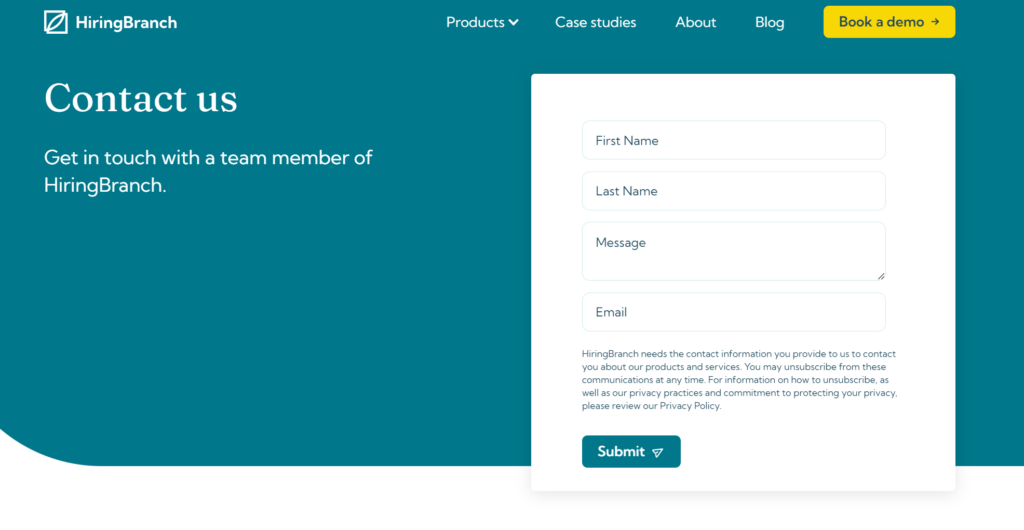
HiringBranch has no pricing page. Every path on its site ends in a contact form or a pilot request. A third-party software directory lists a starting price for HiringBranch that contradicts the vendor's own silence, so treat any number you see outside a signed quote as unreliable.
A worked example, purely illustrative: a regional bank hiring 400 contact-center agents a year would burn through the Standard plan's 100 credits in the first quarter. The remaining 300 candidates at $21 a credit add $6,300, for roughly $7,968 a year before the integration add-on. At that volume the right move is to ask Testlify for Custom pricing and to ask HiringBranch for a written per-candidate rate, then compare both against the current Testlify pricing page rather than a directory listing.
The 30-day money-back guarantee is the other difference worth weighing. It means a 400-agent pilot on Testlify carries a way out. HiringBranch offers pilots, but the exit terms are not public.
Is fairness auditable on each platform?
Both vendors describe their scoring as bias-free, and neither claim is something you should accept without documentation. If you hire in New York City, Local Law 144 requires that any automated employment decision tool has had a bias audit within the past year, that a summary of that audit is public, and that candidates get notice at least 10 business days before the tool is used. Ask each vendor for its most recent audit summary and the adverse-impact ratios by group before you sign.
The deeper question is what the score predicts. A 2022 reanalysis of selection-method validity by Sackett, Zhang, Berry and Lievens in the Journal of Applied Psychology revised many older estimates downward and placed structured interviews among the strongest predictors of job performance, with years of education and general experience among the weakest. The practical lesson is that structure beats intuition and that no single instrument carries the decision. That is an argument for a scored conversation (HiringBranch's whole product) and an argument against relying on it alone (Testlify's multi-signal design). Testlify keeps the final judgment with the hiring team, with reviewer ratings and AI insights recorded side by side, which is also what a defensible audit trail looks like.
When is HiringBranch the better pick?
HiringBranch is the better choice in three situations. First, you hire only customer-facing agents at high volume and want to remove the interview stage entirely, which its no-interview model is designed for. Second, you need spoken-fluency scoring in languages Testlify's library does not cover for your market, since HiringBranch scores voice fluency in five languages and offers the assessment in 14. Third, your candidates live on WhatsApp and a web link would cut your completion rate, so a WhatsApp-native screener is the difference between HiringBranch's claimed 90% completion rate and whatever a cold email link gets you.
If none of those describe you, the tradeoffs run the other way. You will pay an unknown price for one signal, you cannot show candidates their results, integration requires developer time, and the day you need to hire a team lead, an analyst or a developer you will be buying a second platform.
Is Testlify a good HiringBranch alternative?
Yes, for any team that hires beyond the contact center or wants more than one signal per candidate. Testlify replaces the single conversation score with a battery you design: a role test, a cognitive test, a situational judgment set and a two-way AI interview, scored together and reviewed by humans, at a price you can read before the sales call.
The way to assess soft skills with skills assessments on Testlify is to pair the conversational AI interview with the Customer Service test, so a candidate who talks well but cannot resolve a billing scenario is caught before the offer, and a candidate who is quiet on camera but nails the procedural questions is not lost. Teams weighing other conversation-led or psychometric vendors can see the same method applied in the Testlify vs Sova comparison and the Skillmeter head-to-head.
Hire on skills, not a single conversation
Start a 7-day free trial and run your next agent, analyst or developer shortlist through a real skills battery, or book a demo to see the two-way AI interview and proctoring in a live workspace.
Key Takeaways
- HiringBranch is a specialist. It scores soft skills and spoken fluency through a mock customer conversation, which is exactly right for frontline, contact-center hiring and exactly wrong for any role where the job is done at a keyboard. Buy it for what it is, not for what a sales deck implies.
- Testlify is the broader platform. 3,500+ tests, 180k+ questions and configurable two-way AI interviews mean one workflow for agents, analysts and engineers, so you avoid a second vendor the first time hiring moves beyond support.
- Price transparency changes the negotiation. Testlify's $139-a-month Standard plan and its $21 credit price let you model cost before a call. HiringBranch's request-a-quote model does not, so get its per-candidate rate in writing before comparing.
- Fraud coverage is now a hard requirement. With Gartner reporting 6% admitted interview fraud and forecasting one in four fake profiles by 2028, three proctoring checks are thin for unsupervised remote hiring; ask any vendor how it verifies identity, not just tab switches.
- Auditability is a buying criterion, not a footnote. NYC Local Law 144 and similar rules mean you need the bias-audit summary from either vendor on file, and a scoring model that leaves the final decision with a human.
- Use the right number of signals. The 2022 Sackett reanalysis supports structured, scored evaluation over intuition and warns against leaning on one instrument, which is the case for a multi-signal battery over a single conversation score.
FAQs
Related resources
View all
Competitor Comparisons
Testlify vs Emmersion: A detailed comparison
Competitor Comparisons
Testlify vs Eggup: A detailed comparison
Competitor Comparisons
Testlify vs easy.jobs: A detailed comparison
Competitor Comparisons
Testlify vs Discover Assessments: A detailed comparison
Competitor Comparisons
Testlify vs ExpertRating: A detailed comparison
Competitor Comparisons
Testlify vs ExaminLab: A detailed comparison
Get started.
Hire on proof, not resumes.
Run your first skills-based assessment free — no credit card required.