
Testlify vs Kolbe: A detailed comparison
Discover the perfect solution for evaluating your candidates’ skills with Testlify. Dive into our comprehensive Testlify vs Kolbe…
Testlify and Kolbe both ask a candidate to complete an assessment, but they answer different questions. Kolbe measures conation, which is how a person instinctively takes action. Testlify measures whether that person can actually do the job, across role skills, coding, cognitive ability, and behavior. Your choice depends on which answer your next hiring decision needs.
That distinction gets lost in most comparisons, and it costs teams money. The Kolbe A Index was built for team design and self-awareness, not for screening a stack of applicants down to a shortlist. With 5.3 million hires and 3.2 million quits recorded in a single month by the US Bureau of Labor Statistics, most hiring teams are not short on candidates. They are short on evidence about which ones can do the work.
 ChatGPT
 Gemini
 Claude
 Grok
Grok Perplexity
TL;DR
- Kolbe measures instinct, not ability. It scores how someone naturally starts work, not whether they have the skill the role needs.
- Testlify measures job-relevant capability: role-specific tests, coding, cognitive ability, personality, and situational judgment, with proctoring built in.
- Kolbe does not publish pricing. Testlify does, which matters when you are budgeting a hiring cycle rather than a one-off workshop.
- For screening at volume, skills evidence wins. For designing how an existing team divides work, a conative tool like Kolbe has a real job to do.
- The two are not mutually exclusive, but only one of them shortens a shortlist.

What is the Kolbe A Index?
The Kolbe A Index is a 36-question assessment that scores how a person instinctively takes action. It rates you from 1 to 10 across four action modes: Fact Finder, Follow Thru, Quick Start, and Implementor. Kolbe is explicit that it is not an IQ test and not a personality test.
Those four modes describe starting behavior. A high Fact Finder gathers detail before moving. A high Quick Start jumps in and adjusts on the way. Kolbe calls this conation, the part of the mind that drives action, as distinct from cognition (what you know) and affect (how you feel). Kolbe Corp positions the score as fixed: the index is meant to be taken once, because the instincts it measures are not supposed to change.
That fixedness is the tell. An instrument designed to produce a stable, unchanging number about how someone prefers to begin a task is a good fit for a team conversation. It is a poor fit for the question a hiring manager is actually asking, which is whether this candidate can write the SQL query, handle the escalated customer, or read the financial model correctly.
What does Testlify measure instead?
Testlify measures what a candidate can do in the role you are hiring for. That covers role-specific skills tests, coding assessments across 45+ programming languages, cognitive ability, personality and behavioral traits, situational judgment, language, and typing, all scored against the same rubric for every candidate.
The reason to test capability rather than disposition is that capability is the thing moving fastest. Employers expect 39% of workers' core skills to change by 2030, according to the Future of Jobs research from the World Economic Forum, down from 44% in its 2023 edition. A stable instinct score tells you nothing about whether a candidate has kept up. A current, role-mapped assessment does.
This is where a skills-first hiring approach earns its keep. Instead of inferring competence from a resume or a behavioral profile, you observe it directly, before the first interview. Testlify's library of pre-built role assessments covers technical and non-technical roles, and you can build custom assessments when the role does not map cleanly to a template.
How do Testlify and Kolbe compare on features?
The table below sets Testlify and Kolbe side by side across test library, assessment types, candidate experience, anti-cheating, reporting, and enterprise features. Read it for coverage gaps rather than a score: most of the rows where Kolbe shows no support are areas Kolbe never set out to serve.
Features | Testlify | Kolbe |
|---|---|---|
Test Library | ||
Role-specific tests | ✓ | ✗ |
Cognitive ability tests | ✓ | ✓ |
Programming Tests | ✓ | ✗ |
No. of programming languages supported | 45+ | ✗ |
Situational judgment tests | ✓ | ✗ |
Typing test | ✓ | ✗ |
Software skills tests | ✓ | ✗ |
Non-technical tests | ✓ | ✗ |
Psychometric tests | ✓ | ✓ |
Personality tests | ✓ | ✗ |
Motivation test | ✓ | ✗ |
Assessment templates | ✓ | ✗ |
Custom assessments creation | ✓ | ✗ |
Test recommendations for different job roles | ✓ | ✗ |
Coding tests | ✓ | ✗ |
Assessments | ||
Custom assessment builder | ✓ | ✗ |
Custom coding questions | ✓ | ✗ |
Multiple-choice questions | ✓ | ✓ |
Descriptive questions | ✓ | ✗ |
Video interview questions | ✓ | ✗ |
Assessments curated by I/O psychologists | ✓ | ✓ |
Google doc | ✓ | ✗ |
Google sheets | ✓ | ✗ |
Google slides | ✓ | ✗ |
Audio questions | ✓ | ✗ |
Qualifier questions | ✓ | ✗ |
File upload questions | ✓ | ✗ |
Quality check | Extensive process incl. peer reviews, sample testing, review by psychometrician & more | Not stated |
Video interview questions | ||
One-way video interview | ✓ | ✗ |
Custom video questions creation | ✓ | ✗ |
Candidate's recording attempts per question | ✓ | ✗ |
Live video interview | ✗ | ✗ |
Candidate experience | ||
Fully customizable email templates | ✓ | ✗ |
Custom invitation and rejection email | ✓ | ✓ |
Mobile-friendly | ✓ | Not stated |
Candidate support | ✓ | Not stated |
Instructions before assessment | ✓ | ✓ |
Average assessment length | 40-60 minutes | Not stated |
Anti-cheating features | ||
Session recording | ✓ | ✗ |
Snapshot capturing | ✓ | ✗ |
Mouse tracking | ✓ | ✗ |
Copy-paste disabled | ✓ | ✗ |
Microphone and camera access | ✓ | ✗ |
Location access | ✓ | ✗ |
IP address tracking | ✓ | ✗ |
Randomization of question sequence | ✓ | ✗ |
Time limit on tests | Yes, typically 10 minutes | ✗ |
Reporting and analytics | ||
Detailed reports | ✓ | ✓ |
Easy to share reports and scorecards | ✓ | ✗ |
Exportable/downloadable reports | ✓ | ✓ |
Recruiting analytics | ✓ | ✓ |
Candidate benchmarking | ✓ | ✗ |
Completion rate and response insights | ✓ | ✗ |
Enterprise friendly | ||
White label feature | ✓ | ✗ |
Custom branding | ✓ | ✗ |
ATS integration | ✓ | ✓ |
User, role, and access management | ✓ | ✓ |
Bulk candidate invite | ✓ | ✗ |
Share public link invite to candidates | ✓ | ✗ |
Candidate pipeline management | ✓ | ✓ |
Internationalization | ✓ | ✓ |
Campus hiring support | ✓ | ✗ |
Dedicated account manager | ✓ | ✗ |
GDPR compliant | ✓ | ✗ |
Multilingual abilities | ✓ | ✗ |
Customer support | ||
24/7 support | ✓ | ✗ |
On-call support | ✓ | ✓ |
Email support | ✓ | ✓ |
Product demo | ✓ | ✗ |
Training & onboarding tour | ✓ | Not stated |
What makes Testlify different from Kolbe?
The difference is the number of independent signals each tool produces. Kolbe returns one: a conative profile. Testlify is built to combine several, which is the whole idea behind the Testlify Multi-Signal Talent Evaluation Model: combine multiple role-relevant signals, including assessments, interviews, simulations, references, and reviewer feedback, so a decision rests on more than one reading of a candidate.
Selection science backs the multi-signal approach, and it recently upended some received wisdom. A 2022 re-analysis of decades of personnel-selection meta-analyses, summarized by the Society for Industrial and Organizational Psychology, put structured interviews at r = .42 and job knowledge tests at .40, with cognitive ability dropping to .31 and fifth place. The headline finding is not that any single method is king. It is that job-specific methods beat general trait measures.
A conative index is a general trait measure. It is stable by design, it is not mapped to a role, and it produces one number that has to carry the entire decision. That is a lot of weight for one signal. Across the hiring teams we work with, the pattern that keeps showing up is that a single-instrument process feels rigorous and is not, because everyone involved has quietly agreed to treat one score as the answer.
The other practical gap is integrity. If an assessment is scored and used to filter, someone will try to game it. Testlify ships identity checks, session recording, snapshot capture, browser and copy-paste monitoring, IP and location restriction, and question randomization. Kolbe was not designed as a screening gate, so it carries none of that.
How does the Kolbe System work?

Kolbe Corp sells the Kolbe System, a family of indexes built around the Kolbe A Index. The system is organized into four steps: Identify (find instinctive strengths), Optimize (combine talents across a team), Align (match strengths to job requirements), and Expand (hire for the gaps).
Beyond the A Index there is a B Index (how you think your job should be done), a C Index (what a manager expects from the role), and Y and R Indexes for younger people and relationships. Kolbe Corp works across business, hiring, team performance, communication, HR consulting, and coaching.
Used the way it was designed, this is genuinely useful. Comparing an A Index against a C Index tells a manager where a person's instincts and the role's demands pull in different directions, which is a real source of friction on established teams. The catch is that this is a diagnostic for people you have already hired. It does not tell you whether the candidate in front of you can do the work.
How much do Testlify and Kolbe cost?
Pricing is where the two diverge most visibly for a buyer. One publishes rates. The other does not.
Kolbe pricing
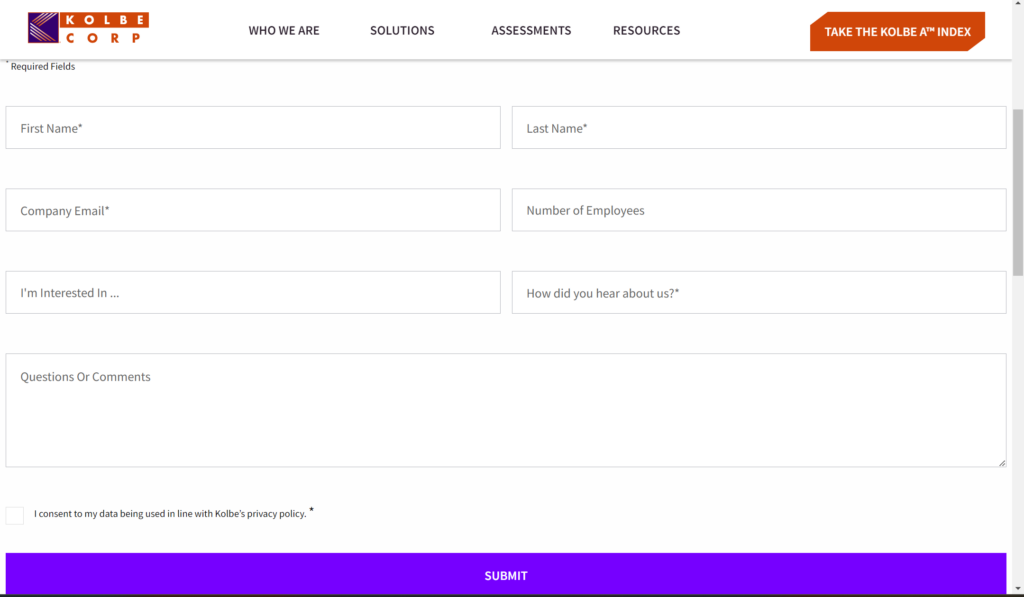
Kolbe does not publish platform pricing publicly. You contact them for a quote. Individual indexes have historically been sold one at a time, which suits a coaching engagement and gets awkward when you need to assess 200 applicants for one requisition.
Testlify pricing
Testlify publishes its plans, with a free trial and per-plan limits you can read before you talk to anyone. Current Testlify plan rates are on the pricing page.
Budget context matters here. SHRM puts the average cost per hire at nearly $4,700, and many employers estimate the full cost of a new hire at three to four times the position's salary once soft costs are counted. Against that, assessment spend is small. The expensive line item is the hire that does not work out, and that is the exact risk a role-relevant assessment is built to reduce.
Which one should your hiring team pick?
Pick Kolbe if the job to be done is team design. If you have a functioning team and you want to understand why two capable people keep colliding on the same project, a conative profile earns its place. It is also a reasonable self-awareness tool, and people generally enjoy taking it.
Pick Testlify if the job to be done is deciding who to hire. Screening a candidate pool, verifying a claimed skill, running a fair and repeatable process, or defending that process later all need role-mapped evidence and an audit trail. A single instinct score gives you none of that.
Here is the honest caveat, and it cuts against us as much as anyone: adding assessment steps has a cost. Every stage you add is a stage candidates can drop out of. Testlify assessments typically run 40 to 60 minutes, and that is real time you are asking someone to spend before they have met you. Ask for it only where the signal is worth it, keep the assessment mapped to competencies that actually matter for the role, and cut any test you cannot explain to a candidate.
Pro Tip: If you are replacing Kolbe in a hiring process rather than a coaching one, do not swap it for a single skills test and call it done. Map the role to two or three competencies you can defend, then pick one assessment per competency. One test replacing one test just moves the single-signal problem sideways.
Hire on evidence, not instinct alone
The fastest way to see whether skills evidence changes your shortlist is to run one live requisition through it and compare the result against the shortlist your current process produced. Start with a Kolbe alternative built for hiring, browse the cognitive ability assessments and psychometric assessments if you want the behavioral signal Kolbe was giving you, or book a demo and have someone walk your role through the assessment builder.
Key Takeaways
- These tools answer different questions. Kolbe measures how someone instinctively starts work; Testlify measures whether they can do the job. Treating them as substitutes is the error that leads teams to screen candidates on a profile that was never built for screening, then wonder why the hires are uneven.
- One signal is a fragile basis for a hiring decision. The Multi-Signal Talent Evaluation Model exists because a decision resting on a single score inherits every weakness of that score. Two or three role-mapped signals that agree are worth far more than one number everyone has agreed to trust.
- Job-specific methods outperform general trait measures. The 2022 selection-validity re-analysis put structured interviews at .42 and job knowledge tests at .40 while cognitive ability fell to .31, which tells you to test the job rather than the person in the abstract. Practically: build the assessment from the role, not from a personality framework.
- Skills move; instincts are designed not to. With 39% of core skills expected to change by 2030, a score built to stay fixed for life cannot tell you whether a candidate is current. Re-verify capability at the point of hire rather than trusting a profile taken years ago.
- Published pricing is a buying signal. Quote-only pricing works for coaching engagements and gets expensive and slow at hiring volume. If you are assessing hundreds of candidates a quarter, model the per-candidate cost before you commit.
- Integrity controls are not optional once an assessment gates a decision. The moment a score filters people out, it becomes worth gaming. Proctoring, identity checks, and randomization are what keep the evidence trustworthy, and a tool built for self-awareness has no reason to include them.
- Assessment length is a real candidate cost. Ask for 40 to 60 minutes only where the signal justifies it, and drop any test you cannot explain to the person taking it.
FAQs
Related resources
View all
Competitor Comparisons
Testlify vs HireSharp: A detailed comparison
Competitor Comparisons
Testlify vs HiringBranch: A detailed comparison
Competitor Comparisons
Testlify vs Emmersion: A detailed comparison
Competitor Comparisons
Testlify vs Eggup: A detailed comparison
Competitor Comparisons
Testlify vs easy.jobs: A detailed comparison
Competitor Comparisons
Testlify vs Discover Assessments: A detailed comparison
Get started.
Hire on proof, not resumes.
Run your first skills-based assessment free — no credit card required.