
Testlify vs Emmersion: A detailed comparison
Looking for a reliable way to assess your job applicants’ skills? Testlify is the ultimate alternative to Emmersion.
Emmersion certifies how well a person speaks and writes a language. Testlify measures whether a person can do the job. Those are two different purchases, and most buyers land on this page because a vendor list put them side by side without saying so.
So the useful question is not which tool has more features. It is which decision you are making, and which tool answers it. What follows compares only what each vendor states about itself, says plainly where Emmersion is the better buy, and covers the part every "best alternatives" listing skips: a language screen is a hiring test, and hiring tests carry legal duties the vendor does not carry for you.

 ChatGPT
 Gemini
 Claude
 Grok
Grok Perplexity
TL;DR: Testlify vs Emmersion
- Emmersion is a language-proficiency assessment. It scores speaking and writing in 9 languages and maps the result to CEFR, TOEFL and ACTFL bands.
- Testlify is a pre-hire skills assessment platform. Its library holds more than 3,500 tests across 12 categories, and language is only one of them.
- They overlap on one job only: screening candidates for communication-heavy roles such as contact center, support and sales.
- Emmersion has been part of IXL Learning since 2022 and now sits alongside Rosetta Stone, so buy it expecting a language-education parent, not a hiring-tools parent.
- Whichever you pick, the moment a score decides who advances, it is a selection procedure, and the employer owns the validity case for it.

What is the difference between Testlify and Emmersion?
Emmersion answers one question: how good is this person's English, Spanish or Japanese, on a recognized scale, in under 15 minutes. Testlify answers a wider one: can this person do the role, judged across coding, cognitive ability, personality, situational judgment, software skills and language. One is a certificate. The other is a shortlist.
That distinction decides which tool belongs in your stack, and it explains why feature grids comparing the two are close to useless. A grid that marks Emmersion absent on coding tests is not exposing a gap. Emmersion never claimed to sell coding tests. It sells language certification, and it says so on its own product pages.
The honest version of the comparison is narrower and more useful: if you hire for jobs where the work happens in a second language, look hard at both. If you hire engineers, analysts, nurses or warehouse leads, only one of these tools is in the running. The same test applies to every vendor pairing on this site, including the Talogy comparison and the TalentMetrix comparison: ask what decision the score is for, then check whether both tools are even trying to answer it.
How does Emmersion work?
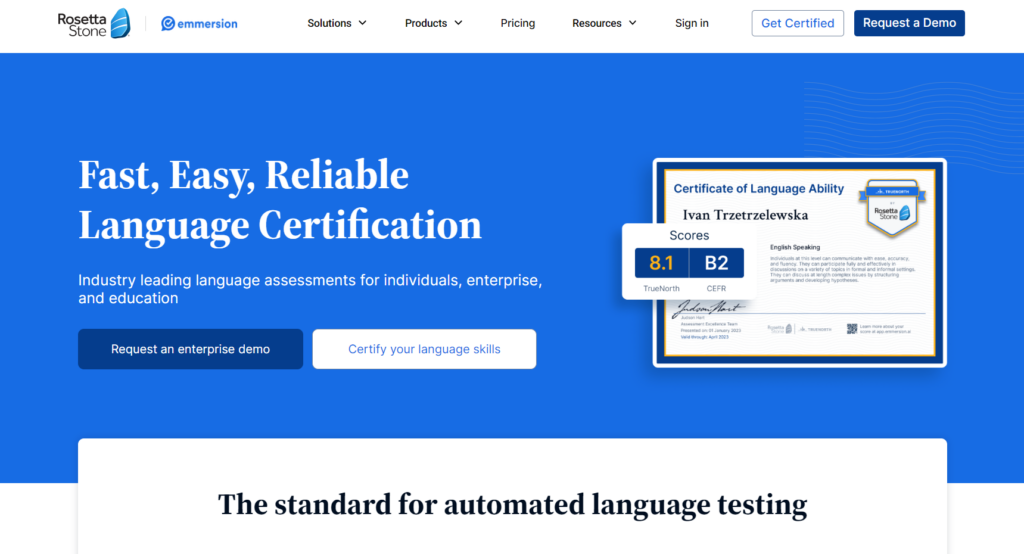
Emmersion runs short, fully adaptive tests that a candidate takes on a phone or laptop and finishes in under 15 minutes. Speaking is assessed through listen-and-repeat items plus open responses to general prompts, writing through typed tasks. Results come back immediately as a TrueNorth score mapped to CEFR, TOEFL, ACTFL and other scales.
Three products carry the brand: TrueNorth for speaking and writing certification, WebCAPE for student placement, and a candidate assessment used for pre-employment language screening. The candidate assessment spec lists 9 languages: English, French, German, Italian, Japanese, Mandarin, Portuguese, Spanish and Tagalog. Admins send a single-use link by email or generate a multi-use link, and an enterprise API exists for teams that want results pushed into their own workflow.
One ownership fact belongs in any 2026 evaluation. IXL Learning acquired Emmersion in 2022, and the product is now presented as the assessment arm of Rosetta Stone. That is not a warning. It does mean the roadmap answers to a language-learning business, so the parts you care about as a recruiter (ATS depth, proctoring breadth, role coverage) are not where the parent company's center of gravity sits.
Testlify vs Emmersion: feature comparison
The table below is built only on dimensions at least one of the two vendors publishes. Where a vendor says nothing, the cell says "Not published" rather than showing an absence nobody verified. An unverified cross is how a comparison page ends up making a false claim about a live company.
Dimension | Testlify | Emmersion |
|---|---|---|
What it measures | Job skills across 12 test categories, language included | Speaking and writing proficiency in one language |
Library size | More than 3,500 tests | Three products: TrueNorth, WebCAPE, candidate assessment |
Languages assessed | Language is 1 of 12 categories; coverage varies by test | 9 languages, speaking and writing |
Score reporting | Skill-level scores, benchmarks, candidate reports | TrueNorth score mapped to CEFR, TOEFL and ACTFL |
Typical length | About 40 to 60 minutes for a role assessment | Under 15 minutes |
Adaptive delivery | Not published | Fully adaptive |
Coding and technical tests | Yes, including live coding | Not published |
Cognitive and personality tests | Yes | Not published |
One-way video interview questions | Yes | Not published |
Proctoring and integrity controls | Identity, environment, browser and AI-assistance signals | Adaptive item selection cited as the anti-cheating control |
Integrations | ATS integrations, API, webhooks | Enterprise API and partner integrations |
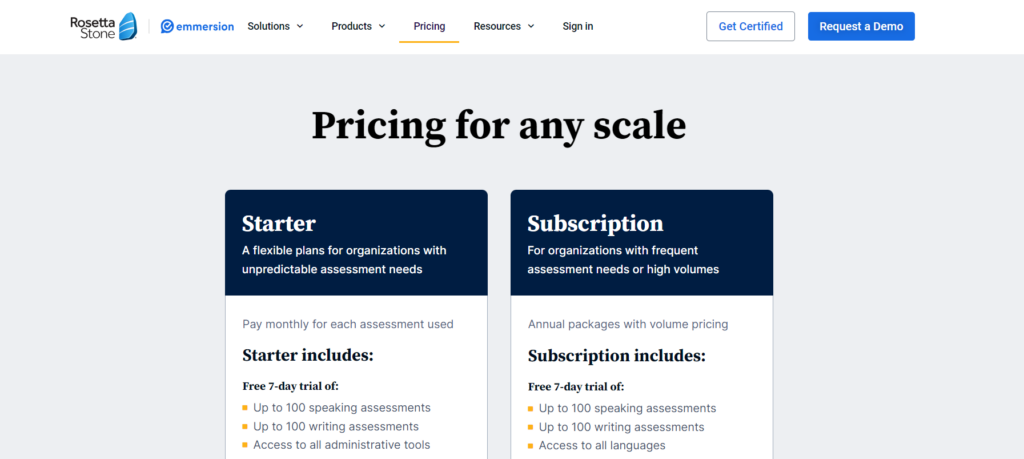
Published price | $139 per month, or $1,668 per year for 100 credits | $49 for an individual certification; organization pricing on request |
Ownership | Testlify | IXL Learning since 2022, alongside Rosetta Stone |
Pro tip: before you compare any two assessment vendors, write down the decision the score will drive. "Who gets a phone screen" and "who gets certified for a client contract" are different decisions, and they justify different tools. Teams that skip this step buy the broader platform and then use a sliver of it.
Is a language test a hiring selection procedure?
Yes, once it gates advancement. Vendor comparisons almost never say so, even though this is the only part of the decision with legal consequences.
The EEOC is blunt about who carries the burden. Its guidance on employment tests and selection procedures says that while a vendor's validity documentation may be helpful, "the employer is still responsible for ensuring that its tests are valid under UGESP." Buying a well-researched instrument does not transfer that duty. It never has.
Language screening adds a second exposure on top. Under EEOC guidance on national origin discrimination, a fluency requirement is permissible only if it is required for effective performance of the position, and applying a uniform fluency bar across a broad range of dissimilar positions can violate Title VII. Accent is treated the same way: a decision based on accent stands only where the accent materially interferes with job performance, and coworker or customer preference is never a defense.
Read that against who is actually applying. Census Bureau data from the 2018-2022 American Community Survey shows 78.3% of the US population age 5 and older spoke only English at home, so roughly one in five spoke another language. A single fluency cutoff applied across every role in a company touches that group hardest, and a cutoff nobody can tie to the job is where the risk sits.
None of this argues against language testing. It argues for setting the bar per role. A support agent handling live calls in Spanish needs a different level than a warehouse picker whose job is picking. Set one bar for both and the instrument is fine while the practice is not.
When is Emmersion the better choice?
Four cases, and they are real ones.
- Certification is the deliverable. A client contract or a regulator wants a CEFR band on file, not a hiring opinion. That is what TrueNorth produces.
- High-volume language screening at speed. Contact centers running thousands of applicants care about a 15-minute adaptive test far more than about test breadth.
- Education placement. WebCAPE places students into course levels. No hiring platform does that job.
- Language is the whole decision. If the role's only open question is proficiency, a dedicated instrument beats a general library, and the Rosetta Stone lineage is a genuine credential here.
Testlify is the better fit when language is one input among several, when the same shortlist needs coding or cognitive evidence, or when the assessment has to survive an audit of how the whole selection process was built. Buyers weighing a broader platform against a specialist tool often read the TalentMesh comparison next, since it covers the same tradeoff with a different vendor.
How much do Testlify and Emmersion cost?
Testlify publishes its plan pricing: $139 per month, or $1,668 per year for 100 credits, which works out at $16.68 per candidate assessed. One credit is used when a candidate starts an assessment. The plan includes 3 user seats, extra seats are $15 per month, additional credits are $21 each, and there is a 7-day free trial.
Emmersion publishes $49 for an individual third-party certification. Organization pricing is quote-based and not published, so any per-candidate figure you see quoted for it on a directory site is somebody's guess. Tier names and per-plan prices for Emmersion do circulate on third-party listings, and none of them trace back to a live first-party source, so none of them belong in a buying case. Unverifiable pricing is worse than no pricing.
The comparison that matters is not the sticker. It is cost per decision. A $49 certificate that resolves the only open question is cheaper than a platform you use once a quarter. A $16.68 assessment that replaces two rounds of phone screening costs less than the recruiter time it gives back.
How should you evaluate both tools before buying?
Run the same five steps against either vendor. They come out of the Testlify Multi-Signal Talent Evaluation Model, which holds that one signal is fragile and several role-relevant signals pointing the same way are what make a decision defensible.
- Write the decision the score drives, in one sentence, before you look at a demo.
- Name the competencies the role actually needs, then ask which of them the tool measures. Anything it does not measure still needs evidence from somewhere.
- Ask the vendor for the validity evidence behind the score, and read it yourself. The duty stays with the employer.
- Set the cutoff per role, not per company, and write down why the level fits the job.
- Check what happens to candidate records if the vendor is acquired again. Ownership changed once here already.
A test that is right for the job and wrong for the decision still produces a bad hire, just with better paperwork.
Hire on evidence, not on one score
See what a role-based assessment looks like against your own shortlist. Start free with a 7-day trial, or book a demo and bring one open role. Comparing the two tools on your own candidates settles the question faster than any grid does. And if language really is the whole decision, a dedicated certification tool is the better buy. That answer is free.
Key takeaways
- These tools are not substitutes. Emmersion certifies language ability; Testlify evaluates job readiness. Treating them as rivals produces a comparison that misleads both buyers and sends at least one of them home with the wrong tool.
- An unverified cross is a claim. Marking a vendor absent on a feature they never described is a factual assertion about a live company. Compare only on dimensions somebody publishes, and label the rest "Not published".
- The employer owns validity. EEOC guidance puts the burden on the employer even when the vendor supplies documentation, so ask for the evidence and read it before the first candidate takes the test.
- Fluency bars belong to roles, not to companies. A uniform requirement across dissimilar jobs is the pattern EEOC guidance flags, and roughly one in five US residents speaks another language at home, so the exposure is not theoretical.
- Ownership is a buying criterion. Emmersion answers to a language-education parent since 2022. That shapes roadmap priorities and it should shape your data-continuity questions.
- Price the decision, not the seat. $49 for a certificate and $16.68 per candidate assessed are only comparable once you know which decision each one closes.
- Use several signals. One score, whatever it measures, is a thin basis for advancing a candidate. Pair it with structured interview evidence and reviewer feedback before anybody says yes.
FAQs
Related resources
View all
Competitor Comparisons
Testlify vs Eggup: A detailed comparison
Competitor Comparisons
Testlify vs easy.jobs: A detailed comparison
Competitor Comparisons
Testlify vs Discover Assessments: A detailed comparison
Competitor Comparisons
Testlify vs ExpertRating: A detailed comparison
Competitor Comparisons
Testlify vs ExaminLab: A detailed comparison
Competitor Comparisons
Testlify vs eVerifile: A detailed comparison
Get started.
Hire on proof, not resumes.
Run your first skills-based assessment free — no credit card required.