
Testlify vs McQuaig: A detailed comparison
Discover the perfect solution for evaluating your candidates’ skills with Testlify. Dive into our comprehensive Testlify vs McQuaig…
 ChatGPT
 Gemini
 Claude
 Grok
Grok Perplexity
Testlify vs McQuaig: which one fits your hiring?
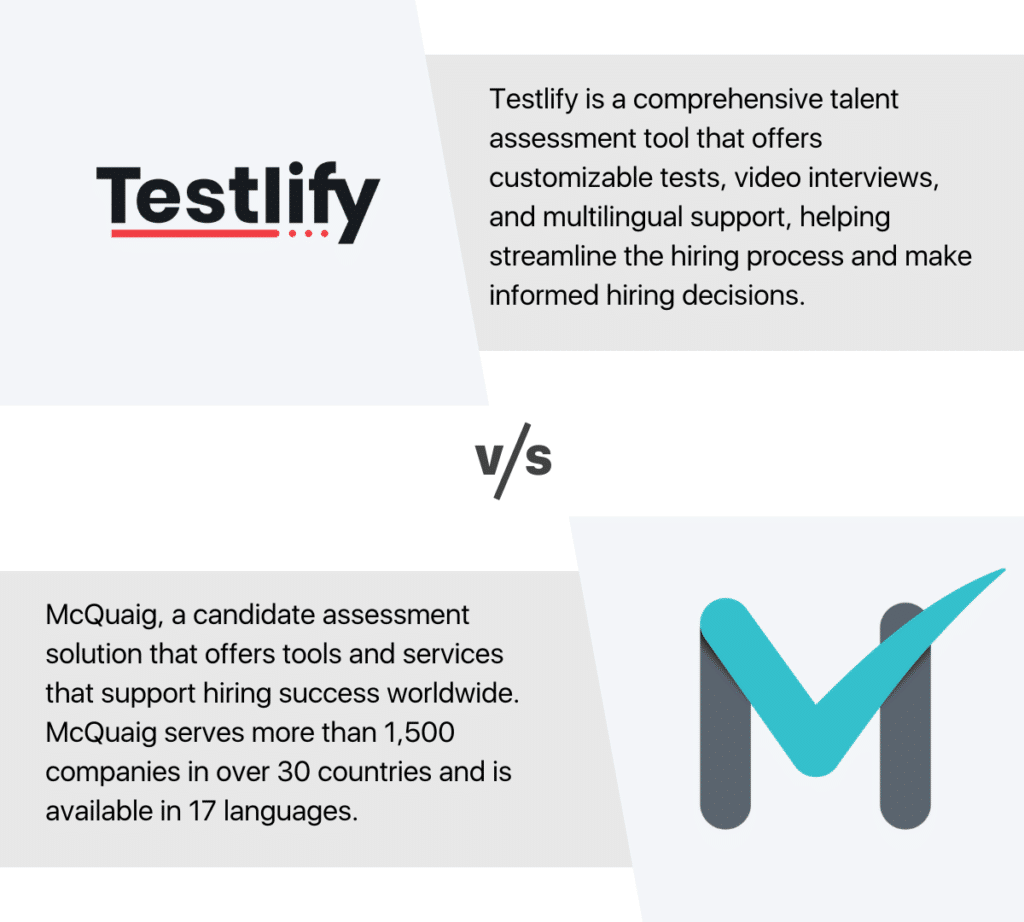
Testlify and McQuaig solve different halves of the same problem. McQuaig measures behavior and mental agility to predict role and culture fit. Testlify measures what a candidate can actually do, across 3,500-plus validated skills tests, then adds proctoring and reviewer scoring on top. Pick on the signal you get wrong most often.
TL;DR
- McQuaig is a behavioral system. Its Job Survey defines the profile a role needs, the Word Survey reads temperament, and the Mental Agility Test times general reasoning.
- Testlify is skills-first. Role-specific tests, coding, software tasks, psychometrics and recorded video answers sit in one platform, with proctoring built in.
- Pricing is the sharpest split. Testlify publishes its plans. McQuaig quotes on request, so you cannot budget from a web page.
- Hiring for testable technical or software skills points to Testlify. Benchmarking behavior for a leadership bench points to McQuaig, which has run this way since 1966.
- Most teams do not have to choose forever. Screen on skills first, then use a behavioral profile on the final three.

What is the McQuaig assessment?
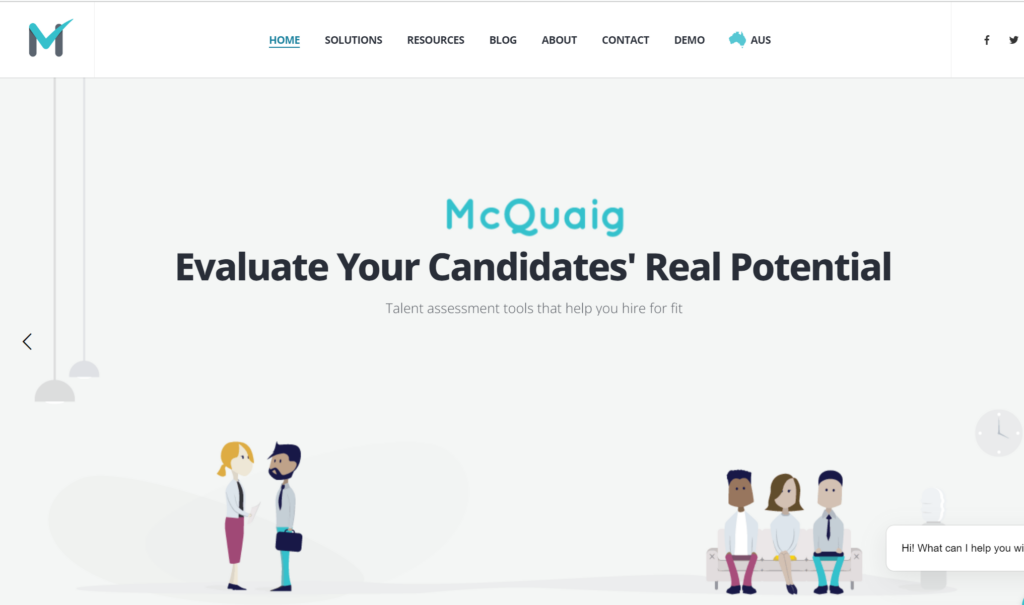
McQuaig is a behavioral and cognitive assessment system that has been running since 1966. It works in three parts: the Job Survey defines the behavioral profile a role needs, the Word Survey reads a candidate's temperament against that profile, and the Mental Agility Test times general reasoning. McQuaig says it works with more than 1,500 companies across 30-plus countries.
The Word Survey takes about 10 to 20 minutes and runs in two sections. It is ipsative, which means candidates rank words against each other instead of scoring each one on a scale, so the output is a relative profile rather than an absolute score. The Mental Agility Test is tighter: 50 questions in 15 minutes, mixing verbal reasoning, logic and basic math.
That design tells you what McQuaig is for. It benchmarks the role first, then asks how close a person sits to that benchmark. Good fit when the thing you are unsure about is temperament. Less good when the thing you are unsure about is whether someone can do the job.
Recommended: Testlify vs Test Partnership: Comparison Guide for HR Teams
Also Read: Testlify vs. Testello: Which Skills Assessment Platform is Best for HR Teams?
What does Testlify measure?
Testlify starts from the job, not the person. You build an assessment from a library of 3,500-plus validated skills tests, add custom questions, coding tasks, software exercises or recorded video answers, then score every candidate against the same rubric. Psychometric and personality tests sit in the same platform when you want them.
Why the split matters: the World Economic Forum found employers expect 39% of workers' core skills to change by 2030, down from 44% in 2023. Temperament does not move at that speed. Skills do. So the instrument that reads skills has to be rebuildable per role, not a fixed battery you buy once and run for a decade.
The Testlify Multi-Signal Talent Evaluation Model is the idea underneath the product: one signal is fragile, several role-relevant signals pointing the same direction are not. A coding score, a recorded answer, a cognitive result and a reviewer rating together tell you more than any one of them, and none of them is asked to carry the whole decision on its own.
Feature comparison: Testlify vs McQuaig
The gap is widest in two places: the test library and anti-cheating. McQuaig covers cognitive, psychometric and personality ground properly. It does not run coding tests, software skills tests, or role-specific test templates, and it does not ship a proctoring stack.
Features | Testlify | McQuaig |
|---|---|---|
Test Library | ||
Role-specific tests | ✓ | ✗ |
Cognitive ability tests | ✓ | ✓ |
Programming Tests | ✓ | ✗ |
No. of programming languages supported | 45+ | ✗ |
Situational judgment tests | ✓ | ✓ |
Typing test | ✓ | ✗ |
Software skills tests | ✓ | ✗ |
Non-technical tests | ✓ | ✗ |
Psychometric tests | ✓ | ✓ |
Personality tests | ✓ | ✓ |
Motivation test | ✓ | ✓ |
Assessment templates | ✓ | ✗ |
Custom assessments creation | ✓ | ✗ |
Test recommendations for different job roles | ✓ | ✗ |
Coding tests | ✓ | ✗ |
Assessments | ||
Custom assessment builder | ✓ | ✗ |
Custom coding questions | ✓ | ✗ |
Multiple-choice questions | ✓ | ✓ |
Descriptive questions | ✓ | ✗ |
Video interview questions | ✓ | ✗ |
Assessments curated by I/O psychologists | ✓ | ✓ |
Google doc | ✓ | ✗ |
Google sheets | ✓ | ✗ |
Google slides | ✓ | ✗ |
Audio questions | ✓ | ✗ |
Qualifier questions | ✓ | ✗ |
File upload questions | ✓ | ✗ |
Quality check | Extensive process incl. peer reviews, sample testing, review by psychometrician & more | - |
Video interview questions | ||
One-way video interview | ✓ | ✗ |
Custom video questions creation | ✓ | ✗ |
Candidate's recording attempts per question | ✓ | ✗ |
Live video interview | ✗ | ✗ |
Candidate experience | ||
Fully customizable email templates | ✓ | ✓ |
Custom invitation and rejection email | ✓ | ✓ |
Mobile-friendly | ✓ | ✓ |
Candidate support | ✓ | - |
Instructions before assessment | ✓ | ✓ |
Average assessment length | 40-60 minutes | - |
Anti-cheating features | ||
Session recording | ✓ | ✗ |
Snapshot capturing | ✓ | ✗ |
Mouse tracking | ✓ | ✗ |
Copy-paste disabled | ✓ | ✗ |
Microphone and camera access | ✓ | ✗ |
Location access | ✓ | ✗ |
IP address tracking | ✓ | ✗ |
Randomization of question sequence | ✓ | ✗ |
Time limit on tests | Yes, typically 10 minutes | - |
Reporting and analytics | ||
Detailed reports | ✓ | ✓ |
Easy to share reports and scorecards | ✓ | ✗ |
Exportable/downloadable reports | ✓ | ✓ |
Recruiting analytics | ✓ | ✓ |
Candidate benchmarking | ✓ | ✓ |
Completion rate and response insights | ✓ | ✓ |
Enterprise friendly | ||
White label feature | ✓ | ✗ |
Custom branding | ✓ | ✓ |
ATS integration | ✓ | ✓ |
User, role, and access management | ✓ | ✓ |
Bulk candidate invite | ✓ | ✓ |
Share public link invite to candidates | ✓ | ✗ |
Candidate pipeline management | ✓ | ✓ |
Internationalization | ✓ | ✓ |
Campus hiring support | ✓ | - |
Dedicated account manager | ✓ | ✓ |
GDPR compliant | ✓ | ✓ |
Multilingual abilities | ✓ | ✓ |
Customer support | ||
24/7 support | ✓ | ✓ |
On-call support | ✓ | ✓ |
Email support | ✓ | ✓ |
Product demo | ✓ | ✓ |
Training & onboarding tour | ✓ | ✓ |
How much do Testlify and McQuaig cost?
Testlify publishes its pricing and McQuaig does not. Testlify's Standard plan is $139 a month, billed at $1,668 a year, and includes 100 candidate credits, which works out at $16.68 per candidate assessed. There is a 7-day free trial with no card required, plus a custom plan for teams assessing more than 25,000 candidates a year.
McQuaig pricing
McQuaig sells through membership packages and does not list prices publicly. You request a quote, so the number depends on your volume and your negotiation, and you cannot sanity-check it against a published rate. For a team trying to compare three tools in two weeks, that is a real cost, not a small one.
Pro tip: when one vendor quotes per seat and another quotes per candidate, convert both to cost per candidate assessed before you compare anything else. Testlify's published plan pricing works out at $16.68 per candidate on the Standard plan. A quote-only vendor cannot be compared until you have that same number in writing.
Which tool is more defensible to auditors?
Both can be. Neither is automatically. The EEOC guidance on employment tests is blunt about where responsibility sits: a selection procedure must be job-related and consistent with business necessity, and the employer, not the vendor, stays on the hook for showing it was properly validated for the job it is used on.
That has a practical edge to it. A single behavioral profile applied to every role in the company is harder to defend than a skills test built from the actual tasks of one role, because the link back to the job is thinner. The US Office of Personnel Management makes the same point about structured evaluation: it exists so candidates "are assessed accurately and consistently". Consistency is the part an auditor can actually see.
So keep the paper. Whichever tool you buy, store the score, the rubric and the reviewer notes for every candidate. That record is what turns "everyone was assessed the same way" from a claim into a document.
When is McQuaig the better choice?
Three cases, honestly. If you are building a leadership bench and want a behavioral benchmark you can reuse across years of internal moves, McQuaig's job-profiling approach is built for exactly that. If your hiring managers already read McQuaig reports fluently, switching costs more than it saves. And if the roles are genuinely hard to test (relationship-led sales, senior general management), temperament may be the most honest signal on the table.
Where it struggles is volume and technical hiring. No coding test, no software skills test, no proctoring, so a remote screening round has to be trusted rather than verified. The Bureau of Labor Statistics counted 7.4 million job openings and 5.3 million hires in June 2026. At that scale, screening is where the hours go, and an unproctored behavioral survey does not narrow a shortlist on capability.
How to choose between them in one week
- Write down the two mistakes you keep making. Wrong-skill hires and wrong-fit hires need different instruments, and most teams only have one of these problems badly.
- Pick one open role. List the five tasks that person actually does in their first month.
- Build a skills assessment from those five tasks, and separately request a behavioral profile for the same role.
- Run both on three current employees you would hire again tomorrow. The tool that ranks them highest is measuring something you already value.
- Convert both quotes to cost per candidate assessed, then decide.
Step five catches more bad buys than any feature grid. A tool that looks cheap per seat can cost triple per candidate once you hit real volume, and nobody notices until renewal.
Hire on evidence, not hunches
If the roles you are filling have testable skills, start there. Build a role-specific assessment, run it on your next shortlist, and compare that ranking against the one your gut produced. Take the 7-day free trial, or book a demo and have someone build the first assessment with you.
Key takeaways
- McQuaig measures behavior, Testlify measures capability. That is the whole comparison, and it means the right answer depends on which of the two you get wrong more often. Audit your last ten bad hires before you shortlist any tool.
- Testlify publishes pricing and McQuaig does not. A published rate lets you budget in an afternoon; a quote-only process adds a procurement cycle and removes your ability to compare on cost per candidate.
- Skills go stale faster than temperament. With 39% of core skills expected to change by 2030, a role-specific test you can rebuild each year ages better than a fixed battery bought once.
- Defensibility sits with you, not the vendor. The EEOC expects the employer to show a test is job-related, so keep the rubric and the scores for every candidate no matter which platform you buy.
- Proctoring is the quiet differentiator for remote hiring. Without session recording, copy-paste controls and identity checks, a remote screening score is a trust exercise rather than evidence.
- Running both is a legitimate answer. Skills first as the screen, behavior on the final three, usually costs less than stretching either tool to cover everything.
FAQs
Related resources
View all
Competitor Comparisons
Testlify vs Kolbe: A detailed comparison
Competitor Comparisons
Testlify vs HireSharp: A detailed comparison
Competitor Comparisons
Testlify vs HiringBranch: A detailed comparison
Competitor Comparisons
Testlify vs Emmersion: A detailed comparison
Competitor Comparisons
Testlify vs Eggup: A detailed comparison
Competitor Comparisons
Testlify vs easy.jobs: A detailed comparison
Get started.
Hire on proof, not resumes.
Run your first skills-based assessment free — no credit card required.